eBook - ePub
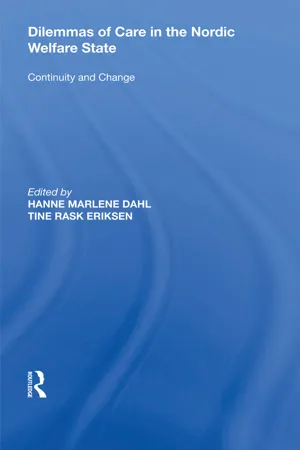
Dilemmas of Care in the Nordic Welfare State
Continuity and Change
- 218 pages
- English
- ePUB (mobile friendly)
- Available on iOS & Android
eBook - ePub
Dilemmas of Care in the Nordic Welfare State
Continuity and Change
About this book
The Nordic welfare model has become an ideal in feminist literature and in welfare state studies. This has heightened scientific and political interest in the model and its key aspects, including the provision and production of care as public responsibility. In this engaging volume, contributors from various professional disciplines - including sociologists, anthropologists, political scientists and educationalists - provide a comprehensive overview of the complex state of paid work in social care within the Nordic welfare states and of the dilemmas facing state-provided care in the region. They develop insights into the conditions, practices and trends in the area of paid care in the social and health care sector, insights that expose the dilemmas and tensions associated with paid care and care education. Divided into four parts, the book will greatly interest academics, post-graduate students and professionals concerned with the Nordic model and welfare states. It will also benefit those from outside the region interested in a specific Nordic tradition of research on publicly-provided care and the current dilemmas and challenges facing training in care.
Information
Part I
Care and Feminist Theory in a Global Perspective
Chapter 1
Social Research, Political Theory and the Ethics of Care in a Global Perspective
Kari Wærness
Introduction
What kind of social research should be argued for in relation to the enormous challenges that problems of globalization and changes in the cultures of survival and care represent for all of us? I will discuss this question here in light of my experiences as a feminist researcher in the field of care for nearly three decades. This research interest developed when in the 1970s I worked as a politically elected leader of the board of public social care and child protection services in my community - a community that is part of the Norwegian city of Bergen. In this political work we had to cope with a lot of challenging problems related to the care of children, disabled and elderly. I often felt a strong lack of relevant scientific knowledge when having to argue for more resources, new public services or reorganization of existing ones. I found the dominant scientific perspectives or paradigms in the political planning discourse on public services to be defective and inadequate for describing the problems in the real world of care in a way that would matter in the political and planning process.
In the context of a well-developed Scandinavian welfare state, many political feminists and feminist researchers found it necessary to develop new perspectives in research on care in order to strengthen the welfare of women and of those dependent on care and help in everyday life. The problem of how to carry out research that would really matter in policies and practice of care was, and still is, a challenging one, even in the Scandinavian context and even more in a global context. And many of the problems in the relationship between practice and policy relevant research are the same. Therefore I will argue that some of the experiences from development of this research field in Scandinavia are relevant to most researchers who want to carry out social research that matters with respect to policies and practices in the field of care and survival.
In this chapter I will first give a brief description of the field of 'research on care' in Scandinavia and then of how this research field in Scandinavia and Britain has developed since the 1970s. Thereafter, I will give a very short presentation of the international theoretical discourse on gender and care and present some thoughts from the new emerging field, feminist ethics of care. And finally I will argue that researchers need to take on more responsibility than they have done hitherto, to develop knowledge that could be a more relevant and influential tool in creating better care policies and practices, not only in the context of modern welfare states, but also from a global perspective.
Scandinavian research on care in the 1990s - two parallel discourses with different influence
'Care', as a definition of different types of activities in the welfare state, was common long before we had any women's studies. In connection with such activities we have established research activities, which in part go further back in time and which are based on other perspectives than feminist research. Research on care for the elderly is a good illustration of the differences between these lines of research. In this area we find a development where dominant paradigms in established gerontology — strengthened by socio-economic welfare expertise and market economic thinking — have contributed to an increasing extent towards defining the elderly and care of the elderly as a socio-economic problem (Eliasson 1996). Based on this view of the problem, efficiency and rational solutions are in demand and are attractive qualities in welfare services for the elderly. Feminist researchers1 see other sides of the welfare services and have formulated perspectives that go against this established perspective. The new perspective is that researchers are more concerned about the real world of care — and do research on concrete care actions, skills, knowledge and ways of thinking on the practical level, at the bottom of the welfare services organizations' hierarchy. Based on this perspective, questions about what care really is and what it means both to those giving and those receiving care, become of key importance. Feminist researchers have criticized the established planning perspective, because it is not based on an adequate understanding of the distinctive nature of care and therefore often generates proposed reforms and measures, which aggravate the situation both for care workers and for those receiving care (Thorsen and Wærness 1999). Both planning research and feminist research in this area are normative in the sense that researchers speak both about the facts and what is good, desirable and possible. The normative perspective is, however, the most clearly expressed in many of the feminist inspired reports, as it is in such research studies that moral, human values and own views on values are most often discussed.
Today, we find these perspectives as parallel discourses in research on the welfare services (Wærness 1999). With the so-called 'quality assurance' way of thinking also becoming a dominant trend in the health and welfare sector, it seems clear that it is the planning perspective, which has the dominant influence on how these services become organized (Slagsvold 1999). The fundamental critique of this new way of thinking appears so far not to have had any effect on the public authorities' implementation of so-called quality assurance programmes in this sector. Based on the feminist inspired perspective, the problem with these quality assurance programmes is not just that they appear to be irrelevant to the concrete problems on a practical level. They can also sometimes help to create what Slagsvold (1995) calls quasi-quality, which means making the quality of care worse than it was before. The knowledge from feminist inspired research has not hitherto had any effect on the structure of the care organizations. The public discussion on how the health and welfare services should be changed is still dominated by academic experts who mainly use a language based on economic, technical and legal rationality — a language that is usually considered to be far removed from the experiences in the real world of care. For several years now, this real world has had key position in Scandinavian and British feminist research on care.
Scandinavian and British feminist research on care - development over time2
In the earliest phase of the Anglo-Saxon feminist research on care we can distinguish between two different discourses; one that places emphasis on care as work and one that places emphasis on the emotional aspects of care (Abel and Nelson 1990). Studies, which placed emphasis on the work content, analysed care as a woman-suppressing practice, full of routine and alienating tasks. Studies that placed emphasis on the emotional aspects, considered care to be a meaningful activity which makes women better people. We might name these perspectives 'the perspective of misery' and 'the perspective of dignity' respectively. In feminist research it is always easy to criticize studies based on one of these perspectives with the other perspective as a point of departure. To develop scientific knowledge on care that should matter in policy and planning it is still a great challenge how to balance these perspectives.
In the anthology Caring: A Labour of Love (Finch and Groves 1983) these perspectives are combined. All the authors in this book have been important participants in the British discourse on care and common to them all is that they study care as a physically and emotionally demanding unpaid job that women carry out in the home. The purpose of this book was to show the hidden care work in the family, how it is shared between men and women and what it costs the caregivers. Criticism was raised against this research, because it was too one-sided, both in the sense that it only focused on the caregivers and not on those receiving the care and that it only discusses informal care and not care as a paid and professional work (Baldwin and Twigg 1991, Morris 1991/92, Qureshi and Walker 1989).
Scandinavian feminist research on care included both unpaid and paid care from the start. Care was also defined as work and feelings and dealt with caregivers and those receiving care. The first research seminar on the subject was arranged in 1978 by the then Research Council of Norway's Secretariat for Social Research on Women under the heading 'Paid and unpaid care', and the topics discussed had a broad basis; care work in the private and public sector, children and care, women's self-organised help arrangements, care functions in families with small children, new roles for children, men and women, emotional fatigue in good-natured caring women in the welfare services and the development of professional nursing at the end of the 19th century. The seminar was based on the understanding that women had the main responsibility for care both in private relations and in the public sector and the following reasons were given for why it is necessary to look more deeply into the care phenomenon:
in order to proceed in the work of extending the social scientific knowledge in this area, based on a women's liberation perspective, and to give the authorities a broader basis with respect to planning and implementing a care organization that takes into consid- eration the needs of those giving and receiving care
(NAVF's Secretariat for Social Research on Women 1979, Foreword, my italics).
Norwegian feminist researchers appear here to be quite typical representatives of modernity in the sense that they show great optimism both with respect to faith in the importance of knowledge and to the friendliness of the Norwegian welfare state towards women. New definitions and distinctions in the field of care were gradually created, definitions that were intended to give clarification in the debate on welfare policy and thereby was believed to have an influence on welfare policy (Wærness 1982). Involvement in welfare policy was included in this research from the start. 'The social service state' and its importance from women's perspective became an important supplement to mainstream research on welfare, which up to the 1990s was mainly concerned with financial support, social security systems and the economic redistributive aspects of the welfare state.
The Anglo-Saxon and Scandinavian feminist-oriented research on care have gradually approached each other and today we can point to three lines of development in this research with respect to the understanding of what care is:
- from either feelings or (manual) work to both/and eventually also intellectual work
- from the family via unpaid women's work in the government's service, to the state as either a women-friendly and/or shaky social service state
- from focus on women as carers and care workers to a perspective that also includes those who need and receive care.
The main emphasis is still on care being 'something good', which is threatened by male, scientific, bureaucratic and market economic rationalities, values and interests and on care as being women's work. However, we can also see the outline of a few new development trends: The risk of encroaching on the other's freedom, which care gives the possibility for, has become a more important topic and there is increasing interest in studying possibilities for service schemes that may be good or better alternatives to more person-oriented and continuous care relations (Gough 1996). There has also been increased focus, inter alia in studies of what is called 'the new paternity', on whether there is a 'masculine kind of care', which is different from the feminine kind (Brandth and Kvande 1996).
One risk of these expansions considered from a feminist viewpoint is that they can lead to the basis for the feminist-oriented research being forgotten, namely the desire to make visible the traditional female work and the social importance of this and thus help to raise women's marginal status in society. Though perhaps there is no great risk of this happening today in the close to practice research on care, i.e. research based on the real world of care. In such research activities one is constantly being reminded, in the same way as documented in the above-mentioned seminar report from 1978, that care obligations are not just distributed according to gender, but also according to social class (and what is becoming more visible in Scandinavia in the recent years also according to ethnicity), that the division of labour among women in this area has changed very much over time and that caregivers can have great power with respect to those dependent on care, even if they have little power and influence in other relations.
The political-sociological and empirically rooted research on care has had a strong position in Scandinavian feminist research. Scandinavian feminist researchers have participated very little, however, in the international development of political-normative theory on care. This does not mean that there are no important contributors in this area. Both the Swedish sociologist Rosmari Eliasson and to an even greater extent, the Norwegian nurse, philosopher and historian, Kari Martinsen, have given important theoretical contributions to care ethics, contributions, which in addition to being based on important philosophers, are also based on women's public care work in the past and present (Eliasson 1987, Eliasson-Lappalainen 1999 and Martinsen 1989, 1993, 1996, 2000). However, this work has still not reached the international theoretical debate on care and gender. Thus their influence on the care discourse in general, also in the Nordic countries, has hitherto been more limited than the influence of leading American feministic theorists in the field. The American feminist theorists have not been so much concerned about specific dilemmas and problems that the welfare state's care workers face. This is perhaps not so strange, if we take into consideration the big differences between the Scandinavian and American welfare state model. Greater understanding of this dominant division in feministic theory and research on care may contribute, however, to a more relevant insight into the care crisis that late-modern societies now appear to be in, regardless of which welfare state model they use as a basis.
The international theoretical discourse regarding care and gender
At the same time as the more close to practice and feminist welfare policy research on care grew in Scandinavia and in the UK, several pioneering feminist studies of a more theoretical and philosophical nature were published in the US. The most internationally known and influential study of a moral philosophic nature was Carol Gilligan's book In a Different Voice: Psychological Theory and Women's Development (1982).3
One main focus in the debate following this book (the so-called Kohlberg-Gilligan controversy) has been the question whether women and men have a fundamentally different approach to morality, or expressed in today's terminology in feminist research; is morality linked to gender? Even if Gilligan has never clearly expressed that 'the different voice' she studies is always a female one, most people have interpreted her as describing a different approach to morality between the sexes. An important part of the rejection of her argumentation has been results from empirical studies, partly based on the same methodology as that used by Gilligan. These empirical studies show that other differences (class, ethnicity) may be as significant to differences in moral development as gender. In addition to these empirical studies, we also have got analyses based on other theories and ways of thinking that support the same argument.
The reason why it was so important for American feminists to reject Gilligan's argumentation was that it could be used to support the correctness of traditional gender roles in American (and Western) culture and thereby strengthen an understanding of men and women as fundamentally different. Several feminist theorists have strongly opposed Gilligan's argumentation and her book has been interpreted as a part of the 1980s backlash of feminism (Faludi 1991). Male theorists (see for instance Habermas 1990, Puka 1990) have claimed that the ...
Table of contents
- Cover
- Half Title
- Title
- Copyright
- Contents
- List of Figures and Tables
- List of Contributors
- Introduction: Dilemmas of Care in the Nordic Welfare State
- PART I: CARE AND FEMINIST THEORY IN A GLOBAL PERSPECTIVE
- PART II: DILEMMAS IN THE NORDIC WELFARE STATE(S) AND THEIR PROVISION OF CARE
- PART III: DILEMMAS IN PROFESSIONS AND USERS IN PUBLIC HEALTH
- PART IV: DIFFERENT FORMS OF KNOWLEDGE AND DILEMMAS OF CARE EDUCATION
- Conclusion: Continuity, Change and Dilemmas
- Index
Trusted by 375,005 students
Access to over 1.5 million titles for a fair monthly price.
Study more efficiently using our study tools.
Frequently asked questions
Yes, you can cancel anytime from the Subscription tab in your account settings on the Perlego website. Your subscription will stay active until the end of your current billing period. Learn how to cancel your subscription
No, books cannot be downloaded as external files, such as PDFs, for use outside of Perlego. However, you can download books within the Perlego app for offline reading on mobile or tablet. Learn how to download books offline
Perlego offers two plans: Essential and Complete
- Essential is ideal for learners and professionals who enjoy exploring a wide range of subjects. Access the Essential Library with 800,000+ trusted titles and best-sellers across business, personal growth, and the humanities. Includes unlimited reading time and Standard Read Aloud voice.
- Complete: Perfect for advanced learners and researchers needing full, unrestricted access. Unlock 1.5M+ books across hundreds of subjects, including academic and specialized titles. The Complete Plan also includes advanced features like Premium Read Aloud and Research Assistant.
We are an online textbook subscription service, where you can get access to an entire online library for less than the price of a single book per month. With over 1.5 million books across 990+ topics, we’ve got you covered! Learn about our mission
Look out for the read-aloud symbol on your next book to see if you can listen to it. The read-aloud tool reads text aloud for you, highlighting the text as it is being read. You can pause it, speed it up and slow it down. Learn more about Read Aloud
Yes! You can use the Perlego app on both iOS and Android devices to read anytime, anywhere — even offline. Perfect for commutes or when you’re on the go.
Please note we cannot support devices running on iOS 13 and Android 7 or earlier. Learn more about using the app
Please note we cannot support devices running on iOS 13 and Android 7 or earlier. Learn more about using the app
Yes, you can access Dilemmas of Care in the Nordic Welfare State by Tine Rask Eriksen, Hanne Marlene Dahl,Tine Rask Eriksen in PDF and/or ePUB format, as well as other popular books in Politics & International Relations & Social Policy. We have over 1.5 million books available in our catalogue for you to explore.