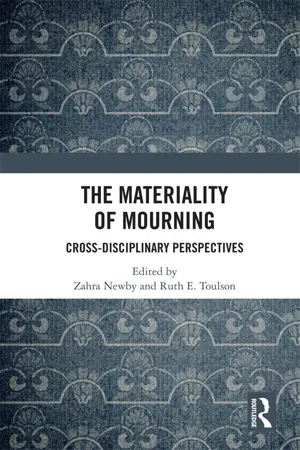
Tangible remains play an important role in our relationships with the dead; they are pivotal to how we remember, mourn and grieve. The chapters in this volume analyse a diverse range of objects and their role in the processes of grief and mourning, with contributions by scholars in anthropology, history, fashion, thanatology, religious studies, archaeology, classics, sociology, and political science. The book brings together consideration of emotions, memory and material agency to inform a deeper understanding of the specific roles played by objects in funerary contexts across historical and contemporary societies.
eBook - ePub
The Materiality of Mourning
Cross-disciplinary Perspectives
- 266 pages
- English
- ePUB (mobile friendly)
- Available on iOS & Android
eBook - ePub
The Materiality of Mourning
Cross-disciplinary Perspectives
About this book
Information
1 Introduction
Emotions and materiality in theory and method
Following the devastating floods in Baton Rouge, Louisiana in 2016, journalists reported that the most grieved for items were boxes of family photographs. When the only images of beloved parents or grandparents were covered with muddy water, the damage was permanent and harrowing. Reflecting on her washed-out home, a woman most mourned the destruction of a tape-recording of her father’s voice, noting, ‘I’ve never felt such loss’. Even seemingly mundane items take on additional importance in such circumstances; one woman affected by the same floods reported that she had managed to save her great-grandmother’s table, already much repaired and now to be repaired once again. The table seems here to exceed its purely functional use to become a potent symbol of the enduring resilience of this individual family.1
Tangible remains play an important role in our relationships with the dead; they are pivotal to how we remember, mourn and grieve.2 Cherished possessions are passed down within families, with seemingly insignificant objects becoming the subject of fierce battles between heirs, while, in other social contexts, the belongings of the dead are destroyed, as their continued presence makes it impossible to forget. Objects can stand in for the dead: monuments act both as substitute for and distraction from the decaying body below. And so important is the corpse – in its materiality – that families who are unable to recover the bodies of loved ones often cannot properly grieve. Yet grieving, remembering and forgetting are also problematically intangible: it can be difficult to talk about loss, to pin it down with words. Historians of funerary monuments have often been reluctant to theorise about grief, preferring the cold certainties of social structure and elite self-representation to the messy world of lived experience. Anthropologists often find that the reality of their interlocutors’ grieving is lost somewhere between the ethnographic field site and the page. In the social sciences, too, the emotions – imagined as ‘internal’ and ‘individual’ – were long deemed to fall only within psychology’s disciplinary purview. Yet without a consideration of how objects function in the context of human emotions, we are left with an incomplete analysis of the nature of grief and mourning.
This volume brings together twelve original chapters by scholars in anthropology, history, fashion, thanatology, religious studies, archaeology, classics, sociology and political science. It presents analysis of a diverse range of objects, from the blood-stained uniforms of World War One soldiers to bone fragments recovered from exhumed graves in crowded Singapore, from an ivory doll found beside the mummy of a child in a Roman tomb to the disarticulated remains of bodies recovered from the World Trade Center Towers following 9/11. What unites the chapters is their focus on a number of questions that have captivated recent scholarship: How much can we glean about past emotions through the physical objects which remain? How comparable are the emotions? Is grief the same, anytime, anyplace? And what can we learn about how to deal with loss from the responses of the past, and other contemporary cultures?
In this introduction we explain the broader intellectual context for this book, and what it aims to achieve. First we offer a historiography of the anthropology and archaeology of funerary practices, before discussing the burgeoning awareness of the need for a proper consideration of the emotions. We then discuss recent theories about the agency of material objects. Our aim is to bring these themes, which are often pursued in isolation, into dialogue, to inform a deeper understanding of the specific roles played by objects in funerary contexts across historical and contemporary societies.
Studying death, neglecting grief
While the study of death has been an enduring area of scholarly interest, such scholarship is frequently marked by a neglect of grief. Within anthropology, there is a long-standing tendency, which continues to this day, to ignore tears and to focus instead on ritual. This focus goes back to the earliest writings on the anthropology of death. Robert Hertz’s seminal text, Death and the Right Hand, for example, depicts the complex double burial rites of the peoples of the Malay Archipelago, principally the Dayak of Borneo.3 In Magic, Science, and Religion, Bronislaw Malinowski describes the death rituals of Papuans and Australasians, particularly the Melanesians of New Guinea, while the ritualised mourning of the isolated Andaman Islanders is the subject for A. R. Radcliffe-Brown.4 The central argument of all these texts is that what death wounds, ritual begins to repair. And what death wounds is the social fabric, society itself.
Death, Hertz notes,
does not confine itself to ending the visible bodily life of an individual; it also destroys the social being grafted upon the physical individual… . Thus, when a man dies, society loses in him much more than a unit; it is stricken in the very principle of its life, in the faith it has in itself.5
In this quotation, and in much other early writing on death, the influence of Émile Durkheim is clear. Hertz was Durkheim’s doctoral student and a member of the influential L’Année sociologique. With other early sociologists and anthropologists, he took on Durkheim’s suggestion that ritual – in making society itself sacred – was central to society’s integrity and coherence.6 Hertz’s focus on ritual as the source of social cohesion can be further understood when one considers that Hertz wrote in the turbulent years leading up to the First World War; he was searching for answers in the lives of these ‘others’. Hertz sought out what held so-called primitive societies together, at a time when the ‘civilised world’ was tearing itself apart. Hertz died in the trenches at Marchéville, northern France in 1915. He did not live to see how influential his seminal text would become.
Durkheim’s influence is visible too in the functionalism of Malinowski, who, for all his focus on the psyche, still saw society in the Durkheimian frame, as a bounded entity with an existence in its own right. ‘Death,’ Malinowski notes,
is, therefore, much more than the removal of a member. By setting in motion one part of the deep forces of the instinct of preservation, it threatens the very coherence and solidarity of the group.7
One finds a similar focus on ritual as the source of social cohesion in the generation of British-trained anthropologists bound by Structural Functionalism, and then in the later work of British and American symbolic anthropologists, who again focused on social structure, coming to Durkheim via the French Structuralism of Claude Lévi-Strauss.8 Iconic works of the 1970s, 1980s and 1990s – Metcalf and Huntington’s Celebrations of Death; Maurice Bloch and Jonathan Parry’s Death and the Regeneration of Life; James Watson and Evelyn Rawski’s Death Ritual in Late Imperial and Early Modern China; and Parry’s Death in Banares – are also part of this intellectual stream: hence their focus on the social rather than the individual; on structure rather than grief; on symbol rather than psyche, and on ritual above all.9
This focus on ritual – and its resulting neglect of both grief and of the individual experience – began to face critique in the late 1980s as part of the post-modern turn. In ‘Grief and a Headhunter’s Rage’, the introduction to his 1989 book, Culture and Truth, Renato Rosaldo attacks anthropology’s tendency to ‘consider death under the rubric of ritual rather than bereavement’ and to ‘tidy things up as much as possible by wiping away the tears and ignoring the tantrums’.10 This focus also presumes that ritual is always highly meaningful, that funeral rituals ‘store encapsulated wisdom as if it were a microcosm of its encompassing cultural macrocosm’.11
Rosaldo also critiques the fact that the Durkheimian focus on society as the unit of examination excludes the individual. In the essay, Rosaldo carefully attends to multiple, highly variable experiences of grief. The reality of loss varies a great deal depending, for example, on one’s closeness to the person who has died, and yet many studies of ritual seem to assume the perspective of the most distanced observer. As Rosaldo points out, grief is different for older Ilongot men, who remember when headhunting was a possibility, than for younger men, who come of age after martial law and, with headhunting forbidden, turn instead to Christianity to ease their pain. A central theoretical point of Rosaldo’s piece is to call for the inclusion of the researcher him or herself. He notes that it was only after the death of his wife Michelle, who tragically fell to her death during fieldwork, that he was truly able to understand the connection between grief and rage that drove the Ilongot to take heads as acts of mourning.12
While influential, at points, Rosaldo’s argument is perhaps too harshly drawn. He opposes grief (regarded as personal, individual, ‘real’) with ritual and ritualised mourning (regarded as socially compelled, a performance, often insincere). Yet ritual and grief are co-constitutive – they create and allow each other – rather than being opposed. It is a mistake to suggest that ‘grief’ is real, while ‘ritualised mourning’ is not. Rituals can provide a mechanism for societies and individuals to cope with death and the loss of the dead person. Further, marking death with ritual remains one of the few human universals – it is that important. Grief and ritual are entangled together, often through material culture.
Discussions in archaeology are only slowly coming to accept that emotion needs to be factored back into our understanding of the archaeological record, against a history of scholarship which has been largely concerned with reconstructing social structures and hierarchies from the material record. The Processual school of Archaeology, which developed in the US in the 1960s and 1970s, applied comparative and quantitative methods to the results of ethnographical research. The aim was to draw up universal theories and frameworks for the ways that burial customs reflect social structures and hierarchies, which could also be applied to past societies.13 Post-processualists later criticised this approach, arguing that mortuary practices need not directly reflect patterns and structures of a society, but can be misleading, with the living manipulating the dead for their own interests.14 As Michael Parker-Pearson summed up in 1999:
The New Archaeology of the 1970s tended to see funerary practices, and the roles or social personae of th...
Table of contents
- Cover
- Title
- Copyright
- Contents
- List of figures
- List of contributors
- Preface
- 1 Introduction: emotions and materiality in theory and method
- Part 1 The afterlife of possessions
- Part 2 Representational objects
- Part 3 The body as material for mourning
- Afterword
- Index
Trusted by 375,005 students
Access to over 1.5 million titles for a fair monthly price.
Study more efficiently using our study tools.
Frequently asked questions
Yes, you can cancel anytime from the Subscription tab in your account settings on the Perlego website. Your subscription will stay active until the end of your current billing period. Learn how to cancel your subscription
No, books cannot be downloaded as external files, such as PDFs, for use outside of Perlego. However, you can download books within the Perlego app for offline reading on mobile or tablet. Learn how to download books offline
Perlego offers two plans: Essential and Complete
- Essential is ideal for learners and professionals who enjoy exploring a wide range of subjects. Access the Essential Library with 800,000+ trusted titles and best-sellers across business, personal growth, and the humanities. Includes unlimited reading time and Standard Read Aloud voice.
- Complete: Perfect for advanced learners and researchers needing full, unrestricted access. Unlock 1.5M+ books across hundreds of subjects, including academic and specialized titles. The Complete Plan also includes advanced features like Premium Read Aloud and Research Assistant.
We are an online textbook subscription service, where you can get access to an entire online library for less than the price of a single book per month. With over 1.5 million books across 990+ topics, we’ve got you covered! Learn about our mission
Look out for the read-aloud symbol on your next book to see if you can listen to it. The read-aloud tool reads text aloud for you, highlighting the text as it is being read. You can pause it, speed it up and slow it down. Learn more about Read Aloud
Yes! You can use the Perlego app on both iOS and Android devices to read anytime, anywhere — even offline. Perfect for commutes or when you’re on the go.
Please note we cannot support devices running on iOS 13 and Android 7 or earlier. Learn more about using the app
Please note we cannot support devices running on iOS 13 and Android 7 or earlier. Learn more about using the app
Yes, you can access The Materiality of Mourning by Zahra Newby, Ruth Toulson, Zahra Newby,Ruth Toulson in PDF and/or ePUB format, as well as other popular books in Social Sciences & Anthropology. We have over 1.5 million books available in our catalogue for you to explore.