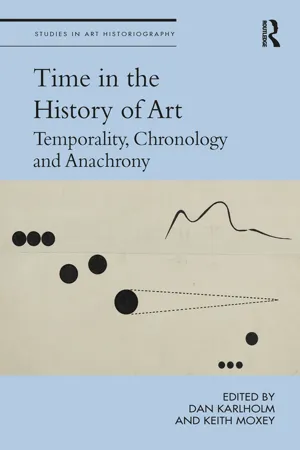
Addressed to students of the image—both art historians and students of visual studies—this book investigates the history and nature of time in a variety of different environments and media as well as the temporal potential of objects. Essays will analyze such topics as the disparities of power that privilege certain forms of temporality above others, the nature of temporal duration in different cultures, the time of materials, the creation of pictorial narrative, and the recognition of anachrony as a form of historical interpretation.
eBook - ePub
Time in the History of Art
Temporality, Chronology and Anachrony
- 254 pages
- English
- ePUB (mobile friendly)
- Available on iOS & Android
eBook - ePub
Time in the History of Art
Temporality, Chronology and Anachrony
About this book
Information
Part I
Historical Time
1
Is History to Be Closed, Saved, or Restarted? Considering Efficient Art History
Why do we get so much pleasure out of being so different not only from others but from our own past? What psychologist will be subtle enough to explain our morose delight in being in perpetual crisis and in putting an end to history?
Bruno Latour1
The symptoms of crisis within the discipline of art history, this time around, seem more profound than usual. While history as such can be understood as in permanent crisis, this word can also point to “a singular, accelerating process in which many conflicts, bursting the system apart, accumulate so as to bring about a new situation after the crisis has passed.” Can we envision a new situation after the current crisis has passed? Can it pass or are we heading for the third meaning of crisis: “purely and simply the final crisis of all history that precedes it, where proclamations of the Last Judgement are everywhere employed?”2
“Whither art history?,” asks a leading academic art journal,3 implying that it is going somewhere (else), while others just note that “art history as we know it is over.”4 In the field of contemporary art, where the signs of crisis are perhaps most evident, new ways to conceptualize the contemporary condition are delivered that account for multiple co-existing times while also drawing a firmer wedge than ever before between an expanding present and the receding past.5 It is on the latter field, and in the aftermath of the 1989 events in particular, that the most drastic diagnoses appear, expressed through a number of post-phenomena from post-modern, post-colonial, post-socialist, and post-historical to post-critical and post-human, to name a few. One of the most troubling categories is post-future, which signals an end to even hoping for solutions, let alone a fresh start. While none of these posts is exclusively relevant to the academic discipline of art history, the latter will be my point of entry here. My interest is in viewing our situation from a slightly shifted perspective than what these inherently historicist post-terms can offer. The very vocabulary is part of the problem; we seem collectively unable to think outside of the box, as it were, of Western modernity with its progressive concept of history and its teleological philosophies of history. Refusing to position myself as either a conservative, hanging on to an art history gone stale, or as a radical, coining ever harsher diagnoses and critical lamentations of this state of affairs, I think it is time to shelve both of these options and contribute a different model. Many of us feel a need to start over, without either closing art history or saving it as some kind of heritage. Restarting art history would of course require some extra memory space and perhaps an external hard drive to house a reconfiguration of its dominant model of history. My excuse for choosing such a big topic for a short essay is pragmatic and political; it is urgent to part from the negative modern route of wholesale critique or postmodern despair (including a certain delight in this despair) and to try to fashion, instead, a non-modern model, for want of a better word, which could do justice to all kinds of art, no matter where or when it was made, to continue mapping and measuring its multiple interconnections, its patterns of change and duration, without locking it up in canonical hierarchies symbiotically linked to national-ethnic origin, monetary value, or temporal recentness.6
Post-history, Post-future, and the Present
“What is new,” according to Jonathan Crary in 2013, “is the sweeping abandonment of the pretense that time is coupled to any long-term undertakings, even to fantasies of ‘progress’ or development. An illuminated 24/7 world without shadows is the final capitalist mirage of post-history, of an exorcism of the otherness that is the motor of historical change.”7 The concept of post-history (posthistoire) performs a peculiar paradox. While claiming to have nothing more to do with history, post-history in itself constitutes a historical sequence; after history, history is no more. Pronouncing this, however, as post- or literally after history betrays the modern historical mindset strung up between then and now, before and after. Being after history is to remain in the space carved out by history, in its trajectory, legacy or “afterness.”8
Referencing post history, or the end of history, is one of the first ways to summarize what contemporaneity in art might mean:
… once art had ended … everything was permitted, since nothing any longer was historically mandated. I call this the Post-Historical Period of Art, and there is no reason for it ever to come to an end. Art can be externally dictated to, in terms either of fashion or of politics, but internal dictation by the pulse of its own history is now a thing of the past.9
Just like Francis Fukuyama, who professed the end of history (and the universal victory of liberal democracy) in 1989, Arthur Danto takes Hegel literally and posits a possibly endless end to the history of art at a certain point in time.10 That is, Hegel’s thesis on the unique resolution of history in history (with the battle of Jena in 1806) is cut and pasted onto a different temporal moment. For Danto this occurred with Andy Warhol’s exhibition at the Stable Gallery in New York in 1964, and for Fukuyama in connection to the events that led to the demolition of the Berlin Wall in 1989. What follows from these respective Hegelianisms is a definition of history where the object of history is pushed forward by some internal force of development or “motor of change” (Crary) dictating its course toward a predetermined goal or end point, wherefrom there can be no more history as such, to no one’s regret, apparently. Getting rid of history even inspires rejoicing: “We sing to the infinity of the present and abandon the illusion of a future,” as Franco “Bifo” Berardi ends his manifesto in After the Future.11 Abandoning the future sounds like a futurist hallucination itself, a sci-fi dream of eternal life for some cyborg species without either of the phenomenological fundamentals of the historical human: experience or expectation. From this short quote alone, a paraphrase of the Futurist Manifesto from 1909, it is clear that what has ended is not the future itself, whatever that would mean exactly, but the “illusion” that the future could be calculated or programmed, foreseeable as a proper effect directly related to causes from within the preceding historical present. This is apparently no longer the case to most observers, perhaps because what lies ahead is too complex, too volatile, too fast and chaotic to be calculable let alone monitored or planned. We can all agree, I suppose, that illusions deserve to be unveiled and abandoned. Believing, however, that this temporal dimension of our human existence can just be abandoned, as an act of will, risks creating another illusion: that the present is infinite. This clearly evades a future-oriented perspective of a more reliable and real kind: not just the “possibility of death” in Martin Heidegger’s phrase, among us mortals, but for the planet itself.12 Are we not facing a future that dare not speak its name, so open and indefinite, so threateningly vacuous and potentially devastating that we simply must rename it? We call it the present.
“The era of post-future has begun.”13 Bifo’s chilling proclamation is essentially, if paradoxically, a modern one by preserving the modernist idea of future as the ideal realization or actualization of being, while simultaneously declaring—in a more postmodern vein—its impossibility. The future is cherished to the point where its loss is not only quietly bemoaned but also commemorated by the new term’s eternal determination of being without future, which is of course a way of being with it. By pulling the overcoming of future—the being without which is a being with—into the future, we seem destined to have to live with after-future for the foreseeable future.
Post-history and post-future are conceptual siblings. When history emerged as a collective singular around 1800, as a new conceptual formation—“history itself”—corresponding to a “new time” (Neuzeit) a.k.a. modernity, the past was artificially separated from the progressing present, with which Western modernity identified, not least to distance itself from nature and the cultures of the world.14 The gap between past and future widened ever more speedily during the high modern era in the nineteenth and twentieth centuries, which, after this era was declared over, eventually led to the perception of a singular “broad present” (Gumbrecht), the idea of a “boundless” or “perennial present” (Harootunian), corresponding to a whole presentist regime of historicity (Hartog).15 Another word for the present, especially on the field of art, is “the contemporary” which “is now widely claimed as a period, composed of loosely related aesthetic tendencies, following and displacing modernism.”16
Danto and Bifo also speak of a “period” or an “era” starting up. The use of such classical periodizations, along with concepts like epistemes or regimes, highlighting cultural dominants and temporal ruptures, surely indicates that we have not left the building of modern history. While the hypothesis of a not only expanding but eternal present or “forever now” is vintage post-history, it adheres to the logic of history as well, with its pre- and post-terms.17 With the past long gone, presumably, if also available as digitalized traces on our screens, and the future evacuated of all the good things moderns projected on it—further progress, emancipation, justice, profit, power, peace, etc.—we seem stuck with a rather monstrous post-future-present-future. The dark undertones of “post-future” are revealing of just how modern this discourse is. Future is still associated, as such, with positive values only, disavowing threats and dangers and the certainty of death. Furthermore, the notion of post-future offensively circumvents the imminent prospects of climate change and environmental disaster, which can afford neither some non-committing or punkish “no future” response, nor a conservative reassuring that nothing will ever change.
When Siegfried Gidieon addressed “the eternal present” sixty years ago, this was to capture the pre-modern world; pre-history’s remarkable constancy before change was introduced and everything started to move, differ, and disintegrate.18 When the eternal present returns in our day, it is in the form of a paradoxical prognosis. When the illusion of future retires, it is immediately replaced by the illusion—the prognosis—of eternity. If this is indeed the “final crisis of all history,” in Koselleck’s words, we hear no Last Judgement proclamations, which would presuppose that we were alarmed, or at least bothered, by such a crisis.
Pre-history and After- or Efficient History
History, in ordinary parlance and since its modern inception in the late eighteenth century in Europe, has been a kind of pre-history, if not at all in the conventional sense of this word, exemplified by Gidieon above, which alludes to a not-yet history or a time without written sources. According to the “normal” definition of history, contemporaneous with but not identical to teleological philosophies of history, history conjures up accounts of what has happened (needless to add: of importance) in history. History shows only what has actually (eigentlich) happened, in Leopold von Ranke’s famous utterance,19 by establishing past happenings in as secure and truthful a way as possible. Notwithstanding the problems involved in this kind of history, which are many but also massively researched for decades, its mode of operation involved two elements that could be fruitfully brought to bear on the present discussion: an open scope and an analogously open end. An open scope means that anything, any content in principle (what?), from anywhere and any point in historical time, could be subjecte...
Table of contents
- Cover
- Title
- Copyright
- Contents
- List of Figures
- Introduction: Telling Art’s Time
- PART I Historical Time
- PART II Post-colonial Time
- PART III Artist’s Time
- PART IV Narrative Time
- PART V Ontological Time
- PART VI Photographic Time
- Index
Trusted by 375,005 students
Access to over 1.5 million titles for a fair monthly price.
Study more efficiently using our study tools.
Frequently asked questions
Yes, you can cancel anytime from the Subscription tab in your account settings on the Perlego website. Your subscription will stay active until the end of your current billing period. Learn how to cancel your subscription
No, books cannot be downloaded as external files, such as PDFs, for use outside of Perlego. However, you can download books within the Perlego app for offline reading on mobile or tablet. Learn how to download books offline
Perlego offers two plans: Essential and Complete
- Essential is ideal for learners and professionals who enjoy exploring a wide range of subjects. Access the Essential Library with 800,000+ trusted titles and best-sellers across business, personal growth, and the humanities. Includes unlimited reading time and Standard Read Aloud voice.
- Complete: Perfect for advanced learners and researchers needing full, unrestricted access. Unlock 1.5M+ books across hundreds of subjects, including academic and specialized titles. The Complete Plan also includes advanced features like Premium Read Aloud and Research Assistant.
We are an online textbook subscription service, where you can get access to an entire online library for less than the price of a single book per month. With over 1.5 million books across 990+ topics, we’ve got you covered! Learn about our mission
Look out for the read-aloud symbol on your next book to see if you can listen to it. The read-aloud tool reads text aloud for you, highlighting the text as it is being read. You can pause it, speed it up and slow it down. Learn more about Read Aloud
Yes! You can use the Perlego app on both iOS and Android devices to read anytime, anywhere — even offline. Perfect for commutes or when you’re on the go.
Please note we cannot support devices running on iOS 13 and Android 7 or earlier. Learn more about using the app
Please note we cannot support devices running on iOS 13 and Android 7 or earlier. Learn more about using the app
Yes, you can access Time in the History of Art by Dan Karlholm, Keith Moxey, Dan Karlholm,Keith Moxey in PDF and/or ePUB format, as well as other popular books in Art & Art General. We have over 1.5 million books available in our catalogue for you to explore.