- 385 pages
- English
- ePUB (mobile friendly)
- Available on iOS & Android
eBook - ePub
About this book
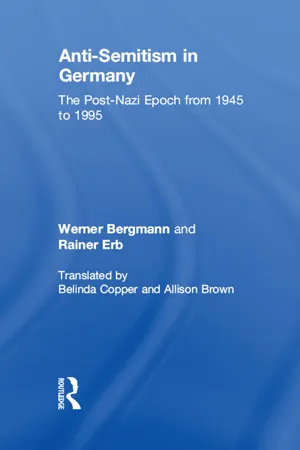
The surrender of Nazi Germany in 1945 marked the end of an epoch during which anti-Semitism escalated into genocide. In the immediate aftermath of World War II, Nazi racist ideology was discredited morally and politically, and the Allied occupation forces prohibited its dissemination in public. However, there was no overnight transformation of individual anti-Semitic attitudes among the public at large. Most surveys conducted since 1946 have confirmed the persistence of massive anti-Semitism in Germany both in the democratic West and the communist East. Based on all empirical survey data available up to now, this volume offers a thorough comparative analysis of anti-Semitism in Germany, and in particular its resurgence with the rise of right-wing extremism since unification.Anti-Semitism in Germany reflects a historically unique opportunity to compare the attitudes of two population groups that shared a common history up to 1945 and then lived under differing political conditions until 1989. The authors find distinct generational patterns in the survival and development of anti-Semitic attitudes. In the Federal Republic hostility towards Jews was more manifest among those who had been socialized to it under the Weimar Republic and Third Reich but less prevalent in subsequent generations. In contrast the authors show younger East Germans as more susceptible to anti-Semitism. The economic and cultural crises of reunification underwrote the strident anti-Zionism of the former communist regime. The authors also explore the anti-Semitic component of the recent wave of xenophobic violence and the disturbing rise of neo-Nazi political activity.This volume is especially noteworthy in its examination of a "secondary" anti-Semitism closely tied to the issue of coming to terms with the Nazi past. The motives behind persisting anti-Semitism can no longer be attributed to ethnic conflict, but go to the core discrepancy between wanting to forget and being reminded. The authors consider this phenomenon within the framework of current German political culture. In its comprehensiveness and methodological sophistication, Anti-Semitism in Germany is a major contribution to the literature on modern anti-Semitism and ethnic prejudice. It will be read by historians, political scientists, sociologists, and Jewish studies specialists.
1
Anti-Semitism in Germany (1945–1995)
Public Opinion
Anti-Semitism research in western Germany began right after the war, as the social scientific observations by the military authorities (OMGUS) of the popular mood in the American zone of occupation included questions of the persistence of anti-Semitic and racist attitudes, attitudes toward Nazism, the questions of collective guilt and on the process of “coming to terms with the past” (cf. Merritt and Merritt 1970, OMGUS Reports Nos. 49, 51, 68, 122, and 175 in the period 1946–1949). In the British zone, similar surveys were carried out; however, they have not yet been analyzed (PORO reports). Let us start with the studies on anti-Semitism conducted in the U.S. zone of occupation and in the early days of the Federal Republic. In the OMGUS studies, conducted in 1946, the following results were obtained: 20 percent showed only a slight tendency toward prejudice, 19 percent were nationalists, 22 percent racists, 21 percent anti-Semites, and 18 percent “hardcore” anti-Semites (Report 49, December, 1946). A repetition of the studies in April, 1948 showed a slight decrease in the proportion of anti-Semites to 19 percent and of “hardcore” anti-Semites to 14 percent (Report 122). This means we could expect that approximately 30 percent to 40 percent of the interviewees demonstrated clearly anti-Semitic attitudes in the early postwar years.1 The interviews were certainly seen within the context of the policies of occupation and reorientation, to which some segments of the population objected. For this reason, the reliability of these early surveys should be judged with caution.2 Nevertheless, the data provide evidence of a massive persistence of anti-Semitism after 1945, which was apparently rekindled as a result of specific postwar conflicts, such as the black market, displaced persons, and controversial restitution of Jewish property.
This was confirmed by the first survey under West German auspices. Shortly before the founding of the Federal Republic of Germany, the Institute for Public Opinion Research in Allensbach (Institut für Demoskopie, IfD) conducted a countrywide representative survey on anti-Semitism that was subtitled “a diagnostic contribution to domestic policy.” Its purpose was to give “German officials an overview of popular opinion on the issue of anti-Semitism” (ibid., in the instructions to the interviewer). This offers us the earliest material on anti-Semitism after 1945, completely preserved and most thoroughly broken down according to socio-demographic characteristics (see table 1.1).
Self-appraisal was revealed to be the most certain indicator of anti-Semitism in our 1987 survey. In 1949 and 1952, 23 percent and even 34 percent, respectively, described themselves as openly anti-Semitic, whereas the group showing no prejudice comprised 30 percent to 47 percent. Since it can be assumed that a portion of the “reserved” and “no opinion” groups also harbor anti-Jewish sentiments, the proportion of anti-Semites in the postwar years can be estimated as between 30 percent and 40 percent. This result corresponds to the findings of a group experiment conducted in the winter of 1950–51 (Pollock 1955, table 9). This study was the first task taken on by the Institute of Social Research after it was reestablished in 1950, and followed in the footsteps of the famous Studies in Prejudice, that is, it took a psychoanalytical approach using a different methodology. In this experiments, discussion groups were formed to talk about specific issues, after the chairman had introduced certain “stimuli.”3 Of those speakers who made any statement at all on the subject of Jews in the group sessions (only 23 percent), 37 percent were assessed as anti-Semitic, 35 percent as ambivalent (somewhat anti-Semitic and/or pro-Jewish statements, some of which were considered latent anti-Semitism), and 28 percent as non-anti-Semitic. The results provided impressive evidence that attitudes toward Jews after 1945 had indeed been affected by the Holocaust. Issues of guilt, guilt projection, attempts to rationalize, and silence were characteristic ways of coping with this complex; that is, anti-Semites found themselves on the defensive. For the participants in the discussions, anti-Semitism and Nazism were closely related. However, the results also indicated that Nazi education and propaganda had had a particularly strong impact on younger people and the better educated. Higher educational levels and youth do not have a moderating effect per se; more important is the prevailing political culture, and therefore also membership in a particular political generation (cf. Fogt 1982; Schuman and Scott 1989; Lang et al. 1993).
TABLE 1.1
“What is your general attitude toward Jews?”
“What is your general attitude toward Jews?”

Source: IfD vol. I.1957.
Combining the results of these four surveys in the postwar period, the following total picture emerges: at least one-third of the population must be categorized as openly anti-Semitic, almost one-third as somewhat anti-Semitic to ambivalent, and at least one-third as non-anti-Semitic.
The results of the 1954 survey commissioned by the Bundeszentrale für Heimatdienst (later renamed in Bundeszentrale für politische Bildung) and conducted by the EMNID Institute were comparable in magnitude. In answer to the free-association question “What comes to mind when you hear the word ‘Jew’?,” a third of those questioned indicated more or less positive attitudes, whereas a “more or less strong emotional rejection” was shown by approximately one-fourth (EMNID 1954, III). One-sixth of the interviewees were rated as harboring clearly negative feelings.4 The remainder were either disinterested (13 percent—the authors of the study suspected that some of these also had negative attitudes in this respect) or made mixed or unemotional associations.
The wave of anti-Semitic incidents that broke out in the winter of 1959 through 1960 began in West Germany, but spread throughout the world. It served to motivate increased empirical research.5 The large international comparative study “Intergroup Attitudes of Youth and Adults in England, France, and Germany” conducted by Melvin Tumin in 1961 and 1962 most likely also represented a reaction to the worldwide wave of anti-Semitism (Tumin 1962). Anti-Semitism played an important role in this study on racism and ethnocentrism. Using an anti-Semitism index, the study found that approximately equal numbers in each of the three countries (between 46 percent and 61 percent) exhibited anti-Jewish attitudes. This study, with its painstaking methodology, was never published in its entirety. Partial results were first published in 1980 by Badi Panahi, in conjunction with his own survey on this subject.
Once again, it was the Frankfurt Institute for Social Research that responded, this time to the trial of Adolf Eichmann, with two waves of representative surveys conducted in 1961, at the beginning and end of the trial (Schmidt and Becker 1967). This survey included a series of questions that could be used in anti-Semitism research. The same data, supplemented with a series of smaller surveys, formed the basis for a 1971 book by Michaela von Freyhold on “Authoritarianism and Political Apathy.” It was significant for the approach we took in our study that von Freyhold found a clear correlation between anti-Semitism and Nazi sympathies. In her opinion, anti-Semitism in West Germany was “more (one) element of the rationalization of Nazism than a separate hostility-she suspected “that authoritarians are infuriated not so much by some fixed stereotype of Jews, but by the silent accusation of the victims, which injures their collective narcissism” (1971, 97). Our study therefore employs this concept of “secondary anti-Semitism,” rather than taking the completely ahistorical approach of Silbermann and Sallen, who proceeded as though modern anti-Semitism continued unchanged in Germany after 1945 (cf. the criticism in Fritzsche 1987).
Despite the Auschwitz trials and the 1965 and 1969 “statute of limitations debates” in the German Bundestag, all of which gained great public attention, there were no larger surveys on anti-Semitism until the 1970s, apart from a few questions occasionally included in surveys by the IfD (cf. Jahrbuch der öffentlichen Meinung, vols. III-V, 1958–1973). The subject was taken up again in the 1970s by academic sociologists such as Alphons Silbermann and Herbert A. Sallen, in their 1972–1975 German Research Society (DFG) project (main EMNID survey in 1974, publication of results in 1976, Sallen 1977, and Silbermann 1982), and Badi Panahi, in a representative 1977–1978 survey on “racism, anti-Semitism, and nationalism in West Germany today” (published 1980), in which he included Tumin’s aforementioned results from 1961 through 1962. The Silbermann study received particular attention in public and political debates because of its findings.6 Based on the degree of acceptance of twenty anti-Semitic items on an “anti-Semitism scale,” the following results were obtained (table 1.2).
TABLE 1.2
“Intensity of anti-Semitic prejudice” 1974
“Intensity of anti-Semitic prejudice” 1974
Rejection | 23,6 % |
Mild acceptance | 46,4 % |
Medium acceptance | 25,6 % |
Strong acceptance | 4,5% |
Total | 100.0 % |
Source: Silbennann 1982, 34.
Explaining that extreme values are often avoided in Likert scales even if these do in fact correspond to the opinions held by those questioned, Silbermann and Sallen combined the figures from strong and medium acceptance to form a group of 30.1 percent with strong acceptance of the anti-Semitic statements. Only 23.6 percent were rated “not anti-Semitic,” and almost half (46.4 percent) of the West German population agreed somewhat with anti-Semitic statements. When these percentages were combined with two additional instruments (a social distance parameter and a behavioral orientation question), Silbermann and Sallen ended up with a slightly more favorable result. In addition to a tolerant group of approximately 30 percent and a strongly anti-Semitic group of approximately 20 percent, the authors concluded that half of the West German population displayed “at least latent remnants of anti-Semitic attitudes” (Silbermann 1982, 63).
Renewed interest in anti-Semitism at the end of the 1970s resulted once again from particular public events. The television series “Holocaust,” which had a completely unexpected impact on the public and led to intensive discussion of the persecution of Jews, was accompanied by surveys asking about anti-Semitic attitudes, attitudes toward German guilt and Nazism and the like (Ernst 1979; Prokop 1981; Ahren et al. 1982; Gast 1982). The state political education authorities had primary responsibility for these studies; they hoped the findings would support their educational efforts. The results showed that the television series led to a short-term change in attitudes. However, because there were no follow-up studies (panels) at greater intervals and the material has not been published, it is not possible to estimate the stability of these changes in attitudes.
Some questions on anti-Semitism also appeared in the extremism studies commissioned by political authorities (the Ministry of the Interior and the Chancellor Helmut Schmidt’s Office) in the late 1970s to measure the potential for right- and left-wing extremism in West Germany. This famous SINUS study (published in 1981) found that 13 percent of the electorate had a firm right-wing extremist worldview, which included anti-Semitism. However, a further “authoritarian-prone” share of the electorate (37 percent) was “immune to militarism, the Führer cult, and anti-Semitism” (93). In evaluating Nazism, and particularly anti-Semitism and racism, the IfD study on the “Potential for Extremism among Young People in the Federal Republic of Germany, 1984” made a similar distinction between right-wing extremists and “right-wing democrats” (Noelle-Neumann and Ring 1984, 77). Of active right-wing extremists, 17.9 percent answered “yes” to the statement, “The influence of the Freemasons and Jews in our country is still great today,” but only 1.4 percent of right-wing democrats answered in the same way (ibid. R-Scale, table 5). These results indicate that active, hardcore anti-Semitism rarely appears as an integral element of a worldview. However, this does not mean that less absolute anti-Semitic attitudes are not found in the German population. Thus an anti-Semitism study must be designed to detect such less-pronounced, more diffuse anti-Semitism; otherwise it would have to be designed as a study of right-wing extremism. In 1985 and 1986, a series of major and minor “anti-Semitic incidents,” particularly the dispute over the performance of the play Der Müll, die Stadt und der Tod (“Garbage, the City, and Death”) by R. W. Fassbinder, once again led to a spate of anti-Semitism surveys, in which anti-Semitism was placed in the context of “coming to terms with the past.” In February, 1986, the IfD was commissioned by Stern magazine to do a representative survey on “Germans and Jews forty years later.” It was partially conceived as an international comparison, and included Austria—which had come under scrutiny due to the Waldheim affair—France, and the United States.7 Renate Köcher prepared the following distribution for the 1986 IfD study, using a cluster analysis of a scale of nineteen items (table 1.3).
The results of the four most recent studies (IfD 1987, and EMNID 1989, 1992, Wittenberg et al. 1991) coincide to a large degree, despite the fact that they used different questions, rating methods, and boundaries between categories. They identify approximately 15 percent of the population as clearly anti-Semitic and between 50 percent and 60 percent as free of prejudice.
TABLE 1.3
“Extent of anti-Jewish sentiment” 1986
“Extent of anti-Jewish sentiment” 1986
Pronounced positive attitudes | 42,1% |
Mildly positive attitudes | 13,1 % |
Mildly negative attitudes | 29,5 % |
Strongly anti-Semitic attitudes (of those: hard core: 6 percent) | 15,3 % |
Total | 100.0 % |
Source: IfD 1986, Appendix: Cluster analysis.
For our 1987 study, Köcher also determined a group of 15 percent with clearly anti-Jewish sentiments [8 percent of which were categorized as vehemently anti-Jewish (IfD 1987, 51; for our own results cf. chap. 2)]. In response to the ultra right-wing Republikaner party’s successful showing at the polls, as well as growing ethnocentricity, Spiegel magazine commissioned the EMNID Institute in the spring of 1989 to conduct a survey on “contemporary history,” which included questions on attitudes toward Jews, Nazism, reparations, and the like. Using a twenty-seven-point scale, comparable values were obtained in 1989 (see table 1.4), although the criteria for distribution into the respective groups were not provided.
TABLE 1.4
“Attitudes toward Jews” 1989
“Attitudes toward Jews” 1989
20–27 points: extremely anti-Semitic | 4 % |
14–19 points: quite anti-Semitic | 10% |
6–13 points: somewhat anti-Semitic | 40% |
0–5 points: not anti-Semitic | 46% |
Total | 100 % |
Source: EMNID 1989, vol. 5.
As far as the extent of residual anti-Semitic attitudes is concerned, the EMNID study obtained a somewhat less favorable distribution than the 1986 IfD study. It is understandable that the categories do not correspond entirely, since this involves making distinctions among very diffuse attitudes. In the end it is impossible to decide where to draw the line. If the criterion for the “not anti-Semitic” category were that none of the responses to the scale statements demonstrate anti-Jewish sentiment, then little more than 25 percent would have been assigned to that group [in the 1987 IfD study, only 12 percent did not satisfy any of the negative conditions (51)]. This type of differentiation hovers in a nebulous gray zone, in which differences in attitudes are very difficult to determine with any precision.
In 1990, following German unification, it became possible for the first time to carry out public opinion surveys in eastern Germany without the supervision of the ruling SED party. In autumn of 1990, two representative anti-Semitism studies were carried out in eastern Germany, one of which also included the western German population for purposes of comparison (Wittenberg, Prosch, and Abraham 1991; Jodice 1991 for the American Jewish Committee). Both studies came to the conclusion, surprising to many, that anti-Semitism was far less widespread in eastern Germany than had been feared; at 4 percent to 6 percent, the percentage of the population that is anti-Semitic was lower than the western German figure of 12 percent to 16 percent anti-Semites.8 Public and scholarly attention was focussed on eastern German young people by the reorientation crisis and the wave of violence against foreigners, primarily by young people, that became acute during the debate on the constitutional right to asylum triggered by the large number of asylum seekers in Germany. Starting in 1990, a series of regional studies on xenophobia and political orientation among young people appeared, each of which included some questions on attitudes toward Jews (Lederer et al. 1991; Förster et al. 1993; Melzer 1992; Sturzbecher, Dietrich, and Kohlstruck 1994; on a non-representative student survey cf. Brusten and Winkelmann 1994, Brusten 1995). These studies showed that the attitudes of fourteen- to twenty-year-old East Germans were more xenophobic and anti-Semitic than those of adults, and that both the attitudes and the political orientations of adolescents had radicalized still further between 1990 and 1994. There is no comparable amount of empirical material available on western German young people (except for one regional study by Infas in 1992). Not until the end of 1991 did the EMNID Institute carry ...
Table of contents
- Cover
- Half Title
- Title Page
- Copyright Page
- Table of Contents
- Preface
- 1. Anti-Semitism in Germany (1945-1995)
- 2. The Berlin Study on Anti-Semitism
- 3. The Distribution of Anti-Semitic Attitudes in West Germany
- 4. Anti-Semitism as a Social Prejudice
- 5. Emotional Rejection of and Social Distance from Jews
- 6. Inclination to Discriminate and Intolerance
- 7. Attitudes of Germans toward Israel
- 8. Group Prejudice and Anti-Semitism
- 9. Subjective Deprivation and Anti-Semitism
- 10. Anti-Semitism within the Context of “Coming to Terms with Nazism”
- 11. Latent Anti-Semitism
- 12. Anti-Semitism in United Germany (1990-1995)
- Appendix 1: Problems in the Development of Anti-Semitism Scales
- Appendix 2: Questionnaire with Basic Count
- Appendix 3: Factor Analyses
- Appendix 4: AS-Stereotype Index
- Bibliography
- Index
Trusted by 375,005 students
Access to over 1.5 million titles for a fair monthly price.
Study more efficiently using our study tools.
Frequently asked questions
Yes, you can cancel anytime from the Subscription tab in your account settings on the Perlego website. Your subscription will stay active until the end of your current billing period. Learn how to cancel your subscription
No, books cannot be downloaded as external files, such as PDFs, for use outside of Perlego. However, you can download books within the Perlego app for offline reading on mobile or tablet. Learn how to download books offline
Perlego offers two plans: Essential and Complete
- Essential is ideal for learners and professionals who enjoy exploring a wide range of subjects. Access the Essential Library with 800,000+ trusted titles and best-sellers across business, personal growth, and the humanities. Includes unlimited reading time and Standard Read Aloud voice.
- Complete: Perfect for advanced learners and researchers needing full, unrestricted access. Unlock 1.5M+ books across hundreds of subjects, including academic and specialized titles. The Complete Plan also includes advanced features like Premium Read Aloud and Research Assistant.
We are an online textbook subscription service, where you can get access to an entire online library for less than the price of a single book per month. With over 1.5 million books across 990+ topics, we’ve got you covered! Learn about our mission
Look out for the read-aloud symbol on your next book to see if you can listen to it. The read-aloud tool reads text aloud for you, highlighting the text as it is being read. You can pause it, speed it up and slow it down. Learn more about Read Aloud
Yes! You can use the Perlego app on both iOS and Android devices to read anytime, anywhere — even offline. Perfect for commutes or when you’re on the go.
Please note we cannot support devices running on iOS 13 and Android 7 or earlier. Learn more about using the app
Please note we cannot support devices running on iOS 13 and Android 7 or earlier. Learn more about using the app
Yes, you can access Anti-Semitism in Germany by Rainer Erb in PDF and/or ePUB format, as well as other popular books in History & World History. We have over 1.5 million books available in our catalogue for you to explore.