For almost sixty years Professor David Jacoby devoted his research to the economic, social and cultural history of the Eastern Mediterranean and this new collection reflects his impact on the study of the interactions between the Italian city-states, Byzantium, the Latin East and the realm of Islam. Contributors to this volume are prominent scholars from across Medieval Studies and leading historians of the younger generation.
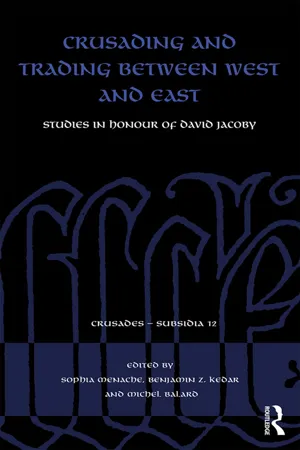
eBook - ePub
Crusading and Trading between West and East
Studies in Honour of David Jacoby
- 368 pages
- English
- ePUB (mobile friendly)
- Available on iOS & Android
eBook - ePub
Crusading and Trading between West and East
Studies in Honour of David Jacoby
Part I
The Crusades and the Latin East
1 The use of paper in the Frankish Levant
A comparative study*
As is well known, paper – a Chinese invention – entered the realm of Islam via Central Asia around the mid-eighth century; it gradually replaced papyrus and significantly curtailed the use of parchment.1 By the time the crusaders reached the Levant, paper had been serving there as normal writing material for Muslims, Oriental Christians and Jews. To what extent did the Franks follow in their footsteps? It is fitting to take up this issue in a volume dedicated to Professor David Jacoby, who has made so many crucial contributions to the study of the Frankish Levant and Byzantium, the history of silk and spices, and sundry other subjects – and from whose targīl (the Israeli version of the German Übung) on “The Competition of the Great Powers in the Eastern Mediterranean in the Fourteenth Century” I greatly profited while attending it in 1958/59 in my freshman year at the Hebrew University.
The most accurate data available on paper’s march to predominance have been assembled by Malachi Beit-Arié in his groundbreaking work on Hebrew codicology:


The early preponderance of paper in the Islamicate realm is corroborated by the breakdown of 441 separate scraps of inscribed material unearthed in 1980 during the excavation of a site in Fustāt (Old Cairo) and dated to the years 950–1050. Of these 441 pieces, 399 were written on paper, just 35 on parchment and 7 on papyrus. The scraps contain vestiges of contracts, letters, petitions and commercial accounts, as well as of religious and literary texts. It is noteworthy that two of the paper fragments display block-printing, one of them presenting a protective amulet prayer.2
As of now, there are no statistics on Muslim and Oriental Christian codices or manuscripts comparable to the data on the Hebrew ones. Yet we know that paper was used by the Abbasid administration already in the days of the caliph Mansūr (r. 754–75), that this use became obligatory in the caliphal chancery under Hārūn al-Rashīd (r. 786–809),3 and that the Fatimids, Ayyubids and Mamluks all continued to use paper for their government documents. The earliest dated Arabic codex on paper, from the year 848, contains an authoritative hadīth collection, Sahīh Muslim,4 and by the mid-tenth century paper had largely replaced parchment in the production of Qur’ān books in the eastern and central parts of the realm of Islam.5 The earliest Oriental Christian book on paper is a Greek codex written in Syria-Palestine in about 800: most of it contains the Doctrina patrum de incarnatione Verbi by Joannes. Damascene.6 The earliest dated Armenian codex on paper is from 981;7 the earliest Syriac manuscripts on paper date from the tenth century;8 the earliest Georgian ones date from the eleventh, but since Tbilisi was under Arab rule from the eighth century onward, paper was probably used there before 1000.9 The earliest dated Hebrew codex on paper, from 1005, contains a commentary on the books of Esther and Proverbs, probably also on other parts of the Bible.10 In Byzantium, the oldest extant documents of the imperial chancery, dating from the mid-eleventh century, are all on paper, and it has been suggested that this might have been so already 200 years earlier.11 The earliest dated Byzantine book on paper is a codex of 1105 copied on Mount Athos, containing the Corpus Dionysiacum and works by Maximus the Confessor.12 Yet the advance of paper codices in Byzantium appears to have been slow: the catalogue of the monastery of Patmos, drawn up in 1201, lists 267 manuscripts on parchment and only 63 on paper; however, while 7.9 per cent of the paper manuscripts deal with secular subjects, only 4.5 per cent of the parchment ones do so.13 In sum, paper was used extensively in the Levant, also for the copying of books of religious content, a long time before 1099, while the progress of paper in Byzantium – attested also by the late appearance of dated Hebrew codices there – was considerably slower. One of the reasons for the preference of paper over parchment was the impossibility to erase a text written on paper and replace it with another one; as a Georgian monk put it, “that’s why our holy fathers say that the dwellers in our monastery must write the Lives and words of the holy fathers not on parchment but on paper, so as not allow our descendants to erase the Lives of the holy fathers and write something different instead.”14
Narrowing our sights on Syria-Palestine, we learn that in about 985 al-Muqaddasī mentions Tiberias and Damascus as centres of paper production;15 in 1047 Nāsir-i Khusraw notes that very good paper is made in Tripoli, superior to that of Samarqand.16 Archaeology may have recently disclosed traces of paper production, because the 768 textile fragments, found in a cave near Jericho and radiocarbon-dated between the early ninth to the late thirteenth century, may have been gathered for its manufacture.17 The Geniza contains much information on the trade in paper in the mid-eleventh century, not only in Tiberias and Damascus but also in Tyre, Jerusalem and Ramla. Most of the documents from eleventh-century Palestine and Syria that made their way into the Cairo Geniza are written on paper.18 The profusion of paper in the Levant goes a long way to explain the large number of books in Oriental private libraries, significantly exceeding the extent of Latin ecclesiastical ones. Usāma b. Munqidh’s claim that King Baldwin III of Jerusalem robbed him of 4,000 bound volumes19 may be an exaggeration. But the private library of Shaykh Tāj al-Dīn al-Kindī b. al-Hasan, who died in Aleppo in 1216, comprised 761 volumes,20 the private library of the Shi‘ite scholar Ibn Tāwūs of Baghdad contained about 1,500 titles in 1252/3;21 and in the 1270s the catalogue of the Ashrafīya library in Damascus listed 2,096 titles.22 In contrast, the library of Durham Cathedral, one of the largest in the West, which inherited the books of several abbeys, owned just 546 volumes in the late twelfth century.23 And while the catalogue of the Frankish cathedral of Nazareth records at about the same time 102 volumes,24 an incomplete inventory of a private Jewish library from the twelfth century or earlier, preserved in the Cairo Geniza, lists 153 books.25
Thus, the Frankish states existed in an environment well supplied with paper. The Franks’ native subjects continued to use paper. Almost all the Geniza letters by Jews who lived under Frankish rule are written on paper,26 and we may assume that the Muslim, Melkite and Samaritan subjects of the Franks likewise preferred to use paper for that purpose. Muslims most likely wrote their Qur’āns on paper,27 whereas Jews and Samaritans used parchment for their Torah scrolls.28 The writing material employed by Melkite subjects for the writing of their books has not yet been systematically studied, but apparently Greek manuscripts – for instance, the Typikon of the Anastasis copied in Jerusalem in 1122 – were mostly written on parchment. On the other hand, the Melkites’ Arabic manuscripts – such as the volume of 1234, now in Damascus, containing canons of various councils and a translation of the Procheiros Nomos – were usually written on paper.29
To what extent did the Franks themselves adopt the use of paper? As of now, we have just one specimen of material evidence for such use. During the works at the Aqsa Mosque in the 1920s, a small piece of paper (Figure 1.1) was discovered between two stones of a pillar supporting the mosque’s dome. It is the only Latin document of the period of the crusades ever discovered in what had been the Frankish Levant. It was written between 1179 and 1184 by Gérard of Ridefort, the seneschal of the Templar Order who was soon to become its Master and to play an important role in the events that led to the Frankish defeat at the Horns of Hattīn. In the letter sent to the Order’s preceptor in Jerusalem, Gérard reports on the action taken against an aberrant Templar.30 The letter, now on display in the Islamic Museum on Jerusalem’s Haram, reveals that the scribe used most sparingly the paper on which he wrote, cutting it just above his first and just below his last line. His thriftiness suggests that paper was rather expensive.31
Gérard’s is not only the sole extant letter on paper from the Frankish Levant: Apparently it is the earliest letter on paper in the Latin world that has come down to us. There is evidence for earlier use of paper in the West. The paper-and-parchment missal of the abbey of Santo Domingo de Silos is dated to the tenth or eleventh century, the all-paper Latin glossary of that abbey to the tenth, eleventh or twelfth,32 while a Latin-Arabic glossary, mostly written on paper, was presumably composed in Toledo in the second half of the twelfth century;33 the first and third of these manuscripts appear to have been the work of Mozarabs. Countess Adelaide of Sicily issued in 1109 a Greek-and-Arabic order on paper (the Arabic text, which presents her as malikat Siqilyah, i.e. queen of Sicily, unwittingly anticipates her becoming, for a few years, the wife of King Baldwin I of Jerusalem).34 The earliest Genoese notarial cartulary, that of Giovanni Scriba dating from the years 1154–64, is written on paper evidently originating in the realm of Islam: five of its folios formed part of an immense Arabic missive with Latin interlinear translation (possibly dispatched from Fatimid Egypt to the Commune of Genoa), with the words al-Rūm, al-Shāmiyyīn and al-Faranj appearing in its fragments.35 A contemporaneous copy of the 1179 Treaty of Cazola between Alfonso VIII of Castile and Alfons el Cast of Aragon was also written on paper.36 Yet in the considerable literature on the early use of p...
Table of contents
- Cover
- Half Title
- Series
- Title
- Copyright
- Contents
- David Jacoby, un passeur entre Orient et Occident
- David Jacoby publications
- List of contributors
- Part I The Crusades and the Latin East
- Part II Venice and the Byzantine world
- Part III Medieval trade
- Part IV Silk
- Index
Trusted by 375,005 students
Access to over 1.5 million titles for a fair monthly price.
Study more efficiently using our study tools.
Frequently asked questions
Yes, you can cancel anytime from the Subscription tab in your account settings on the Perlego website. Your subscription will stay active until the end of your current billing period. Learn how to cancel your subscription
No, books cannot be downloaded as external files, such as PDFs, for use outside of Perlego. However, you can download books within the Perlego app for offline reading on mobile or tablet. Learn how to download books offline
Perlego offers two plans: Essential and Complete
- Essential is ideal for learners and professionals who enjoy exploring a wide range of subjects. Access the Essential Library with 800,000+ trusted titles and best-sellers across business, personal growth, and the humanities. Includes unlimited reading time and Standard Read Aloud voice.
- Complete: Perfect for advanced learners and researchers needing full, unrestricted access. Unlock 1.5M+ books across hundreds of subjects, including academic and specialized titles. The Complete Plan also includes advanced features like Premium Read Aloud and Research Assistant.
We are an online textbook subscription service, where you can get access to an entire online library for less than the price of a single book per month. With over 1.5 million books across 990+ topics, we’ve got you covered! Learn about our mission
Look out for the read-aloud symbol on your next book to see if you can listen to it. The read-aloud tool reads text aloud for you, highlighting the text as it is being read. You can pause it, speed it up and slow it down. Learn more about Read Aloud
Yes! You can use the Perlego app on both iOS and Android devices to read anytime, anywhere — even offline. Perfect for commutes or when you’re on the go.
Please note we cannot support devices running on iOS 13 and Android 7 or earlier. Learn more about using the app
Please note we cannot support devices running on iOS 13 and Android 7 or earlier. Learn more about using the app
Yes, you can access Crusading and Trading between West and East by Sophia Menache, Benjamin Z. Kedar, Michel Balard, Sophia Menache,Benjamin Z. Kedar,Michel Balard in PDF and/or ePUB format, as well as other popular books in History & European History. We have over 1.5 million books available in our catalogue for you to explore.