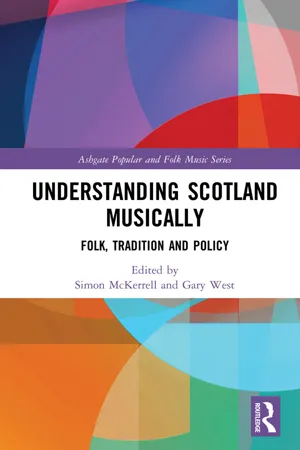
Scottish traditional music has been through a successful revival in the mid-twentieth century and has now entered a professionalised and public space. Devolution in the UK and the surge of political debate surrounding the independence referendum in Scotland in 2014 led to a greater scrutiny of regional and national identities within the UK, set within the wider context of cultural globalisation. This volume brings together a range of authors that sets out to explore the increasingly plural and complex notions of Scotland, as performed in and through traditional music. Traditional music has played an increasingly prominent role in the public life of Scotland, mirrored in other Anglo-American traditions. This collection principally explores this movement from historically text-bound musical authenticity towards more transient sonic identities that are blurring established musical genres and the meaning of what constitutes 'traditional' music today. The volume therefore provides a cohesive set of perspectives on how traditional music performs Scottishness at this crucial moment in the public life of an increasingly (dis)United Kingdom.
eBook - ePub
Understanding Scotland Musically
Folk, Tradition and Policy
- 290 pages
- English
- ePUB (mobile friendly)
- Available on iOS & Android
eBook - ePub
Understanding Scotland Musically
Folk, Tradition and Policy
About this book
Information
1 Understanding Scotland musically
Introduction
This book is an attempt to address the question of how we might understand Scotland musically. In setting out this question we are deliberately focusing upon the object ‘Scotland’ and sometimes ‘Scottishness’ in and through music. This is because we believe that previous generations of scholars have (quite legitimately) attempted to answer a linked, yet quite different question: how we might understand Scottish music. Scottish music as the object of study has less appeal to today’s scholars because most of the arts and humanities disciplines where we might meet and try to answer this question, have moved to a position that rests upon understanding the contingent, changing and plural nature of national culture(s). Today, modern Scotland is a country that has a long and often contested set of national traditions, with rich histories of both indigenous and new genres of music that have emerged and which support hybrid, modern identities. Polish-Scots, Irish-Scots and Indian-Scots (amongst others) have also brought their own musical cultures, and indigenous Scots have become more adventurous in their musical culture, resulting in a rich and diverse constellation of musical subcultures. There has been a great surge in the porosity between musical genres since the advent of greater access online to different musical communities of practice, and this has been mirrored by a growth and atomisation of the voices across Scottish culture who are willing and able to contribute to understanding what Scottish music might and could be today.
The scholarly response to this, as in other areas of cultural reflection, has been to shift our attention from culture as a static object towards understanding culture as a process that people engage in. The benefit of this shift is that we now have the ability to move scholarship beyond the temporal, geographical and ethnic concerns that previously lay at the core of attempts to understand national cultures, and to focus instead upon how people today understand culture and what it can mean and do in society. Unlike the sciences, our task as scholars of music and culture is not to answer pre-determined hypotheses or questions posed by nature, but to help all people critically understand culture and thus in a very Aristotelian way, to live a good life (Hesmondhalgh, 2013). This book is therefore concerned with understanding how people understand Scotland and Scottishness in and through musical culture because this can help us collectively to inform our approaches to musical education, cultural policy, musical aesthetics, and perhaps most importantly, our sense of belonging to Scotland, wherever we might live.
The theorisation of musical nationalism1 has a long and intellectually plural history, across a number of disciplines including the central ones that support the aims of this book such as ethnology, ethnomusicology, popular music studies, ballad studies, education, historical musicology and cultural studies (amongst others). Historically, much of this history has depended upon key cultural figures in national and cultural traditions who have curated a sense of the ‘national’ in terms of cultural signifiers that have been mythologised and collocated with sonic traditions. This mythologisation therefore has depended historically upon both the standing of these cultural and intellectual figures as well as the sense of shared authenticity of the signifiers that they have drawn upon. Think of the constant and ongoing re-negotiation of the cultural authority and significance of figures such as Robert Burns, Sir Walter Scott, Hugh MacDiarmid or Hamish Henderson2 – all of whom are key to the story of Scottish national culture. The well-worn (and critically aware) scholarship of nationalism from Anderson (2006), Gellner and Breuilly (2008) and Hobsbawm (2012) reminds us that the national idea is highly contingent, malleable and yet extremely powerful in our lives.
That is still true today, and perhaps even more so with the rise of online musical culture. In some senses, music has become more, not less, powerful in constructing a sense of nationhood because many can now access it instantly and wherever they are in the world. As Bohlman reminds us, when considering music and nationalism in Europe:
Nationalism no longer enters music only from the top, that is, from state institutions and ideologies, but may build its path into music from just about any angle, as long as there are musicians and audiences willing to mobilize cultural movement from those angles.
(Bohlman, 2011, 56)
This deterritorialisation of musical nationalism has seen the rise of the political significance in music across the late modern West. In the recent European past, music has been freshly implicated in nationalist and political movements (for good and ill) in ways that have not been seen for decades, from musically constructed nationalist discourses (Biddle and Knights, 2007; Bohlman, 2004; Boyes, 2010; Ceribašić, 2014) to shifting sonic nationalisms in post-communist Europe (Buchanan, 2002; Nercessian, 2000; Rice, 2002), to the recent musical re-emergence of the nationalist far right (Machin and Richardson, 2012; Spracklen, 2013). Musical nationalism is today on the rise, and as much as some commentators wish to divorce music from nationalism, music continues to be crucial (and popular) in the construction of national identity and belonging precisely because of its affective power. Bohlman predicates the European love-hate relationship between music and nationalism within the tensions that arise between (1) the modern rationalist’s wish for music to be autonomous of culture and often problematic notions within nationalism; (2) that nationalist music trivialises and reduces the unique sonic markers of identity in music into more bland, universalist texts ultimately moving towards kitschness; and (3) that nationalist musics give voice to the destructive and intolerant in society (2011). Of course, the counterpoint to all of these is twofold in that national musics have immense power to construct a sense of collective belonging (witness the popularity of national anthems and key songs at sporting events), and second, that not all music that constructs nationalism is ‘national music’ by any means.
This book sets out to understand Scotland musically which is at once both a plural and contested position, but we contend that there are certain shared values that underpin the cultural notion of ‘Scotland’ and ‘Scottishness’ which are evident across the book. Clearly, no single musician, group or canon of music can make the claim to constructing Scotland, and the variety of issues and styles raised in this collection evidence this position. One can feel ‘Scottish’ or more usually, a sense of national belonging when listening to anything from piobaireachd to pop. It is, however, our position that because of the authenticity lent to it by the process of oral development and historical transmission that the ‘traditional music’3 of Scotland lies at the core of almost all claims to ‘Scottishness’ or nationalist constructions of Scotland across musical genres. We contend that the process of re-imagining and mythologising Scotland is, and has been, always overwhelmingly constructed via the traditional music of Scotland. Such that when the notion of ‘Scottishness’ or a ‘Scottish’ voice has been explored within classical, or popular traditions, it almost always relies at source upon the orally developed and transmitted traditional music for the sonic signification of ‘Scotland’.
Scotland’s case is intriguing; not since the 1960s anti-nuclear protests songs have Scottish traditional music and musicians been so politically engaged. Almost the entire community of practice came out in favour of Scottish independence during the 2014 referendum, and the musical contributions to the campaign were highly visible in public gigs and key lobby groups such as TradYES, the national collective for traditional musicians in favour of Scottish independence (McFadyen, 2013).
Social media during the referendum campaign not only provided a route for democratic access to political activism for all flavours of nationalists in Scotland, it also launched a more politically engaged civic debate in Scotland which saw key hegemonic actors such as Scottish Labour and the BBC challenged by a wide array of citizens now thrust into new collectivist and exciting action (Anonymous, 2014; see for example Ferguson, 2013). The use of social media cannot be underestimated in the new production of Scottish nationalism: there are numerous striking examples of Scottish cultural and civic nationalists building support for independence in and through traditional music throughout the two-year referendum campaign including: new songs composed in support of cultural and political independence (MacKenzie, 2014); Scottish Government collocation of traditional fiddling and piping with nationalism in their political videos and in tourism marketing (Sanderson, 2015), and; gigs and albums explicitly in support of Scottish independence (for example Brown, 2014). Traditional music emerged in a new online public discourse about the independence referendum in a striking example of cultural nationalists supporting a determinedly civic nationalist campaign by the Scottish National Party. Despite the relative lack of a culturally nationalist discourse, traditional music was presented during the first referendum campaign as a sonic signifier of a future, more progressive, culturally independent and confident Scottish nation. The almost wholesale political alignment of traditional music in very public social media, gives perhaps a false view of the total community of practice who more closely reflected the political opinions of the population as a whole (55% against independence to 45% in favour in the 2014 Scottish referendum) when it came to rejecting Scottish independence. In a purposive online survey conducted during the summer of 2014 with the community of practice in Scottish traditional music, ‘only 53% of respondents reported that they supported independence, with 21% undecided and 15% firmly against’ (McKerrell, 2016, 96). Nevertheless, the public debate that emerged in 2013 and 2014 leading up to the first referendum on Scottish independence on 18 September 2014, brought the relationship between traditional music as a marker of national cultural independence and political nationalism back into plain view, and has led to a more highly politicised online discourse within the community of practice that has not been seen since the mid-twentieth-century Scottish folk revival. This online use of fora and social media within and beyond the musical community of practice is new, and cannot be ignored in any discussion of musical nationalism in the future.
At the time of writing, Scotland’s constitutional position is a matter of significant public debate, precipitated through the June 2016 UK referendum on leaving the EU in which Scotland decisively voted to remain in the EU. ‘Indyref2’ when it arrives promises to be of a different character given the unstoppable macro-political forces in the British Isles during 2017 and 2018, and perhaps this time there will be more of a focus on the part culture plays in a people’s vision for its future. What is certain however, is that regardless of whether Scotland remains part of the United Kingdom when the dust settles in 2019 or indeed, part of the European Union and/or the UK, Scottish traditional music will be a crucial part of many individual’s identity, both those living within and without Scotland itself. In that sense, the Scottish part of ‘Scottish traditional music’ does matter, and matters intensely to many performers, listeners and fans. But if one listens carefully to the music and the people, one can hear a sense of Scottishness and music that is plural, contested and healthier than it has ever been. Scottishness is manifested not in any claim to oldness or provenance in this musical nationalism, with the concomitant and inevitable exclusionary logic; it is manifested humanely, in the sense of belonging and shared endeavour through performance and discourse where each person has a unique personal sense of Scottishness and its musical manifestation. This book evidences that claim with several nuanced conceptions of a musical Scotland. It is our hope that this plural and tolerant form of Scottishness is retained in whatever political future lies ahead, that those who perform and craft identities in and through Scottish traditional music, remain committed to an open and plural notion of what that might mean, without letting the destructive binary polarities of historical nationalisms take root in the music-political debate leading up to the next referendum on Scottish independence.
Musical nationalisms and genre
The question of understanding a musical nationalism has most often been approached from a concern with the musicological past of the origins and provenance of musical ‘objects’. Much of the European construction of musical nationalism has always rested upon the historical, racial and ethnic provenance of musical objects. These include both the first publications of key traditional songs and tunes, as well as often conflating the public status of key cultural commentators with their pronouncements on the origins of their nation’s music. Sometimes, such as in the case of Highland Cathedral or The Blaydon Races, it has been the vernacular popularity of the tune or song that leads to its adoption as a signifier of identity despite clearly having been imported into the home culture from elsewhere (Gammon, n.d.; Korb and Roever, n.d.). Much of the musicological historiography of nationalism grew out of mythologisation of dead, male, white composers in the art tradition. Whilst musicology itself has now mostly moved on from these elitist and hegemonic positions, it is safe to say that the ‘pale and male’ lineages of composers of classical music still hold great signification in the public square (Khomami, 2015). Not least with those Tory politicians who have repeatedly sought to reinstate and aggrandise ‘dead white Germans’ within the English GCSE and A-Level music curricula (Garner, 2014). But in the sense of how the national culture has been constructed, and who has agency in this task, the mythologisation of music and nationalism used to rest fairly squarely on the European literate elite. For example, Jean-Jacques Rousseau, the Swiss theorist who was so instrumental in the continental European enlightenment and particularly for his work on The Social Contract (pub. 1762), was one of the key mythologisers of the musical nationalism. He is not only responsible for the egregious (and highly problematic) idea that Scottish and ‘Chinese’ traditional musics are somehow related via pentatonicism and scale-type, but also for much national mythologising on French and Italian music. In broader terms, he espoused a view whereby music was fundamentally about melody and human morality, and that harmony and complexity were degradations of music (a view still sometimes shared). But Rousseau in common with many other enlightenment thinkers of the late eighteenth century plucked simplicity and melodic purity as ideals that were metaphorically close to the rural, simplistic and authentic lifestyle of the eighteenth-century peasant-class thereby, through nothing more than mere homology really, linking aesthetic ideals on Italian (good) and French Opera (bad) to sonic traits. Today’s scholars have rejected that sense of a monolithic nature metaphor to recognise that it is people that create musical and national cultures, and therefore complexity is the starting point for any theorisation of musical nationalism.
Another key writer to do this was the foundational thinker of the musical enlightenment, Johannes Gottfried Herder. Herder in the 1760s was really the first European intellectual to make explicit the collocation between racial or ethnic nationalism and traditional culture (subsequently, so relied upon by the Nazi party (Atkins, 2010)). Herder’s language advocated both the racial ‘purity’ of oral tradition amongst the peasantry as a means of understanding his ‘nationalbildung’ (the ‘spirit of the nation’), and also provided the motivation to the literate elite to collect the stories, songs and tunes of ‘das Volk’ in order to safeguard the authentic music of the people. In so doing, he set the tone for at least 150 years of antiquarian and subsequently, scholarly interest in establishing the romantic link between the orally transmitted songs and stories of (ideally) rural, illiterate peasantry and the core enlightenment ideal of ‘the nation’ across Europe. Scotland at that time was interestingly one of the most literate nations in Europe, and so had a more complex relationship between orality and literacy, which found perhaps its most elaborate expression in the Ossianic scandals instigated by James Macpherson around the same period in the 1760s (Gelbart, 2007; see Trevor-Roper, 2008). But by the turn of the nineteenth century, and certainly by the time Sir Walter Scott was able to publish his Minstrelsey of the Scottish Border in February 1802, the heavy-set romanticisation and collocation of nature, race and orally transmitted music was established, and much of the Scottish cultural history of the nineteenth century can be thought of as a highly classed invention of ‘Scotland’ and ‘Scottishness’ that has only really been debunked in the last twenty or thirty years through careful scholarship.
What is apparent when one is seeking to understand the social semiotics or cultural history of a nation’s musical culture, is that first, music and nationalism live on, and are indeed thriving within increasing cultural globalisation (Biddle and Knights, 2007) and secondarily, that not all nations are musically constructed in the same way. If one suggests, as we do here, that Scottish traditional music lies at the heart of almost all claims to cultural ‘Scottishness’, then one has to be clear that other genres of music cannot lay claim to a distinctively ‘Scottish’ voice that is independent of that nation’s orally developed motivic and melodic tradition. Scotland cannot claim to have had a strong independent art music ‘voice’ in the international sphere, not because of a lack of music, but partially probably because of the teaching lineages and aesthetics of Scottish art music composers, who have almost without exception drawn upon Scottish traditional music for their sonic markers of ‘Scottishness’. The key melodies, motifs, and structures of orally developed and transmitted traditional tunes and songs have formed the backbone of the sonic ‘Scottishness’ that key figures in Scottish art music history have sought in their composition. The eighteenth century attempts to produce Scottish art music, naturally enough drew upon traditional tunes in James Oswald’s and William MacGibbon’s output. Nineteenth-century figures such as Alexander MacKenzie and Hamish MacCunn are remembered more for their contribution to education, or for their orchestral and chamber adaptations of traditional Scottish ballads and tunes. More recently, every serious Scottish art music composer (with the possible exception of Thea Musgrave) such as Peter Maxwell-Davies, James MacMillan, Eddie McGuire, Bill Sweeney, and the late Ronald Stevenson have all heavily relied upon the pre-existing content of traditional music when developing a Scottish aesthetic. There is no denigration in this, in fact, it is a validation of the health and aesthetic beauty of the vernacular, indigenous oral traditions that every Scottish art music composer looking to develop a ‘Scottish’ sound in their work from the Earl of Kelly to today, has drawn upon traditional Scottish music. It is perhaps not contentious therefore to suggest that the Scottish art music tradition never produced a central canon with its own distinctive art music voice, comparable to other European nations in terms of compositional lineages. And therefore, if one is to understand Scotland musically, it is centrally important to understand how that Scottish aesthetic is and has been developed in the indigenous, orally developed traditional music of Scotland.
When we look to the continent, and compare the national art music voice of Scotland with the European traditions, it is clear that Scotland cannot claim a distinctive art music voice in the way that other nations can: France had Debussy, Ravel, Roussel, Stravinsky, even in terms of instrumental styles, it is not uncommon in art music traditions to speak of the ‘French school’ of composition, violin, vocal performance styles or for instance of chamber music. There were also for instance, almost 1,000 music publishers in France between 1820 and 1914 (Lesure, n.d.). Germany similarly enjoyed a particular sense of a national school or voice in composition across many instrumental and vocal traditions. For many aesthetic and historiographical reasons (their musical output amongst them), Germany probably can lay claim to the strongest national voice in composition, performance style and public engagement with classical music. Giants such as Beethoven, Bach, Mendelssohn, and Wagner all contribute to our sense of a cohesive German national voice in the art music tradition. The geo-political area known as the Netherlands is perhaps more comparable to Scotland in terms of its place in relation to the central European classical traditions. Indeed, Andrew Blake points out that Oskar Schmitz’s well known wartime accusation against Britain that it was ‘Das lande ohne musik’ (‘the land without music’) was not without a basis in fact: there was a great deal of music in Victorian and Edwardian Britain, but it was of the popular and vernacular forms, rather than the elite art music forms (Blake, 1997). He goes on to suggest that Schmitz’s accusation perhaps came a generation too late given the rise of Elgar, Vaughan Williams, and subsequently Tippett and Britten. But really, as is so common throughout the ‘British’ cultural commentariat, he is using ‘British’ as a synonym for ‘English’. The rejection of this constant (and culturally deb...
Table of contents
- Cover
- Title
- Copyright
- Dedication
- Contents
- List of figures
- List of tables
- List of musical examples
- General editor’s preface
- Preface
- Acknowledgements
- Notes on contributors
- 1 Understanding Scotland musically
- Part I Policy and practice
- Part II Porosity, genres, hybridity
- Part III Home and host
- Part IV The past in the present
- References
- Index
Trusted by 375,005 students
Access to over 1.5 million titles for a fair monthly price.
Study more efficiently using our study tools.
Frequently asked questions
Yes, you can cancel anytime from the Subscription tab in your account settings on the Perlego website. Your subscription will stay active until the end of your current billing period. Learn how to cancel your subscription
No, books cannot be downloaded as external files, such as PDFs, for use outside of Perlego. However, you can download books within the Perlego app for offline reading on mobile or tablet. Learn how to download books offline
Perlego offers two plans: Essential and Complete
- Essential is ideal for learners and professionals who enjoy exploring a wide range of subjects. Access the Essential Library with 800,000+ trusted titles and best-sellers across business, personal growth, and the humanities. Includes unlimited reading time and Standard Read Aloud voice.
- Complete: Perfect for advanced learners and researchers needing full, unrestricted access. Unlock 1.5M+ books across hundreds of subjects, including academic and specialized titles. The Complete Plan also includes advanced features like Premium Read Aloud and Research Assistant.
We are an online textbook subscription service, where you can get access to an entire online library for less than the price of a single book per month. With over 1.5 million books across 990+ topics, we’ve got you covered! Learn about our mission
Look out for the read-aloud symbol on your next book to see if you can listen to it. The read-aloud tool reads text aloud for you, highlighting the text as it is being read. You can pause it, speed it up and slow it down. Learn more about Read Aloud
Yes! You can use the Perlego app on both iOS and Android devices to read anytime, anywhere — even offline. Perfect for commutes or when you’re on the go.
Please note we cannot support devices running on iOS 13 and Android 7 or earlier. Learn more about using the app
Please note we cannot support devices running on iOS 13 and Android 7 or earlier. Learn more about using the app
Yes, you can access Understanding Scotland Musically by Simon McKerrell, Gary West, Simon McKerrell,Gary West in PDF and/or ePUB format, as well as other popular books in Media & Performing Arts & Music. We have over 1.5 million books available in our catalogue for you to explore.