eBook - ePub
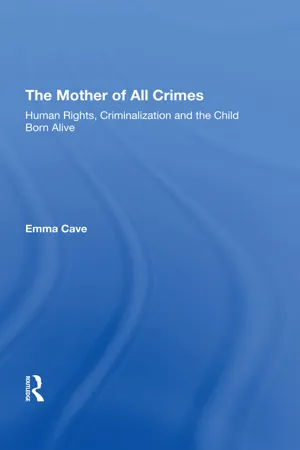
The Mother of All Crimes
Human Rights, Criminalization and the Child Born Alive
- 171 pages
- English
- ePUB (mobile friendly)
- Available on iOS & Android
eBook - ePub
About this book
This book considers the appropriate response of the criminal law with regard to women whose acts or omissions in pregnancy cause the death or injury of the child born alive. It compares recent developments in English law in the light of the Human Rights Act 1998, with those in America, which has seen an enormous growth in litigation over the last two decades. In England and Wales, the 'born alive rule' is currently applied only to third parties who injure the fetus, which is later born alive and dies as a result of these injuries. In some American states, a rule of similar origins has been extended so as to criminalize recent mothers whose acts or omissions in pregnancy caused injury or death to the resulting child. The author examines the implications of the laws in both systems, and also looks at the rights of the mother and child in relation to the obligations of the state to protect both of them.
Chapter 1
The Status of the Fetus
In England and Wales the law gradually increases the protection of the fetus as it comes nearer to legal personhood, which is achieved at birth. Though this does not necessarily bring the rights of fetus and woman into conflict, it has the effect of gradually increasing the potential for conflict.
In the USA, the law operates in a similar manner, increasing the protection of the fetus as it progresses in gestation. The US Constitution, which is defined and protected by the Supreme Court, governs the entire federal system. The Constitution protects the human rights of the citizens of America and has had a major role in defining the abortion rights of pregnant women. Each individual state is left to develop its own laws to the extent that it does not conflict with the Constitution. States have different definitions of the onset of legal personhood and operate different mechanisms to ensure that the fetus is protected adequately before that time. The ‘born alive rule’ that operates in English law has also been adopted by many states in America. There it has been adapted and extended in various ways. In its narrowest form (and its current state in England and Wales) it declares that a third party who injures a fetus which is later born alive and dies as a result of the injury, may be guilty of homicide. Three possible extensions were examined in the Introduction. The first extends the rule to criminalize women who, whilst pregnant, harm the fetus which is born alive and dies as a result of those injuries. The second category extends the rule to include third parties or women who, whilst pregnant, cause injury to a child born alive. The third includes third parties or pregnant women who cause injury or death to a fetus, which for the purposes of the state law is defined as a person. Alternatively, the born alive rule has been overridden with existing or newly enacted legislation.
The government has an interest in protecting the fetus, but that protection proceeds on the basis of its potential to become a person in law, and its human derivation. As there is potential for the interests of fetus and pregnant woman to conflict, a balancing exercise must take place to determine the respective legal rights of each. A theory of autonomy is expounded in Chapter 2 in an attempt to fulfil this criterion. It is then argued that criminalizing pregnant women does little to overcome problems caused by maternal activities that harm the fetus and child born alive in practical terms, and is theoretically unsound in terms of ethical and legal theory.
The Importance of Autonomy
The balancing of the rights of the pregnant woman and fetus is an exercise not only of moral philosophy but also of law. It has been stated in the Introduction that, though law and ethics are entwined, the law is bound by rules of precedence and general applicability. This and the next chapter therefore consider moral arguments purely in the context of their potential application in law. This chapter considers the appropriate legal response to the need to protect the fetus. The next attempts to balance this with the human rights of the pregnant woman. Of the various rights that potentially conflict with the interests of the fetus, autonomy is given precedence. It is argued that the key to an appropriate balance of interests and rights lies here.
Gerald Dworkin put forward a theory of autonomy with a procedural rather than a substantive definition.1 Once the definition is examined and accepted, it is suggested that negative rights to freedom from intervention warrant greater protection than positive rights to demand it. In the unique circumstances where the woman’s human rights potentially conflict with the interests of the fetus and potential child, it is argued that a pregnant woman’s negative rights should be protected to the same extent as a non-pregnant individual’s. Any conduct that would not be considered illegal in the absence of pregnancy, should be tolerated in law.2 Thus, it is contended that the pregnant woman has a right to insist that others do not damage the fetus she carries, or end its life without her consent. She has a legal right to continue activities that are considered legal in the absence of pregnancy, such as smoking tobacco, working or drinking alcohol, even though harm may result to the fetus.
It cannot be stated as a general rule that all individuals should be treated equally with regard to their negative rights to shun state intervention. There are cases where the law rightly reacts by prohibiting acts that may harm the human rights of other persons. An epileptic may be banned from driving until his condition is stabilized. A driver may be criminalized for driving under the influence of alcohol. Why then can we not prohibit a woman from drinking, smoking, working, or over-exercising whilst pregnant? The answer is a complex one. It is based on the necessity to reach a compromise between the rights of the woman and the interests of the fetus and potential child. The drunk driver and epileptic driver risk damage to the human rights, and in particular the right to life, of other individuals. The consequent limitations on their activities are well defined and the damage to their autonomy small. Balancing the two, it is possible to prevent substantial harm whilst impinging in only a minor way on the driver’s autonomy.
In the case of the pregnant woman, her activities may cause harm or loss of life to a potential being, which does not yet carry full human rights. Due to the fact that the fetus is contained within the womb of the woman and therefore utterly reliant on her for life, protecting it from potential harm would involve considerable limitation of the pregnant woman’s autonomy. The balance here is quite different; it is unsustainable.
Conversely, the value of autonomy is not always important enough to warrant third parties following the whim of the pregnant woman to the detriment of the fetus. Therefore, positive action involving third parties, such as abortion, genetic engineering or fetal surgery, should not be granted to the pregnant woman without consideration of the state interest in protecting the fetus and potential child. This position is not uncontentious, but is suggested as a legally applicable means of protecting both fetus and pregnant woman. It does not accord with every sector of public opinion but, like the legal definition of personhood at birth, it compromises between the various moral standpoints.
The Status of the Fetus
The status of the fetus is considered in this chapter in order to support two propositions. The first is that the woman’s right to reject state intervention with regard to her otherwise legal acts and omissions in pregnancy overrides the state interest in fetal health or life. The second is that the state has a duty to protect the fetus, potential child and child born alive through curbing the pregnant woman’s demands for intervention. A charged debate surrounds the area and it is not possible within the scope of this work to voice each of the numerous religious, cultural and political standpoints. Instead, some of the arguments are eliminated and others are commended in an attempt at compromise, and to reach a legally workable conclusion.
There is a wide divergence in views as to the relevant moral status of the fetus. For Peter Singer3 killing is wrong when it frustrates the desire of a self-conscious being to live. On this basis, killing a fetus is different to killing an adult. Even the death of a neonate, caused by acts or omissions of the mother whilst pregnant, might be viewed as acceptable on the basis that the child is not yet self-conscious. At the opposite end of the spectrum the Roman Catholic Church takes a fundamentalist position, contending that the fetus has a soul from conception and that its sanctity of life should be respected from that point. There are various positions that view stages in-between conception and autonomous thinking as the all-important time when the fetus should be protected in law as a person.4 In English law personhood is not achieved until birth, and the same is true in many American states.5 Lack of personhood status does not prevent protection of the fetus on other grounds, but to ascribe legal personhood to the fetus would be to ascribe all the corollary legal rights that personhood entails. This, it is submitted, is legally unworkable. If the law labels a fetus a ‘person,’ it should have the full rights of a person resulting in the potential conflict of legal rights between fetus and pregnant woman. Consider, for example, the pregnant woman whose life ultimately depends on medical treatment that will kill the fetus. If both are persons of equal legal standing, then it becomes essential to determine whose rights should take precedence. Even where both would die without the treatment, the law would have difficulty permitting the intentional killing of the fetus person.6 In fact the equal rights of both fetus and pregnant woman lead to quite bizarre scenarios. In Missouri, where a fetus is defined as a person from conception for the purposes of certain laws, a pregnant woman serving three years for forgery and theft claimed, though she was ultimately unsuccessful, that the state was unconstitutionally imprisoning her fetus who had committed no crime whatsoever.7
Brody8 argued that fetuses are persons and that though there is no duty to save another fetal-person, there is a positive duty not to harm him. On this view, all the acts in-between harming and killing would become illegal. This would mean that the woman’s right to smoke, drink, exercise, not exercise, work, or live in a polluted area could be jeopardized if the fetus is also labelled a person. The fact that pregnant woman and fetus are inextricably linked means that the potential for conflict in rights and interests is immense. The legal label ‘person’ becomes empty and irrelevant if what really matters is not when personhood physically begins, but when it becomes morally important.9 The argument that the law should ascribe the fetus personhood rights from conception is therefore flawed. Other moral arguments warrant the legal protection of the fetus, not as a person but as an entity capable of achieving personhood.
The Argument of Potential for Life
The fetus has potential to become a person. On this basis it might be offered protection from a particular point when its potential becomes so significant that it should be regarded for all intents and purposes as a person; it might be afforded gradually increasing protection as its potential increases; or retrospective protection when its potential has been realized because it has been born alive. Each of these claims is examined in turn. The first is rejected whilst the second and third are accepted as offering useful guidance as to the appropriate level of protection to afford the fetus.
The first argument envisages protection from a particular point in gestation, such as conception or viability, when potential becomes pertinent for some reason. At this point the fetus should be protected on an equal basis with born persons. As a child is given protection and valued highly, the proponents argue, so too the fetal potential for becoming this child should be valued from that point in time.10
Some commentators argue that the point in gestation where potential should result in legal personhood status is viability.11&12 This is because the fetus can potentially survive independently of and externally to the woman from this point. Various states in America have legislated to this effect.13 However, there are problems of legal certainty in this argument, because as technology advances, the point when a fetus becomes viable changes. The fetus is a potential person, but the argument fails to provide any firm method by which to afford the fetus protection and for this reason it is subject to criticism. Onset of personhood rights at birth has the advantage of certainty, though this is not to say that protection (on a basis other than legal personhood) cannot gradually increase throughout gestation as the fetus nears childhood.
An alternative view is that the fetus should be protected from conception by virtue of its potential to become a person. Marquis14 argued that to deprive the fetus of its future is similar in moral terms to depriving an adult of his future. Abortion is therefore justifiable only when it would also be morally acceptable to kill a competent adult. Brown15 contended that the ‘future like ours’ argument is flawed because it is derived from equivocation on what constitutes ‘a future of value’. The term, he argued, can be taken to mean ‘potential future of value’ or ‘self-represented future of value’. As to the latter, the fetus does not have any concept of self. Brown stated:
[O]ne should not fall into the trap of thinking that the fetus as it was at the time of an abortion had a self-represented future to lose. One may mourn the absence of the child the fetus would have become, but in doing so one is coming to terms with a painful mental representation in one’s own mental life, not acting on behalf of a person who had a future of his or her own.16
As to the former, Brown maintained that it is not presumptively seriously wrong to deprive someone of a potential future of value. People can and often do die in ways that do not violate their rights, such as the person who dies because the resources are not available to give him a kidney transplant. The potential future of value is dependent on favourable external circumstances and the fetus has no right to this. It relies on the woman to provide the environment that will enable it to realize its potential. The woman has no duty to provide this because it would involve the sacrifice of her own rights to autonomy and bodily integrity.17
Marquis responded,18 ackno...
Table of contents
- Cover
- Half Title
- Title
- Copyright
- Contents
- Acknowledgments
- Introduction
- 1 The Status of the Fetus
- 2 The State Interest in Protecting the Pregnant Woman and the Significance of Autonomy
- 3 Criminalization of Pregnant Women and Mothers in the USA
- 4 Crimes Against the Fetus Born Alive in England and Wales
- 5 Criticism of the United States’ Extensions of the Law
- 6 Alternatives to Extended Criminalization
- Bibliography
- Index
Trusted by 375,005 students
Access to over 1.5 million titles for a fair monthly price.
Study more efficiently using our study tools.
Frequently asked questions
Yes, you can cancel anytime from the Subscription tab in your account settings on the Perlego website. Your subscription will stay active until the end of your current billing period. Learn how to cancel your subscription
No, books cannot be downloaded as external files, such as PDFs, for use outside of Perlego. However, you can download books within the Perlego app for offline reading on mobile or tablet. Learn how to download books offline
Perlego offers two plans: Essential and Complete
- Essential is ideal for learners and professionals who enjoy exploring a wide range of subjects. Access the Essential Library with 800,000+ trusted titles and best-sellers across business, personal growth, and the humanities. Includes unlimited reading time and Standard Read Aloud voice.
- Complete: Perfect for advanced learners and researchers needing full, unrestricted access. Unlock 1.5M+ books across hundreds of subjects, including academic and specialized titles. The Complete Plan also includes advanced features like Premium Read Aloud and Research Assistant.
We are an online textbook subscription service, where you can get access to an entire online library for less than the price of a single book per month. With over 1.5 million books across 990+ topics, we’ve got you covered! Learn about our mission
Look out for the read-aloud symbol on your next book to see if you can listen to it. The read-aloud tool reads text aloud for you, highlighting the text as it is being read. You can pause it, speed it up and slow it down. Learn more about Read Aloud
Yes! You can use the Perlego app on both iOS and Android devices to read anytime, anywhere — even offline. Perfect for commutes or when you’re on the go.
Please note we cannot support devices running on iOS 13 and Android 7 or earlier. Learn more about using the app
Please note we cannot support devices running on iOS 13 and Android 7 or earlier. Learn more about using the app
Yes, you can access The Mother of All Crimes by Emma Cave in PDF and/or ePUB format, as well as other popular books in Law & Criminal Law. We have over 1.5 million books available in our catalogue for you to explore.