The increasing global competition of knowledge economies has begun a new era of labour migration, as economies chase 'the best and the brightest': the movement of highly skilled workers. This book examines the experiences of highly educated migrants subjected to two distinct and incompatible public discourses: one that identifies them in terms of nationality and presupposed religion, and another that focuses on their education and employment status, which suggests that they deserve the best treatment from societies engaged in the global 'race for talent'. Presenting new empirical research collected in Amsterdam, Barcelona and London amongst highly educated migrants from Turkey, the author draws on their narratives to address the question of whether such migrants should be apprehended any differently from their predecessors who moved to Europe as 'guestworkers' in the twentieth century. With attention to the reasons for which highly skilled workers choose to migrate and then stay (or not) in their 'host' countries, their connection to their multiple homes and the ways in which they meet the challenges of integration – in part by way of their position in relation to other migrants – and their acquisition of citizenship in the 'host' country, The Migration of Highly Educated Turkish Citizens to Europe offers insights on an under-researched trend in the field of migration. The author develops three nexuses – the mobility/migration nexus, the mobility/citizenship nexus, and the mobility/dwelling nexus – to account for the embedded sense of mobility that underlies these 'new' migrants and offers a holistic picture about their trajectory from 'arrival to settlement' and all that lies in-between. As such, it will appeal to scholars in the fields of sociology and political science with interests in migration and mobility, ethnicity and integration.
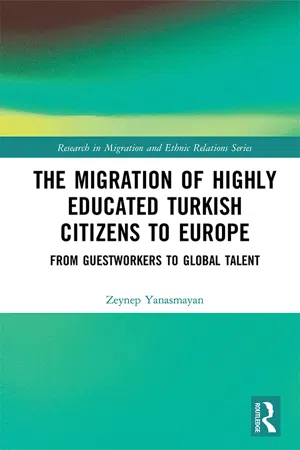
eBook - ePub
The Migration of Highly Educated Turkish Citizens to Europe
From Guestworkers to Global Talent
- 158 pages
- English
- ePUB (mobile friendly)
- Available on iOS & Android
eBook - ePub
The Migration of Highly Educated Turkish Citizens to Europe
From Guestworkers to Global Talent
About this book
Information
Part I
The mobility/migration nexus
1 Elsewhere starts here1
A journey begins with the determination and readiness to leave behind familiar worlds, with an eagerness for new adventures. My journey with the highly educated migrants from Turkey starts with their narratives on how their migration journeys began. This chapter sets the stage for a thorough exploration of the respondents’ individual migration trajectories and examines the motives that lay behind their decision to migrate.
Scholars of international migration have long been preoccupied with advancing general explanations for the phenomenon of human migration. Accordingly, migration has overwhelmingly been perceived as a once-and-for-all event, heavily shaped by structural, but mostly economic, factors (Arango 2000; Massey et al. 1993). This ‘instrumentalist view of migration, whether expressed in terms of the macro push–pull models or, at the behavioural level, in terms of stimulus and response’ (McHugh 2000: 74) has long overlooked the complexity of migration decisions that are in reality far from mathematical. Even though the early theorizations were mainly developed in response to the movement of labour migrants from less developed to more developed regions, they left their mark on the highly skilled migration, which, more often than not, took for granted the role of the macro-economic structures and the principle of ‘benefit maximization’ at the individual level.
Patterns of highly skilled migration are thought to reflect the extent of the expansion of global trade and of the spread of transnational corporations (Findlay 1990; Salt 1992). The natural link that has come to be established in the literature between capital flows and the flow of individuals shapes the contours of this debate and shadows the ‘human’ aspects of the reality on the ground. As Koser and Salt (1997: 294) assert, the main theoretical advances in this literature have positioned ‘the movement of the highly skilled within broader economic processes of global restructuring and proposed a pattern of movement determined less by the aspirations of individuals, and more by the changing patterns of demand and the development of an organizational infrastructure’. Therefore, as Favell (2001) argues, the main questions of migration studies have remained peripheral to discussions on highly skilled migration, albeit with growing exceptions that I will summarize in the next section.
This chapter recognizes the complex nature of migration and attempts to explore through the accounts of the respondents the extent to which it is a cognitively negotiated phenomenon that is not just about moving locations. Aiming to enhance without denying the relevance of the prevailing human-capital development explanations, I show how different motives are combined to form a unique mix for each migrant. More importantly, this chapter starts unravelling the mobility/migration nexus by first developing the notion of mobility as ‘a fundamental aspect of social life’ (Easthope 2009: 61) that is embedded in the decision of migration. The understanding of mobility as integral to social life attests to the ‘situatedness and rootedness of migration in the flow of everyday life’ (McHugh 2000: 74). Last but not least, this chapter also touches upon general facilitators and the attendant constraints that impinge on the decision of the migration, such as networks and immigration policies, both of which are often disregarded in the literature on highly skilled migration.
Personal motives, constraints and facilitators of migration
An increasing number of qualitative studies, focusing mostly on intra-EU or West-West migration, seek to inquire into the complexity of migration decisions, as it is ‘increasingly clear that a significant proportion of these global population flows cannot be understood within a straightforward economic rubric’ (Conradson and Latham 2005: 288).
Based on a study of New Zealanders living in London, Conradson and Latham (2005) are among the first to empirically show the normalized status of mobility in the lives of certain people. They identify migration as an essential rite of passage to adulthood (2005: 289). Migration for them becomes more a means to realize a project of self-development than to ensure career advancement. They embed their finding within the broader sociological trends of societal individualization that understands the self as a continuous individual project (Bauman 2000, 2001; Beck and Beck-Gernsheim 2002; Giddens 1991). The centrality of migration as a project of self-realization is important here, although the identification strategies will be addressed more closely in Part III of this study. The relevance of self-realization not only shifts the scholarly attention away from economic aspirations, but also points to a motive that eludes easily identifiable instrumental categories.
The intertwining of notions, such as freedom, self-realization and mobility, as well as the complexity of migration decisions, have been echoed in other studies focusing on intra-EU mobility (Favell 2008; Kennedy 2010; Ryan and Mulholland 2014; Scott 2006; for an exception, see Armbruster 2010), although they differ in their emphasis. For instance, in his study on the trajectories of over sixty highly educated European migrants in Manchester, Kennedy (2010) argues that, for most of his respondents, career or educational desires were paramount, although the desire to travel and/or escape from home with a view to achieve a higher degree of self-realization was also significant. More importantly, Kennedy (2010) stresses the link between individual and structural factors, and highlights the prominence of opportunities and constraints that influence migration decisions. Questioning ‘the idea that the world was their oyster’, Kennedy (2010: 280) asserts that ‘it was the relative paucity of available or promising economic opportunities at home, alongside an expanding service sector in Britain, that had induced most to seek new avenues’.
Rutten and Verstappen’s study (2014) completes this picture by showing that purely economic explanations cannot fully encapsulate the stories of migrants from developing countries either. Concentrating on Indian migrants in London and their families back in Gujarat, Rutten and Verstappen (2014: 1228) reveal a combination of socio-economic and personal motivations, namely, earning money and gaining status, as well as an eagerness to experience new lifestyles. Therefore, the ‘self-development type’ identified by Conradson and Latham (2005) is not germane to West-West migration. However, the study undertaken by Rutten and Verstappen (2014) introduces refinement into such studies and bring to light constraints that have thus far eluded attention. First of all, their case study suggests that migrants from developing countries might nevertheless experience more monetary need and urgency. Second, the type of self-development expected to be achieved through migration is not solely an internal matter of soul-searching, but also a function of escaping traditionally assigned gender roles, parental control and social pressure. As to how this particular aspect can be introduced into the mix for highly educated migrants from Turkey will be addressed in the next chapter. Last but not least, while Kennedy’s (2010) study draws attention to the labour markets as providing both opportunities and constraints, Rutten and Verstappen (2014) show how migration choices are also delimited by the visa policies in place. This diverges from the bulk of the literature on highly skilled migration, including the above-mentioned studies, which assume that skilled migrants practically enjoy unhindered mobility as ‘work permit systems have changed to accommodate the global search for expertise’ (Salt 1997: 2).
Another factor that taps into the migration decisions that recent studies on highly educated migration underscore is the role of social networks (Beaverstock 2002, 2005; Conradson and Latham 2005; Ryan and Mulholland 2014). This is perhaps hardly surprising as migration networks, which are typically defined as sets of interpersonal relations that link migrants with relatives and friends back in the country of origin (Arango 2000: 291; Massey et al. 1993: 448), are by now part and parcel of migration studies and rank among the most-cited explanatory factors of migration. It is argued that social and kinship networks offer social capital for would-be migrants and tend to decrease the costs and risks of an eventual move; therefore, individuals, families or communities with previous experience with migration are more predisposed to migration. The salience and potency of networks in the last few decades have increased, given the proliferation of restrictive policies of immigration. Family reunification provisions are among the few open channels of migration to Europe and they thus provide the basis for sustained flows, since prospective migrants are apt to use their kinship networks with a view to circumvent restrictive immigration policies (Böcker 1995: 156). This phenomenon has also given rise to the term ‘chain migration’, which is an important determinant in explaining the maintenance of Turkish migration to Europe, both during and after the recruitment period (Abadan-Unat 2011; Böcker 1995; Reniers 1999). On the other hand, the significance of networks for highly skilled migration has thus far been greatly downplayed, with the human capital paradigm as a dominant player in the field (Meyer 2001: 94). Meyer (2001) claims that highly skilled migrants mobilize a wider range of networks composed of colleagues, fellow alumni and friends that replace the traditional kin-based ties. Indeed, most recent scholarship now recognizes the importance of friendship networks, as well as of growing up well acquainted with previous migration experiences in migration decisions.
This chapter builds on these recent in-depth investigations of the experiences of highly skilled migrants and seeks to understand what lies behind the migration decisions of highly educated migrants from Turkey in the three cities under scrutiny. Since Turkish migration to Europe has typically followed the ‘guestworker’ pattern, the movement of highly educated Turkish citizens remains severely understudied. Moreover, highly educated migrants from Turkey have typically chosen North America as their primary destination, even though some changes have been noted since 9/11. In her comprehensive exploratory study, Akçapar (2009) opens a window into the highly educated Turkish migrants in the US, with additional details about their demographics, networks and experiences. She also analyses their reasons for non-return, a topic more closely addressed in the next chapter. However, she does not expand on their initial reasons for migration. On the other hand, a recent comparative study of highly skilled migrants from Turkey (Özcürümez and Yetkin Aker 2016) in Canada and Germany examines the motives for migration. In line with the literature above, the authors draw attention to the combination of personal and social factors (among which career advancement appears predominantly), to the impact of social networks, as well as to the social context in the country of destination. Nevertheless, neither Akçapar (2009) nor Özcürümez and Yetkin Aker (2016) address migration as a step within the trajectory of self-development in its own right.
This chapter continues this recent conversation in the literature and expounds on the motives, constraints and facilitators of migration for highly educated migrants from Turkey. The chapter is structured around the main reasons for migrants deciding to leave Turkey. However, it simultaneously draws attention to the intertwined nature of their motives, which escape easy categorizations. It puts forth three arguments with regard to the complexity of migration decisions. First, and most importantly, the chapter shows – in line with the recent literature on highly skilled migration – that a human capital perspective alone cannot describe the full extent of the migration phenomenon. Although professional and educational reasons are evidently an important part of the picture, there is more to this decision: self-development, eagerness to flee the pressure, to break away from routine and, not insignificantly, the intrigue of travel. An embedded sense of mobility that is seen as a means to achieve all these desires is ingrained in these decisions. I call this the mobility/migration nexus. As argued by Conradson and Latham (2005), mobility, in the sense of migration, can be a conscious life strategy geared to alter the stability-change pendulum of identity. In a postmodern era, identity is understood as embodying a paired essence that is simultaneously linked to both place and mobility. Whereas the stability of the external environment has been seen as paramount for maintaining coherent identities, the importance of change in the external environment for identity development has been equally underscored (Easthope 2009: 65, 77). Change, in large part, ‘is made up of other people’s continuities, quite suddenly coming up close to us as well’ (Hannerz 1996: 25). At the same time, mobility need not always involve spatial mobility; it could refer to a predisposition, an intrinsically cognitive experience of travel. For instance, Dawson (1998: 219–220) shows that even though people live in one place, ‘they engage cognitively in movement’, in a way that informs their lived reality of ‘fixity’. Mobility as an ‘intrinsic cognitive alternative’ is what gives its title to this chapter: ‘Elsewhere starts here’. While mobility does not necessarily call for physical mobility or migration, so that those who ‘stay’ are not deemed less ‘mobile’, migration decisions invariably entail an embedded sense of mobility. Different from Conradson and Latham (2005), this does not have to constitute an independent category, for even migrants who primarily migrate for career advancement are predisposed to mobility and harbour mobility aspirations.
In a second step, the chapter identifies some ‘facilitators’ for migration. These facilitators include geographical proximity, intra-company arrangements and, most importantly, social networks. Having an acquaintance, a friend or a family member in a certain country does not per se constitute a reason to leave Turkey, but it contributes to the determination of the destination country. There is a difference between the triggers and the planning and implementation stage, which is where networks are brought into play. Nevertheless, the networks under question are mostly sporadic contacts, as suggested by Meyer (2001), which should be differentiated from the more regularized practices of chain migration. Similarly, in their study, Rutten and Verstappen (2014: 1221) also argue that their respondents do not resort to chain migration, which is usually associated with low-skilled migration.
Finally, in a third step, I highlight some constraints that impact on the migration decisions, among them level of access to the labour market, the special sector of the migrant and, most significantly, immigration policies. The current visa system in European countries allows admission into the territories in very specific cases of employment and education, aside from humanitarian grounds. The policies in place do not accommodate or reflect the richness of individual experiences and the migrants’ embedded sense of mobility. The available migration channels therefore delimit the contours of what is ‘feasible’ and effectively disguise mobility-driven motivations with human capital-related explanations. When migrants attempt to rationally explain their moves, explanations such as ‘I quit my job; I take my little car and go away’ (Favell 2008: 65) are seldom heard, since no European country issues a visa for that determination. Therefore, whereas intra-European mobility is fed by the surrounding structure, theirs is rather limited by it. In a similar vein, Rutten and Verstappen (2014: 1221) argue that ‘education has come to be viewed as the easiest and fastest route to go abroad’ in India.
The data for the reasons of arrival was gathered using two different techniques. In addition to being personally interviewed, respondents were asked to fill out a basic form with biographical information, where they also needed to state their reasons for migration. This dual technique allowed me to go beyond the descriptive clusters and ultimately reveal this intertwining of reasons. The motives for migration, more often than not, run parallel to their migration channel and legal status at the time of the entry. Accordingly, four categories of reasons are identified: educational, professional, family-related and mobility-driven.
Educational motives
Since the group under scrutiny is composed of highly qualified people, educational motives typically refer to advanced master’s or doctoral degrees.2 Yet a relatively small group, particularly in London, also includes those who initially arrived for language instruction, and who – with the exception of one respondent – continued with their education to earn advanced degrees. Regardless of the initial impetus for seeking language instruction, lan...
Table of contents
- Cover
- Half Title
- Series Page
- Title Page
- Copyright Page
- Dedication
- Table of Contents
- Acknowledgements
- Introduction: Making sense of highly educated migration: the case for mobility nexuses
- PART I: The mobility/migration nexus
- PART II: The mobility/citizenship nexus
- PART III: The mobility/dwelling nexus
- Appendix
- Index
Trusted by 375,005 students
Access to over 1.5 million titles for a fair monthly price.
Study more efficiently using our study tools.
Frequently asked questions
Yes, you can cancel anytime from the Subscription tab in your account settings on the Perlego website. Your subscription will stay active until the end of your current billing period. Learn how to cancel your subscription
No, books cannot be downloaded as external files, such as PDFs, for use outside of Perlego. However, you can download books within the Perlego app for offline reading on mobile or tablet. Learn how to download books offline
Perlego offers two plans: Essential and Complete
- Essential is ideal for learners and professionals who enjoy exploring a wide range of subjects. Access the Essential Library with 800,000+ trusted titles and best-sellers across business, personal growth, and the humanities. Includes unlimited reading time and Standard Read Aloud voice.
- Complete: Perfect for advanced learners and researchers needing full, unrestricted access. Unlock 1.5M+ books across hundreds of subjects, including academic and specialized titles. The Complete Plan also includes advanced features like Premium Read Aloud and Research Assistant.
We are an online textbook subscription service, where you can get access to an entire online library for less than the price of a single book per month. With over 1.5 million books across 990+ topics, we’ve got you covered! Learn about our mission
Look out for the read-aloud symbol on your next book to see if you can listen to it. The read-aloud tool reads text aloud for you, highlighting the text as it is being read. You can pause it, speed it up and slow it down. Learn more about Read Aloud
Yes! You can use the Perlego app on both iOS and Android devices to read anytime, anywhere — even offline. Perfect for commutes or when you’re on the go.
Please note we cannot support devices running on iOS 13 and Android 7 or earlier. Learn more about using the app
Please note we cannot support devices running on iOS 13 and Android 7 or earlier. Learn more about using the app
Yes, you can access The Migration of Highly Educated Turkish Citizens to Europe by Zeynep Yanasmayan in PDF and/or ePUB format, as well as other popular books in Ciencias sociales & Emigración e inmigración. We have over 1.5 million books available in our catalogue for you to explore.