- 210 pages
- English
- ePUB (mobile friendly)
- Available on iOS & Android
eBook - ePub
About this book
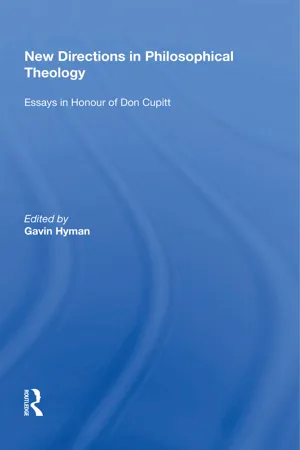
At the beginning of a new millennium, philosophical theology has become more contested than ever before. The appearance of non-realist theologies, postmodern theologies, and the theology of 'radical orthodoxy', has provoked a vibrant debate about the nature of theology itself. In what new directions should theology be moving in the wake of the 'end' of modernity? For over thirty years, Don Cupitt has been provoking theologians to reconsider the nature of their discipline. Taking their inspiration from his work and writing in his honour on the occasion of his 70th birthday, some of the leading figures in the contemporary theological scene address urgent questions facing theology today and, in doing so, exemplify the methodological diversity which characterises the contemporary field.
Information
Introduction
Gavin Hyman
The terrain of theology today is, above all else, a contested site. This is not simply to say that it is a site marked by disagreements; that, after all, is nothing new. Rather, it is to claim that theology is marked by much more fundamental disputes regarding its very self-understanding and self-definition. What presuppositions do we bring to the study of theology and how appropriate are they? What methodological practices should inform our study of theology and which should be left behind? What is the relationship between philosophy on the one hand and theology on the other? How are we to understand the interaction between the practice of theology and the wider culture and society which constitutes its backdrop and context? How is theology affected by the advent of what is now popularly known as postmodernism? To what extent does postmodernism provide a unique opening for the return of theology? To what extent is theology even possible in postmodern times?
Whilst some of these questions are directly posed by the unique conditions of our contemporary culture, many of them are, on the contrary, far from new. But what distinguishes contemporary theology from its past is the preoccupation, even obsession, with these methodological questions. Although theology has always been a site of disagreement, for the last century or so these disagreements took place, for the most part, in the context of a consensus that took the modern enlightenment framework as a given, what Catherine Pickstock later in this volume calls ‘the liberal compromise of the inherited, predominantly Anglican or quasi-Anglican tradition in the United Kingdom’. The characteristics of this compromise or consensus are difficult to identify in any comprehensive way, but the most prominent include attempts to: reconcile theology to the implications of post-Kantian philosophy; revise or restate theology in terms that are consistent with and speak to contemporary culture; engage in apologetics to justify the legitimacy of theology in rational terms; develop an account of how theology may legitimately be said to ‘represent’ reality. Doubtless one could further identify numerous other characteristics but these concerns and efforts were ones that undoubtedly framed the theological enterprise for many years and which, in effect, constituted what may be described as the liberal consensus in theology. Today, however, these various enterprises are regarded with suspicion both individually and collectively by increasing numbers of contemporary theologians. As a consequence, before one can even begin to engage in theological debate, it is first necessary to clarify and defend the particular methodological framework within which one is working and to specify what implications this has for the very definition of theology itself. Much theological debate today occurs at a second-order level (or, rather, at a third-order level if it is accepted, after Hans Frei, that all theology is a second-order reflection upon Christian practice) concerning questions of the very task, self-understanding and possibility of theology in the contemporary world.
In many ways, this new situation has been immensely exhilarating and exciting and has served to revitalise the field. At the very least, it has made the study of theology considerably more interesting than when it was conducted within the straitjacket of the liberal enlightenment consensus. In particular, the last two decades or so have witnessed extraordinary theological developments at a level of creativity unseen for many years. The 1980s, for instance, gave rise to the controversial and much discussed non-realist theology of Don Cupitt in the United Kingdom, whilst in the United States Mark C. Taylor was developing his influential and seminal interpretation of a postmodern a/theology. Both figures garnered considerable followings in their respective countries as well as provoking sharp criticisms from hostile combatants. What both thinkers did, however, in their different ways, was force theologians to question the inherited consensus of the ‘liberal compromise’ that had framed theological thought for so long in the Anglo-American world. This process of reflection bore many fruits, one of the most prominent of which was the emergence during the 1990s of the ‘radical orthodoxy’ school of theology. As is well known, this provocative postmodern recuperation of theological orthodoxy is associated with the work of John Milbank, Catherine Pickstock and Graham Ward in particular and has given rise to a vibrant international debate. The relationship between these two very distinct contemporary forms of postmodern theology, which emerged in the last two decades of the twentieth century, is a fascinating one. For although their respective prescriptions for theology are highly distinct – and perhaps even antithetical – they nevertheless emerge from similar preoccupations arising from the fields of continental philosophy and critical theory. Their disagreement, therefore, though sharp, is nonetheless conducted against the backdrop of a common awareness that we are now living in a new world and that the old enlightenment consensus will no longer do. Needless to say, however, although these two forms of postmodern theology have strongly resisted each other, it must also be said that both of them have been fiercely resisted by those who want to argue that proclamations of the ‘end’ of the modern theological paradigm are premature. As they have added their own voices to the increasingly loud cacophony, theology has emerged as – to borrow Alasdair MacIntyre’s phrase – a ‘community of contested discourses’.
Although, as I have said, such contestation has served to revitalise theology, it has nevertheless had the unfortunate corollary of exacerbating polarisation and ghettoisation within the field. The theological disputants have tended to polarise into various schools and movements, each producing its own agenda and strategy of action and with a certain inward turn as each group has focused their efforts on the task at hand. In a certain sense, therefore, it would not be wholly inaccurate to characterise the state of theology in recent years as being one that has witnessed a proliferation of manifestos, schools, programmes, factions, agendas and parties. Although inevitable, and in some ways necessary, in order to develop specific responses to the particular circumstances I have just outlined, a case could be made for suggesting that the time has now come to dismantle some of these barriers and to peer over some of these walls in order to broaden the arena of dialogue and dispute. It may be said that one of the purposes of this volume is to make a modest contribution to the inauguration of such an exchange. Consequently, it brings together philosophical theologians of many different persuasions in order that they may engage creatively with each other – not in order to reach agreement but in order to come to a greater understanding – and to allow the reader to come to a greater understanding – of their differences. The essays that follow, therefore, serve to illuminate the startling methodological diversity in the study of philosophical theology today as well as clarifying the relationships between these differing approaches.
But for all the differences, I think it is fair to say that all the contributors are agreed that theology today must be taken in new directions. They may disagree sharply as to what these directions should be, but they are in little doubt that such new directions are needed. With the collapse of – or at least with a weakening of confidence in – the old liberal consensus, the theologians represented here are all asking: ‘what next?’ and their essays may all be viewed as partial answers to this omnipresent question.
It is entirely appropriate that a collection of essays devoted to the articulation of new directions for theology in light of the collapse of the old liberal consensus should have been written and assembled in honour of Don Cupitt. For he has devoted most of his professional life to articulating new directions for theology and was the first figure to draw the attention of the theological community, in a particularly powerful way, to the collapse of modern liberalism. It would not be an exaggeration to say that in the British context, he was the theologian who effectively inaugurated the subsidence of the liberal consensus within theology and ushered in the new more contested era in theology that we are experiencing today. Although many of the theologians who followed in his wake have wanted to take theology in directions quite different to the ones that he himself was proposing, it is nevertheless the case that many of them are profoundly indebted to his pioneering work and acknowledge the importance of his own insights for their ways of thinking. It is indeed a tribute to his towering influence as well as to his generous personality that so heterogeneous a group of thinkers as is gathered here should all be united in wanting to pay tribute to a man to whom they all feel that they owe so much.
Don Cupitt was born on 22 May 1934 in Oldham, Lancashire. After attending a primary school in Southport, he went away to boarding school at Charterhouse in Surrey, where he ended up as a head of house and a school monitor. At the age of 18, he went up to Trinity Hall, Cambridge, in order to read for the Natural Sciences tripos. It was while he was at Cambridge that he decided to be ordained as a priest in the Church of England. Consequently, he abandoned the natural sciences and read theology for the second part of the Cambridge tripos. He graduated in 1955 and his period of National Service was served as a second lieutenant in the Royal Signals. After this, he returned to Cambridge and became a member of Westcott House, one of the Cambridge theological colleges, in order to train for the Anglican priesthood. While there, he also read for what was then Part III of the Theological Tripos, taking papers in the Philosophy of Religion. This he did with such distinction that his teachers and examiners doubtless suspected that this was a theologian in the making.
Cupitt’s first curacy was to be served in the industrial Lancashire of his birth. (It is interesting to note how many Cambridge-trained future theologians served their curacies in Lancashire: Michael Goulder and Brian Hebblethwaite are two other examples.) Consequently, he was ordained on Trinity Sunday 1959 in Manchester Cathedral by Bishop William Greer and became Curate in the parish of St Philip, Salford. St Philip’s was in the heart of the industrial north. He later commented that ‘Old Salford on the west bank of the Irwell and old Manchester facing it on the east bank together make up the oldest large industrial area in the world’. St Philip’s itself had been built in the first quarter of the nineteenth century: ‘The government recognized that in the new manufacturing towns a population was developing which was quite without religion, and it voted two large grants of public money for the provision of churches as a thank-offering of victory at Waterloo. St Philip’s, a formidable pile erected in 1824 by Sir Robert Smirke in the Grecian style then fashionable, is one of the "Waterloo churches".’ Cupitt later confessed that one of his motives for returning to Lancashire was to ‘test my understanding of Christianity against the realities of life in an industrial city’ and he tells us of the profound impact upon him of dealing with everyday tragedies of parish life, such as the birth of handicapped children and parishioners dying young of cancer (see The Sea of Faith, 1994, pp. 21–2, 34–7).
In the midst of all the demands made upon the time of a city curate, however, Cupitt did not abandon his academic interests. In 1961, he published two articles in the journal Theology. One of these, ‘Four Arguments against The Devil’, is particularly interesting as it advanced arguments in favour of a ‘symbolic’ interpretation of the devil’s existence that bear an uncanny resemblance to some of the arguments he would develop twenty years later in favour of a ‘symbolic’ interpretation of the existence of God. In any case, it was clear that Cupitt’s interests and talents lay in an academic direction and, after having served the customary three year curacy, he returned to Cambridge to succeed Robert Runcie and John Habgood as Vice-Principal of Westcott House. It was during his time at Westcott that he married his wife, Susan, and they subsequently had three children – John, Caroline and Sally. Theologically, it was a turbulent time, particularly with the publication of John A.T. Robinson’s Honest to God in 1963. Cupitt later confessed himself to have been relatively unperturbed by the theological developments of the 1960s and indeed, in another early article, ‘What is the Gospel?’ (1964), he affirmed the indispensability of orthodox objective theism for an intelligible understanding of the message of the gospel. Other articles and reviews were similarly dismissive of the emerging ideas of the ‘death of God’. It was perhaps in light of this that one of his students from the mid-1960s (and one of the contributors to this volume) confides that he found his teacher ‘a bit too conservative for my tastes’.
Over at Emmanuel College, the then Dean, Howard Root, was one of those who offered to deal with some of the vituperative correspondence then being sent to Robinson by hostile readers (an experience that Cupitt himself was later to find all too familiar). Root recruited some of his students to assist in the task and the image of large piles of letters scattered on the floor of his study is an abiding memory to some of them. Root was himself soon to move on, however. This was the time of the founding of new university campuses all over Britain as attempts were made to widen university access to young people. Deans and chaplains at Oxford and Cambridge found themselves presented with unique opportunities as chairs of theology and headships of departments of theology were advertised with unprecedented regularity. Howard Root left Cambridge to take up the chair of the...
Table of contents
- Cover
- Title
- Copyright
- Contents
- List of Contributors
- Acknowledgements
- Introduction
- Bibliography of Don Cupitt's Academic Publications, 1961-2003
- Index
Trusted by 375,005 students
Access to over 1.5 million titles for a fair monthly price.
Study more efficiently using our study tools.
Frequently asked questions
Yes, you can cancel anytime from the Subscription tab in your account settings on the Perlego website. Your subscription will stay active until the end of your current billing period. Learn how to cancel your subscription
No, books cannot be downloaded as external files, such as PDFs, for use outside of Perlego. However, you can download books within the Perlego app for offline reading on mobile or tablet. Learn how to download books offline
Perlego offers two plans: Essential and Complete
- Essential is ideal for learners and professionals who enjoy exploring a wide range of subjects. Access the Essential Library with 800,000+ trusted titles and best-sellers across business, personal growth, and the humanities. Includes unlimited reading time and Standard Read Aloud voice.
- Complete: Perfect for advanced learners and researchers needing full, unrestricted access. Unlock 1.5M+ books across hundreds of subjects, including academic and specialized titles. The Complete Plan also includes advanced features like Premium Read Aloud and Research Assistant.
We are an online textbook subscription service, where you can get access to an entire online library for less than the price of a single book per month. With over 1.5 million books across 990+ topics, we’ve got you covered! Learn about our mission
Look out for the read-aloud symbol on your next book to see if you can listen to it. The read-aloud tool reads text aloud for you, highlighting the text as it is being read. You can pause it, speed it up and slow it down. Learn more about Read Aloud
Yes! You can use the Perlego app on both iOS and Android devices to read anytime, anywhere — even offline. Perfect for commutes or when you’re on the go.
Please note we cannot support devices running on iOS 13 and Android 7 or earlier. Learn more about using the app
Please note we cannot support devices running on iOS 13 and Android 7 or earlier. Learn more about using the app
Yes, you can access New Directions in Philosophical Theology by Gavin Hyman in PDF and/or ePUB format, as well as other popular books in Teologia e religione & Religione. We have over 1.5 million books available in our catalogue for you to explore.