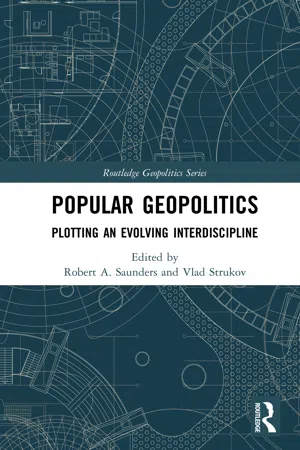
This book brings together scholars from across a variety of academic disciplines to assess the current state of the subfield of popular geopolitics. It provides an archaeology of the field, maps the flows of various frameworks of analysis into (and out of) popular geopolitics, and charts a course forward for the discipline. It explores the real-world implications of popular culture, with a particular focus on the evolving interdisciplinary nature of popular geopolitics alongside interrelated disciplines including media, cultural, and gender studies.
eBook - ePub
Popular Geopolitics
Plotting an Evolving Interdiscipline
- 256 pages
- English
- ePUB (mobile friendly)
- Available on iOS & Android
eBook - ePub
Popular Geopolitics
Plotting an Evolving Interdiscipline
PART I
Mapping the (inter)discipline of popular geopolitics
1 The origins and evolution of popular geopolitics
An interview with Jo Sharp and Klaus Dodds
Jason Dittmer
Introduction
When I was a PhD student (1999–2003) studying newspaper representations of Central and Eastern Europe during NATO and EU expansion, Klaus Dodds’s and Jo Sharp’s work was central to the way in which I came to position my work within wider literatures. More importantly, however, when I subsequently decided to shift from ‘legitimate’ news media to the decidedly more vulgar study of superheroes and their imbrication in geopolitical discourse, it was their critical opening into the worlds of popular culture that gave me the courage to push the boundaries of what was acceptable to study within the field of critical geopolitics. Both had paved the way for my work, Dodds with his analyses of political cartoons and James Bond films, and Sharp with her work looking at the treatment of Russia (as a mirror for American identity) in Reader’s Digest magazine. I think it is safe to say that, without these two scholars, there would either be no field of popular geopolitics or it would have taken a much different form at a much later date.
Indeed, one of the themes of the interview we had in summer 2015 is the highly contingent nature of events. I was especially interested to discover the particular collision of intellectual currents, social networks, and personal circumstances that brought about their unique formulations of popular geopolitics. A paradox can be identified in their responses to this question. First, they both acknowledge the interdisciplinary nature of the influences, from Edward Said to Michael Shapiro to Antonio Gramsci. Further, it is their wide-ranging interests in specific geographic regions—most obviously the Soviet Union (Sharp) and the South Atlantic and Antarctica (Dodds)—that fuelled their focus on popular culture and its relation to geopolitics. Nevertheless, it is the ‘small world’ nature of the discipline of geography—specifically the poststructuralist branch of political geography from which critical geopolitics emerged in the 1990s—that enabled popular geopolitics to take hold and become a project in its own right. The key authors of critical geopolitics were young contemporaries of one another – inviting one another to participate in panels, special issues, and other academic projects. This fertile environment enabled popular geopolitics to territorialise as a field and yet, that field has sometimes been better at reiterating these two luminaries’ claims than at advancing their concepts or theories. In fact, my own early work on nationalist superheroes is susceptible to this critique, largely replicating elements of both Klaus’s and Jo’s work. From Klaus I took the emphasis on the visual shorthand of comics and cartoons, and from Jo I took an interest in serialised narratives that underpin ultimately conservative geopolitical visions of the world. In the intervening years, I moved from the U.S. to London, and subsequently became good friends with both Klaus and Jo, which is likely apparent in the tone of the interview. In fact, when I first moved to London and was waiting for my furniture to arrive on a slow boat from New York City, I slept on my bedroom floor with only a pillow and duvet borrowed from Klaus to cushion me. Geography can indeed be a ‘small world’.
Until recently, I think it is safe to say that popular geopolitics remained insulated from some of the broader research currents in related fields, such as cultural studies (in fact, this was the driving force behind the speakers’ series that germinated the volume you hold in your hands). Nevertheless, the field is now in a period of rapid change, with a new generation of young scholars taking an interest and importing their own interdisciplinary concepts and intellectual inspirations. It is for this reason that I wanted to ensure that the early history of the field was documented, as it has an historical and geographical context that is crucial to understanding the conceptual development of the field. As Jo Sharp notes below, however, the future is not beholden to the past, and that is a good thing.
The following has been edited and abridged, with references inserted where appropriate.
Jason: Thank you very much for agreeing to do this. As the two people perhaps most foundational to popular geopolitics in geography, I was wondering if you both might describe the landscape of critical geopolitics1 when you came to it. Klaus, why don’t you go first?
Klaus: Thank you for inviting me. My first exposure to something that might be called critical geopolitics came entirely by accident. That was when I alighted upon an article published by Simon Dalby, I think in 1989 or 1990, that talked about geopolitics in ways that struck me as rather interesting, but at the same time reminded me of something by Gearóid Ó Tuathail three or four years earlier, which I had perhaps not taken as much notice of as I should have, on the language and nature of US-Salvadoran foreign relations2 —I can’t remember the title (presumably Ó Tuathail 1986). In both cases, I came away with a sense in which geopolitics could be something rather different than what I had been taught as an undergraduate, which had been a fairly conventional diet of the Great Men associated with geopolitics, and a straightforward periodisation of how ideas came and went, but one which was not informed by social theory. So, I was excited by the work of Simon Dalby and Gearóid Ó Tuathail, both of whom were interested in discourse and language and were also reasonably new to academia. You could associate with them—these were people who represented an entirely different generation of political geographers distinct from Peter Taylor, or John Agnew, or whomever.
Jason: How about you, Jo?
Jo: Well, critical geopolitics was quite new, because I came to it in 1990, I suppose, so the words had not long been used. Obviously, there was Gearóid Ó Tuathail and John Agnew’s first piece (Ó Tuathail and Agnew 1992). But the piece that first captured my imagination was Simon Dalby’s work and his book Creating the Second Cold War (Dalby 1990), 3 which I found fabulous and really brought a lot of things into focus. I didn’t really come to geopolitics as such. Well, I came to it in a sort of roundabout way because I didn’t have any intention of studying critical geopolitics. I think the specific institutions that I moved through have been quite instrumental in the ways that I came across and engaged with particular academic approaches. So, I had come to Syracuse because I wanted to work with John Agnew, not because of the critical geopolitics article, but because of his book Place and Politics (Agnew 1987), which I had used for my undergraduate dissertation to look at identity in the Shetland Islands. I had then done a course with the late Graham Smith on—well it started off at the beginning of the year as the Geography of the Soviet Union and by the end of the year it was the Geography of Russia. It was a fabulous time to be doing that course. It was a course that looked at the changing geographies of the Soviet Union and how that drove the end of the Cold War; it wasn’t America winning, or any of these simplistic arguments, but that it had a very different society, particularly in the ethnic fringes. Nationalism drove the end of the Cold War. I found that argument very persuasive and very interesting; I wondered what it would be like to combine some of his ideas and some of John Agnew’s ideas, but look at Russian nationalism as dominant rather than marginal. So that was the plan; very old-school. Two things happened which then brought me to critical geopolitics. I hope you weren’t expecting any brief answers [laughter].
Jason: Never.
Jo: So, the first was that I had to take courses since I was doing my Master’s and PhD in the United States, so I did everything I could on Russia and the Soviet Union. So that took me out of geography and into political science, and I couldn’t understand why the person teaching the course didn’t use Graham’s explanation of what happened. So, he was in there saying—it was basically Sovietology, the idea that you could understand change in the Soviet Union by looking at where people were standing in funerals, and who was carrying the coffin, and these sorts of things. And I said, ‘No, no!’ It was in no way an arrogant interjection because I was just saying ‘I’ve come across this other guy’s ideas which are so much better!’ [laughter] And I just couldn’t convince the professor that this was a better explanation. This was the first time that I think I had really been hit by the idea that there were very different explanations for something. I perceived that what he had was a very old-fashioned, simplistic view; I had been exposed to a much more nuanced political-cultural-geographical explanation of what was going on. We were just … like ships in the night. At the same time as that was happening, I was exposed to postmodernism for the first time. So, I took a course with Jim Duncan that was very interdisciplinary—he ran it with someone from landscape architecture—and I had never come across anything like this before. It was brilliantly taught, and also it introduced me to the idea of discourse, the politics of language, the politics of knowledge, all these sorts of things. So, at the same time that I was seeing this happen in the course about Russia, I was getting the conceptual grounding in the postmodernism course. So those two things really came together in my head and lead me to a Master’s dissertation that was the beginnings of Reader’s Digest as an example of this, drawing together those two experiences. Then I came across the early incarnations of critical geopolitics and thought, ‘Oh yes, that is what I am trying to do.’ So, it wasn’t so much that I read critical geopolitics and thought ‘this is what I want to do’, but that I—and I suppose others came to it the same way—was experiencing competing narratives of a major historical world event at the same time as I was exposed to poststructuralism. And I wonder, also, whether there is any significance to the fact that some of the earliest proponents of critical geopolitics were from the fringes of Britain, but were at the time of working in North America. So, you have Simon and Gearóid from Ireland, John Agnew from Cumbria (which is almost its own country in Britain), myself from Scotland—Klaus is the outlier coming from the heart of Empire—but I wonder if we were much more conscious of that politics of language—of the use of ‘British’ versus ‘Scottish’, ‘Irish’, a sense of ‘Northern Englishness’4 —and that poststructuralist approach gave us an intellectual language for something we’ve been thinking about anyway. I’ve never spoken to the others about this; I suspect it isn’t coincidence.
Jason: It would be interesting, sometime when we are all sitting down for a beer, to float that idea. I think I’ve heard Simon say something similar about himself and Gearóid.
Jo: I suppose there is the introduction to Critical Geopolitics (Ó Tuathail 1996); Gearóid grounds himself in the introduction when he starts off with a bit of Irish history, saying, ‘this is where I am coming from’.
Jason: In your story, you say you started Condensing the Cold War (Sharp 2000) by combining these two courses, but what actually made you decide to do what we would now call Popular Geopolitics? That was a form of discourse that hadn’t been studied and which was in fact excluded from a lot of the early critical geopolitics.
Jo: I think it was because I didn’t come to it as critical geopolitics. I came into it wanting to study Russia; I had been doing this course that made me realise there was more than one narrative going on. I had some of the language from the postmodern/poststructural course to explain that. Edward Said’s Orientalism also influenced me (Said 1978).5 I thoug...
Table of contents
- Cover
- Half-Title
- Series
- Title
- Copyright
- Dedication
- Contents
- List of figures
- List of tables
- Foreword An odd couple? Popular culture and geopolitics
- Acknowledgements
- Introduction
- PART I Mapping the (inter)discipline of popular geopolitics
- PART 2 Popular geopolitics goes global and looks into the future
- Conclusion
- List of contributors
- Index
Trusted by 375,005 students
Access to over 1.5 million titles for a fair monthly price.
Study more efficiently using our study tools.
Frequently asked questions
Yes, you can cancel anytime from the Subscription tab in your account settings on the Perlego website. Your subscription will stay active until the end of your current billing period. Learn how to cancel your subscription
No, books cannot be downloaded as external files, such as PDFs, for use outside of Perlego. However, you can download books within the Perlego app for offline reading on mobile or tablet. Learn how to download books offline
Perlego offers two plans: Essential and Complete
- Essential is ideal for learners and professionals who enjoy exploring a wide range of subjects. Access the Essential Library with 800,000+ trusted titles and best-sellers across business, personal growth, and the humanities. Includes unlimited reading time and Standard Read Aloud voice.
- Complete: Perfect for advanced learners and researchers needing full, unrestricted access. Unlock 1.5M+ books across hundreds of subjects, including academic and specialized titles. The Complete Plan also includes advanced features like Premium Read Aloud and Research Assistant.
We are an online textbook subscription service, where you can get access to an entire online library for less than the price of a single book per month. With over 1.5 million books across 990+ topics, we’ve got you covered! Learn about our mission
Look out for the read-aloud symbol on your next book to see if you can listen to it. The read-aloud tool reads text aloud for you, highlighting the text as it is being read. You can pause it, speed it up and slow it down. Learn more about Read Aloud
Yes! You can use the Perlego app on both iOS and Android devices to read anytime, anywhere — even offline. Perfect for commutes or when you’re on the go.
Please note we cannot support devices running on iOS 13 and Android 7 or earlier. Learn more about using the app
Please note we cannot support devices running on iOS 13 and Android 7 or earlier. Learn more about using the app
Yes, you can access Popular Geopolitics by Robert A. Saunders, Vlad Strukov, Robert A. Saunders,Vlad Strukov in PDF and/or ePUB format, as well as other popular books in Physical Sciences & Geography. We have over 1.5 million books available in our catalogue for you to explore.