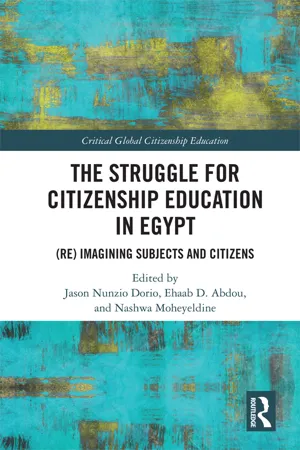
This book offers nuanced analyses of the narratives, spaces, and forms of citizenship education prior to and during the aftermath of the January 2011 Egyptian Revolution. To explore the dynamics shaping citizenship education during this significant socio-political transition, this edited volume brings together established and emerging researchers from multiple disciplines, perspectives, and geographic locations. By highlighting the impacts of recent transitions on perceptions of citizenship and citizenship education in Egypt, this volume demonstrates that the critical developments in Egypt's schools, universities, and other non-formal and informal spaces of education, have not been isolated from local, national, and global debates around meanings of citizenship.
eBook - ePub
The Struggle for Citizenship Education in Egypt
(Re)Imagining Subjects and Citizens
- 272 pages
- English
- ePUB (mobile friendly)
- Available on iOS & Android
eBook - ePub
The Struggle for Citizenship Education in Egypt
(Re)Imagining Subjects and Citizens
About this book
Information
Part I
Pre-revolution
Spaces of Citizenship Reproduction and Resistance
1 Envisioning Hope in Post-revolutionary Egypt Through Critical Citizenship Education
In the volatile socio-political aftermath of the January 25th Revolution, what it means to be an Egyptian citizen and the role of the Egyptian state is still in flux. Although the 2014 Constitution mandates that the new Egyptian state be formed as a “democratic republic based on citizenship and the rule of law,” the extent, practices, and implementation of citizenship are yet to be determined.1 As the Egyptian state is currently undergoing a “process of redefining itself” (Brown, Shahin, & Stacher, 2013, p. 224), observers describe the transition as an “identity crisis” within Egyptian society or what Meijer and Butenschøn (2017) label as a crisis of citizenship.2 On the one end of the contentious citizenship spectrum in Egypt, there is a revolutionary citizenship, which is grounded in revolutionary ideals of “bread, freedom, social justice and dignity” generally demanding increases in political participation, critiquing corruption, calling for the need to address multifaceted injustices, the right to dissent without fear, opening up of new spaces of opposition and participation, and an ethics of care for country and fellow humans toward encouraging imaginative and critical citizens. On the other end of the spectrum, there is reactionary, counter-revolutionary citizenship, championed by the need for security and stability, which has clamped down on freedoms of speech and assembly, grounded in macro-economic neoliberal restructuring and development promoting grand national projects, wrapped in Egyptian nationalism and initiatives, such as Tahya Misr3 that call for loyal and obedient subjects. Given the new dynamics between citizens and the state, it is imperative that empirical and theoretical research explores and makes sense of the contemporary socio-political undercurrents, particularly with regard to education.
Weaving socio-political events and educational developments associated with January 2011 Egyptian Revolution and its aftermath to concepts of citizenship and citizenship education, the purpose of this chapter is to provide a theoretical and contemporary contextual overview, framing issues and themes covered throughout this volume. Grounded in critical and postcolonial theories, we challenge both the theories of idealized citizenship projected by Western scholars and normative nationalist constructions of citizenship promoted by state, religion, or kinship. Alternatively, we call for reimagining citizenship and citizenship education in North Africa and Southwest Asia, where people continue to show agency in creating spaces of resistance in formal and non-formal settings, despite systemic constraints on active citizenship. Drawing on Bayat’s (2013) “art of presence,” we attempt to reveal the often hidden spaces, processes, and methods of citizenship formation and learning that have the possibility of social change. We propose the Revolution and recent socio-political events act as a platform for transformative citizenship education and conclude with a survey of challenges and recent policy developments that have implications for the future of citizenship education in Egypt.
The Dialectics of Subject and Citizen: Problems Conceptualizing Citizenship
Normative constructions of citizenship focus on the navigation of institutionally and socially agreed-upon rights and responsibilities of citizens in a given national space, assuming common political knowledge. Knight Abowitz and Harnish (2006) explain, “citizenship, at least theoretically, confers membership, identity, values, and rights of participation and assumes a body of common political knowledge” (p. 653). For this volume we operationalize citizenship as interrelated elements of membership, rights, participation, and knowledge, which in turn are connected to power and a range of issues, struggles, and processes closely linked to and shaped by problematic relationships between citizens (and non-citizens) and the state (the social contract), and among citizens (and non-citizens) themselves.
When approaching citizenship in the North Africa and Southwest Asia region, there must be an understanding that overall normative assumptions and ideals of citizenship and citizenship education have largely been based upon experiences emanating from European and North American liberal democratic political contexts (Akar, 2017a; Kovalchuk & Rapoport, 2018; Robins, Cornwall, & von Lieres, 2008). Therefore, as Parolin (2009) argues, any analysis of “citizenship in the Arab world requires first a disentanglement from all those ideas, images and suggestions that have settled into the concept in the course of European political thought” (p. 25). Underlying the Western conceptualization of citizenship is a premise that complete citizenship can only exist in liberal democracies, where there is a strong identification among citizens with the polity, where the rule of law is pervasive, and equality and political mutual trust are commonplace. Moreover, complete citizenship is founded upon presumptions that kinship bonds have been eroded and citizens are free and autonomous.
We argue that existing forms of citizenship in Arabic-speaking countries do not conform to the idealized citizenship developed in and promoted by North American and European countries. Critical questions of ethics and validity should therefore be asked of research that attempts to utilize a particular cultural lens when examining social and political realities of another culture (Said, 1979/1994). Citizen–state and citizen–citizen (non-citizen) relations have developed and manifested differently in every country, employing varying degrees of exclusion and inclusion, and accordingly, deviate between contexts and polities (Robins et al., 2008). Therefore, glaring disparities exist between the perceived dominant narratives and national myths of citizenship and the everyday social, cultural, economic and political practices and realities of citizenship and democracy.
Consequently, frameworks for understanding citizenship that are grounded in critical and postcolonial theories (Eidoo et al., 2011) question normative approaches and assumptions of citizenship and citizenship education taking contextualized dimensions and the politics of everyday life into consideration. Robins et al. (2008) argue for an approach to researching citizenship “that begins not from normative convictions but from everyday experiences in particular social, cultural and historical contexts” (p. 1070). With regards to citizenship education, Akar (2017a) calls for an inside-out approach that “allows people from distinct cultural contexts to present their own understandings and experiences” and their own “conceptualizations of citizenship” (pp. 419–420). Therefore, a rethinking of citizenship and citizenship education within North Africa and Southwest Asia is needed.
Similar to several other contexts across the region, counter-revolutionary policies and authoritarian rule in Egypt continue to restrict organized and legal opposition—expressing little tolerance for sustained dissenting visions of citizenship—demanding a greater reliance on alternative models of social and political change. Accordingly, an important aspect of the book is to explore how ordinary youth and educators are transforming various educational spaces and subverting authoritarian education and rule, connecting education with social and political change. Asef Bayat (2013) explains, in the absence of “free activities” and in light of the repression against citizens that are deemed “political” and engaging in contentious politics, citizens are forced “to exit the [formal] political scene at least temporarily, or to go underground” (p. 11). Consequently, it is imperative to not only examine citizens’ participation within formal political realms, or the relations between how active citizens, social movements, and education might openly defy authoritarian rule, but to also explore the everyday acts of citizenship (Isin & Nielsen, 2008). This is the dynamic citizenship we witness in various contexts in the region that is conditioned by the changing dialectic between agency and systemic constraints on active citizenship. Therefore, we attempt to make visible daily citizen acts that go “under the radar,” taking into consideration the contextualized complexities of Egypt and the broader region. This leads us to Bayat’s (2013) theory of social non-movements, described as “a collection of actions of noncollective actors that embody shared practices whose fragmented but similar activities trigger much social change” (p. 15). These non-movements can be seen as a struggle for citizenship that “interlocks activism with the practice of everyday life” (Bayat, 2013, p. 12), and despite state opposition, when non-movements make their gains and when gains are formally institutionalized, those social actors engaged in acts of citizenship transition from subject into citizen.
Bayat further argues that citizens in the region
cannot spearhead a democratic shift unless they master the art of presence—the skill and stamina to assert collective will in spite of all odds by circumventing constraints, utilizing what is possible, and discovering new space within which to make themselves heard, seen, felt, and realized.
(2013, p. 313)
The strategic benefits of active citizenship by ordinary citizens within everyday spaces are much more challenging for authoritarian regimes to “suppress” and “silence” compared with “organized movements” or “collective resistance” (p. 313). The significance of this lens of social and political change is that it allows for an uncovering of citizen agency and the “art of presence” within immediate domains (such as schools, classrooms, neighborhoods, and social media), countering misconceptions that Egypt and states in the region are somehow an abyss of active citizenship.
Ideally, citizens can be viewed as free, autonomous persons, being active and equal in civil and political life, whereas subjects are “persons subjected to ruler’s will,” “not autonomous partners engaging in civil life,” and thus, are simply “part of the landscape of the ruler’s estate” (Tétreault, 2000, p. 72). Freire (1974/2008) explains that the role of humans in and with the world is neither passive nor limited to biological forces. Humans possess a “creative dimension” where they “can intervene in reality in order to change it.” Thus, citizenship is an “acquired experience, creating and recreating,” and an “integration with one’s context,” which requires relating to and reading the world, which are necessary in “responding to its challenges” (Freire, 1974/2008, p. 4). Freire proposes an important dialectic between integrated individuals—or “citizens”—and adaptive individuals—or “subjects.” For Freire, in order to survive, an adaptive subject, incapable of changing reality, is forced to adapt to the oppressive environment through a submerged reality and a passive existence—a dehumanizing reality. In contrast, citizens, as integrated persons, “attempt to overcome the factors, which make them accommodate or adjust, in a struggle—constantly threatened by oppression—to attain their full humanity” (Freire, 1974/2008, p. 4). As the closed society containing subjects who are submerged in reality breaks open—as would clearly be the case with momentous political events and upheavals—citizens emerge closer to their full humanity. Freire (1974/2008) elaborates, “No longer mere spectators, [citizens] uncross their arms, renounce expectancy, and demand intervention. No longer satisfied to watch, they want to participate. This participation disturbs the privileged elite, who band together in self-defense” (p. 11).
There is a notable transitional pathway from the subject to the citizen. Therefore, citizenship, “represents a transition from the person/subject, the subservient, acquiescent individual, to the participating individual who participates in the making of social life in all its manifestations” (Manna, 1995, p. 91). In relation to the state, the subject is passive, obedient, and loyal; the subject’s reality is submerged in the structures of power taught, ascribed, and forced onto the subject by the state. Dialectically, at its most evolved and engaged level, a citizen would have thoughtful and reflective agency in life. That type of citizen would create spaces in which citizens actively participate, act through lenses of social responsibility and justice, and often strive for self, community, and state transformation. Beyond formal recognition by the state, the acts of citizenship entail the creation of justice-seeking spaces grounded in the symbiotic relation between knowledge (critical awareness of social, economic, and political conditions) and action (behavior that attempts to transform self and society)—that is, praxis (Freire, 1970/2007). The perpetual struggle for citizenship ascends from the essential blend of knowledge and action needed to supplant subjecthood with citizenship.
In the case of modern Egypt, successive regimes—under the banner of security and through monopolizing both legitimate and illegitimate power—significantly controlled the party system, civil society, and the government. This created multiple forms of exclusion for many Egyptians, which manifested into a culture of fear and a submerged citizenship—equating to subjecthood for many Egyptians and resulting in what Abdelhalim (2015) refers to as a “citizenship of subjugation” (p. 61). Nonetheless, especially during the last decade of Mubarak’s rule, encouraged by access to education and innovative forms of knowledge, new influential oppositional groups of citizens emerged out of perpetual exclusion. These groups challenged their subjecthood, power asymmetries, and socio-economic inequalities by reimaging spaces and forms of citizenship. The internal and external contention surr...
Table of contents
- Cover
- Half Title
- Series
- Title
- Copyright
- Dedication
- Contents
- About the Contributors
- Foreword
- Acknowledgments
- Introduction
- Part I Pre-revolution: Spaces of Citizenship Reproduction and Resistance
- Part II Post-revolution: Citizenship Narratives and Spaces in Schools and Universities
- Part III Post-revolution: Non-formal and Informal Spaces of Citizenship Education
- Index
Trusted by 375,005 students
Access to over 1.5 million titles for a fair monthly price.
Study more efficiently using our study tools.
Frequently asked questions
Yes, you can cancel anytime from the Subscription tab in your account settings on the Perlego website. Your subscription will stay active until the end of your current billing period. Learn how to cancel your subscription
No, books cannot be downloaded as external files, such as PDFs, for use outside of Perlego. However, you can download books within the Perlego app for offline reading on mobile or tablet. Learn how to download books offline
Perlego offers two plans: Essential and Complete
- Essential is ideal for learners and professionals who enjoy exploring a wide range of subjects. Access the Essential Library with 800,000+ trusted titles and best-sellers across business, personal growth, and the humanities. Includes unlimited reading time and Standard Read Aloud voice.
- Complete: Perfect for advanced learners and researchers needing full, unrestricted access. Unlock 1.5M+ books across hundreds of subjects, including academic and specialized titles. The Complete Plan also includes advanced features like Premium Read Aloud and Research Assistant.
We are an online textbook subscription service, where you can get access to an entire online library for less than the price of a single book per month. With over 1.5 million books across 990+ topics, we’ve got you covered! Learn about our mission
Look out for the read-aloud symbol on your next book to see if you can listen to it. The read-aloud tool reads text aloud for you, highlighting the text as it is being read. You can pause it, speed it up and slow it down. Learn more about Read Aloud
Yes! You can use the Perlego app on both iOS and Android devices to read anytime, anywhere — even offline. Perfect for commutes or when you’re on the go.
Please note we cannot support devices running on iOS 13 and Android 7 or earlier. Learn more about using the app
Please note we cannot support devices running on iOS 13 and Android 7 or earlier. Learn more about using the app
Yes, you can access The Struggle for Citizenship Education in Egypt by Jason Dorio,Ehaab Abdou,Nashwa Moheyeldine,Jason Nunzio Dorio,Ehaab D. Abdou in PDF and/or ePUB format, as well as other popular books in Education & Comparative Education. We have over 1.5 million books available in our catalogue for you to explore.