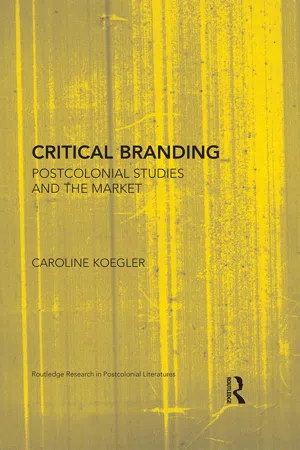
Critical Branding: Postcolonial Studies and the Market provides an original answer to what Sarah Brouillette has called postcolonial studies' 'longstanding materialist challenge', illuminating the relationship between what is often broadly called 'the market' and the practice and positionality of postcolonial critics and their field, postcolonial studies. After much attention has been paid to the status of literary writers in markets, and after a range of sweeping attacks against the field for its alleged 'complicity' with capitalism, this study takes the crucial step of systematically exploring the engagement of postcolonial critics in market practice, substituting an automatic sense of accusation (Dirlik), dread (Westall; Brouillette), rage (Young; Williams), or irony (Huggan; Ponzanesi; Mendes) with a nuanced exploration and critique. Bringing together concepts from business studies, postcolonial studies, queer studies, and literary and cultural studies in an informed way, Critical Branding sets on a thorough theoretical footing a range of categories that, while increasingly current, remain surprisingly obscure, such as the market, market forces, and branding. It also provides new concepts with which to think the market as a dimension of practice, such as brand narratives, brand acts, and brand politics. At a time when the marketisation of the university system and the resulting effects on academics are much on our minds, Critical Branding is a timely contribution that explores how diversely postcolonial studies and the market intersect, for better and for worse.
- 238 pages
- English
- ePUB (mobile friendly)
- Available on iOS & Android
eBook - ePub
About this book
Information
Part I
Consolidating Postcolonialism
1 Reading the Longstanding Materialist Challenge
As Sarah Brouillette plausibly indicates with her formulation “longstanding materialist challenge” (2011, 19), the history of postcolonial discourse incorporates a struggle with the question of what status to give economy-related issues. The occasionally ferocious debates on the relationship between postcolonialism and Marxism, and postcolonialism and poststructuralism, encapsulate this struggle. It is a struggle that can be thought of as fundamental to the very ethical and political foundations of postcolonialism: Does it suffice to engage with cultural (re-)incarnations of colonialisms and imperialisms – and related acts of resistance – within a generalised framework of anti-capitalist, leftist intellectualism? Or does postcolonialism need a more systematic and more detailed engagement with socioeconomic practices, forces, and events in order to fulfil its promise of a liberationist discourse? Does the (perceived) lack of such investigations perhaps even point to a complicity between postcolonialism and capitalism, as Arif Dirlik has prominently suggested (1998; 1992)?
As Anna Bernard, Ziad Elmarsafy, and Stuart Murray have recently indicated, the rift between materialism and poststructuralism may currently no longer be as pronounced as it once was (2016, 4) and, as I said in the introduction, it is not least Graham Huggan’s and other scholars’ innovative materialist assessments of the crossovers of literary writing and the market that have contributed to this ongoing process of a recalibration of the material in postcolonial studies. We see, then, that a new sense of historicity has entered the debate.
Taking up this sense of historicity, i.e. the sense that the Marxist-poststructuralist rift in postcolonial studies is one that has changed shape over time, one purpose of this chapter is to look back: to critically (and, of necessity, selectively) retrace cornerstones of postcolonial studies’ longstanding materialist challenge. Specifically, my goal is to discuss how the material (e.g. ‘capitalism’, ‘economy’, ‘the market’, etc.) has been imagined meta-discursively and how these imaginations have facilitated work on identity narratives and, ultimately, brand narratives of postcolonialism. What role has the charge of ‘complicity in capitalism’ played in ideological battles over the legitimacy of postcolonial critique, battles frequently waged between Marxist and poststructuralist critics? What mechanisms of inclusion and exclusion have operated through these distinctions, either excluding (alleged) Marxists or (alleged) poststructuralists from the sphere of worthwhile and politically relevant postcolonial critique? Is it possible that the field of postcolonial studies has entered, after decades of accusation, embarrassment, and continuing discomfort, a phase in which ‘complicit in capitalism’ is gradually becoming an acceptable positionality? How does this positionality inform perceptions of postcolonial studies’ ethical and political legitimacy? I will consider these questions in the following with reference to five overall themes: identity, imagination, integrity, complicity, and post-complicity (“Complicity 2.0”).
The Question of Identity
The longstanding materialist challenge has not only been troublesome, it has also provided a source for identity narratives variously situating postcolonial studies as ‘complicit with’ capitalism, ‘wrestling with’ the economic, or as ‘different from’ Marxism. In this section, I will engage with the following questions: How is the ethico-political discourse-identity of postcolonialism policed and consolidated where economy is concerned? How, in turn, do economy-related debates provide distinctive markers for the imagined community of postcolonial critics and postcolonial discourse? How is symbolic capital accumulated through these imaginings and negotiations?
For initial consideration, it is helpful to revisit a canonical debate surrounding Aijaz Ahmad, Arif Dirlik, Fredric Jameson, and postcolonialism. In Postmodernism, or, the Cultural Logic of Late Capitalism (1991), Jameson sets out to intimately interlace postmodernism and capitalism. With a sense of inevitability, he declares that there can be no ‘outside’ of commodification once postmodernism is the state of the art and society. There is no capacity for political resistance because means of “distantiation”, rooted in the subject’s authenticity and capacity for self-reflection, no longer exist (Jameson 1991, 48–49). Jameson thus paints a sober image of postmodern subjectivity, an image that will become central also for his much-debated essay “Third-World Literature in the Era of Multinational Capitalism” (1986). Here, Jameson outlines his perception of the relationship between ‘First World’ postmodernism and the ‘not-yet’ postmodern culture of the ‘Third World’. While the former entails a separation of the private and the political (Jameson 1986, 69), the latter signifies formerly colonised cultures where the private and the political still form a symbiosis. This symbiosis may initially have been a result of colonial epistemic violence, but, as it is materially grounded (and grounding), it is also empowering and epistemologically superior. In characterising this relationship, Jameson takes his call from Hegel’s Master-Slave-Dialectic and derives from it a mutual dependence of ‘Third World culture’ and ‘First World culture’ in their need for reciprocal recognition. In what might be called an attempt at ‘saving’ US epistemology (which he suggests is “crippl[ed]” [76]), Jameson promotes an opening-up of US canons to ‘Third World cultural production’. This will potentially facilitate “a new view of ourselves, from the outside” (68) and thus a more rounded epistemology.
As is well known, Jameson’s argument has been brusquely rejected for relying on an unduly generalising and patronising argument. Paradigmatic for these criticisms has been Ahmad’s essay on “Jameson’s Rhetoric of Otherness”, first published by Social Text (1986) and later again in In Theory (1992). Ahmad takes offence at a variety of points, such as the manner in which Jameson subsumes various different countries, cultures, and peoples under the label ‘Third World’; that Jameson’s representation of these spheres is reminiscent of colonial grand narratives of ‘development’ vs. ‘underdevelopment’ and ‘knowledge’ vs. ‘experience’; and that Jameson constructs all of ‘Third World Literature’ as having one ultimate referent: the (neo-)imperialism of the ‘First World’.1 Succinctly, Ahmad concludes with the well-known statement: “Jameson’s is not a First World text; mine is not a Third World text. We are not each other’s civilizational Others” ([1992] 2008, 122).
The reception of both Jameson’s and Ahmad’s arguments reveals crucial insights about how postcolonialism has negotiated the notions of Marxism and economy at its fuzzy edges. Where Marxism is concerned, the refutation of Jameson’s argument has had the function of a symbolic-capital-bestowing opportunity for postcolonial critics, though this is not a straightforward matter. For Imre Szeman, Jameson’s essay has been promoted as a negative example of “what not to do” (2001, 803; emphasis in the original). Indeed, this rejection of Jameson seems to have attained the status of an identity narrative, serving as “a convenient bibliographic marker of those kinds of theories of third world literature that everyone now agrees are limiting and reductive” (ibid.). Szeman also underlines the significant fact that Jameson’s essay was, in the 1980s, “one of the first responses to postcolonial literary studies from a major critic outside the field” (804). As such, it allowed postcolonial critics to highlight the pervading relevance of their own criticisms, as Jameson’s ‘case’ showed that simplistic and stereotyping views of “North-South relations” prevailed even in “supposedly critical political theories” – and Szeman clarifies: “like Marxism” (ibid.). Such conclusions were then instrumentalised and arranged to directly feed into identity narratives of postcolonial studies as (a) more sophisticated than Marxism, and as therefore (b) rightfully non-Marxist or even anti-Marxist. Ultimately, as Szeman argues, this interpretation was a “self-definitional opportunity for postcolonial studies” and allowed postcolonial critics to legitimise the desired shift away from Marxism towards deconstruction, the latter represented by critics such as Gayatri Chakravorty Spivak and Homi Bhabha (ibid.).
Paired with the “self-definitional opportunity” (2001, 804) that Szeman observes, the rejection of Jameson bestowed an opportunity for symbolic capital accumulation and – as I will suggest here preliminarily – a favourable branding of the field of postcolonial studies. First, according to Neil Lazarus (2011), the rejection of Jameson was facilitated by a collective sense of outrage coming from postcolonial critics, students, and others. Such outrage enabled, and was in turn symptomatic of, a segregating discursive practice that was based not on “contestation or disputation of Jameson’s arguments” but on “a blanket and largely a priori dismissal of them” (Lazarus 2011, 92). It happened with such ferocity (“almost overnight”), and was of such a scale, that Lazarus elevates it to the status of collective memory: It will be known to “[a]nyone teaching postcolonial studies in the Anglo-American academy during the late 1980s and 1990s” (ibid.). Indeed, Lazarus considers the debate as so well-known that he poses a riddle, convinced that most of his readers “will know which passage I am referring to, even before I cite it”. It is, of course, Jameson’s hypothesis that “[a]ll third-world texts are necessarily […] national allegories” (ibid.).
Lazarus observes in postcolonial critics and students not only a collective outrage paired with superficial dismissal, but describes also their claim to moral superiority: “[A]lmost overnight, ‘Jameson’ seemed to have become a dirty word to my students”; and “[i]t was as though, for postcolonialists, Jameson had suddenly fallen foul of the standards not only of intellectual credibility but also of decency” (2011, 92; emphasis in the original). In other words, Jameson’s dismissal was cast as a moral stance. From Lazarus’s description we understand that Jameson’s conceptualisation might not only have been illogical or disputable, but indeed unethical – a response that delegitimised Jameson not only as an intellectual but also as a person. Jameson’s essay was not treated as a fleeting faux pas, but apparently revealed a fundamental flaw inherent in Jameson’s scholarship, and in the whole of Marxist scholarship by extrapolation. Jameson – and Marxism – had been branded.
In unfavourably branding, and then dismissing, not only Jameson but also Marxism, the following chain of thought was established:
- Jameson’s binarisation of ‘First World’ and ‘Third World’ formations bespeaks a cultural essentialism.
- This cultural essentialism is readable as a latter-day Orientalism.
- Jameson’s methodology is Marxist.
- Therefore, Marxism is culturally essentialist and Orientalist.
(Lazarus 2011, 99)
Lazarus’s systematisation characterises the response of postcolonial critics to Jameson’s essay, and Marxism by extension, as an essentialising procedure. Lazarus also hints at a paradox: Essentialism was that to which critics objected in Jameson’s essay, yet in their “a priori dismissal” (2011, 92) of Jameson and Marxism, essentialism, even othering, was replicated. While the question remains to what extent Lazarus’s own representation of the events is as representative as he implies, I suggest that the tendency to essentialise and issue large-scale disavowals can at least occasionally be observed in postcolonial discourse where discourse boundaries are negotiated. In fact, this epistemological procedure remains, unfortunately perhaps, one of the primary social mechanisms in identity and community building processes both inside and outside of academia.
As will emerge in Section 3 and again in Chapter 7, the approach that Lazarus observes here, which seeks to secure a moral high ground and thereby to accumulate symbolic capital for postcolonial critics, remains a popular strategy where the boundaries of postcolonial discourse are policed with regard to both Marxism and economy. Lazarus’s systematisation of the response to Jameson illustrates the attempted self-elevation of postcolonial critics over ‘Jameson-Marxism’, i.e. the step-by-step absorption of their symbolic capital by rejecting them from a morally superior position. We see the construction of a brand narrative that brands Jameson-Marxism as essentialist and, by implication, postcolonial studies as ethical, sophisticated, nuanced, and self-aware. We see how ‘postcolonial studies’ absorbs the symbolic capital previously squeezed out of ‘Jameson’ and ‘Marxism’.
The rejection of Jameson had its correspondence in the appropriation of Ahmad’s (1992) critique of Jameson, i.e. in its reduction to a criticism of Jameson’s national allegory hypothesis. Amongst other things, Ahmad’s essay was misappropriated in that it was read as dismissing Jameson for his Marxism; by contrast, Ahmad has insisted that his essay targeted Jameson for “not [being] rigorous enough in its Marxism” ([1992] 2008, 10; my emphasis). This reduction was an opportunistic incorporation of Ahmad’s argument into the brand narrative sketched above, in the sense that Ahmad’s symbolic capital as a ‘Third World’ critic could be fittingly enlisted by postcolonial critics to undermine Jameson. Ahmad’s challenge “We are not each other’s civilizational Others” ([1992] 2008, 122) seemed well in tune with the slogan ‘The Empire Writes Back’, which challenged the west’s hegemony in allocating roles on the world stage, to its ‘others’ in particular. Ahmad has called this appropriation of his argument “a matter of considerable personal irritation” (10). Yet Ahmad’s own identity politics in the essay somewhat depend on his embrace of a non-western standpoint, so that it is perhaps not surprising that it was valorised by postcolonial critics not as a Marxist contribution, but instead as a “‘Third-Worldist’ critique”, as Lazarus has suggested (2011, 101). I will come back to this question further below; suffice it to say here that the interpretation of Ahmad’s essay (and Ahmad’s discontent with this interpretation) can be understood as symptomatic of conflicting and at times counter-intuitive identity and brand politics engaged in by critics who attempt to commission each others’ narratives for their own political and politico-discursive goals.
The instrumentalisation of both Jameson’s and Ahmad’s works can be considered indicative of a widespread desire in postcolonial studies of the late 1980s and 1990s to situate Marxism outside of postcolonialism. These discursive events illustrate the central function of Marxism, and of economic issues more broadly, for identity narratives and brand narratives in which critics situate their own work and their field not only intellectually but also morally and ideologically. Lazarus’s own discussion of Jameson’s and Ahmad’s works can be included here: not without reason does he call his chapter on Jameson a “defence”.2 Clearly, Lazarus can be seen as utilising both Jameson’s and Ahmad’s works not for dismissing, but instead for resurrecting Marxism: for rebranding and thus revalorising Jameson-Marxism as significant for postcolonial studies. Indeed, to illustrate the need for a re-grounding of postcolonial studies in a materialist perspective is the pronounced goal of Lazarus’s The Postcolonial Unconscious (2011). In this vein, Lazarus’s revision of the Jameson debate seems to be based on the following considerations: if Jameson’s scholarship can be rebranded and revalorised, so perhaps can Marxism; if Ahmad’s critique of Jameson can be revealed to incorporate ‘Third-Worldism’ itself, and if the response of postcolonial critics to Jameson can be understood as essentialising, so perhaps can the charge of Jameson’s essentialism be mitigated and the damage to his and Marxism’s symbolic capital be repaired.
While Jameson was dismissed by postcolonial critics for his Marxism, Dirlik has criticised both Jameson and postcolonial studies as ‘too postmodern’. Dirlik thus makes the inverse criticism and this is perhaps not all too surprising. Jameson frequently presents the developments described in Postmodernism, or, the Cultural Logic of Late Capitalism (1991) as more or less inevitable rather than criticising them. This has been a red rag for many Marxist critics such as Dirlik, to the extent that Jameson (himself a pronounced Marxist) has been attacked for even rendering this description. Dirlik sees Jameson’s “Marxist theoretical stance” as having been “infiltrated, disturbed and reconfigured by postmodernism” (1998, 1). Yet, despite his frustration with Jameson’s study, Dirlik seems to have found at least some inspiration here, using Jameson’s notion of pervading commodification as a tool for his own critique: to criticise postcolonialism.3 For Dirlik, both postcolonialism and postmodernism “resonate with a contemporary Global Capitalism” (xi).
Dirlik first published his critique (“The Postcolonial Aura”) in 1994 when the consolidation of postcolonialism as a broadly non-Marxist and instead poststructuralist project was ongoing.4 In the 1998 extended version of his article – a monograph entitled The Postcolonial Aura – Dirlik writes again against the legitimacy of a discursive and culture-based rather than materialist approach:
The postcolonialist (and postmodernist) insistence on the world as a social construct, against a representation of the world that recognizes to it a reality beyond human will and cognition, expresses a voluntarism that is very much synchronous with contemporary capitalism (Disney professes a similar epistemology).
(2008, xi; my emphasis)
For Dirlik, the adherence to po...
Table of contents
- Cover
- Half Title
- Title Page
- Copyright Page
- Table of Contents
- List of Figures
- Acknowledgements
- Introduction
- PART I Consolidating Postcolonialism
- PART II Reworking the Market
- PART III Branding Postcolonialism
- A Conclusion in Five Brand Acts
- Bibliography
- Index
Trusted by 375,005 students
Access to over 1.5 million titles for a fair monthly price.
Study more efficiently using our study tools.
Frequently asked questions
Yes, you can cancel anytime from the Subscription tab in your account settings on the Perlego website. Your subscription will stay active until the end of your current billing period. Learn how to cancel your subscription
No, books cannot be downloaded as external files, such as PDFs, for use outside of Perlego. However, you can download books within the Perlego app for offline reading on mobile or tablet. Learn how to download books offline
Perlego offers two plans: Essential and Complete
- Essential is ideal for learners and professionals who enjoy exploring a wide range of subjects. Access the Essential Library with 800,000+ trusted titles and best-sellers across business, personal growth, and the humanities. Includes unlimited reading time and Standard Read Aloud voice.
- Complete: Perfect for advanced learners and researchers needing full, unrestricted access. Unlock 1.5M+ books across hundreds of subjects, including academic and specialized titles. The Complete Plan also includes advanced features like Premium Read Aloud and Research Assistant.
We are an online textbook subscription service, where you can get access to an entire online library for less than the price of a single book per month. With over 1.5 million books across 990+ topics, we’ve got you covered! Learn about our mission
Look out for the read-aloud symbol on your next book to see if you can listen to it. The read-aloud tool reads text aloud for you, highlighting the text as it is being read. You can pause it, speed it up and slow it down. Learn more about Read Aloud
Yes! You can use the Perlego app on both iOS and Android devices to read anytime, anywhere — even offline. Perfect for commutes or when you’re on the go.
Please note we cannot support devices running on iOS 13 and Android 7 or earlier. Learn more about using the app
Please note we cannot support devices running on iOS 13 and Android 7 or earlier. Learn more about using the app
Yes, you can access Critical Branding by Caroline Koegler in PDF and/or ePUB format, as well as other popular books in Literature & Literary Criticism. We have over 1.5 million books available in our catalogue for you to explore.