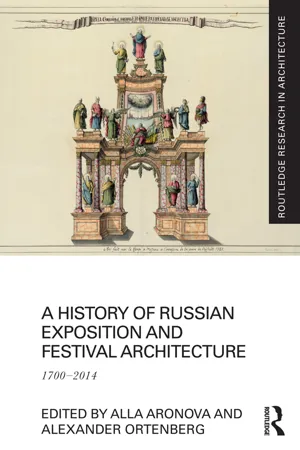
This collection of thirteen vignettes addresses several important episodes in the history of Russian temporary architecture and public art, from the royal festivals during the times of Peter the Great up to the recent venues including the Sochi Winter Olympics. The forms and the circumstances of their design were drastically different; however, the projects discussed in the book share a common feature: they have been instrumental in the construction of Russia's national identity, with its perception of the West - simultaneously, a foe and a paragon - looming high over this process. The book offers a history of multidirectional relationships between diplomacy, propaganda, and architecture.
eBook - ePub
A History of Russian Exposition and Festival Architecture
1700-2014
- 328 pages
- English
- ePUB (mobile friendly)
- Available on iOS & Android
eBook - ePub
A History of Russian Exposition and Festival Architecture
1700-2014
About this book
Information
Part I (Prologue)
1700–1775.
Westernization of Russia
1 Peter I
The celebration as an architectural object
The era of Peter the Great saw the emergence of high society celebrations in Russian culture. For the monarch and his inner circle, opulent celebrations found a place in almost every event of governmental or personal significance and became vital elements of the newfound social order. They functioned within three frameworks: secular, court, and sacred. With this frequency came an inevitable and serious sequence of refinements to the practices for directing and designing such events. In subsequent reigns, within and beyond the eighteenth century, it was the secular celebration that became an indispensable (if not the most important) regular occurrence in Russian societal life.
The focus of celebratory dramatic arts of the era was the construction of the new mythology of societal power. First, this was expressed in the motif of classically-inspired triumphs, well developed in European postRenaissance ceremonial practice.1 However, the Russian version interpreted the precedent differently. The monarch was not the lead victor, but rather part of his people, who were the collective victors. This governmental myth-making, which turned to the rich arsenal of diverse media in temporary architecture and theatrical representations, bore witness to the unwavering transformation of Russian culture into baroque self-definition.
The image of the devout tsar, garbed in full-length and rigid robes embroidered with precious stones and infrequently appearing in public, was replaced by the carpenter-tsar, running around in a Dutch coat on the streets of St. Petersburg without guards and unashamed to share a table with his sailors. The tsaritsa-mother transformed into the empress-lover, who commenced the post-banquet dancing. The daughters of the tsar no longer retired to the women’s spaces and convents; they learned to flirt, dance, and wear high-waisted dresses with décolleté and wigs. The magnates removed their high hats and fur coats, and donned waistcoats and lace. Facades of residential mansions, built according to “the rules of architecture” replaced urban street fences. Rustic mansions with their clusters of husbandry and agricultural structures gave way to straightened lanes, manicured bosquets, ornamental lawns, and sculptural ponds. Russians studied how to live in aristocratic spaces and, with each celebration, the set design played the role of a grandiose “spectacle,” which demonstrated a “transformed Russia.”
The perception of a celebration as a type of public “spectacle” with its own “dramaturgy” and “scenography” defines the approach to describing these events in this chapter. The first part identifies the main design solutions that emerged as the primary Petrine celebrations were established. The second part investigates the characteristic conventions of their scenography.
At the beginning of the eighteenth century, royal festivals split into three distinct categories. Most festivals until this point belonged to one of two categories: folkloric and state events. The folkloric festivals, rooted in pagan traditions, continued with no apparent change. However, the relationship between state celebrations and liturgical rites underwent a dramatic transformation; by the 1710s they were on two different tracks. Church events became more public and incorporated secular elements. Meanwhile, state festivals largely eliminated any religious references.
The new festival tradition could be traced to the Russian victory at the battle of Azov in 1696, whose celebration established a standard practice for military triumphal processions, the most important among the period’s popular festivals. The next crucial event in this process was the alignment of the Russian calendar to the European one. Both the day that marked the new year and the year that marked the beginning of time were shifted. Thus, the year 7208 no longer ended at the end of the summer, and the next year, 1700 AD, started in the winter, on January 1. The entirety of the clockwork was replaced. On this day, medieval Russia (Rus’) woke up as a modern nation (Rossiia). The celebration of the New Year established this new type of public festival. Triumphant military celebrations had dominated the domestic political discourse of the first two decades of the century, and the contents and the orchestration of the New Year’s festivities were also determined by these events.
Peter involved himself in event design and production much more actively than any other European post-Renaissance monarch, any of his Russian predecessors, or any of his successors.2 The importance that Peter accorded to the new festival tradition was epitomized in the publication of the official state calendar for the year 1725, which marked certain dates as nationwide celebrations with standardized scenography.3 The calendar established eighteen holidays, including the “solemn (torzhestvennye), festive (prazdnichnye), and triumphal (viktorial’nye) days.” Six of them were civic events (New Year’s Day and the anniversaries of five military victories). Ten were the royal family’s name-days, birthdays, weddings, and anniversaries of coronations. The name day of the Emperor gradually gained the status of a public event, the rest were celebrated privately by the family and the royal court.4 The last two national events were festivals, which were nominally Church celebrations. One of them, the day of the Apostle Saint Andrew First-Called, the namesake of the first Russian military medal, became a court event. The other, the anniversary of the interment of Saint Alexander Nevsky’s remains (in the St. Petersburg monastery dedicated to his cult), became a festival celebrated by the city’s inhabitants. Peter’s own funerary events quite literally became the last act in his transformation of Russia’s festival culture.
Establishing the new festival calendar required the destruction of the old one. Among the tools of destruction, the most effective and the most bizarre was the “Most Comical All-Drunken Council,” established by Peter in the beginning of 1690s. Eccentric street performances became its most popular manifestations.5
The development of military celebrations and their core elements
As mentioned above, a radically new celebratory tradition started after the young Tsar’s first military victory at Azov. Festivities continued for an extended period and included three major events. The first started immediately after the signing of the act of surrender by the Ottoman authorities, which took place outside the city walls on July 19, 1696, on the battlefield itself; the second celebration took place in Moscow, on September 30; and the third took place in Krasnoe Selo, the Tsar’s estate near the capital, on February 13, 1697.
The first phase, which lasted until August 18, consisted of feasts in commanders’ tents (shatry) accompanied by a gun salute and fireworks in the nearby city of Cherkassk. In Moscow, prayers were offered and, in the Kremlin, on Cathedral Square, the people were offered treats. The second phase took place in Moscow and was choreographed as a military celebration à l’antique, with a temporary triumphal arch, pyramids, and pictorial representations of the battle.6 The procession followed a carefully designed route culminating in the triumphal complex. It was set to music, poetry recitals, and a gun salute. The last phase consisted of two days of banquets culminating in fireworks around Shrovetide (maslenitsa).7 The fireworks were elaborate and grand, much more grandiose than necessary for the small audience of the Tsar’s closest associates gathered on a private estate. The incongruity and scale of the celebrations reveal the experimental stage of the new festival tradition. Nonetheless, the Azov festivities introduced all the elements and scenographic techniques that were used in subsequent Petrine military celebrations during the first decade of the eighteenth century, the most active period of the Great Northern War. All of these celebrations would start with a party on the battlefield, subsequently rippling outward in circles, engaging an increasingly large swath of Russia’s population and culminating in military parades and popular celebrations with fireworks.
The year 1701 witnessed two important victories, at Riapnina and Errestfer hamlets (myza’s). As in the case of Azov, the first act consisted of feasts on the battlefield itself. The second phase, a parade accompanied by a gun salute and military banners flying over fortified walls, took place at the nearby Pechersky Monastery and in the city of Pskov. The third phase was the first instance of merging a celebration of military victory with that of the beginning of the New Year. The even...
Table of contents
- Cover
- Half Title
- Title Page
- Copyright Page
- Table of Contents
- List of illustrations
- Note on contributors
- Acknowledgements
- List of abbreviations, and translator and editors’ note
- Introduction
- Part I (Prologue) 1700–1775. Westernization of Russia
- Part II 1829–1901. Industrial revolution and the search for the sources of Russian exceptionalism
- Part III 1925–1940. Revolution as rapid modernization
- Part IV 1958–1978. The Cold War and Westernization of the USSR under Khrushchev and Brezhnev
- Epilogue
- Index
Trusted by 375,005 students
Access to over 1.5 million titles for a fair monthly price.
Study more efficiently using our study tools.
Frequently asked questions
Yes, you can cancel anytime from the Subscription tab in your account settings on the Perlego website. Your subscription will stay active until the end of your current billing period. Learn how to cancel your subscription
No, books cannot be downloaded as external files, such as PDFs, for use outside of Perlego. However, you can download books within the Perlego app for offline reading on mobile or tablet. Learn how to download books offline
Perlego offers two plans: Essential and Complete
- Essential is ideal for learners and professionals who enjoy exploring a wide range of subjects. Access the Essential Library with 800,000+ trusted titles and best-sellers across business, personal growth, and the humanities. Includes unlimited reading time and Standard Read Aloud voice.
- Complete: Perfect for advanced learners and researchers needing full, unrestricted access. Unlock 1.5M+ books across hundreds of subjects, including academic and specialized titles. The Complete Plan also includes advanced features like Premium Read Aloud and Research Assistant.
We are an online textbook subscription service, where you can get access to an entire online library for less than the price of a single book per month. With over 1.5 million books across 990+ topics, we’ve got you covered! Learn about our mission
Look out for the read-aloud symbol on your next book to see if you can listen to it. The read-aloud tool reads text aloud for you, highlighting the text as it is being read. You can pause it, speed it up and slow it down. Learn more about Read Aloud
Yes! You can use the Perlego app on both iOS and Android devices to read anytime, anywhere — even offline. Perfect for commutes or when you’re on the go.
Please note we cannot support devices running on iOS 13 and Android 7 or earlier. Learn more about using the app
Please note we cannot support devices running on iOS 13 and Android 7 or earlier. Learn more about using the app
Yes, you can access A History of Russian Exposition and Festival Architecture by Alla Aronova, Alexander Ortenberg, Alla Aronova,Alexander Ortenberg in PDF and/or ePUB format, as well as other popular books in Architecture & Architecture General. We have over 1.5 million books available in our catalogue for you to explore.