These essays provide original reflections and new evidence for the lives and work of an outstanding medieval couple, Peter Abelard and Heloise. The main themes of the author's studies are the careers and the thought of Peter Abelard, his philosophy, theology and monastic teaching, his relationship in marriage and in religious life with Heloise and their correspondence. The essays, now brought together in a single volume, show how much is still to be learned from the presentation of new evidence and the opening of new enquiries about the lives and calamities of Peter Abelard and Heloise.
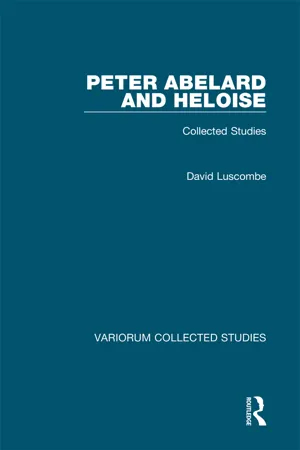
- 318 pages
- English
- ePUB (mobile friendly)
- Available on iOS & Android
eBook - ePub
1
From Paris to the Paraclete
The correspondence of Abelard and Heloise
Abelard was not a Parisian nor a Frenchman. None the less, the duchy of Brittany, and especially the county of Nantes into which he had been born in 1079, was increasingly open to and taking part in opportunities of all kinds opening up in France.1 Breton clergy went to the schools of Anjou to study; and sometimes they returned to occupy and to reform Breton bishoprics.2 Abelard himself from the mid 1090s attended the schools of Tours and Loches and Angers3 and like his fellow Breton Robert of Arbrissel, the founder of the abbey of Fontevraud, he went on to Paris in search of further opportunities to study; and, like Robert too, Abelard eventually became an abbot.4 He remained throughout his life in touch with his Breton homeland – his patria – returning there in illness,5 and when his mother Lucy entered religion,6 entrusting Heloise to his sister during her pregnancy in 1116,7 placing his son Astralabe with this same sister for his upbringing,8 dedicating his Dialectica to his brother Dagobert,9 accepting election around 1125/7 as abbot of the monastery of Saint-Gildas de Rhuys in the diocese of Vannes on the southern, Atlantic coast of the duchy10 and in this role playing a part in the affairs of the duchy, and appearing from time to time in the entourage of Conan III, the count of Nantes and duke of Brittany.11
Heloise’s family, which is less well known than Abelard’s, belonged to the nobility of the Paris region.12 Her uncle Fulbert was a canon of Notre-Dame13 and she was educated in the nearby convent of Argenteuil.14 There is reason to think that she belonged on her father’s side to a branch of the Beaumont family, or of the closely related family of Montmorency-Bantelu, and that she had on her mother’s side Chartrain connections.15 The Montmorencys were dominant in the Val d’Oise, and the advowson of the convent of Argenteuil was in the hands of one of their number; they were neighbours, and by no means harmonious ones, of the abbots of Saint-Denis.16
In the earliest years of the twelfth century Paris was still a dilapidated, crumbling city largely confined to an island on the Seine.17 Louis VI, at the start of his reign in 1108, was hemmed in by the counts of Meulan and Corbeil, and by the lords of Montmorency. But, following the sack of the city by the count of Meulan in 1111, he established a ville neuve on the right bank of the Seine in a vigorous drive to promote settlement and commerce. On the left bank in 1113 Louis officially founded the new abbey of SaintVictor; hitherto a lonely hermitage, it quickly grew to be a notable centre for scholarly clergy.18 The east of the Cité itself had been dominated by the vast, ruinous basilica of Saint-Etienne while further to the east arose the more recent church of Notre-Dame. To the north of these lay the cloister and most of the canons’ houses. Apart from the dean, the chanter and the chancellor, the chapter comprised three archdeacons, three priest-canons, three deacons, three subdeacons and three acolytes. The bishop himself occupied a palace to the south of the cathedral, close to the Petit Pont. And in the years before (or in) 1116 Louis VI fixed the boundaries of the close.19
Abelard was not brought up here, but he came as a mature student around the year 1100 to complete an education that had been pursued largely in the valley of the Loire. The state of the school in Paris at the time is obscure. But bishop Guillaume, who died in 1102, had been a pupil of that famous teacher, bishop Ivo of Chartres, as was Galo, his successor as bishop in Paris from 1104.20 These two bishops heralded a period of rapid growth for the school;21 increasing numbers of students were to come and to breed conflicts, a climax being reached perhaps after Abelard had left Paris and in the 1120s when bishop Gerbert suspended Master Gualo from teaching in the close and moved the school away from the canons’ properties and closer both to his palace and to the Petit Pont which leads to the rive gauche. Henceforth external pupils, such as Abelard himself had been, were no longer to lodge in the canons’ houses.22
A battle of ideas unquestionably took place in Paris between Abelard and his master William of Champeaux in the early 1100s23 but personal alliances and quarrels were also involved and the politics of the royal court bore closely upon them.24 Stephen de Garlande, from 1105 the royal chancellor, was like William an archdeacon and had houses in the closed;25 and when Abelard first set up school, not in Paris but at the castrum and royal residence of Melun, he had the support of powerful figures.26 When after a short while he moved away from Melun – and the reason for this may well have been a rift between Stephen and the king – he took his teaching to the little town of Corbeil, closer to Paris, but in the hands of Count Odo who was opposed to the king.27 Nor need it be a coincidence that, when shortly afterwards (and perhaps still in 1105) Abelard returned home to Brittany, for reasons of health, the de Garlandes, in alliance with Milo of Troyes, were fighting the Rocheforts who had taken Prince Louis into their keeping. Only when the cloud of disgrace was lifted from the de Garlandes, probably in 1108, did Abelard see fit to return from Brittany to France.28
1108 is also the year in which William of Champeaux took the habit of a regular canon and resigned his archdeaconry to join the new community at Saint-Victor on the left bank. This followed the accession to the throne of Louis VI and a reversal in 1107 of alliances in the royal court leading to William's exclusion from royal favour.29 The Parisian basin was in the grip of military operations. Gui de Rochefort lost the seneschalship – which had given him command of the royal army – and was replaced by Anseau de Garlande. Stephen de Garlande was restored to the royal chancellorship.30 And the new archdeacon, Gilbert, who succeeded William, attempted to install Abelard in the episcopal school of Paris, but he failed to overcome the influence of William over bishop Galo who imposed another nominee.31 So Abelard went back to Melun and to the royal court32 and then came to the Mont Sainte-Geneviève to the south of Paris where Stephen was dean of the abbey. It was on the lands or in the church of Sainte-Geneviève that Abelard taught around 1109 and 1110.33 He finally secured appointment as master in Paris only after the resignation of William's successor and after William left Paris to become bishop of Châlons in 1113.34 There followed at least three undisturbed years of teaching in the cathedral close35 until the course of his relationship with Heloise and his brutal emasculation led him, probably in 1117/18, to put his wife back into the convent of Argenteuil and to place himself under the rule of abbot Adam at the royal monastery of Saint-Denis.36
These ructions are evoked very sketchily in the letter now universally known under the title of Historia calamitatum.37 Until William of Champeaux finally left Paris, the account is largely couched 'in the terminology of a military operation aimed at the academic capture of the stronghold of Paris'.38 The frequent metaphors employed of assault and battle, of siege and camps, of occupation and retreat, gain significance when we take into account the close connections between the clerical and military struggles in royal France.39 At precisely the time that Abelard taught on the Mont Sainte-Geneviève, and prepared there for his assault on the cathedral school, Roger count of Meulan in March 1111 raided the Cité from the rive droite, sacked the royal palace and cut the bridges across the Seine.40 This bragging martial language is not the least of reasons for reading the text as an acceptably contemporary document.41
As much can be said too of the account of Heloise. It is believable, even so long before the invention of safe methods of artificial contraception, that Heloise should have insisted that she preferred the freedom of concubinage to the tie of wedlock. Heloise is represented in the Historia as one who wanted to reject the marriage bond and who, desperately as well as forcefully, turned St Jerome's arguments against marriage in directions Jerome never intended.42 In the first of her letters Heloise writes that the name of wife might seem more sacred or more binding, but sweeter would always be the word friend, even that of mistress or concubine.43 This sentiment, coming from a woman, at a time when concubinage was not socially disreputable but when the prohibitions of clerical marriage and other laws of marriage were still being sharpened, is not so daringly original nor so old-fashioned as to be implausible. To many concubines it was an advantage to keep their clerical partners well away from marriage.44
Another persistent objection to the contemporary character of the Historia is that the quotations it contains from the Bible are put in a form not invented before the thirteenth century.45 In particular, in evoking Abelard's shame on becoming a eunuch and therefore unclean, the Book of Deuteronomy is quoted: 'An eunuch . . . shall not enter into the church of the Lord'.46 The reference given in the Historia to chapter 21 is (we might presume) a simple error for chapter 23 where the passage is now found, but the objection is that such an error could not have been made until after the early thirteenth century when Stephen Langton devised a new system of chapter numberings, where-upon this passage was included for the first time in a chapter numbered 23. The objection is, however, groundless, not because of the possibility that copyists of the extant MSS (which are all later than Stephen Langton) may have sensibly adjusted the text to a new system,47 nor because of the possibility that the quotation was interpolated during the thirteenth century into an earlier copy,48 but because of the fact that the supposedly new system was not wholly new. In some twelfth-century Bibles, this particular passage in Deuteronomy is quite clearly in a chapter numbered 23...
Table of contents
- Cover
- Series Page
- Half Title
- Title
- Copyright
- Contents
- Preface
- Abbreviations
- Bibliography
- 1 'From Paris to the Paraclete: The correspondence of Abelard and Heloise', Raleigh Lecture on History. Proceedings of the British Academy, 74 (1988; date of publication 1989), pp. 247–283. © The British Academy. Reprinted by permission.
- Peter Abelard: Philosopher
- Peter Abelard: Theologian
- Peter Abelard and Heloise
- Peter Abelard: Monk
- Index
- Index of Manuscripts
Trusted by 375,005 students
Access to over 1.5 million titles for a fair monthly price.
Study more efficiently using our study tools.
Frequently asked questions
Yes, you can cancel anytime from the Subscription tab in your account settings on the Perlego website. Your subscription will stay active until the end of your current billing period. Learn how to cancel your subscription
No, books cannot be downloaded as external files, such as PDFs, for use outside of Perlego. However, you can download books within the Perlego app for offline reading on mobile or tablet. Learn how to download books offline
Perlego offers two plans: Essential and Complete
- Essential is ideal for learners and professionals who enjoy exploring a wide range of subjects. Access the Essential Library with 800,000+ trusted titles and best-sellers across business, personal growth, and the humanities. Includes unlimited reading time and Standard Read Aloud voice.
- Complete: Perfect for advanced learners and researchers needing full, unrestricted access. Unlock 1.5M+ books across hundreds of subjects, including academic and specialized titles. The Complete Plan also includes advanced features like Premium Read Aloud and Research Assistant.
We are an online textbook subscription service, where you can get access to an entire online library for less than the price of a single book per month. With over 1.5 million books across 990+ topics, we’ve got you covered! Learn about our mission
Look out for the read-aloud symbol on your next book to see if you can listen to it. The read-aloud tool reads text aloud for you, highlighting the text as it is being read. You can pause it, speed it up and slow it down. Learn more about Read Aloud
Yes! You can use the Perlego app on both iOS and Android devices to read anytime, anywhere — even offline. Perfect for commutes or when you’re on the go.
Please note we cannot support devices running on iOS 13 and Android 7 or earlier. Learn more about using the app
Please note we cannot support devices running on iOS 13 and Android 7 or earlier. Learn more about using the app
Yes, you can access Peter Abelard and Heloise by David Luscombe in PDF and/or ePUB format, as well as other popular books in History & World History. We have over 1.5 million books available in our catalogue for you to explore.