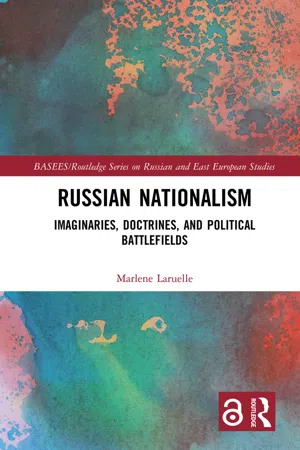
This book, by one of the foremost authorities on the subject, explores the complex nature of Russian nationalism. It examines nationalism as a multilayered and multifaceted repertoire displayed by a myriad of actors. It considers nationalism as various concepts and ideas emphasizing Russia's distinctive national character, based on the country's geography, history, Orthodoxy, and Soviet technological advances. It analyzes the ideologies of Russia's ultra-nationalist and far-right groups, explores the use of nationalism in the conflict with Ukraine and the annexation of Crimea, and discusses how Putin's political opponents, including Alexei Navalny, make use of nationalism. Overall the book provides a rich analysis of a key force which is profoundly affecting political and societal developments both inside Russia and beyond.
- 248 pages
- English
- ePUB (mobile friendly)
- Available on iOS & Android
eBook - ePub
About this book
Information
Part I
Nationalism as imperial imaginary
Cosmos, geography, and ancient past
1
Cosmism
Russian messianism at a time of technological modernity1
The core doctrines shaping Russian nationalism, such as Slavophilism and Pan-Slavism, have been well studied. Yet another school of thought, fundamental to understanding today’s ideological framing, has attracted less scholarly attention: Cosmism. Cosmism is rooted in the Romantic and organicist tradition that rejects divisions of knowledge, assumes that scientific progress and spiritual quest go hand-in-hand, and believes in an intrinsic link between micro- and macrocosms. Cosmism’s main ramifications date from the 1920s, when the Bolshevik Revolution blended occult traditions and sciences of the future. It gave a new lease of life to a secular millenarism that was founded on ancient utopian traditions present in Orthodoxy. God-building, bioCosmism, theories of rejuvenation with blood (Bogdanov), Lenin’s unique embalming method – all constituted part of this spiritual-utopian kaleidoscope that the Revolution had awakened.2 These universalist utopias emerged in the early 1920s, but were eliminated during the Great Turn of 1929. Stalinism no longer wanted to hear dreams about humanity’s potentialities; it wanted to change nature and society by force. It was no longer committed to a transformation of humanity as a whole, but sought to prove the superiority of Russian-Soviet science in its competition with the capitalist world.
Yet, as a maximalist ideology par excellence, Cosmism was the only futurist trend of the early 1920s to survive the Great Turn. Its totalitarian features and the importance it assigned to technological modernity were in agreement with the ambitions of “total realization” that were operative both in the Bolshevik years and under Stalin. Cosmism was thus able to find some common ground with Stalinism, permitting the latter to instrumentalize it as part of the victory of Soviet science. Later, it found common ground with Khrushchevian détente over the conquest of space.3 Like the United States, the Soviet Union transposed its religious and political messianism into creating a space utopia, legitimated by scientific progress and the advance of flight technologies.4 Cosmism therefore managed to navigate the troubled waters of the informal Soviet world: it was neither reduced to an instrument of state propaganda nor openly dissident, and found its niche in the various spaces of intellectual freedom permitted in Soviet society. Since then, it has constituted a critical cornerstone of post-Soviet nationalist repertoires.
The genesis of Cosmist thinking: a contextualization
Cosmism drew many of its philosophical precepts from the great currents of thought preceding it and tried to put forward an original and innovative synthesis of the relations between science and faith. It is rooted in the Romantic ideology of the late eighteenth and early nineteenth centuries and organicist theories that assume the existence of laws of harmony among humankind, nature, and the cosmos. It also drew inspiration from the scientism of the turn of the twentieth century and the nomogenetic precepts used to challenge Darwinism. Lastly, Cosmism is inspired by the messianic statements of Soloviev and Dostoevskii concerning the reconciliation of humanity over and above its division into different nations.
Rooted in the German Naturphilosophie elaborated from the end of the eighteenth century, Romantic ideology appeals to a new model of intelligibility in which primacy is given to the human factor. It asserts that human beings retain their essential singularity, are irreducible to numerical analysis, and that science goes hand-in-hand with faith: the organization of phenomena is explicable by recourse to providence. Hence, Romantic ideology does not challenge the facts and laws established by experimental research, but rather their placement in the general scheme of knowledge. Though it accepts the encyclopaedic knowledge of the Renaissance, it dismisses that of the Enlightenment, which it apprehends as a collection of unrelated pieces of knowledge that reject faith. Romanticism aims, in fact, to restore a lost unity by endorsing a science that is total and transdisciplinary. It endorses a return to a philosophy that recognizes the rights of imagination and emotion.
For the Romantics, the value of an event appeared only when it was placed in a meaningful context. As such, they maintained the necessity of constructing a higher level of knowledge, a philosophy of humanity that encompassed both faith and science.5 This Romantic thinking was strongly marked by the birth of a general theory of biology that made flora and fauna part of the same processes as humans. Nature was no longer considered a mythological divinity but an internal economy subject to logics that humans could understand. Accordingly, Lebenskraft (vital force) became the major scientific theme of the era. Not by chance did Naturphilosophie have great success in both the medical milieus and the fields of Earth science and botany. The mechanicist revolution had assured the triumph of an analytic representation of the universe. However, as machines have no self-awareness, the mind that creates them must be of another order. Organicism thus sought to reestablish a previously dominant mode of knowledge, wherein instead of placing limits on its ambitions to decipher the superficial organization of phenomena, it strove to forge an alliance with the “essence” of reality. For the artificial construction of mechanicism, it substituted a living growth that obeyed not abstract rules but an immanent inspiration. Organicism established the possibility of understanding the world on the principle of analogy. It proposed a vitalist schema of growth whose dynamism progresses from birth to death, and which maintains, between the elements that it assembles, an intimate solidarity, in which mechanisms are subordinated to the government of finality: the part cannot be realized without the whole, or the whole without the parts. Multiplicity and unity do not stand in contradiction.6
While Romanticism had wanted to “put [Isaac] Newton on trial”7 and asserted that a mechanistic and clockwork-like vision of the human automaton would lead straight to an industrial hell, Cosmism affirmed exactly the opposite. In so doing, it drew on the scientific revival of the late nineteenth and early twentieth centuries. This revival rejected positivism, interpreted as a resignation of the mind, which considers that science has no say in the inner meaning of the phenomena whose sequences it sketches. But for the scientists, science aimed to provide the response to the great questions – religious and moral – of humanity, those to which religion also responds. As Jules de Gaultier explained in 1911:
scientist belief repeats the sum of petitions comprising the program of human hope in its messianic and moral forms. It restores the theme of the always reborn and unfulfilled dream of human consciousness on the search for better futures among the perspectives on a development that is inestimable in duration.8
Cosmism is based wholly on this scientific precept, which it pushes to the extreme. It can therefore be understood as a vitalist theory indirectly inspired by Bergsonian thought. Already convinced, thanks to its organicist influences, about rehabilitating the alchemy of the Renaissance, Cosmism also drew inspiration from the parascientific quests of its time, such as spiritism, hypnotism, somnambulism and telepathy, the discovery of so-called animal magnetism (mesmerism), palingenesis, and metempsychosis. All these challenges to the limits of science encouraged the belief that there are some parts of scientific knowledge still inaccessible to the human mind. The discovery of the atom, the gene, and the idea according to which every living cell registers and reacts to natural phenomena came to profoundly influence Cosmism.
Cosmism also appropriated some Russian intellectual traditions. In the second half of the nineteenth century, several thinkers, stimulated by Darwinism, set out to investigate the relations between science and faith, as well as the epistemology of science.9 The embryologist Karl Ernst von Baer (1792–1876), whose theories were very popular in Europe, objected, for example, to the idea that natural selection suffices to explain evolution. Anticipating the theory of mutations that Hugo de Vries (1848–1935) would later develop, Baer subscribed to immanentism and was a supporter of so-called ontogenetic evolution, an approach conceived as fulfilling a plan.
Similar notions can be found in the work of the famous pan-Slavist theoretician Nikolai Danilevskii (1822–1885). In his Darwinism: A Critical Study (Darvinizm. Kriticheskoe issledovanie), published in two volumes in 1885 and 1889, he postulated that Darwinism was not a matter of botany or zoology, but a philosophical interrogation into the origin of humanity and the organicity (tselesoobraznost’) of nature. He therefore acknowledged a positivist point in Darwin’s theory, which is that it puts the naturalist back into nature insofar as it proves the need to study forms of life in their environment and not to wait until they are extinct to classify them: their harmony must be explained rather than each living thing taken individually.10 Nevertheless, for Danilevskii, the idea of systematizing chance in the mechanisms of evolution amounted to a negation of the existence of God: how, from a series of chance events without any coordination among them, could a harmonious order emerge? If humans are only descendants of the ape, then nihilist and atheist thinking is justified: Danilevskii judged the idea of the struggle for survival, in which only the strongest survive, eminently anti-Christian. Here, he followed the German Theodor Eimer (1843–1898), who promoted the idea of inner predetermined evolution – an idea ignored by Darwin, who privileged external causality.11
In the early twentieth century, Lev Berg (1876–1950) pursued Baer’s and Danilevskii’s claims that there existed an alternative nomogenesis to Darwinism in his work Nomogenesis (1922).12 His nomogenetic theory of evolution postulates that evolution obeys laws; for example, that it is a development of preexisting rudiments or potentialities, rather than a series of adaptive responses by organisms to their environment. Berg, however, rejected all vitalist approaches. For him, conformity to a goal was a property of the living and not a mysterious force. Along the same lines, Boris Chicherin (1828–1904), anticipating Bergson, spoke of an inner, goal-oriented vital force and believed that the onl...
Table of contents
- Cover
- Half Title
- Series Page
- Title Page
- Copyright Page
- Contents
- List of tables
- Introduction
- PART I Nationalism as imperial imaginary: cosmos, geography, and ancient past
- PART II Nationalism as doctrine: experimenting with new repertoires
- PART III Nationalism as political battlefield: in the streets, for or against the Kremlin
- References
- Index
Trusted by 375,005 students
Access to over 1.5 million titles for a fair monthly price.
Study more efficiently using our study tools.
Frequently asked questions
Yes, you can cancel anytime from the Subscription tab in your account settings on the Perlego website. Your subscription will stay active until the end of your current billing period. Learn how to cancel your subscription
No, books cannot be downloaded as external files, such as PDFs, for use outside of Perlego. However, you can download books within the Perlego app for offline reading on mobile or tablet. Learn how to download books offline
Perlego offers two plans: Essential and Complete
- Essential is ideal for learners and professionals who enjoy exploring a wide range of subjects. Access the Essential Library with 800,000+ trusted titles and best-sellers across business, personal growth, and the humanities. Includes unlimited reading time and Standard Read Aloud voice.
- Complete: Perfect for advanced learners and researchers needing full, unrestricted access. Unlock 1.5M+ books across hundreds of subjects, including academic and specialized titles. The Complete Plan also includes advanced features like Premium Read Aloud and Research Assistant.
We are an online textbook subscription service, where you can get access to an entire online library for less than the price of a single book per month. With over 1.5 million books across 990+ topics, we’ve got you covered! Learn about our mission
Look out for the read-aloud symbol on your next book to see if you can listen to it. The read-aloud tool reads text aloud for you, highlighting the text as it is being read. You can pause it, speed it up and slow it down. Learn more about Read Aloud
Yes! You can use the Perlego app on both iOS and Android devices to read anytime, anywhere — even offline. Perfect for commutes or when you’re on the go.
Please note we cannot support devices running on iOS 13 and Android 7 or earlier. Learn more about using the app
Please note we cannot support devices running on iOS 13 and Android 7 or earlier. Learn more about using the app
Yes, you can access Russian Nationalism by Marlene Laruelle in PDF and/or ePUB format, as well as other popular books in Social Sciences & Ethnic Studies. We have over 1.5 million books available in our catalogue for you to explore.