eBook - ePub
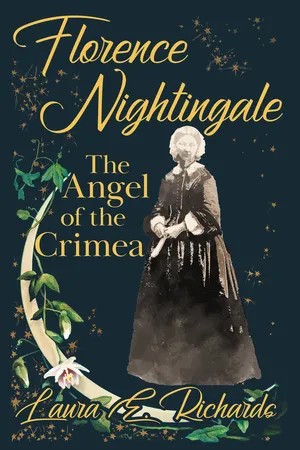
Florence Nightingale the Angel of the Crimea
With the Essay 'Representative Women' by Ingleby Scott
- 119 pages
- English
- ePUB (mobile friendly)
- Available on iOS & Android
eBook - ePub
Florence Nightingale the Angel of the Crimea
With the Essay 'Representative Women' by Ingleby Scott
About this book
First published in 1909, "Florence Nightingale the Angel of the Crimea" is a biographical sketch of Nightingale by American author Laura Elizabeth Howe Richards
Florence Nightingale (1820–1910) was an English social reformer, statistician, and pioneer of modern nursing. She became famous during the time she served as manager and trainer of nurses during the Crimean War, giving nursing a positive reputation and becoming a Victorian culture icon. Also known as "The Lady with the Lamp", she was an accomplished writer who produced work related to medical knowledge. Contents include: "How Florence Got Her Name", "Little Florence", "The Squire's Daughter", "Looking Out", "Waiting For The Call", "The Trumpet Call", "The Response", "Scutari", "The Barrack Hospital", "The Lady-In-Chief", "The Lady With The Lamp", etc.
Laura Elizabeth Howe Richards produced over 90 books over many genres, including poetry, biographies, and children's literature. Her most notable work is her children's poem "Eletelephony". Other notable works by this author include: "Baby's Rhyme Book" (1878), "Babyhood: Rhymes and Stories, Pictures and Silhouettes for Our Little Ones" (1878), and "Baby's Story Book" (1878). Read & Co is republishing this volume now in a high-quality, modern edition, complete with a biography of the author by Elizabeth Lee.
Information
CHAPTER I.
HOW FLORENCE GOT HER NAME.
One evening, some time after the great Crimean War of 1854-55, a company of military and naval officers met at dinner in London. They were talking over the war, as soldiers and sailors love to do, and somebody said: "Who, of all the workers in the Crimea, will be longest remembered?"
Each guest was asked to give his opinion on this point, and each one wrote a name on a slip of paper. There were many slips, but when they came to be examined there was only one name, for every single man had written "Florence Nightingale."
Every English boy and girl knows the beautiful story of Miss Nightingale's life. Indeed, hers is perhaps the best-loved name in England since good Queen Victoria died. It will be a great pleasure to me to tell this story to our own boys and girls in this country; and it shall begin, as all proper stories do, at the beginning.
Her father was named William Nightingale. He was an English gentleman, and in the year 1820 was living in Italy with his wife. Their first child was born in Naples, and they named her Parthenope, that being the ancient name of Naples; two years later, when they were living in Florence, another little girl came to them, and they decided to name her also after the city of her birth.
When Florence was still a very little child her parents came back to England to live, bringing the two children with them. First they went to a house called Lea Hall, in Derbyshire. It was an old, old house of gray stone, standing on a hill, in meadows full of buttercups and clover. All about were blossoming hedgerows full of wild roses, and great elder-bushes heavy with white blossoms; and on the hillside below it lies the quaint old village of Lea with its curious little stone houses.
Lea Hall is a farmhouse now, but it still has its old flag-paved hall and its noble staircase of oak with twisted balustrade, and broad solid steps where little Florence and her sister "Parthe" used to play and creep and tumble. There was another place near by where they loved even better to play; that was the ancient house of Dethick. I ought rather to say the ancient kitchen, for little else remained of the once stately mansion. The rest of the house was comparatively new, but the great kitchen was (and no doubt is) much as it was in the days of Queen Elizabeth.
Imagine a great room with heavy timbered roof, ponderous oaken doors, and huge open fireplace over which hung the ancient roasting jack. In the ceiling was a little trap-door, which looked as if it might open on the roof; but in truth it was the entrance to a chamber hidden away under the roof, a good-sized room, big enough for several persons to hide in.
Florence and her sister loved to imagine the scenes that had taken place in that old kitchen; strange and thrilling, perhaps terrible scenes; they knew the story of Dethick, and now you shall hear it too.
In that old time which Tennyson calls "the spacious days of great Elizabeth," Dethick belonged to a noble family named Babington. It was a fine house then. The oaken door of the old kitchen opened on long corridors and passages, which in turn led to stately halls and noble galleries. There were turrets and balconies overlooking beautiful gardens; and on the stone terraces gay lords and ladies used to walk and laugh and make merry, and little children run and play and dance, and life go on very much as it does now, with work and play, love and laughter and tears.
One of the gay people who used to walk there was Anthony Babington. He was a gallant young gentleman, an ardent Catholic, and devoted to the cause of the beautiful and unfortunate Mary Queen of Scots.
Though ardent and devoted, Babington was a weak and foolish young man. He fell under the influence of a certain Ballard, an artful and designing person who had resolved to bring about the death of the great English Queen, and was induced by him to form the plot which is known in history as Babington's Conspiracy; so he was brought to ruin and death.
In the year 1586 Queen Mary was imprisoned at Wingfield Manor, a country house only a few miles distant from Dethick. The conspirators gathered other Catholic noblemen about them, and planned to release Queen Mary and set her once more on the throne.
They used to meet at Dethick where, it is said, there is a secret passage underground leading to Wingfield Manor. Perhaps—who knows?—they may have sat in the kitchen, gathering about the great fireplace for warmth; the lights out, for fear of spies, only the firelight gleaming here and there, lighting up the dark corners and the eager, intent faces. And when the plot was discovered, and Queen Elizabeth's soldiers were searching the country round for the young conspirators, riding hither and thither along the pleasant country lanes and thrusting their sabres in among the blossoming hedgerows, it was here at Dethick that they sought for Anthony Babington. They did not find him, for he was in hiding elsewhere, but one of his companions was actually discovered and arrested there.
Perhaps—again, who knows?—this man may have been hiding in the secret chamber above the trap-door. One can fancy the pursuers rushing in, flinging open cupboards and presses, in search for their prey; and finding no one, gathering baffled around the fireplace. Then one, chancing to glance up, catches sight of the trap-door in the ceiling. "Ha! lads, look up! the rascal may be hiding yonder! Up with you, you tall fellow!" Then a piling up of benches, one man mounting on another's shoulders—the door forced open, the young nobleman seized and overpowered, and brought down to be carried off to London for trial.
Anthony Babington and his companions were executed for high treason, and Queen Mary, who was convicted of approving the plot, was put to death soon after.
All this Florence Nightingale and her sister knew, and they never tired of "playing suppose" in old Dethick kitchen, and living over again in fancy the romantic time long past. And on Sundays the two children went with their parents to old Dethick church, and sat where Anthony Babington used to sit, for in his days it was the private chapel of Dethick. It is a tiny church; fifty people would fill it to overflowing, but Florence and her sister might easily feel that the four bare walls held all the wild history of Elizabeth's reign.
Anthony Babington in doublet and hose, with velvet mantle, feathered cap, and sword by his side; little Florence Nightingale in round Leghorn hat and short petticoats. It is a long step between these two, yet they are the two most famous people who ever said their prayers in old Dethick church. The lad's brief and tragic story contrasts strangely with the long and beautiful story of Florence Nightingale, a story that has no end.
When Florence was between five and six years old, she left Lea Hall for a new home, Lea Hurst, about a mile distant. Here her father had built a beautiful house in the Elizabethan style, of stone, with pointed gables, mullioned windows and latticed panes. There was a tiny chapel on the site he chose, hundreds of years old, and this he built into the house, so that Lea Hurst, as well as Lea Hall and Dethick, joined hands with the old historic times. In this little chapel, by and by, we shall see Florence holding her Bible class. But I like still to think of her as a little rosy girl, running about the beautiful gardens of Lea Hurst, or playing house in the quaint old summerhouse with its pointed roof of thatch. Perhaps she brought her dolls here; but the dolls must wait for another chapter.
Soon after moving to Lea Hurst, the Nightingales bought still another country seat, Embley Park, in Hampshire, a fine old mansion built in Queen Elizabeth's time, and at some distance from Lea Hurst.
After this the family used to spend the summer at Lea Hurst, and the winter at Embley. There were no railroads then in that neighborhood; the journey was sometimes made by stagecoach, sometimes in the Nightingales' own carriage.
Embley Park is one of the stately homes of England, with its lofty gables, terraces and shadowing trees; and all around it are sunny lawns, and gardens filled with every sweet and lovely flower.
Now you know a little of the three homes of Florence Nightingale, Lea Hall, Lea Hurst, and Embley Park; next you shall hear what kind of child she herself was.
CHAPTER II.
LITTLE FLORENCE.
All the boys, and very likely some of the girls, who have got as far as this second chapter, will glance down the page, and exclaim: "Dolls!" Then they will add whatever is their favorite expression of scorn, and perhaps make a motion to lay the book down.
Wait a moment, girls, and boys too! I advise you to read on, and see what came in this case of playing with dolls.
There were a good many thousands of boys in England at that time, in the Twenties and Thirties, who might have been badly off when the terrible Fifties came, if Florence Nightingale had not played with her dolls. Read on, and see for yourselves!
Florence Nightingale loved her dolls dearly, and took the greatest possible care of them; and yet they were always delicate and given to sudden and alarming illnesses. A doll never knew when she might be told that she was very ill, and undressed and put to bed, though she might but just have got on her new frock. Then Mamma Florence would wait upon her tenderly, smoothing her pillow, bathing her forehead or rubbing her poor back, and bringing her all kinds of good things in the doll-house dishes. The doll might feel very much better the next day, and think it was time to get up and put on the new frock again; but she was very apt to have a relapse and go back to bed and gruel again, once at least, before she was allowed to recover entirely.
The truth is,...
Table of contents
- REPRESENTATIVE WOMEN
- CHAPTER I.
- CHAPTER II.
- CHAPTER III.
- CHAPTER IV.
- CHAPTER V.
- CHAPTER VI.
- CHAPTER VII.
- CHAPTER VIII.
- CHAPTER IX.
- CHAPTER X.
- CHAPTER XI.
- CHAPTER XII.
- CHAPTER XIII.
- CHAPTER XIV.
- CHAPTER XV.
Trusted by 375,005 students
Access to over 1.5 million titles for a fair monthly price.
Study more efficiently using our study tools.
Frequently asked questions
Yes, you can cancel anytime from the Subscription tab in your account settings on the Perlego website. Your subscription will stay active until the end of your current billing period. Learn how to cancel your subscription
No, books cannot be downloaded as external files, such as PDFs, for use outside of Perlego. However, you can download books within the Perlego app for offline reading on mobile or tablet. Learn how to download books offline
Perlego offers two plans: Essential and Complete
- Essential is ideal for learners and professionals who enjoy exploring a wide range of subjects. Access the Essential Library with 800,000+ trusted titles and best-sellers across business, personal growth, and the humanities. Includes unlimited reading time and Standard Read Aloud voice.
- Complete: Perfect for advanced learners and researchers needing full, unrestricted access. Unlock 1.5M+ books across hundreds of subjects, including academic and specialized titles. The Complete Plan also includes advanced features like Premium Read Aloud and Research Assistant.
We are an online textbook subscription service, where you can get access to an entire online library for less than the price of a single book per month. With over 1.5 million books across 990+ topics, we’ve got you covered! Learn about our mission
Look out for the read-aloud symbol on your next book to see if you can listen to it. The read-aloud tool reads text aloud for you, highlighting the text as it is being read. You can pause it, speed it up and slow it down. Learn more about Read Aloud
Yes! You can use the Perlego app on both iOS and Android devices to read anytime, anywhere — even offline. Perfect for commutes or when you’re on the go.
Please note we cannot support devices running on iOS 13 and Android 7 or earlier. Learn more about using the app
Please note we cannot support devices running on iOS 13 and Android 7 or earlier. Learn more about using the app
Yes, you can access Florence Nightingale the Angel of the Crimea by Laura E. Richards,Ingleby Scott in PDF and/or ePUB format, as well as other popular books in History & Social Science Biographies. We have over 1.5 million books available in our catalogue for you to explore.