eBook - ePub
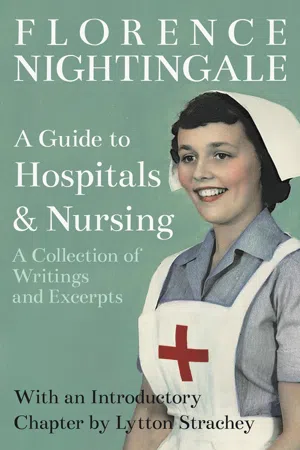
A Guide to Hospitals and Nursing - A Collection of Writings and Excerpts
With an Introductory Chapter by Lytton Strachey
- 223 pages
- English
- ePUB (mobile friendly)
- Available on iOS & Android
eBook - ePub
A Guide to Hospitals and Nursing - A Collection of Writings and Excerpts
With an Introductory Chapter by Lytton Strachey
About this book
Florence Nightingale (1820–1910) was an English social reformer, statistician, and pioneer of modern nursing. She became famous during the time she served as manager and trainer of nurses during the Crimean War, giving nursing a positive reputation and becoming a Victorian culture icon. Also known as "The Lady with the Lamp", she was an accomplished writer who produced a large corpus of work related to medical knowledge. A great example of such writing is "Guide To Hospitals And Nursing", within which Nightingale outlines some key principles of nursing with a particular focus on nursing for the poor and underprivileged. Highly recommended for those with an interest in the history and development of nursing and not to be missed by the discerning collector. Contents include: "Florence Nightingale, By Lytton Strachey", "Suggestions On A System Of Nursing For Hospitals In India", "Trained Nursing For The Sick Poor", "Workhouse Nursing - The Story Of A Successful Experiment", "Amy Sanitary Administration, and Its Reform Under The Late Lord Herbert", "Health Teaching In Towns And Villages. Rural Hygiene", etc. Other notable works by this author include: "Notes on Nursing: What Nursing Is, What Nursing is Not" (1859), "Suggestions for Thought" (1860), and "Una and the Lion" (1871).This classic work is being republished now in a new edition complete with an introductory chapter by Lytton Strachey.
Information
Topic
HistoriaSubtopic
Historia militar y marítimaFLORENCE
NIGHTINGALE
TO HER NURSES
I
London, May, 1872.
For us who Nurse, our Nursing is a thing, which, unless in it we are making progress every year, every month, every week, take my word for it we are going back.
The more experience we gain, the more progress we can make. The progress you make in your year’s training with us is as nothing to what you must make every year after your year’s training is over.
A woman who thinks in herself: “Now I am a ‘full’ Nurse, a ‘skilled’ Nurse, I have learnt all that there is to be learnt”: take my word for it, she does not know what a Nurse is, and she never will know; she is gone back already.
Conceit and Nursing cannot exist in the same person, any more than new patches on an old garment.
Every year of her service a good Nurse will say: “I learn something every day.”
I have had more experience in all countries and in different ways of Hospitals than almost any one ever had before (there were no opportunities for learning in my youth such as you have had); but if I could recover strength so much as to walk about, I would begin all over again. I would come for a year’s training to St. Thomas’ Hospital under your admirable Matron (and I venture to add that she would find me the closest in obedience to all our rules), sure that I should learn every day, learn all the more for my past experience.
And then I would try to be learning every day to the last hour of my life. “And when his legs were cuttit off, He fought upon his stumps,” says the ballad; so, when I could no longer learn by nursing others, I would learn by being nursed, by seeing Nurses practise upon me. It is all experience.
Agnes Jones, who died as Matron of the Liverpool Workhouse Infirmary (whom you may have heard of as “Una”), wrote from the Workhouse in the last year of her life: “I mean to stay at this post forty years, God willing; but I must come back to St. Thomas’ as soon as I have a holiday; I shall learn so much more” (she had been a year at St. Thomas’) “now that I have more experience.”
When I was a child, I remember reading that Sir Isaac Newton, who was, as you know, perhaps the greatest discoverer among the Stars and the Earth’s wonders who ever lived, said in his last hours: “I seem to myself like a child who has been playing with a few pebbles on the sea-shore, leaving unsearched all the wonders of the great Ocean beyond.”
By the side of this put a Nurse leaving her Training School and reckoning up what she has learnt, ending with—“The only wonder is that one head can contain it all.” (What a small head it must be then!)
I seem to have remembered all through life Sir Isaac Newton’s words.
And to nurse—that is, under Doctor’s orders, to cure or to prevent sickness and maiming, Surgical and Medical,—is a field, a road, of which one may safely say: There is no end-no end in what we may be learning every day.[2]
I have sometimes heard: “But have we not reason to be conceited, when we compare ourselves to ... and ...?” (naming drinking, immoral, careless, dishonest Nurses). I will not think it possible that such things can ever be said among us. Taking it even upon the worldly ground, what woman among us, instead of looking to that which is higher, will of her own accord compare herself with that which is lower—with immoral women?
Does not the Apostle say: “I count not myself to have apprehended: but this one thing I do, forgetting those things which are behind, and reaching forth unto those things which are before, I press toward the mark for the prize of the high calling of God in Christ Jesus”; and what higher “calling” can we have than Nursing? But then we must “press forward”; we have indeed not “apprehended” if we have not “apprehended” even so much as this.
There is a little story about “the Pharisee” known over all Christendom. Should Christ come again upon the earth, would He have to apply that parable to us?
And now, let me say a thing which I am sure must have been in all your minds before this: if, unless we improve every day in our Nursing, we are going back: how much more must it be, that, unless we improve every day in our conduct as Christian women, followers of Him by whose name we call ourselves, we shall be going back?
This applies of course to every woman in the world; but it applies more especially to us, because we know no one calling in the world, except it be that of teaching, in which what we can do depends so much upon what we are. To be a good Nurse one must be a good woman; or one is truly nothing but a tinkling bell. To be a good woman at all, one must be an improving woman; for stagnant waters sooner or later, and stagnant air, as we know ourselves, always grow corrupt and unfit for use.
Is any one of us a stagnant woman? Let it not have to be said by any one of us: I left this Home a worse woman than I came into it. I came in with earnest purpose, and now I think of little but my own satisfaction and a good place.
When the head and the hands are very full, as in Nursing, it is so easy, so very easy, if the heart has not an earnest purpose for God and our neighbour, to end in doing one’s work only for oneself, and not at all—even when we seem to be serving our neighbours—not at all for them or for God.
I should hardly like to talk of a subject which, after all, must be very much between each one of us and her God,—which is hardly a matter for talk at all, and certainly not for me, who cannot be among you (though there is nothing in the world I should so dearly wish), but that I thought perhaps you might like to hear of things which persons in the same situation, that is, in different Training Schools on the Continent, have said to me.
I will mention two or three:
1. One said, “The greatest help I ever had in life was that we were taught in our Training School always to raise our hearts to God the first thing on waking in the morning.”
Now it need hardly be said that we cannot make a rule for this; a rule will not teach this, any more than making a rule that the chimney shall not smoke will make the smoke go up the chimney.
If we occupy ourselves the last thing at night with rushing about, gossiping in one another’s rooms; if our last thoughts at night are of some slight against ourselves, or spite against another, or about each other’s tempers, it is needless to say that our first thoughts in the morning will not be of God.
Perhaps there may even have been some quarrel; and if those who pretend to be educated women indulge in these irreligious uneducated disputes, what a scandal before those less educated, to whom an example, not a stone of offence, should be set!
“A thousand irreligious cursed hours” (as some poet says), have not seldom, in the lives of all but a few whom we may truly call Saints upon earth, been spent on some feeling of ill-will. And can we expect to be really able to lift up our hearts the first thing in the morning to the God of “good will towards men” if we do this?
I speak for myself, even more perhaps than for others.
2. Another woman[3] once said to me:—“I was taught in my Training School never to have those long inward discussions with myself, those interminable conversations inside myself, which make up so much more of our own thoughts than we are aware. If it was something about my duties, I went straight to my Superiors, and asked for leave or advice; if it was any of those useless or ill-tempered thoughts about one another, or those that were put over us, we were taught to lay them before God and get the better of them, before they got the better of us.”
A spark can be put out while it is a spark, if it falls on our dress, but not when it has set the whole dress in flames. So it is with an ill-tempered thought against another. And who will tell how much of our thoughts these occupy?
I suppose, of course, that those who think themselves better than others are bent upon setting them a better example.
And this brings me to something else. (I can always correct others though I cannot always correct myself.) It is about jealousies and punctilios as to ranks, classes, and offices, when employed in one good work. What an injury this jealous woman is doing, not to others, or not to others so much as to herself; she is doing it to herself! She is not getting out of her work the advantage, the improvement to her own character, the nobleness (for...
Table of contents
- FLORENCE NIGHTINGALE
- SUGGESTIONS ON A SYSTEM OF NURSING FOR HOSPITALS IN INDIA.
- TRAINED NURSING FOR THE SICK POOR
- WORKHOUSE NURSING
- ARMYSANITARY ADMINISTRATION, AND ITS REFORM UNDER THE LATE LORD HERBERT.
- HEALTH TEACHING IN TOWNS AND VILLAGES.
- FLORENCE NIGHTINGALE TO HER NURSES
- NURSING — WHAT IT IS, AND WHAT IT IS NOT.
Trusted by 375,005 students
Access to over 1.5 million titles for a fair monthly price.
Study more efficiently using our study tools.
Frequently asked questions
Yes, you can cancel anytime from the Subscription tab in your account settings on the Perlego website. Your subscription will stay active until the end of your current billing period. Learn how to cancel your subscription
No, books cannot be downloaded as external files, such as PDFs, for use outside of Perlego. However, you can download books within the Perlego app for offline reading on mobile or tablet. Learn how to download books offline
Perlego offers two plans: Essential and Complete
- Essential is ideal for learners and professionals who enjoy exploring a wide range of subjects. Access the Essential Library with 800,000+ trusted titles and best-sellers across business, personal growth, and the humanities. Includes unlimited reading time and Standard Read Aloud voice.
- Complete: Perfect for advanced learners and researchers needing full, unrestricted access. Unlock 1.5M+ books across hundreds of subjects, including academic and specialized titles. The Complete Plan also includes advanced features like Premium Read Aloud and Research Assistant.
We are an online textbook subscription service, where you can get access to an entire online library for less than the price of a single book per month. With over 1.5 million books across 990+ topics, we’ve got you covered! Learn about our mission
Look out for the read-aloud symbol on your next book to see if you can listen to it. The read-aloud tool reads text aloud for you, highlighting the text as it is being read. You can pause it, speed it up and slow it down. Learn more about Read Aloud
Yes! You can use the Perlego app on both iOS and Android devices to read anytime, anywhere — even offline. Perfect for commutes or when you’re on the go.
Please note we cannot support devices running on iOS 13 and Android 7 or earlier. Learn more about using the app
Please note we cannot support devices running on iOS 13 and Android 7 or earlier. Learn more about using the app
Yes, you can access A Guide to Hospitals and Nursing - A Collection of Writings and Excerpts by Florence Nightingale,Lytton Strachey in PDF and/or ePUB format, as well as other popular books in Historia & Historia militar y marítima. We have over 1.5 million books available in our catalogue for you to explore.