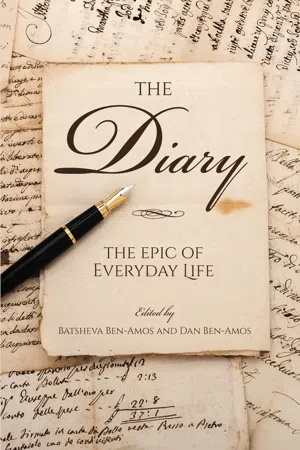
The diary as a genre is found in all literate societies, and these autobiographical accounts are written by persons of all ranks and positions. The Diary offers an exploration of the form in its social, historical, and cultural-literary contexts with its own distinctive features, poetics, and rhetoric. The contributors to this volume examine theories and interpretations relating to writing and studying diaries; the formation of diary canons in the United Kingdom, France, United States, and Brazil; and the ways in which handwritten diaries are transformed through processes of publication and digitization. The authors also explore different diary formats, including the travel diary, the private diary, conflict diaries written during periods of crisis, and the diaries of the digital era, such as blogs. The Diary offers a comprehensive overview of the genre, synthesizing decades of interdisciplinary study to enrich our understanding of, research about, and engagement with the diary as literary form and historical documentation.
eBook - ePub
The Diary
The Epic of Everyday Life
- 492 pages
- English
- ePUB (mobile friendly)
- Available on iOS & Android
eBook - ePub
About this book
Information
Publisher
Indiana University PressYear
2020Print ISBN
9780253046994
9780253046987
eBook ISBN
9780253046956
PART I
Diary Theories
1
The Practice of Writing a Diary
Philippe Lejeune and Catherine Bogaert
Translated from French by Dagmara Meijers-Troller1
Who Keeps a Diary?
In present-day France, who keeps a diary? The question is difficult to answer for several reasons. It is a discreet activity. It is possible to keep a diary among family or in public without attracting notice, but more often, people do it out of sight, without mentioning it to friends and family. It is also an occasional or irregular activity. People keep a diary in times of crisis, during a phase of life, or to chronicle a voyage. They begin, let it slide, and then pick it up again. Few people adhere to a strict daily regimen of writing over a long period of time, recording as much as possible in detail. Most diaries follow a theme, an episode, a single thread of the fabric of a life. When the page has been turned, they are forgotten and sometimes even destroyed.
And yet, in 1988, in answer to the question “Have you, in the course of the last twelve months, kept a diary of your impressions and thoughts?,” 7 percent of those questioned responded yes. The survey, conducted by France’s Ministry of Culture, was aimed at French people over the age of fifteen.2 This means that about three million individuals turned to writing as a complement to their lives. In 1997, the positive response to the same question was 8 percent. Clearly, then, the practice is not outmoded. There are no statistics before 1988, but we can hypothesize that more diaries are kept today than in the nineteenth century and that there is a practical connection between diary writing and the school attendance rates of adolescents. The extension of the mandatory schooling age from fourteen to sixteen, decreed in France in 1958, by virtue of keeping a considerable number of adolescents out of the workforce and carrying their notebooks instead, certainly favored the growth of the practice of writing a diary.
Indeed, an analysis of the results shows that the practice of keeping a diary diminishes with age: 13 percent of adolescents between the ages of fifteen and eighteen, 11 percent of adults from twenty to twenty-four years, and 6 percent of the population thereafter maintain one. This descending curve can be seen as well for other forms of writing. It is true that when compelled by necessity, one may begin a diary at any time of life. But the practice is more likely begun during adolescence, especially among girls. The difference in journaling between girls and boys is huge: between the ages of fifteen and nineteen, 19 percent of girls said they kept a diary compared to 7 percent of boys. If the survey had considered the ten-to-fourteen-year-old age group, the difference would have been even greater: at that age, diaries are a group culture and a rite of passage for girls, while most boys are indifferent or even hostile toward the idea (“a girl’s thing”). In adulthood, beginning at age twenty-five, the picture becomes more evenly balanced, with a slight female predominance. There is no surprise here: as a general rule, women read and write more than men.
Why do adolescent girls have such a passion for keeping diaries? Is it natural or cultural or a little of both? Whatever the case, it parallels historical conditioning: during the nineteenth century in France, girls were systematically pushed to keep a diary, often supervised. Today, girls still often receive locked diaries as a gift for Christmas or birthdays, a rare practice for boys.
Is there a psychological profile for a diarist? It is doubtful, because, as this chapter shows, keeping a diary can be the response to a number of compelling situations. There are as many different personality types among diarists as there are among nondiarists—especially since one is often a diarist on occasion, rather than by vocation, and because each one invents his or her own approach in a genre where there may be models but there are no rules. Nevertheless, all diarists have two undeniable things in common: a taste for writing and a preoccupation with the passage of time.
Is there a social profile? Yes: diary keeping is most frequent among the educated or those who live in cities. In a survey of people “with a poor cultural capital,”3 sociologist Bernard Lahire was struck by his respondents’ incomprehension of the practice of keeping a diary, which they perceived as hypocritical: when you have something to say to others, you should say it to their faces! To sit alone in your corner writing things that nobody will ever read would seem abnormal.
Is it possible that we retreat into a diary nowadays because the bonds of community are weakening or to compensate for the fragmentation and depersonalization of social life? This idea can be formulated in a different way: the current development is part of a long-term trend. Since antiquity in the West, we have witnessed a gradual personalization of control over an individual’s own life and time management. It’s what was already spoken of poetically in the past as the “heart of hearts,” the shift from an external and social jurisdiction (the forum) to a purely inward and personal tribunal, that of the conscience. The current growth of diary writing undoubtedly corresponds to this delegation of power, with individuals in charge of managing themselves, with their own complaint departments and archives.
The Diary and Time
What is a diary? The word itself tells us that it is day-to-day writing: a series of dated written records. For the moment, let us set aside the French expression journal intime (a diary). In German, it is simply referred to as Tagebuch. In English, it is either a diary or a journal. In Spanish, Portuguese, and Italian, it is diario. In French, the distinction is often made between journal intime (diary) and journal (the news or newspaper) to avoid confusion, a problem that does not occur in other languages. But intimacy only became a part of the diary late in its history, as a secondary mode. If we need an adjective, we could speak of the “personal journal or diary.” The Greeks spoke of ephemerides (from hemera, or day); the Romans, of diarium (from dies, or day). The word diaire was still in use in Old French but disappeared in the course of the sixteenth century, while it persisted in the other Romance languages and in English. The French have recently borrowed the substantive diarist from English because French had no word to designate the person who keeps a journal (journalist is already taken and intimiste is too limited in meaning): this borrowed language is in fact a return to a lost tradition. As for the word journal, it was originally an adjective, diurnalis, meaning “daily.” In sixteenth-century France, one still spoke of registres journaux or of papiers journaux, which was then shortened to journal or journaux.
The cornerstone of the diary is the date. The diarist’s first act is to note the date at the top of the page he or she will write on. The words that are written under a given date are called an “entry” or “note.” A diary with no dates is ultimately no more than a simple notebook. The dating may be more or less precise and spaced out over time, but it is of vital importance. A diarist writes an entry at a specific moment, without any knowledge of the future, and can be certain that it will not be modified. A diary that has been corrected or edited at a later time may gain in literary value, but it will have lost its essential characteristic: the authenticity of the moment. When the clock strikes twelve midnight, I can no longer change a thing. If I do so, I have left the genre of diary and strayed into autobiography.
The diary is a trace: almost always handwritten, in the first person, colored by the distinctive effects of individual handwriting. It is a trace on a medium: notebooks chosen or received as gifts or loose leaves diverted from their scholastic purpose. Sometimes, this written trail is accompanied by other traces—flowers, objects, diverse signs plucked from daily life and transformed into relics—or by drawings and designs. When you read “the same text” printed in a book, is it truly the same? Like a work of art, the diary only truly exists as a unique piece.
A diary is a series of traces. It presupposes an intention to mark out a period of time by means of reference points. A single trace would have a different function: instead of accompanying the flow of time, it would fix it in a defining moment. Unlike a diary, a solitary trace would be a “memorial”: Blaise Pascal (1623–62) made note of only one single event in his life—his definitive spiritual conversion of Monday, November 23, 1654—on a dated parchment that he carried, sewn into the lining of his doublet, until the end of his life. A journal or diary, on the other hand, is a long-term affair. The series is not necessarily daily or regular. There are two types of diarist: those who adhere to regularity and worry if they miss a single day and those who write only when they actually have something to say. The diary can be either a tightly or loosely knit fabric of time.
This initial definition leaves aside any considerations of purpose, content, or form of the diary. It outlines a fixed core that the accounting books of Jucundus, found in Pompeii, and the diaries of modern-day teens have in common: the mastery of time. The purpose of diaries has constantly varied throughout history. In the beginning, diaries were collective and public, before also spreading into the private, then individual, and finally the most secretive intimate spheres. Suffice it to say that a diary always serves at the very least to build or exercise the memory of its author (whether an individual or a group). As for the content of a diary, it depends on its function: all aspects of human activity can provide the occasion for keeping a diary. After all, the form of the entries is entirely free. Assertions, narrative, lyrical prose—anything goes, as does any level of language or style, though the diarist may choose these based on whether he or she is writing just as a reminder or with the intention of appealing to others. The only formal traits that are universal follow from the definition proposed above: fragmentation and repetition. A diary is first and foremost a list of days, a sort of cogwheel mechanism that allows you to lock into gear with time. But it has managed to evolve into much, much more.
The Diary and the Individual
Since the end of the eighteenth century, the diary has come to serve individuals. And diarists have been among the first to analyze and critique their own practice. From the seventeen thousand pages of Henri-Frédéric Amiel’s Journal (1821–81), it has been possible to extract a small, somewhat pessimistic treatise on the practice of keeping a diary.4 And there is another author, Eugène Dabit (1898–1936), who wonders, hesitantly, about taking the first step of keeping a totally sincere diary, but when doing so, immediately sets the precondition of absolute secrecy:
June 3, 1932. . . . It’s always the same thing. I have little taste for keeping a diary. Laziness, cowardice, ennui—it’s a little of each. But, wouldn’t I get to know myself better by learning to think more clearly, and even improve my writing? Y...
Table of contents
- Cover
- Title Page
- Copyright
- Contents
- Acknowledgments
- Introduction / Batsheva Ben-Amos and Dan Ben-Amos
- Part I: Diary Theories
- Part II: The Creation of a Diary Canon
- Part III: The Transformation of the Manuscript
- Part IV: The Travel Diary
- Part V: The Private Diary
- Part VI: The Diary in Political Conflict
- Part VII: Online Diaries
- Index
- About the Authors
Trusted by 375,005 students
Access to over 1.5 million titles for a fair monthly price.
Study more efficiently using our study tools.
Frequently asked questions
Yes, you can cancel anytime from the Subscription tab in your account settings on the Perlego website. Your subscription will stay active until the end of your current billing period. Learn how to cancel your subscription
No, books cannot be downloaded as external files, such as PDFs, for use outside of Perlego. However, you can download books within the Perlego app for offline reading on mobile or tablet. Learn how to download books offline
Perlego offers two plans: Essential and Complete
- Essential is ideal for learners and professionals who enjoy exploring a wide range of subjects. Access the Essential Library with 800,000+ trusted titles and best-sellers across business, personal growth, and the humanities. Includes unlimited reading time and Standard Read Aloud voice.
- Complete: Perfect for advanced learners and researchers needing full, unrestricted access. Unlock 1.5M+ books across hundreds of subjects, including academic and specialized titles. The Complete Plan also includes advanced features like Premium Read Aloud and Research Assistant.
We are an online textbook subscription service, where you can get access to an entire online library for less than the price of a single book per month. With over 1.5 million books across 990+ topics, we’ve got you covered! Learn about our mission
Look out for the read-aloud symbol on your next book to see if you can listen to it. The read-aloud tool reads text aloud for you, highlighting the text as it is being read. You can pause it, speed it up and slow it down. Learn more about Read Aloud
Yes! You can use the Perlego app on both iOS and Android devices to read anytime, anywhere — even offline. Perfect for commutes or when you’re on the go.
Please note we cannot support devices running on iOS 13 and Android 7 or earlier. Learn more about using the app
Please note we cannot support devices running on iOS 13 and Android 7 or earlier. Learn more about using the app
Yes, you can access The Diary by Batsheva Ben-Amos, Dan Ben-Amos, Batsheva Ben-Amos,Dan Ben-Amos in PDF and/or ePUB format, as well as other popular books in Literature & Literary Criticism. We have over 1.5 million books available in our catalogue for you to explore.