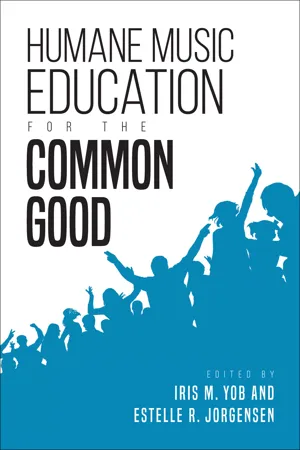
Why teach music? Who deserves a music education? Can making and learning about music serve the common good? A collection of essays considers the answers.
In
Humane Music Education for the Common Good, scholars and educators from around the world offer unique responses to the recent UNESCO report titled
Rethinking Education: Toward the Common Good. This report suggests how, through purpose, policy, and pedagogy, education can and must respond to the challenges of our day in ways that respect and nurture all members of the human family.
The contributors use this report as a framework to explore the implications and complexities that it raises. The book begins with analytical reflections on the report and then explores pedagogical case studies and practical models of music education that address social justice, inclusion, individual nurturance, and active involvement in the greater public welfare. The collection concludes by looking to the future, asking what more should be considered, and exploring how these ideals can be even more fully realized. This volume boldly expands the boundaries of the UNESCO report to reveal new ways to think about, be invested in, and use music education as a center for social change both today and going forward.
eBook - ePub
Humane Music Education for the Common Good
- 288 pages
- English
- ePUB (mobile friendly)
- Available on iOS & Android
eBook - ePub
Humane Music Education for the Common Good
About this book
Information
Publisher
Indiana University PressYear
2020Print ISBN
9780253046918
9780253046901
eBook ISBN
9780253046925
Topic
EducationSubtopic
Education Theory & PracticePART I
CRITIQUE AND CLARIFICATION
1
THERE IS NO OTHER
Iris M. Yob
IT IS RARE FOR THE TITLE OF A publication to end with a question mark, but the 2015 UNESCO document Rethinking Education: Towards a Global Common Good? does just that.1 In this case, the question mark captures the central tension in simultaneously thinking globally about the welfare of all while valuing diversity and individual differences. Can one speak of a common good or a single common good when rethinking an education that is appropriate across worldwide contexts, challenges, and opportunities? In this chapter, I will explore whether the tensions can be resolved and, if so, how. I will do so by exploring the apparent conflict between the concept of “the Other,” which recognizes the individuality of each member of the human family, and the concept that there is no Other, which embraces everybody regardless of their differences.
The Other: Humanity Up Close
A significant reality faced by teachers and educational policy makers for every age group is the substantial diversity among learners. Individual readiness, abilities, interests, and needs present themselves to teachers who want to do their best for each student. Then there are personal histories and inherited differences to take into account, which can determine if the match between the individual learner and the official curriculum is a good one or a soul-destroying mismatch that imprisons the student in an educational environment that saps his or her curiosity and discourages active engagement in learning and personal development. Teachers have long recognized these differences, and many experiment with ways to meet the individual needs of each learner in their care.
Of course, this diversity manifests in more than learning readiness and inherited and cultivated abilities. A recognition of multiculturalism has become standard in referring to diversity in society and in the classroom. Racial and ethnic backgrounds help form our self-understanding, perception of the world, and values and belief systems, as well as shaping how others see us and respond to us. These backgrounds give us language and the words we use to communicate and make meaning. Across our communities, there are others whose skin tone is different and who dress in different clothes, eat different foods, sing different songs, play different instruments, enjoy different games, speak different languages, and worship different deities in different ways and in different sacred places. Add to this mix the range of differences in gender and sexual orientation and identity, age, physical ability and appearance, political affiliation, family background, geographic location, life experiences, loves, hopes, dreams, and fears. Getting our heads around the “booming, buzzing confusion” of the world around us is a formidable task.2 It is a task that teachers in both formal and informal educational settings need to be responsive to in ways that promote the well-being and personal development of each individual in their care.3
The apparent diversity in our communities and educational institutions has compelled us to examine the notions of equality and fairness. Equality demands that everyone has the same opportunities and access to resources. Fairness acknowledges that equality cannot be determined by quantity alone but may mean differences in the kinds of offerings we provide. For instance, a differently abled learner may need a one-on-one caretaker, mentor, or teacher’s aide to participate in classroom exercises with everybody else; a Muslim teenage girl may be better served by a girls-only swim class; the choice of repertoire or performance venue for a school choir may need to be chosen with sensitivity to the different affiliations and belief systems of the choir members and their parents.4 Such accommodations may challenge the notion of “equality” if understood rigidly or simplistically; they demand creativity in conception and practice to maximize fairness for all. The fundamental goal of equality and fairness is inclusion. No one is to be left out despite his or her differences, even if inclusion requires accommodations.
Postmodernism shares with multiculturalism a number of key premises: “a valuation of marginality, a suspicion of master discourses, a resistance to empty conventions.”5 It allows different interpretations of shared facts and even the existence of facts that may have been automatically filtered out by one’s assumptions and beliefs. It does not, however, support propaganda created to convince others of a particular account or ideology, such as “alternative facts” and “fake news,” because they lack evidence, reason, and integrity in any shared system of meaning making. Postmodernism challenges our self-understanding and worldviews by acknowledging the existence of and validating the Other, including even the “nomads” or “schizophrenics” in our society.6 For instance, a person may be white and, therefore, mainstream but also a woman, making her a nomad in a man’s world, just as an old person is a nomad in a young person’s world. Someone who is gay, wheelchair-bound, and an immigrant may hold multiple senses of self. When followed through to its logical conclusion, we become increasingly aware that we too are Other—we may be multiple Others within ourselves or may be nomads out of the mainstream. And we are certainly Other to others.
Postmodernism has opened the door to new words and concepts as we respond to this growing awareness of the Other. Poststructuralism is one natural companion of postmodernism, with its fundamental premise that the interpretation of texts, how one reads and understands something written by another, or even something enacted, played, or sung, is not necessarily what is intended by the author or performer but is determined by the reader/watcher/listener’s personal history, context, intentions, and values. So, multiple possible interpretations and meanings can be ascribed to every text and act. For teachers, this means that each learner can be seeing and hearing and viscerally experiencing something different in a shared learning event.
Deconstruction is another companion of postmodernism. Its basic premise is that words are not reality but signifiers and therefore notoriously unreliable. Claims made in a modernist mode are taken as certain, universally applicable, and stable; claims seen through the lens of postmodernism can be questioned because they are individually or locally understood and, therefore, changeable and open to interrogation. In other words, what one individual takes as inalienable truth is possibly just one truth among many possible truths at any particular moment in time—or possibly even an untruth for some. Failure to acknowledge the possibility of multiple truths can result in policy actions, teaching approaches, and communal relationships that are inimical and violent to some Others.
In an extreme form, deconstructionist ideas are nihilist; that is, they lead to the conclusion that there can be no certainties. In a less extreme form, deconstruction is a critical approach to what we know. It encourages us to interrogate and problematize key concepts, assumptions, and truisms that we might have taken for granted and that might alienate us from others or at some level do harm to others by violating their very way of thinking and being. This approach can open us to new possibilities and alternative worldviews, or at least to the very real possibility that there are alternatives.
Understanding the Other—and there are grave concerns about whether this is even possible—or at least acknowledging to ourselves that there are Others requires us to take a close-up view of the human family. It has given added impetus to the various rights movements: civil rights, women’s rights, LGBT rights, and the rights of the differently abled, for instance. Each of these movements has taken as fundamental that the differences exhibited by individual groups should be protected and included in social policy, access to resources, and fair treatment. “Politically correct” language, or how we talk about the Other, and the inclusiveness and sensitivity to differences that we demonstrate in our discourse has grown out of the same root, no matter how disparaged it may have become.
When mishandled and incomplete, however, the close-up view can also tempt us into classifying and stereotyping, sorting and dividing, identifying and separating. The rifts between different others can promote wariness and even fear of the Other—fear of losing one’s own identity in a morass of legitimate othernesses, fear of the challenges others might pose to one’s cherished way of being and the sharing of resources that might be required, fear of an implicit requirement to change. Because of these fears, schools may assume the responsibility, tacit or explicit, to move the Other toward being more mainstream and therefore more “acceptable”—to moderate and dominate, rather than include and smooth the sharp edges of exception, to create a sameness (that can end up being dull and monochromatic). So, the close-up view must go deep, pushing through any initial fear and reticence to a fuller acceptance and celebration of the differences within the human family. This is where a humane music education takes place.
There Is No Other: The Wide-Angle View
While the close-up view of humanity is a preferred option for all of us living effectively in today’s world and mandatory for teachers who must respond to differences every day and in every learning event, the wide-angle view is equally compelling. As our view zooms out to encompass increasingly wider sweeps, from individuals to classrooms, communities, nations, and the world, human beings begin to merge into one, differences become fuzzier, and commonalities across all individuals emerge. If we zoom out far enough, we begin to see the common humanness, the shared history and potential futures, and the common ecological system in which that humanity exists, to which it contributes, and by which it is nurtured. The wide-angle view is also a preferred option.
The expression “There is no Other” both acknowledges the existence of the Other and simultaneously affirms something more than otherness.7 It is an iteration of much moral philosophy and the fundamental ethic of the world’s religions: “Do unto others as you would have them do unto you.”8 The Golden Rule, as the statement is best known, invites one to see the Other in oneself and oneself in the Other. It blurs the differences that might exist among us as human beings and encourages us to reach for a common humanity that collectively knows pains, fears, needs, hopes, aspirations, and dreams. This goes beyond empathy for others to embrace a oneness with others.
With public discourse that seems dominated by extremists on all sides and entre...
Table of contents
- Cover
- Title Page
- Copyright
- Contents
- Introduction: Education for the Common Good in a Diverse World / Iris M. Yob
- Part I: Critique and Clarification
- Part II: Pedagogy and Teacher Preparation
- Part III: Educating Others for the Common Good
- Part IV: Elaborations and Expansions
- Conclusion: On Making Music Education Humane and Good: Gathering Threads / Estelle R. Jorgensen
- Index
Trusted by 375,005 students
Access to over 1.5 million titles for a fair monthly price.
Study more efficiently using our study tools.
Frequently asked questions
Yes, you can cancel anytime from the Subscription tab in your account settings on the Perlego website. Your subscription will stay active until the end of your current billing period. Learn how to cancel your subscription
No, books cannot be downloaded as external files, such as PDFs, for use outside of Perlego. However, you can download books within the Perlego app for offline reading on mobile or tablet. Learn how to download books offline
Perlego offers two plans: Essential and Complete
- Essential is ideal for learners and professionals who enjoy exploring a wide range of subjects. Access the Essential Library with 800,000+ trusted titles and best-sellers across business, personal growth, and the humanities. Includes unlimited reading time and Standard Read Aloud voice.
- Complete: Perfect for advanced learners and researchers needing full, unrestricted access. Unlock 1.5M+ books across hundreds of subjects, including academic and specialized titles. The Complete Plan also includes advanced features like Premium Read Aloud and Research Assistant.
We are an online textbook subscription service, where you can get access to an entire online library for less than the price of a single book per month. With over 1.5 million books across 990+ topics, we’ve got you covered! Learn about our mission
Look out for the read-aloud symbol on your next book to see if you can listen to it. The read-aloud tool reads text aloud for you, highlighting the text as it is being read. You can pause it, speed it up and slow it down. Learn more about Read Aloud
Yes! You can use the Perlego app on both iOS and Android devices to read anytime, anywhere — even offline. Perfect for commutes or when you’re on the go.
Please note we cannot support devices running on iOS 13 and Android 7 or earlier. Learn more about using the app
Please note we cannot support devices running on iOS 13 and Android 7 or earlier. Learn more about using the app
Yes, you can access Humane Music Education for the Common Good by Iris M. Yob, Estelle R. Jorgensen, Iris M. Yob,Estelle R. Jorgensen in PDF and/or ePUB format, as well as other popular books in Education & Education Theory & Practice. We have over 1.5 million books available in our catalogue for you to explore.