NAMED A BEST BOOK OF THE WEEK BY THE NEW YORK POST
ALSO AVAILABLE AS AN AUDIOBOOK
A from-the-trenches view of New York Daily News and New York Post runners and photographers as they stop at nothing to break the story and squash their tabloid arch-rivals.
When author Mike Jaccarino was offered a job at the Daily News in 2006, he was asked a single question: "Kid, what are you going to do to help us beat the Post?" That was the year things went sideways at the News, when the New York Post surpassed its nemesis in circulation for the first time in the history of both papers. Tasked with one job—crush the Post—Jaccarino here provides the behind-the-scenes story of how the runners and shooters on both sides would do anything and everything to get the scoop before their opponents.
The New York Daily News and the New York Post have long been the Hatfields and McCoys of American media: two warring tabloids in a town big enough for only one of them. As digital news rendered print journalism obsolete, the fight to survive in NYC became an epic, Darwinian battle. In America's Last Great Newspaper War, Jaccarino exposes the untold story of this tabloid death match of such ferocity and obsession its like has not occurred since Pulitzer– Hearst.
Told through the eyes of hungry "runners" (field reporters) and "shooters" (photographers) who would employ phony police lights to overcome traffic, Mike Jaccarino's memoir unmasks the do-whatever-it-takes era of reporting—where the ends justified the means and nothing was off-limits. His no-holds-barred account describes sneaking into hospitals, months-long stakeouts, infiltrating John Gotti's crypt, bidding wars for scoops, high-speed car chases with Hillary Clinton, O.J. Simpson, and the baby mama of a philandering congressman—all to get that coveted front-page story.
Today, few runners and shooters remain on the street. Their age and exploits are as bygone as the News–Post war and American newspapers, generally. Where armies once battled, often no one is covering the story at all.
Funding for this book was provided by: Furthermore: a program of the J. M. Kaplan Fund
eBook - ePub
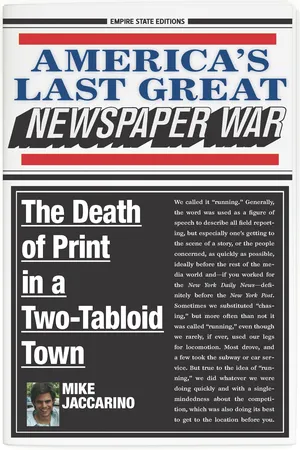
America's Last Great Newspaper War
The Death of Print in a Two-Tabloid Town
- 336 pages
- English
- ePUB (mobile friendly)
- Available on iOS & Android
eBook - ePub
About this book
Information
Publisher
Empire State EditionsYear
2020Print ISBN
9780823298518
9780823287383
Edition
1eBook ISBN
9780823287390
1

“Serb Thug to New York …
Kiss My Ash”
Kiss My Ash”
New York Post headline, June 27, 2008
WE CALLED IT “RUNNING.” Generally, the word was used as a figure of speech to describe all field reporting, but especially one’s getting to the scene of a story, or the people concerned, as quickly as possible, ideally before the rest of the media world and—if you worked for the New York Daily News—definitely before the New York Post. Sometimes we substituted “chasing,” but more often than not it was called “running,” even though we rarely, if ever, used our legs for locomotion. Most drove, and a few took the subway or car service. But true to the idea of “running,” we did whatever we were doing quickly and with a single-mindedness about the competition, which was also doing its best to get to the location before you. The “running,” as I said, didn’t so much concern the actual act as the way you hustled and the consequences of arriving late.
A reporter who “ran” was called a “runner,” while a photographer was called a “shooter,” although when a shooter was engaged in pursuing a story—and especially breaking news—his pursuit of that story, and hustle to the scene of it, was called “running” as well. You might, therefore, have asked a shooter about his day and received the reply, “I ran on two MVAs [motor vehicle accidents] in Borough Park and Brownsville, then on an EDP [emotionally disturbed person] in East New York.”
Some shooters carried scanners to eavesdrop on the NYPD’s and FDNY’s dispatch frequencies and thus know when and where news was breaking. By doing so, they might achieve a head start on their running versus the opposition. One News shooter even jury-rigged a scanner into the console of his car amid a shrine-like arrangement of photos portraying NYPD and FDNY officers. These were prayer cards from the funerals he’d covered after 9/11, although they acted, for him, as more than just dashboard ornaments. One day, he confided to me that “those dead heroes watch over me” from beyond their graves and that he needed such protection because he often drove recklessly, going the wrong way on oneway streets, to reach breaking-news scenes before the Post or, worse, the NYPD shut them down to the media.*
This was Daily News shooter Todd Maisel, and Todd had a practiced method for running, or rather being in good position once the scanner crackled to life and the running began. Todd told me that when he wasn’t otherwise engaged in a scheduled assignment, or covering breaking news, he spent summer days at Coney Island, near the pier, so as to be close enough to document any swimmers caught up by rip tides. In the winter, he parked near Prospect Park’s skating pond in an equally grim vigil for anyone who might fall through the ice. If you called Todd on his cell phone and got voicemail, his recorded message was “Hi, this is Todd Maisel. I’m at a homicide or a fire. Leave a message.”
While some shooters like Todd used police scanners, others invested in a BNN, or Breaking News Network pager, which outsourced the monitoring of the NYPD and FDNY frequencies to a third party. This contractor then culled newsworthy events from the chaff of mundane chatter and forwarded the specifics along to a pager in the form of text notifications. Some photographers harbored phony police lights that could be affixed to a roof mount on their vehicles to aid in the navigation of traffic while running to a scene. Todd, in particular, was renowned for driving on the Brooklyn–Queens Expressway’s shoulder while employing such a yellow light, dodging mountains of traffic citations only by virtue of a hoarded treasure in PBA cards. Regardless, had he been cited, the fine could then have been expensed to and reimbursed by the News, or argued in court with the aid of a form letter curated by the photo desk. This form letter had spaces allocated for media affiliation, the description of the circumstances that had led to the citation, and an explanation of how the demands of serving the public good as a journalist offset the danger one had posed to society by breaking the law. In some cases, I knew journalists to fill out this last area with rhetoric far more befitting a civil rights attorney’s closing argument than any pleading for leniency from a traffic violation. Regardless, runners and shooters did not slow for fear of additional citations. The reality of competition and the incredibly short half-life of breaking news ensured that, if anything, they ran even harder.
Back then, the News and the Post assigned shooters geographic areas in which they would wait, often in their vehicles, monitoring NYPD and FDNY dispatch. Then and once they heard broadcast of an incident constituting breaking news, the race, or running, began. At the time of this narrative, Todd had South Brooklyn for the News and Gary Miller had it for the Post; Debbie Egan-Chin had North Brooklyn for the News and Paul Martinka had it for the Post; Michael Schwartz and Sam Costanza had northern Manhattan and the South Bronx for the News and Robert Kalfus had it for the Post; Anthony DelMundo had much of Queens for the News and Ellis Kaplan covered it for the Post. Each tabloid could thus better reach breaking-news scenes—or just “scenes”—before the other. Runners, on the other hand, were typically dispatched from the newsroom or permitted to linger near their homes until the demands of breaking news required otherwise. It should be noted that the aforementioned shooters were in addition to the armies fielded to surveil certain locations of import, or just float from place to place as a supplement to those already listed.
The Daily News runner Kerry Burke once said the first thing he considers after receiving an assignment is “How in Christ am I going to get there first? You need to get there before everything shuts down, before the police version is rehearsed, while the actual witnesses are still around. You need to get a participant, a principal to the story. If that means commandeering a cab, it’s commandeering a cab!”1
Newsday, the Long Island tabloid, employed a runner named Matt Nestel who often arrived late to scenes, or later than the News and the Post, not through any fault of his own but because Newsday took only an occasional interest in city affairs and typically got tips long after its more plugged-in rivals. Nestel often had to timidly ask victims, and loved ones, to repeat what they’d already said, and what he got was rarely as good as what the News and the Post had gotten. Nobody wanted to discuss a loved one’s murder a single time, never mind twice, for late-arriving reporters who’d missed the first act. And even if they did, what they said was rarely as good as that first, almost sublime, go ’round, when all their anguish and anger came right out of their hearts and into your notebook. After that, they often became numb. But, as I said, Matt’s tardiness was through no fault of his own.
Those who ran worked “the street,” as opposed to “rewrite” reporters who cobbled the quotes, color, and facts that runners obtained in the street—then phoned to the newsroom—into polished, published accounts. Some runners were deemed “monsters” and others soft. It was hard to come back once a runner was branded one or the other, but not impossible. A few good “gets” could redeem anyone and especially if a News or Post runner had gotten them and their rival had not. In this way, runners developed reputations, which were hard-won and preceded them. They meant the world to us. Sometimes, after ten days on stakeout in front of the same address, they felt like all we had.
Most runners smoked, the routine necessity of loitering in a single place for long periods demanding some method of reliable distraction. It was during my time on the street I became first a casual smoker, then a committed one. Most, too, lived on bodega diets, pizza, anything obtained quickly and scarfed en route back to the stakeout, or scene, you had dangerously abandoned to obtain food. Often, you agreed with the Post to go simultaneously (the same applied to bathroom breaks), but if you went, and they didn’t and then scored, you likely would not get another chance to apply the lesson you had learned.
Concerning dress, most runners wore some variation of jeans and a button-down, casually dressed as one might be on a Saturday afternoon for a street fair or football game. Some took this casualness too far—News runner Matt Lysiak comes to mind—and wore shorts and a T-shirt, although even Matt donned jeans and a sweater or button-down when temperature, or circumstances, demanded. Most, if not all, runners wore sneakers. And I would say the corps, as a whole, mistrusted any runner who wore dress shoes to a scene. One, I recall, consistently wore penny loafers and became an object of scorn behind his back and derision not behind his back, although in the latter case the derision was tempered in the form of teasing. Whoever was teasing him might have believed they were doing him a favor—but in that way, he never comprehended the seriousness of his offense and so persisted in the wearing of penny loafers.
There was a specific reason for dressing casually, apart from the obvious demand for comfort in a job requiring you to spend considerable time outdoors, or loitering for long periods—that is, we didn’t want to stand out too much from the crowds in the poor neighborhoods where violent crime most often occurred and to which we, as runners, were most often dispatched. Also, we dressed casually so the inhabitants of these neighborhoods might feel some solidarity when solicited for a quote. The thinking went that if you looked too well-to-do, you were more likely to inspire contempt than sympathy, no matter what might be the realities of your paycheck and its similarities to that of the source to whom you were speaking. Also, we didn’t want anyone mistaking us for a cop. In many such neighborhoods, no one would talk to you if they thought you were one, whereas they might if you were only a reporter, and especially a slovenly dressed one. There were, of course, situational-specific departures from this general rule of dressing casually. If one were, say, sneaking into a wedding or a funeral—and in the latter case, especially to eavesdrop on the eulogy—you would likely dress in the mode of those in attendance, or perhaps even leverage a pair of penny loafers to your advantage. But, as I said, you wouldn’t want to wear such shoes unless there was a good reason.
A few runners and shooters achieved such respect among their colleagues that they were permitted certain eccentricities concerning dress. Kerry Burke, for one, wore the same outfit every day—a white collared shirt, black jeans, black tie, and black shoes that came as close to being sneakers without crossing the line. When temperature demanded, he added a hoodie and an overcoat—an outfit, in sum, theoretically underpinned with notions contradicting the aforementioned prevailing wisdom among runners. As Kerry once said:
We’re walking into their lives, very often on the worst day of their lives. They don’t owe us anything [and] this might seem like an old Catholic-school boy, but I … show up with a shirt and tie. Basically, they don’t know me from jack, and I’m going into their homes, their places of worship, their hospital rooms. A shirt and a tie convey respect. It’s very basic stuff. It also conveys authority: I’m someone you should talk to. I mean, it’s not something I grew up doing. Hell, I was a rock critic for a number of years with a ripped T-shirt and a leather jacket. But this is a remarkably different game. And dress shoes. Always wear dress shoes. People look at your shoes. Dress shoes say you’re important. They say you’re official. They say you’re employed. People respond to that. I’m nobody special; I just happened to be the dude in the shirt and tie. I’m always looking at these cats that show up looking like second-string Hunter S. Thompsons. People don’t respect them. Detectives don’t want to talk to them.2
But Kerry’s outfit wasn’t the most interesting part of his attire. That would be the book bag that he wore perpetually slung over his shoulder and whose contents the New York Times once described as “tools for survival and infiltration, including a heavy-duty flashlight and enough trail mix for a 24-hour stakeout.”3 And maybe because this account left room for speculation, but more likely because we loved all things Kerry, runners from both the News and the Post filled our long stakeout hours concocting outlandish inventories for the bag. Grappling hooks! Granola! Pens! Wigs! Mustaches! Spare notebooks! In that same Times story, Kerry was quoted as telling tabloid rookies, “You have not adequately covered a homicide if your shoes are not wet with the victim’s blood.”
Daily News shooter Marc Hermann preferred a vintage approach to daily attire, dressing as an actor would in, say, a 1920s period drama. (Marc did audition for and appear as an extra in several such shows, including Cinemax’s “The Knick.”) Every day, he wore outfits from that era—big, wide ties; suit vests; and fedoras with his NYPD-issued press credential stuck under the hat band as they did in the days of Winchell—appropriate in some sense because, for newspapers, at least, their trajectory was mostly downhill from there.
And then there was Todd, who didn’t dress unusually unless the stakes of a given story, as it concerned the News’ battle with the Post, had reached sufficient levels of hysteria. Then he would retrieve from the trunk of his Chevy Malibu what looked like a bulletproof vest but was, in fact, the flak jacket he’d worn while embedded with U.S. troops during the second Iraq war. He’d drape this over his photographer’s/fly fisherman’s vest and work in that fashion. I once asked him about the jacket and he replied, “Because when you go to war, you have to bring the right equipment.” The war, of course, no longer concerned America’s battle with Saddam Hussein but the News’ struggle with the Post.
Most of the time, a runner’s day concerned the carrying out of what were called “door knocks.” Someone had been shot. Someone had been named in a legal action. The tabloid’s “library,” or research department, would trace that person’s address—and those of their relatives, associates, or anyone in a position to lend context, color, quotes, and “studio”* photographs. It was the runner’s job to get to these locations, knock on the door, and convince whoever answered in that ten-or-so seconds before they slammed it shut to discuss something immensely personal. Some runners made an art of the door knock and routinely delivered. Others had spottier records. In the aggregate, I imagine, the art involved was the same as, or similar to, that of making a cold call to hawk a parcel of stock.
Some door knocks were impossible, and no matter what the runner said, the person simply would not talk. Maybe they had money and felt above having their name in the paper. Or they lived in some big, fancy house in a fancy ZIP code and felt entitled to politely tell the runner to fuck off. Then there were door knocks where negligence was involved—and the person who answered, or their kin, was a plaintiff in a civil action naming the city, their landlord, building super, the mayor, and/or even the commissioner of police; and in those instances they’d present you with a business card embossed with their lawyer’s name, the one who had directed them not to—under no circumstances—talk.
Conversely, there were door knocks in which the person’s willingness to speak, even zest for the opportunity, made it impossible to fail. They opened the door and reacted as if they’d been awaiting your arrival. Maybe they were angry society—the city or the NYPD had somehow failed them and they had an axe to grind in print. Or maybe they felt so long neglected by the same institutions that now, here, was that rare, if not singular, instance when people actually cared about their thoughts and what they had to say—and they felt honored that their private pain was finally deserving of public attention.
But most of the time the person who answered the door was surprised by your interest. Sure, they felt put off, or at least initially, by questions conce...
Table of contents
- Cover
- Title Page
- Copyright
- Dedication
- Contents
- Prologue: “Shell Shock for News Nuts”
- 1 “Serb Thug to New York … Kiss My Ash”
- 2 “All Play, No Pay for Page Fix”
- 3 “Ford to City: Drop Dead”
- 4 “Cops Shoot Groom Dead”
- 5 “N.J. Miss in a Fix Over Her Pics!”
- 6 “2 Cops Shot During Traffic Stop”
- 7 “Tracked Down and Busted in Pa. Woods”
- 8 “Sports’ Worst Nightmare”
- 9 “‘Mayday’ Last Call from Doomed Bravest at Ground Zero”
- 10 “The Juice Is on the Loose: O.J. Simpson Leaves Jail after Posting $125,000 Bail”
- 11 “Preppie Killer Robert Chambers Acts Like a ‘Dumb’ Doper”
- 12 “Legend of Jim Leyritz’s Swing against Braves Spoiled by His Swigs”
- 13 “If Spitzer Really Wore Socks in Bed, May Mean Fear of Intimacy: Sex Experts”
- 14 “Ma Goes to Bat for Derek Jeter”
- 15 “What to Tell Kids When Daddy Has Two Families”
- 16 “Temple of Doom … Madoff Fleeced Fifth Avenue Synagogue”
- Glossary
- Notes
- Index
Trusted by 375,005 students
Access to over 1.5 million titles for a fair monthly price.
Study more efficiently using our study tools.
Frequently asked questions
Yes, you can cancel anytime from the Subscription tab in your account settings on the Perlego website. Your subscription will stay active until the end of your current billing period. Learn how to cancel your subscription
No, books cannot be downloaded as external files, such as PDFs, for use outside of Perlego. However, you can download books within the Perlego app for offline reading on mobile or tablet. Learn how to download books offline
Perlego offers two plans: Essential and Complete
- Essential is ideal for learners and professionals who enjoy exploring a wide range of subjects. Access the Essential Library with 800,000+ trusted titles and best-sellers across business, personal growth, and the humanities. Includes unlimited reading time and Standard Read Aloud voice.
- Complete: Perfect for advanced learners and researchers needing full, unrestricted access. Unlock 1.5M+ books across hundreds of subjects, including academic and specialized titles. The Complete Plan also includes advanced features like Premium Read Aloud and Research Assistant.
We are an online textbook subscription service, where you can get access to an entire online library for less than the price of a single book per month. With over 1.5 million books across 990+ topics, we’ve got you covered! Learn about our mission
Look out for the read-aloud symbol on your next book to see if you can listen to it. The read-aloud tool reads text aloud for you, highlighting the text as it is being read. You can pause it, speed it up and slow it down. Learn more about Read Aloud
Yes! You can use the Perlego app on both iOS and Android devices to read anytime, anywhere — even offline. Perfect for commutes or when you’re on the go.
Please note we cannot support devices running on iOS 13 and Android 7 or earlier. Learn more about using the app
Please note we cannot support devices running on iOS 13 and Android 7 or earlier. Learn more about using the app
Yes, you can access America's Last Great Newspaper War by Mike Jaccarino in PDF and/or ePUB format, as well as other popular books in Languages & Linguistics & Business History. We have over 1.5 million books available in our catalogue for you to explore.