Recently the alarm has been raised – basic freedoms are under attack in our universities. A generation of 'snowflake' students are shutting out ideas that challenge their views. Ideologically motivated academics are promoting propaganda at the expense of rigorous research and balanced teaching. Universities are caving in and denying platforms to 'problematic' public speakers. Is this true, or is it panic and exaggeration?
Carolyn Evans and Adrienne Stone deftly investigate the arguments, analysing recent controversies and delving into the history of the university. They consider the academy's core values and purpose, why it has historically given higher protection to certain freedoms, and how competing legal, ethical and practical claims can restrict free expression.
This book asks the necessary questions and responds with thoughtful, reasoned answers. Are universities responsible for helping students to thrive in a free intellectual climate? Are public figures who work outside of academia owed an audience? Does a special duty of care exist for students and faculty targeted by hostile speech? And are high-profile cases diverting attention from more complex, serious threats to freedom in universities – such as those posed by domestic and foreign governments, industry partners and donors?
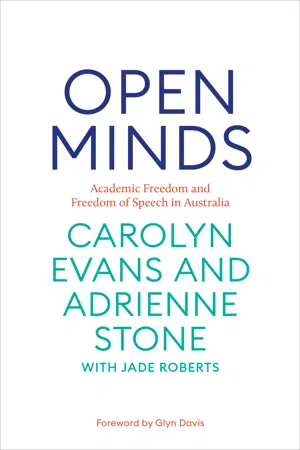
eBook - ePub
Open Minds
Academic freedom and freedom of speech of Australia
- 224 pages
- English
- ePUB (mobile friendly)
- Available on iOS & Android
eBook - ePub
About this book
Information

HISTORICAL CONFLICTS: STUDENT RADICALS AND PINK PROFESSORS
On 4 May 1932, The Age reported that tensions between Labor Club members and other students at the University of Melbourne had boiled over into a series of incidents on campus. A large group of medical students were outraged by seditious comments allegedly made by a student and Labor Club member named Mr Ingwerson, including a statement that the British flag was ‘saturated with the blood of martyrs’. An angry mob ambushed Mr Ingwerson while he ate lunch at a university cafeteria, but he escaped with the help of friends. Later that day, ‘several hundred’ students gathered outside the Labor clubhouse. Three of its members attempted to barricade themselves in the office of the student newspaper, Farrago, but were seized and ‘rushed through a lane formed by the students from the clubhouse door to the lake, into which [they] were thrown’.1
The Age described the scene by the lake:
While they were standing in about 18 inches of water, the crowd of over 1000 students sang the national anthem, and gave cheers for the King and the British Empire, and hoots for the Communist Party. They refused to allow the … students to come out of the lake until they had also sung the national anthem.2
The article goes on to note that ‘several policemen were present during the ducking, but did not interfere’. A spokesperson for the mob ‘said that the demonstration was intended as a gesture to the Communistic element in the university to show that it would not be permitted to interfere with activities that were not in harmony with its own’.3 In an announcement published in Farrago, Professor W.E. Agar, president of the professorial board, was equivocal in his condemnation of the dunking, suggesting some responsibility lay with the Labor Club students themselves.4
As this glimpse of an earlier era shows, universities have long been sites of conflict between students, staff, the political classes and the wider community. From medieval times, when universities were built like fortresses as protection against the townsfolk, who commonly clashed with students, to the current moment, when the pros and cons of deplatforming controversial on-campus speakers are widely debated, the history of universities is replete with examples of political tension, acrimonious debate and even violence. As a result, the scope of academic freedom and the nature of free speech in universities have long been contested issues.
We sometimes hear claims that free speech and academic freedom are in a particularly perilous state in these early decades of the twenty-first century. Students are characterised as intolerant of different points of view, in contrast to previous generations, who enjoyed a vigorous intellectual debate, and academic freedom is said to be under unprecedented attack from the forces of political correctness. On the basis of three studies over a three-year period, the Institute for Public Affairs, a conservative public-policy think tank, claims that ‘the majority of Australia’s universities limit the diversity of ideas on campus’ and ‘there is evidence of increasing censorship at Australia’s universities’.5
However, in considering such claims, we would do well to recall that freedom of speech and academic freedom in Australian universities have been controversial issues for at least a century and have at times been debated on a larger scale and with far greater intensity than they are today. We might also remember that threats to these freedoms have come from both the political left and the political right, and that Australia has tended to avoid the harsher repressiveness seen in other countries. It is sobering to learn about the ways in which illiberal governments around the world have attacked universities as part of orchestrated campaigns of wider political and social repression, and there are examples of liberal democracies with poor records too.6
The historical treatment of universities at home and elsewhere in the world has much to teach us about the importance of protecting academic freedom and free speech from opponents inside and outside the academy. This chapter gives an overview of several periods in Australia’s history in which free speech and academic freedom were put under serious pressure. Trends can be seen. In the early and mid-twentieth century, when the student body was largely conservative, it was left-wing students and academics who came under attack from the government and sometimes other students and staff. It was then the Labor Party that defended intellectual freedom. Over the decades, this dynamic shifted and now students and faculty are more often associated with left-wing and progressive causes, while accusations of intolerance and censorship, and claims that intellectual freedom is under attack, typically come from conservative voices.
The intensity of the debate on these issues, in government and within universities, has also differed over time, as has the willingness of various university leaders to defend the rights of students and staff. Yet there are uncanny echoes in the public condemnation of students and faculty across the decades. Aspects of our language may have changed, but many of the tactics deployed to silence dissenting voices have a long lineage.
Prewar Debates
In the first half of the twentieth century, pacificism and the rise of communism and fascism were hotly debated issues in Australian universities. Pacifism had many proponents in the lead-up to World War I, but the Australian government and many others saw it as a serious threat to the country’s military strength. Academics who vocally opposed war were strongly criticised by the government and the public.7 As early as 1902, Professor George Wood, the co-founder of the Australian Anti-War League, was censured by the senate of the University of Sydney, following widespread criticism of his public comments against the Boer War.8
Australia’s engagement in World War I brought these tensions to a head, with pacifists and anti-conscription campaigners, including individuals from within the academy, being treated with hostility by the government and many members of the public. As the war progressed and casualties mounted, Australia’s participation became more unpopular with the general population, who voted down conscription in two plebiscites.9 It was this context that gave rise to the case of Vere Gordon Childe, which has been described as ‘one of the earliest instances of the intervention of the state in academic appointments in Australia’.10
Childe studied at Queen’s College, Oxford, from 1915 to 1917, an experience that strengthened his existing socialist and pacifist views.11 On his return to Australia, Childe campaigned against the introduction of conscription and as a result of his activism was subjected to surveillance by the Department of Defence and had his mail censored.12 He secured a position as a senior resident tutor at the University of Sydney’s St Andrew’s College in November 1917, but he kept the role for little more than six months. At Easter in 1918, Childe addressed a peace conference and in May of the same year the college principal requested he resign, which he did.13 Colleagues who sympathised with Childe’s situation attempted to find other work for him at the university, but in July the university senate refused to appoint him as a tutor in ancient history, apparently on advice from the defence department that his appointment during wartime was undesirable.14
William McKell, a member of parliament in New South Wales and future leader of the Australian Labor Party, raised the issue in parliament, questioning the university senate’s decision and the legality of Childe’s treatment.15 Such protests were to no avail, however, and in 1921, having worked as a schoolteacher and as a speechwriter and private secretary to Labor politician John Storey, Childe left Australia for England, where he went on to have a successful academic career in archaeology.16
The period between the two world wars was also a tumultuous one, and increasing global tension – resulting from the rise of both fascism and communism in 1930s Europe – led to heated discussions on Australian campuses. On 22 March 1937, the University of Melbourne hosted a debate on the Spanish Civil War, organised by the university’s debating society, which examined the contention ‘that the Spanish Government is the ruin of Spain’. The debate pitted the Catholic student group, the Campion Society, against the university Labor Club and Catholic Party.17
Australian historian Manning Clark was in the audience and paints a memorable picture of the scene:
Early in 1937 I had a refresher course in tribal loyalty … To my surprise I entered a room occupied by two howling mobs – one for and one against the Spanish government. It was like being in the outer at a game between Carlton and Collingwood … Before the chairman and the speakers entered the theatre the exchanges between [supporters of either side] were lost in the uproar. Some students ran over the roof to add to the hubbub and noise in the theatre. The chairman … called for order … But his appeals fell on deaf ears.18
Some parties expressed concern that on-campus free speech was under threat. Dubbing the debate a ‘Spanish bull fight’, Farrago reported that the debate’s external speaker, the Reverend J. Gray Robertson, could hardly be heard over the ‘vocal barrage put up by a section of the audience’.19 In a letter to the editor published in the same issue, a reader complained of ‘the ill-mannered interruption’ of Robertson:
The truth or falsehood of the speaker’s statements is quite beside the point; he has come at the invitation of three university societies, and deserved at least the courtesy of a hearing. To unite strong feelings with tolerance of opposed views is not easy, but if this happy union is denied in a university, where can we hope to find it?20
In the wake of the debate, Vice-Chancellor Raymond Priestly called for more tolerance and objectivity in the discussion of current events:
I am a keen supporter of free speech and free discussion in a university. Nevertheless, I have viewed with some dismay certain manifestations arising out of the discussion of social and political questions here, particularly recently. One is a certain intolerance which I believe to be incompatible with dispassionate and unbiased examination of the facts and reasoned discussion and which, it seems to me, have b...
Table of contents
- Cover Page
- Title Page
- Copyright
- Contents
- Foreword
- Acknowledgements
- Introduction
- 1. Historical Conflicts: Student Radicals and Pink Professors
- 2. Laws and Regulations Protecting Academic Freedom and Freedom of Speech
- 3. Academic Freedom
- 4. Freedom of Speech and Its Limits
- 5. Emerging Threats: Funding Models and Research Partnerships
- 6. Fostering Open Minds: Some Practical Options
- Appendix A: A Summary of the ‘Report of the Independent Review of Freedom of Speech in Australian Higher Education Providers’
- Appendix B: A Critical Review of the Institute for Public Affairs’ ‘Free Speech on Campus Audit 2018’
- Notes
- Index
- Back Cover
Trusted by 375,005 students
Access to over 1.5 million titles for a fair monthly price.
Study more efficiently using our study tools.
Frequently asked questions
Yes, you can cancel anytime from the Subscription tab in your account settings on the Perlego website. Your subscription will stay active until the end of your current billing period. Learn how to cancel your subscription
No, books cannot be downloaded as external files, such as PDFs, for use outside of Perlego. However, you can download books within the Perlego app for offline reading on mobile or tablet. Learn how to download books offline
Perlego offers two plans: Essential and Complete
- Essential is ideal for learners and professionals who enjoy exploring a wide range of subjects. Access the Essential Library with 800,000+ trusted titles and best-sellers across business, personal growth, and the humanities. Includes unlimited reading time and Standard Read Aloud voice.
- Complete: Perfect for advanced learners and researchers needing full, unrestricted access. Unlock 1.5M+ books across hundreds of subjects, including academic and specialized titles. The Complete Plan also includes advanced features like Premium Read Aloud and Research Assistant.
We are an online textbook subscription service, where you can get access to an entire online library for less than the price of a single book per month. With over 1.5 million books across 990+ topics, we’ve got you covered! Learn about our mission
Look out for the read-aloud symbol on your next book to see if you can listen to it. The read-aloud tool reads text aloud for you, highlighting the text as it is being read. You can pause it, speed it up and slow it down. Learn more about Read Aloud
Yes! You can use the Perlego app on both iOS and Android devices to read anytime, anywhere — even offline. Perfect for commutes or when you’re on the go.
Please note we cannot support devices running on iOS 13 and Android 7 or earlier. Learn more about using the app
Please note we cannot support devices running on iOS 13 and Android 7 or earlier. Learn more about using the app
Yes, you can access Open Minds by Carolyn Evans,Adrienne Stone in PDF and/or ePUB format, as well as other popular books in Law & Public Law. We have over 1.5 million books available in our catalogue for you to explore.