Friends are good for your health. The strength of your social relationships is a remarkably good predictor of how long you will live. Strong social connections also make communities more resilient, efficient and satisfying. But today Australians have fewer close friends and local connections than in the past, and more of us say we have no-one to turn to in tough times.
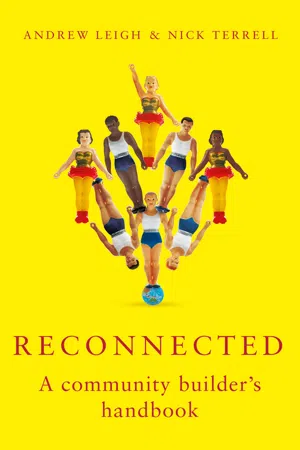
In Reconnected, Andrew Leigh and Nick Terrell look at how we can turn this trend around. Organisations such as parkrun and Greening Australia are mobilising thousands of people to stay fit and improve their local neighbourhoods. Technology is providing new ways to raise funds and to volunteer. And from the popular 'No Lights No Lycra' dance nights to the atheist 'Sunday Assembly' movement, Australians are finding new ways to connect in the twenty-first century.
With optimism and intelligence, Leigh and Terrell show what works and what doesn't when it comes to community-building, and introduce us to some remarkable and inspirational people. Reconnected is an essential guide to for anyone interested in strengthening social ties.
- 304 pages
- English
- ePUB (mobile friendly)
- Available on iOS & Android
eBook - ePub
About this book
Information
1
SOCIAL CAPITAL
Imagine your ideal community. One in which you’ve got plenty of friends, and plenty of time to spend with them. A society where your street is lively and safe, and neighbours are happy to mind your dog when you’re on holiday. Local cafés where people know your name. Creative communities telling Australian stories. More local sporting teams than you can shake a cricket stump at. The kind of politics where people work together to solve local problems, rather than bickering about leaders, slurs and slip-ups.
Suppose that this sense of common purpose extended to the workplace, so that people felt fulfilled in their jobs, respected by their co-workers and valued by their managers. Imagine employment that’s flexible by default, so the boss doesn’t scoff when you say you’d like to work a four-day week so you can care for a relative – or just practise your favourite hobby.
Picture, too, an Australia in which friendships comfortably bridge traditional divides, in which everyone shares a pride in the nation’s 60,000-year Indigenous heritage, volunteers to help those who are down on their luck and takes the time to check in on neighbours who’ve newly arrived from overseas. Envisage the strength that such a connected society has when adversity strikes: volunteer fire brigades at the ready, foodbanks well stocked, community centres prepared.
It’s a world we’d all like to live in – but too often the reality of modern life is rushing past your neighbours (who you really must introduce yourself to one day), getting stuck in traffic, rolling your eyes at the latest social media outrage and wondering how anyone ever finds time to catch up with friends. In Reconnected, we look at how Australia has become more disconnected – and how together we can turn it around.
Living in a more connected way isn’t just pleasurable, it enables us to tackle larger challenges. Problems such as climate change, inequality, inactivity and loneliness threaten our future. Solving them will require collective action. In all of human history, there’s few instances in which a crisis was resolved by one person acting alone.
The missing pieces of Australia’s community-building puzzle are hiding in plain sight. Australia is fortunate to have thousands of inspirational social entrepreneurs in our midst. From sporty types organising weekend fun runs to altruists providing laundry services to homeless people, ‘social capitalists’ are helping to grow a more connected community. Better yet, many are deploying tactics that can be replicated elsewhere. Identifying these common threads is the purpose of our book.
But first, there’s a core concept we need to understand: social capital.

Four hundred and fifty kilometres south of New Zealand’s South Island lies Auckland Island, a cold and hilly landmass. For most of human history, the island has been uninhabited. Then in 1864 something unusual happened.1 In the space of four months, two Australian ships were wrecked at opposite ends of the island: the Invercauld on the northwest, and the Grafton on the south-east.
The Invercauld was under the command of Captain George Dalgarno, who when disaster struck seems to have been focused only on his own survival. Dalgarno’s attitude of ‘every man for himself’ saw six of the twenty-four sailors under him perish in the shipwreck, including a sick young crewman. In the coming weeks, the survivors roamed the island, repeatedly abandoning those who were ill to die on their own. When they caught wild pigs, each man ate as much as he could. One night, William Hervey threw another of the shipwrecked sailors, Fred Hawser, out of their stick shelter on the basis that he was being a ‘nuisance’. Hawser died. A few days later it was discovered that ‘Hervey had been eating some of Hawser’. A year after the shipwreck, a rescue ship arrived. Only three of the Invercauld’s original twenty-five crew survived.
On the other side of the island, things unfolded differently. Commanding the Grafton was Captain Thomas Musgrave. When his ship hit a rocky beach and foundered, Musgrave ordered his men to stay aboard and wait until daylight. They then took ashore food, a gun and a dinghy, and even managed to transfer a critically ill crewmate. Over the coming months, the five Grafton sailors worked together to build a cabin with a stone chimney, dining table and desk. They made a chess set to keep themselves entertained and brewed beer by fermenting a sweet root they dug up (‘It is not very good, but still it is preferable to cold water,’ Musgrave wrote in his diary).2 Under Musgrave’s leadership, they built blacksmith’s bellows and used them to enlarge the dinghy. Eighteen months after being wrecked, they made the 450-kilometre sea journey to New Zealand’s South Island. Because the boat could only carry three safely, two men stayed behind. The voyage was a success, and a rescue vessel returned to pick up the other two sailors. Everyone survived.
The story of the Invercauld and the Grafton tells us something vital about how groups survive and thrive. While one group resorted to cannibalism, the other set about community building. It is telling that Musgrave and his men built a chess set – playing games maintained their morale and their mutual efforts forged a sense of common purpose. The crew of the Grafton built what is known as ‘social capital’, and all survived to tell their stories.
To economists, capital is an asset that can produce a valuable return. One form of capital is physical capital, such as cars and computers. Another is human capital, such as education and know-how. If you’re running a company, you need both the right machines and appropriately skilled workers – a mix of physical and human capital.
But your company probably won’t get far if your workers are constantly bickering, and that’s where social capital comes in. Social capital is the idea that the ties that bind us together have an inherent value. In a society where people don’t trust each other, you have to be on the lookout for cheats and crooks. Commerce becomes tediously complicated. But in a ‘high-trust’ society, things flow smoothly.
The two extremes can be found in the diamond market. In the diamond mines of South Africa, workers are heavily monitored to ensure they do not steal the stones. Pat-downs, x-ray machines and cameras are used at the end of a shift to check that employees have not swiped diamonds. Workers’ uniforms do not have pockets or cuffs. Crafty employees have been known to swallow diamonds or hide them in their shoes. Employers don’t trust their workers, and subject them to extreme scrutiny. But when diamonds arrive in New York, it’s a different story.3 Almost half the world’s diamonds are handled by merchants on 47th Street. A diamond might pass through the hands of seven or eight people, as it is inspected and matched to the right buyer. Each person’s profit margin can be as thin as 1 to 2 per cent, so the payoff from cheating is huge. But the New York Diamond Dealers Club works on trust, with diamonds exchanged based on a handshake or a signature on a receipt. Joining the club is notoriously difficult, because it involves establishing one’s character. Most of the dealers are Orthodox Jews with strong religious and cultural ties to one another. Without such high levels of trust, the 47th Street diamond dealers could never have created such a successful conglomerate.
Social capital is vital for business, but it also makes for a more pleasurable life. A wide network of friends gives you more social options on a Saturday night, and more people with whom to share your joys. Friends, Marcel Proust said, are ‘the charming gardeners who make our souls blossom’.4 Being a member of a club or having a sense of belonging to your neighbourhood increases the likelihood that you feel happy and satisfied with your life.5 Drawing support from family and friends is especially good for wellbeing.6 Social connections can also provide a safety net when hard times hit. Those close to us provide a buffer against loss – in the words of Helen Keller, ‘walking with a friend in the dark is better than walking alone in the light’. Distant connections can help too – if you’re fired, a broad network of loose acquaintances can be useful in helping you find work. Sociologist Mark Granovetter argued that when it comes to job-hunting, what really helps is to have a strong network of ‘weak ties’.7
Friends may be good for your health. There is a strong association between longevity and the strength of a person’s social relationships.8 Indeed, some have argued that social isolation is as dangerous as smoking fifteen or more cigarettes each day, and more dangerous than binge drinking or obesity. Randomised trials that have improved participants’ social capital and then measured their health relative to a control group find weaker evidence of the link between social capital and health. But even among these more rigorous studies, there is some evidence that improved social capital leads to better self-reported health and wellbeing.9
Volunteering is also linked to a range of positive outcomes. Researcher Stephen Post found that volunteering is associated with happiness, health and longevity.10 Volunteers feel healthier, sleep better, are less stressed and better able to adjust to change, and have a higher sense of self-worth and value to their community. Post argues that volunteering is so beneficial that doctors should prescribe it to their patients, just as many currently prescribe exercise.11 Community-sector leader Joanne Fritz suggests that volunteering builds community, reduces loneliness, increases socialising, creates new bonds and friendships, helps people develop emotional stability, improves self-esteem, helps people cope with mental illness, increases longevity, reduces the risk of Alzheimer’s, leads to graceful ageing, burns fat, saves lives, improves educational experiences, enhances job prospects, develops corporate communities and is just plain fun.12
Post’s and Fritz’s claims read like the riff of an old-time medicine show, and should be viewed with the same scepticism. After all, correlation doesn’t mean causation. For example, it’s possible that happier and healthier people are more inclined to volunteer in the first place. But a modicum of randomised evidence suggests there may be a modicum of truth in the causal claims. In one experiment, a group of secondary school students were randomly assigned either to do volunteer work assisting younger children or to a control group.13 Four months later, the volunteers had significantly lower cholesterol levels and body mass indices than students in the control group. Another experiment asked primary school students to perform three acts of kindness each week.14 Compared with a randomly selected control group, students who performed the acts of kindness were rated as more popular by their peers, gaining an average of 1.5 more friends over the four-week period. As developmental psychologist Marilyn Price-Mitchell puts it, the finding supports the idea that ‘nice guys finish first’.15
Strong social capital may also help political institutions work more effectively. In 1993, political scientist Robert Putnam wrote a pioneering book that aimed to answer the question of why government had always functioned so much more effectively in northern Italy than in southern Italy. Making Democracy Work found that the difference went back to medieval times, with the north having more social institutions, such as football tournaments, choral societies and neighbourhood associations. Drawing on the work of sociologist James Coleman, Putnam concluded that local governments work best where civil society is strongest – a finding that has since been reinforced in dozens of different studies around the globe.
Social capital is also intertwined with egalitarianism. In their 2020 book The Upswing, Putnam and Shaylyn Garrett describe the Gilded Age era of the late 1800s in the United States as ‘highly individualistic, starkly unequal, fiercely polarized, and deeply fragmented’. By the 1960s, the country had become more equal, more generous and more socially engaged. But then the trend reversed, and America today is increasingly split apart. The United States has gone from being an individualistic ‘I’ society to a connected ‘we’ society, then back to an individualistic ‘I’ society again. Globally, it turns out that countries which are more equal are also more socially cohesive.16 As the French might put it, égalité and fraternité go together. If you care about reducing the gap between rich and poor, you should worry about how Australian social life is coming apart.
Recognising the importance of social capital, researchers set about tracing the trends in community life. While no single measure sums up the level of social capital in a community, a variety of indicators point in a similar direction. In his 2000 book Bowling Alone, Putnam documented the decline in civic community from the 1960s to the 1990s by drawing on surveys showing that Americans were less likely to know their neighbours and less inclined to trust one another. Fewer families ate dinner together or had friends over to their homes. And since Bowling Alone was published, the decline has continued. Americans have fewer close friends and are less trusting of each other.17 Confidence in business, media and religious organisations and politicians has decreased.
Across many other advanced nations, research teams uncovered similar trends. Voter turnout at elections, membership of political parties, union membership and church attendance have fallen.18 In many European nations, including Britain, Germany, France and Spain, civic institutions are fraying.
In Australia, my (Andrew’s) book Disconnected was published in 2010, a decade after Bowling Alone. It found that Australians are less likely to be active members of any organisation than we were in the 1960s. Specific mass-membership organisations – such as Scouts, Guides, Rotary and Lions – attracted a smaller share of t...
Table of contents
- Cover Page
- Title Page
- Copyright
- Contents
- 1. Social Capital
- 2. Dissecting the Disconnection Disaster
- 3. Volunteering
- 4. CyberConnecting
- 5. Getting Active
- 6. Fostering Philanthropy
- 7. Social Connections and Social Purpose
- 8. Spiritual Connections
- 9. Politics Please
- 10. Leadership Lessons
- 11. Reconnecting Australia
- Acknowledgements
- Endnotes
- Index
- Back Cover
Trusted by 375,005 students
Access to over 1.5 million titles for a fair monthly price.
Study more efficiently using our study tools.
Frequently asked questions
Yes, you can cancel anytime from the Subscription tab in your account settings on the Perlego website. Your subscription will stay active until the end of your current billing period. Learn how to cancel your subscription
No, books cannot be downloaded as external files, such as PDFs, for use outside of Perlego. However, you can download books within the Perlego app for offline reading on mobile or tablet. Learn how to download books offline
Perlego offers two plans: Essential and Complete
- Essential is ideal for learners and professionals who enjoy exploring a wide range of subjects. Access the Essential Library with 800,000+ trusted titles and best-sellers across business, personal growth, and the humanities. Includes unlimited reading time and Standard Read Aloud voice.
- Complete: Perfect for advanced learners and researchers needing full, unrestricted access. Unlock 1.5M+ books across hundreds of subjects, including academic and specialized titles. The Complete Plan also includes advanced features like Premium Read Aloud and Research Assistant.
We are an online textbook subscription service, where you can get access to an entire online library for less than the price of a single book per month. With over 1.5 million books across 990+ topics, we’ve got you covered! Learn about our mission
Look out for the read-aloud symbol on your next book to see if you can listen to it. The read-aloud tool reads text aloud for you, highlighting the text as it is being read. You can pause it, speed it up and slow it down. Learn more about Read Aloud
Yes! You can use the Perlego app on both iOS and Android devices to read anytime, anywhere — even offline. Perfect for commutes or when you’re on the go.
Please note we cannot support devices running on iOS 13 and Android 7 or earlier. Learn more about using the app
Please note we cannot support devices running on iOS 13 and Android 7 or earlier. Learn more about using the app
Yes, you can access Reconnected by Andrew Leigh,Nick Terrell in PDF and/or ePUB format, as well as other popular books in Social Sciences & Cultural & Social Anthropology. We have over 1.5 million books available in our catalogue for you to explore.