The burgeoning film industry in the Weimar Republic was, among other things, a major site of German-Jewish experience, one that provided a sphere for Jewish "outsiders" to shape mainstream culture. The chapters collected in this volume deploy new historical, theoretical, and methodological approaches to understanding the significant involvement of German Jews in Weimar cinema. Reflecting upon different conceptions of Jewishness – as religion, ethnicity, social role, cultural code, or text – these studies offer a wide-ranging exploration of an often overlooked aspect of German film history.
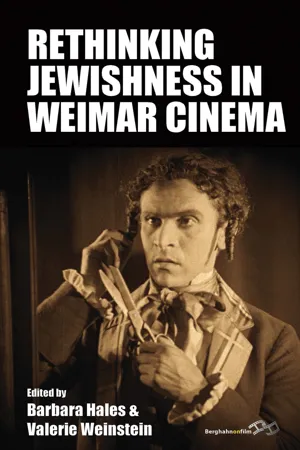
eBook - PDF
Rethinking Jewishness in Weimar Cinema
- 366 pages
- English
- PDF
- Available on iOS & Android
eBook - PDF
Rethinking Jewishness in Weimar Cinema
About this book
Information
Table of contents
- Contents
- Figures
- Acknowledgments
- Introduction — The Jewishness of Weimar Cinema
- Part I — Jewish Visibility On and Off Screen
- Chapter 1 — Humanizing Shylock: The “Jewish Type” in Weimar Film
- Chapter 2 — Energizing the Dramaturgy: How Jewishness Shaped Alexander Granach’s Performances in Weimar Cinema
- Chapter 3 — The Jewish Vamp of Berlin: Actress Maria Orska, Typecasting, and Jewish Women
- Chapter 4 — Jewish Comedians beyond Lubitsch: Siegfried Arno in Film and Cabaret
- Chapter 5 — Alfred Rosenthal’s Rhetoric of Collaboration, the Politics of Jewish Visbility, and Jewish Weimar Film Print Culture
- Part II — Coding and Decoding Jewish Difference
- Chapter 6 — Two Worlds, Three Friends, and the Mysterious Seven-Branched Candelabrum: Jewish Filmmaking in Weimar Germany
- Chapter 7 — Homosexual Emancipation, Queer Masculinity, and Jewish Difference in Anders al die Andern (1919)
- Chapter 8 — Der Film ohne
- Chapter 9 — “The World Is Funny, Like a Dream”: Franziska Gaal’s Verwechslungskomödien and Exile’s Crisis of Identity
- Part III — Jewishness as Antisemitic Construct
- Chapter 10 — Cinematically Transmitted Disease: Weimar’s Perpetuation of the Jewish Syphilis Conspiracy
- Chapter 11 — The Einstein Film: Animation, Relativity, and the Charge of “Jewish Science”
- Chapter 12 — “A Clarion Call to Strike Back”: Antisemitism and Ludwig Berger’s Der Meister von Nürnberg (1927)
- Chapter 13 — Banning Jewishness: Stefan Zweig, Robert Siodmak, and the Nazis
- Chapter 14 — Detoxification: Nazi Remakes of E.A. Dupont’s Blockbusters
- Coda
- Chapter 15 — “Filmrettung: Save the Past for the Future!”: Film Restoration and Jewishness in German and Austrian Silent Cinema
- Afterword
- Index
Trusted by 375,005 students
Access to over 1.5 million titles for a fair monthly price.
Study more efficiently using our study tools.
Frequently asked questions
Yes, you can cancel anytime from the Subscription tab in your account settings on the Perlego website. Your subscription will stay active until the end of your current billing period. Learn how to cancel your subscription
No, books cannot be downloaded as external files, such as PDFs, for use outside of Perlego. However, you can download books within the Perlego app for offline reading on mobile or tablet. Learn how to download books offline
Perlego offers two plans: Essential and Complete
- Essential is ideal for learners and professionals who enjoy exploring a wide range of subjects. Access the Essential Library with 800,000+ trusted titles and best-sellers across business, personal growth, and the humanities. Includes unlimited reading time and Standard Read Aloud voice.
- Complete: Perfect for advanced learners and researchers needing full, unrestricted access. Unlock 1.5M+ books across hundreds of subjects, including academic and specialized titles. The Complete Plan also includes advanced features like Premium Read Aloud and Research Assistant.
We are an online textbook subscription service, where you can get access to an entire online library for less than the price of a single book per month. With over 1.5 million books across 990+ topics, we’ve got you covered! Learn about our mission
Look out for the read-aloud symbol on your next book to see if you can listen to it. The read-aloud tool reads text aloud for you, highlighting the text as it is being read. You can pause it, speed it up and slow it down. Learn more about Read Aloud
Yes! You can use the Perlego app on both iOS and Android devices to read anytime, anywhere — even offline. Perfect for commutes or when you’re on the go.
Please note we cannot support devices running on iOS 13 and Android 7 or earlier. Learn more about using the app
Please note we cannot support devices running on iOS 13 and Android 7 or earlier. Learn more about using the app
Yes, you can access Rethinking Jewishness in Weimar Cinema by Barbara Hales,Valerie Weinstein, Barbara Hales, Valerie Weinstein in PDF and/or ePUB format, as well as other popular books in Media & Performing Arts & German History. We have over 1.5 million books available in our catalogue for you to explore.