
- 200 pages
- English
- ePUB (mobile friendly)
- Available on iOS & Android
eBook - ePub
About this book
An inspirational journey from footballer to trader
GOALS TO GOLD tells the fascinating and unexpected story of one man's journey from top-flight football to the cut-and-thrust world of the financial markets.
This book also explores the relationship between sports and trading success - making it the perfect book for any sports fan who's ever wondered whether they could make a go of it in the markets.
Lee Sandford spent 17 years as a professional footballer, playing for Portsmouth, Stoke City, Sheffield United and Reading. But when his career was over, he didnâ??t retire to a pundit's sofa or the golf course. He entered another fiercely competitive world: the stock market.
Goals to Gold tells the story of his days as a footballer and subsequent time as a trader, laying bare the sobering facts of a life scattered with huge achievements, near misses and big disappointments.
Part exploration of the unseen side of football and part introduction to financial trading, it shows how the important qualities in football and trading alike are hard work, determination, patience and sticking to your strategy even when the studs-up tackles are flying.
Packed with real-life, behind-the-scenes stories involving promotion, relegation and trophies in football and trading through booms and busts in the markets, Goals to Gold is a gripping and revealing read - perfect for football fan and trader alike.
PART ONE: THE FOOTBALL YEARS
Chapter One: Hampshire Heaven
Early days in Elephant and Castle
MY FIRST MEMORY of playing football is a somewhat painful one. I was five and my brother Paul was nine. Paul and his friends met up every Saturday to play football on a big concrete area near where we lived. It was probably a series of disused tennis courts that had doubled as netball courts – the kind of nasty, hard surface that could really mess up a kid’s face. I would go along with my dad, who acted as their referee and coach, and watch from the sidelines.
One Saturday I begged dad to let me play and he said I could. I was so excited; I knew I had a lot to prove to these big lads and if I played well, they’d let me play again. Everything was riding on my first appearance. I had been playing one-touch football with Paul and our cousin Chris in our six-foot long front yard and I was confident I could control the ball.
I got put on just before half time and hovered around in centre midfield, waiting for my big moment. Finally it came. Craig Andrews passed me the ball. I caught it easily with my left foot, turned and started dribbling down the left wing. Two seconds later I felt intense pain and heard a big crack. The next thing I knew, I was lying on the ground with dad looking down at me.
I’d knocked myself out. I’d been so busy watching the ball and trying to keep control of it, I hadn’t seen some small goal posts down the wings (presumably erected for a 5-a-side game that would be played on the width of the main pitch). I’d run straight into one of these hard, metal posts and given myself an almighty crack on the head. That was my excuse for not doing well at academic subjects at school sorted; I lost half my brain cells when I was five!
At the time, we were living over a pub in Elephant and Castle where dad was working as a publican. For a place named after a pub, Elephant and Castle lived up to its name as a boozy, petty crime-ridden London borough on the south side of the river, just east of Waterloo. In the early 1970s, the area was still recovering from the extensive bombing it suffered during the Second World War, which had left many people having to double and triple up with their extended families in large Victorian town houses and prefabs.
The general overcrowding and lack of space in London had led the government to spearhead several relocation projects. Keen to get us out of the rundown place we were living in, and give us a bigger and better home, my parents applied for one in Basingstoke.
Move to Basingstoke
Basingstoke is an old Hampshire market town about 50 miles southwest of London. Hampshire County Council had done a deal with London to take some of their overspill and had undertaken a huge new building project. There were housing developments springing up all over the countryside that surrounded Basingstoke. The deal was if you could get a local job, the council would automatically rehouse you.
Looking back to the time just before we moved, Paul was beginning to get into a bit of trouble with our older cousins and local lads. As I looked up to my older brother so much, I have no doubt I would have soon followed in his footsteps. To give Paul and me a better start in life by moving us out of London, my parents had to sacrifice their own social lives, and the proximity to their support network of family and friends. It must have been tough for them, especially at the start, but they may have saved their sons from a life of petty crime and pretty poor prospects.
When dad managed to get a job as a security guard in a large company based in Basingstoke, we were guaranteed a new home in the local area, but the houses and school weren’t quite ready. Dad had to start his new job and give up the pub meaning we temporarily had nowhere to live, so we moved in with my nan for a few months. I was sharing a bed with my brother, we only had an outside toilet and our bath was in the kitchen. It was a far cry from the glamorous life of a professional footballer that I was already starting to dream of!
The first thing that hit me when we finally moved out to Basingstoke was how much space there was. There was the modest development of houses, a school, some shops, and then miles and miles of space for as far as the eye could see. For a kid who wants to run and run, it was heaven. Unlike my parents (I’m sure), I don’t remember missing London for a moment. I was too young for that kind of nostalgic longing. All I could see was the benefit of moving out of the big, overcrowded city and having endless clean, green space to run around in. Once I saw that, I never looked back.
The other thing that was all clean, shiny and new was our school. It had only been open for about three or four years, so Paul’s class, Year Four, comprised the oldest kids in the school. There was no old gang ruling the roost, there was no graffiti or broken equipment. It was ours for the taking.
Furthermore, our sports fields seemed endless. No more playing football on concrete courts; there was lush, green grass everywhere. I quickly became a sports nut. I was good at everything: cricket, football, running, rugby; basically, if it involved running, I was good at it. I was the school sports captain in the making. I was never happier than when I was outside, running around and getting muddy. Of course, this helped detract from the fact I was absolutely useless at my schoolwork!
Weekends in London had been spent hanging around the pub being told not to get in the way; Saturdays and Sundays were dad’s busiest times, with only a few hours off to spend with his kids. By contrast, weekends in our new home were about walking for miles and miles across green fields, and hanging out with dad for hours on end, bird watching through his top-notch binoculars. We were immersed in nature; it was fast becoming an idyllic childhood as far as I was concerned.
Getting serious about football
I probably got more serious about football over other sports because of my best friend at the time, Matt. We’d met at primary school and that’s where we first got really keen on football. Matt’s dad ran the local football team, so as soon as we were old enough and good enough, Matt and I were recruited. By the time we were approaching our teens, we had become local football heroes, playing games every weekend. We were always entering and winning tournaments, leading to cabinets full of trophies and medals.
My dad was instrumental in making it possible for me to play so much football at an early age. He would drive me to practice every Tuesday, and to all the weekend games; he was on my side every step of the way. The only thing dad and I seriously fell out over was our football teams. He supported Chelsea. In defiance, and partly because we had an uncle, Jim, who worked at White Hart Lane, Paul and I had chosen Spurs. My Uncle Jim was a great guy. He sadly passed away recently, but he left a real legacy behind him; many of my family members (myself, Paul, and many of our cousins) are all still huge Spurs fans.
Mum’s support was crucial too. Without her, I wouldn’t have had any kit to play in! Us boys would pile out of the house on a Sunday morning and return several hours later, happy, exhausted and covered in mud. There would be baths run, the washing machine would be loaded up with our filthy clothes, and there would be a big Sunday roast on the table by three o’clock.
My parents never put much pressure on me in terms of my schoolwork. They simply said, “Do your best, son. As long as you do your best, that’s fine with us.” Looking back, I think what I actually heard was, “Do as little as you can get away with.” I know my friends got punishments and lost privileges for not doing their homework, but mum and dad were pretty laid back with me. I seem to remember getting a CSE in Pottery and Art, but that was about it from my time at school. I often ask myself if I regret the fact that my parents didn’t push me harder to get a better education. Maybe it would have given me other opportunities, but perhaps I would have rebelled anyway. My head was filled with sport; there was no room for anything else.
There was another big reason why I lacked the motivation and incentive to try hard academically... I knew I had a job lined up as soon as I hit 16. That must have played a major part in how little I did in school.
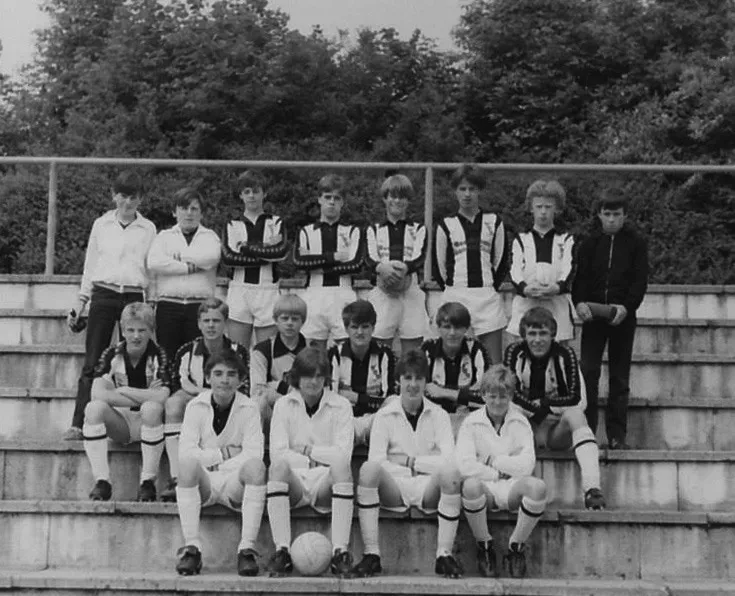
Team photo from my childhood club Beechdown FC (I am in the middle row, second from the right)
Interest from Southampton and Portsmouth
At the age of 13, I was already on the books at Southampton, which meant they were seriously considering giving me a schoolboy contract once I turned 14. This would have tied me to them for two years, but wouldn’t necessarily guarantee me a paid apprentice contract at 16, which is what any young, hopeful footballer is looking for.
A few months after I turned 13, I went away for a week for the Hampshire trials. It was hugely exciting as it was my first real trip away from my home and family, and it meant playing football non-stop for a whole week. At that point, football-obsessed as I was, it was my dream come true. I clearly remember watching the royal wedding of Prince Charles and Lady Di while I was at the trials, so this must have been late July 1981. I arrived home from the trials tired but exhilarated, with the whole summer stretching ahead of me. All I could think about was football, about how many hours of playing I could fit in over the summer holidays.
The following week we were sitting down to dinner on an ordinary Thursday night and there was a knock on the door. It was Dave Hirst, a scout for Portsmouth Football Club (PFC), Southampton’s biggest rivals. He told me he’d been watching me at the Hampshire trials and that Portsmouth wanted me to sign schoolboy forms with them. I wasn’t sure. While I wasn’t that happy at Southampton, I felt like it would be disloyal to sign with Portsmouth. I knew Southampton was expecting me to sign schoolboy forms with them once I turned 14.
Seeing my hesitation, Dave pulled out his trump card. He told me if I signed the schoolboy forms with Portsmouth, they would guarantee me an apprentice contract when I turned 16. I was still only 13, so I couldn’t sign the schoolboy forms until I turned 14, but Dave said I could go down to Portsmouth that summer and see what I thought. If I liked it, I could sign with them when I turned 14 the following April, with a guaranteed contract at 16.
Southampton hadn’t made that guarantee so it was a massive pull. Plus, as I’d told dad only a few months before, I wasn’t really enjoying myself at Southampton anymore. I wasn’t feeling challenged there; it was becoming too monotonous. I wasn’t even sure anymore that I wanted to stick it out for two more years as a schoolboy at Southampton. Dad encouraged me to do whatever I thought would make me happy. So in the end it wasn’t a hard choice. Once I turned 14, I signed the forms with Portsmouth.
Clearly, I owe a lot to Dave Hirst. He saw potential in me and supported me throughout my time at Portsmouth. He had a keen eye for talent and helped to identify and develop many young players, such as Spurs midfielder and England player Darren Anderton.
I had to keep it a big secret at school; I couldn’t tell anyone about the contract I’d signed with Portsmouth that was going to allow me to leave, with a guaranteed job, at 16. Now, of course, I had an excuse to slack off my schoolwork completely. Why did I need an education when I knew I had a job to go to? I wasn’t cocky, but I didn’t worry if I got in trouble for not working hard enough. I knew something they didn’t know... that I didn’t need an education. Or so I thought in my naïve, football-obsessed teenage mind.
The future contract did keep me out of trouble in other ways. For teenagers who aren’t particularly academic, there are always too many distractions and temptations. It’s the same in any generation. In my day, glue sniffing was the drug of choice, but in every generation there will be those unhealthy choices that kids can make that will jeopardise their chances of getting a good education.
Sport plays such an important role in keeping kids focused on something healthy and away from smoking and drugs; they need a physical outlet. I remember plenty of parties during my teenager years – there were girls, there was beer – but nothing was more important to me than football. The best thing we can do for our kids is to keep them involved in sport, to keep physical exercise a big part of their lives, giving them something to focus on outside of schoolwork. But maybe not at the expense of it, as it became for me!
In my last two years at school, I was in serious training. Dad used to drive me to all my practices and games. He had been working as a postman for a few years by then. He would do a night shift from 11pm until 4am, sleep a few hours during the day, and then drive me to practice before going to work again. There’s no way I would have been able to do any of it without the help and support of my parents. I am forever grateful to them for all they did.
Paul got the same support, and he played for Basingstoke for a while, but his heart wasn’t invested quite as deeply as mine. I’m sure he could have made it as a professional player too if he’d pushed himself, but he had other, stronger interests. He was always very supportive of me, though, coming to games and proudly cheering me on.
Of course we had our brotherly fights, meaning proper physical fights. He was the older brother, I was the annoying little brother, so he was always telling me to get lost and stop bothering him, which obviously goaded me on. Dad would drag us off each other telling us we had to stop fighting and be kinder to each other because we were brothers; his own brother had fled to Australia in slightly dubious circumstances and he’d hardly seen him as an adult, so he wanted Paul and me to be close and appreciate each other. We did appreciate each other deep down. But we were also average teenage boys who showed their lo...
Table of contents
- Cover
- Publishing details
- Follow us, like us, email us
- About the author
- Introduction
- PART ONE: THE FOOTBALL YEARS
- PART TWO: TRADING THE MONEY MARKETS
- PART THREE: TRADING STORIES
- PART FOUR: TRADING IN FOOTBALL TERMS
- FINAL WORD
Trusted by 375,005 students
Access to over 1.5 million titles for a fair monthly price.
Study more efficiently using our study tools.
Frequently asked questions
Yes, you can cancel anytime from the Subscription tab in your account settings on the Perlego website. Your subscription will stay active until the end of your current billing period. Learn how to cancel your subscription
No, books cannot be downloaded as external files, such as PDFs, for use outside of Perlego. However, you can download books within the Perlego app for offline reading on mobile or tablet. Learn how to download books offline
Perlego offers two plans: Essential and Complete
- Essential is ideal for learners and professionals who enjoy exploring a wide range of subjects. Access the Essential Library with 800,000+ trusted titles and best-sellers across business, personal growth, and the humanities. Includes unlimited reading time and Standard Read Aloud voice.
- Complete: Perfect for advanced learners and researchers needing full, unrestricted access. Unlock 1.5M+ books across hundreds of subjects, including academic and specialized titles. The Complete Plan also includes advanced features like Premium Read Aloud and Research Assistant.
We are an online textbook subscription service, where you can get access to an entire online library for less than the price of a single book per month. With over 1.5 million books across 990+ topics, we’ve got you covered! Learn about our mission
Look out for the read-aloud symbol on your next book to see if you can listen to it. The read-aloud tool reads text aloud for you, highlighting the text as it is being read. You can pause it, speed it up and slow it down. Learn more about Read Aloud
Yes! You can use the Perlego app on both iOS and Android devices to read anytime, anywhere — even offline. Perfect for commutes or when you’re on the go.
Please note we cannot support devices running on iOS 13 and Android 7 or earlier. Learn more about using the app
Please note we cannot support devices running on iOS 13 and Android 7 or earlier. Learn more about using the app
Yes, you can access Goals to Gold by Lee Sandford in PDF and/or ePUB format, as well as other popular books in Business & Azioni. We have over 1.5 million books available in our catalogue for you to explore.