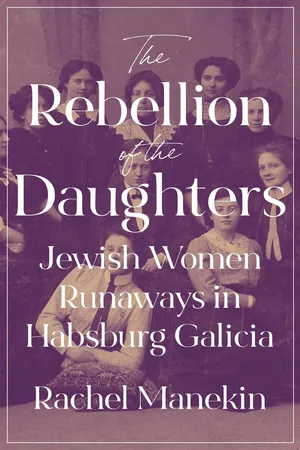
An in-depth exploration of the flight of young Jewish women from their Orthodox homes during the late nineteenth and early twentieth centuries
The Rebellion of the Daughters investigates the flight of young Jewish women from their Orthodox, mostly Hasidic, homes in Western Galicia (now Poland) in the late nineteenth and early twentieth centuries. In extreme cases, hundreds of these women sought refuge in a Kraków convent, where many converted to Catholicism. Those who stayed home often remained Jewish in name only.
Relying on a wealth of archival documents, including court testimonies, letters, diaries, and press reports, Rachel Manekin reconstructs the stories of three Jewish women runaways and reveals their struggles and innermost convictions. Unlike Orthodox Jewish boys, who attended "cheders," traditional schools where only Jewish subjects were taught, Orthodox Jewish girls were sent to Polish primary schools. When the time came for them to marry, many young women rebelled against the marriages arranged by their parents, with some wishing to pursue secondary and university education. After World War I, the crisis of the rebellious daughters in Kraków spurred the introduction of formal religious education for young Orthodox Jewish women in Poland, which later developed into a worldwide educational movement. Manekin chronicles the belated Orthodox response and argues that these educational innovations not only kept Orthodox Jewish women within the fold but also foreclosed their opportunities for higher education.
Exploring the estrangement of young Jewish women from traditional Judaism in Habsburg Galicia at the turn of the twentieth century, The Rebellion of the Daughters brings to light a forgotten yet significant episode in Eastern European history.
- English
- ePUB (mobile friendly)
- Available on iOS & Android
eBook - ePub
About this book
Information
Publisher
Princeton University PressYear
2020Print ISBN
9780691271064
9780691194936
eBook ISBN
9780691207094
Topic
Theology & ReligionSubtopic
Eastern European History1
The Origins of the “Daughters’ Question”
AT THE END OF the nineteenth and the beginning of the twentieth centuries, hundreds of young Jewish women ran away from their homes and found shelter in a Kraków convent, where many of them subsequently converted to Roman Catholicism. The runaway phenomenon attracted the attention of the press, as well as that of the Austrian and Galician authorities. Particularly noteworthy was that most of the women were legally minors from Orthodox Jewish homes. Nothing like this appears to have occurred in other places where Jews converted to Christianity.
The runaway phenomenon presented the most extreme example of a more widespread problem referred to at the time as the “Daughters’ Question,” a predicament in Galician Jewish society that resulted from the clash between familial expectations and female aspirations during this period. The runaway phenomenon exposed the failure of traditional Jewry to adapt itself to a world in which young women underwent a process of Polish acculturation with little religious Jewish education that often left them frustrated and unwilling to adopt their mothers’ lifestyles. Of course, the overwhelming number of young Galician Jewish women did not run away from their homes, much less convert; they accepted their roles as Orthodox wives and mothers, sometimes after some resistance. But all young women were affected by the political and cultural changes in Habsburg Galicia, though they reacted differently to them, as we shall see in this and subsequent chapters.
A detailed examination of the stories of some of the female runaways, together with what can be gleaned from press reports, official correspondence, police investigations, and court cases, reveal three important factors responsible for precipitating the crisis in Galician Jewish society: the rise in attendance of girls in school coupled with the dearth of Jewish education, the spread of cultural activities intended for young women, and the practice of parentally arranged marriages at an early age. These factors do not explain why hundreds of runaways chose the city of Kraków as their destination, or how they were able to convert despite their status as minors. For this we need to introduce two other factors: the Kraków convent that sheltered these women and facilitated their conversions, and the peculiar legal status of the runaways who were still legally under the custody of their Jewish parents.
Compulsory Education in Habsburg Galicia
In the last quarter of the nineteenth century, Orthodox Jewish girls in Galicia, including daughters of Hasidic families, started attending public and private primary schools in unprecedented numbers. To be sure, this was not the first time Galician Jewish girls had attended schools. Already in the late eighteenth century, the Austrian administration appointed the Bohemian-born Jewish Maskil (enlightener) Herz Homberg (1749–1841) to establish and supervise German Jewish elementary schools composed of one to three grades to teach Jewish boys and girls the rudiments of reading and writing in German as well as basic arithmetic.1 Attendance was mandatory, but many in the Jewish community opposed the schools. When the schools closed in 1806, Jews were allowed to attend Galician public schools (which were not many), although they had to sit on separate benches.2 Neither Christians nor Jews welcomed Jewish attendance at these schools, and since attendance wasn’t enforced, only a small number of Jewish children enrolled. The Austrian administration did retain a 1789 requirement that Jewish brides and grooms present a school diploma or pass an examination on basic school subjects in order to receive a marriage permit,3 abolishing the requirement only in 1859.4 But this was of little consequence, since most Galician Jews preferred to avoid the legally required marriage procedure and to marry only according to Jewish religious law. The imperial policy designed to “civilize” Galician Jewry, viewed as culturally backward and religiously superstitious by the Austrian administration, failed to achieve its stated goal.
In subsequent years a considerable number of Galician Jewish children, including girls, attended the schools established by the Jewish communities in Tarnopol, Brody, Kraków, Lwów, Bolechów, Przemyśl, Andrychów, as well as in some smaller communities. Since the curriculum for boys in these schools deviated significantly from that of the traditional ḥeder, which was restricted to traditional Jewish texts,5 the schools attracted children from the Jewish acculturated and professional classes, and not from the Orthodox Jewish population. The latter also did not send their children to non-Jewish schools, a practice that became increasingly prevalent among non-Orthodox Jews beginning in the mid-nineteenth century.
Instead, Orthodox Jewish families with the wherewithal hired private tutors to teach their daughters to read Jewish prayers, and occasionally works like Ẓe’ena u-re’ena, the popular seventeenth-century Yiddish compilation that included a selection with a commentary of translated scriptural texts read in the synagogue on the Sabbath,6 or Jewish ethical works translated into Yiddish. Affluent families often provided their daughters private lessons in foreign languages and classical literary works.7 Secular education was not provided according to a well-organized curriculum but depended on the availability of local tutors.8 Girls generally learned about women’s religious obligations from their mothers.
This situation began to change after several laws were enacted that obligated parents, under threat of punishment, to send their children to school. Since Galician Jews, as Austrian citizens, were subject to the same laws as were Christians, it is important to see how these laws came about, how they gradually took hold in Galicia, and what became the educational options for Galician Jewish children. In particular, it is important to see how the new compulsory education law affected the vastly different educational experiences of Orthodox Jewish boys and girls, thus giving birth to the “Daughters’ Question” and the runaway phenomenon.
After passing the fundamental laws about the rights of citizens in December 1867, Austrian liberals began taking steps to curtail the power of the Catholic Church. On May 25, 1868, the two houses of the Austrian Parliament approved the three so-called May Laws that abolished the control of the Roman Catholic Church in matters of matrimony and education and regulated the interconfessional relations between citizens based on equal treatment of all recognized churches and religious societies.9 Prior to the promulgation of the May Laws, education in the Habsburg Empire had been the exclusive province of the Roman Catholic Church, as agreed upon in the 1855 concordat between Austria and the Holy See. The Catholic consistories together with the district administrations also supervised the small number of Jewish schools in Galicia, except for the study of the Jewish religion.
The Catholic Church fought vehemently against the new laws, but the liberals persisted in their anti-concordat legislation. The clashes between the Austrian Catholic clergy and the state turned into what was referred to at the time as a culture war (Kulturkampf), although it was much milder than the parallel German case. After all, Austrian officials were mostly Roman Catholic themselves, but what they refused to do was grant the Church exclusive authority and control in public life.
The May Law regarding schools established principles pertaining to all public schools, especially the relations between school and religion.10 It stipulated in its first clause that supervision of matters of teaching and education belonged to the state. While the teaching of religion was to remain under the control of the religious establishments, all other school subjects were to be independent of any influence of churches or religious societies. Still, the law allowed churches and religious societies, if they so wished, to establish private parochial schools at their own expense; however, such schools needed to be subject to the laws governing teaching. Attendance in schools established for a particular religious faith could not be denied to students of another faith, and teaching positions in public schools were to be open to all citizens with the appropriate skills regardless of their religious faith. Religion teachers and religious subjects, on the other hand, needed approval from the relevant religious communal institutions.
On May 14, 1869, after a series of contentious parliamentary debates, the emperor signed the compulsory primary education law, which put into practice the principles outlined in the 1868 education May Law.11 Its first clause stipulated that the purpose of the primary public school was to provide children with an ethical-religious education, develop their mental abilities, equip them with knowledge and skills necessary for furt...
Table of contents
- Cover Page
- Series Page
- Title Page
- Copyright
- Contents
- Illustrations
- Acknowledgments
- Abbreviations
- Note on Transliteration and Terminology
- Introduction
- 1. The Origins of the “Daughters’ Question”
- 2. Religious Ardor: Michalina Araten and Her Embrace of Catholicism
- 3. Romantic Love: Debora Lewkowicz and Her Flight from the Village
- 4. Intellectual Passion: Anna Kluger and Her Struggle for Higher Education
- 5. Rebellious Daughters and the Literary Imagination: From Jacob Wassermann to S. Y. Agnon
- 6. Bringing the Daughters Back: A New Model of Female Orthodox Jewish Education
- Conclusion
- Appendix: In Their Own Words
- Bibliography
- Index
- Series List
Trusted by 375,005 students
Access to over 1.5 million titles for a fair monthly price.
Study more efficiently using our study tools.
Frequently asked questions
Yes, you can cancel anytime from the Subscription tab in your account settings on the Perlego website. Your subscription will stay active until the end of your current billing period. Learn how to cancel your subscription
No, books cannot be downloaded as external files, such as PDFs, for use outside of Perlego. However, you can download books within the Perlego app for offline reading on mobile or tablet. Learn how to download books offline
Perlego offers two plans: Essential and Complete
- Essential is ideal for learners and professionals who enjoy exploring a wide range of subjects. Access the Essential Library with 800,000+ trusted titles and best-sellers across business, personal growth, and the humanities. Includes unlimited reading time and Standard Read Aloud voice.
- Complete: Perfect for advanced learners and researchers needing full, unrestricted access. Unlock 1.5M+ books across hundreds of subjects, including academic and specialized titles. The Complete Plan also includes advanced features like Premium Read Aloud and Research Assistant.
We are an online textbook subscription service, where you can get access to an entire online library for less than the price of a single book per month. With over 1.5 million books across 990+ topics, we’ve got you covered! Learn about our mission
Look out for the read-aloud symbol on your next book to see if you can listen to it. The read-aloud tool reads text aloud for you, highlighting the text as it is being read. You can pause it, speed it up and slow it down. Learn more about Read Aloud
Yes! You can use the Perlego app on both iOS and Android devices to read anytime, anywhere — even offline. Perfect for commutes or when you’re on the go.
Please note we cannot support devices running on iOS 13 and Android 7 or earlier. Learn more about using the app
Please note we cannot support devices running on iOS 13 and Android 7 or earlier. Learn more about using the app
Yes, you can access The Rebellion of the Daughters by Rachel Manekin in PDF and/or ePUB format, as well as other popular books in Theology & Religion & Eastern European History. We have over 1.5 million books available in our catalogue for you to explore.