How differing forms of repression shape the outcomes of democratic transitions
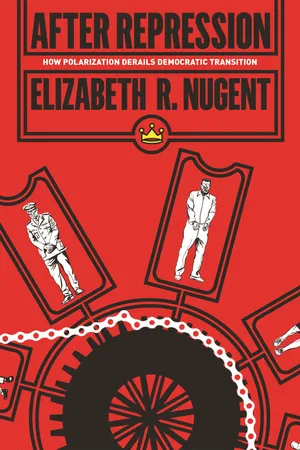
In the wake of the Arab Spring, newly empowered factions in Tunisia and Egypt vowed to work together to establish democracy. In Tunisia, political elites passed a new constitution, held parliamentary elections, and demonstrated the strength of their democracy with a peaceful transfer of power. Yet in Egypt, unity crumbled due to polarization among elites. Presenting a new theory of polarization under authoritarianism, After Repression reveals how polarization and the legacies of repression led to these substantially divergent political outcomes.
Drawing on original interviews and a wealth of new historical data, Elizabeth Nugent documents polarization among the opposition in Tunisia and Egypt prior to the Arab Spring, tracing how different kinds of repression influenced the bonds between opposition groups. She demonstrates how widespread repression created shared political identities and decreased polarization—such as in Tunisia—while targeted repression like that carried out against the Muslim Brotherhood in Egypt led opposition groups to build distinct identities that increased polarization among them. This helps explain why elites in Tunisia were able to compromise, cooperate, and continue on the path to democratic consolidation while deeply polarized elites in Egypt contributed to the rapid reentrenchment of authoritarianism.
Providing vital new insights into the ways repression shapes polarization, After Repression helps to explain what happened in the turbulent days following the Arab Spring and illuminates the obstacles to democratic transitions around the world.
- English
- ePUB (mobile friendly)
- Available on iOS & Android
eBook - ePub
About this book
Information
Publisher
Princeton University PressYear
2020Print ISBN
9780691203058
9780691203065
eBook ISBN
9780691203072
PART I
Theoretical Perspectives
1
Introduction
2011 unleashed an unprecedented level of mass mobilization that swept the Middle East and made the inconceivable—a democratic transition of power—finally seem possible. Prior to the wave of protests that became known as the Arab Spring, Middle Eastern dictators typically held onto power for decades. Most had managed to survive the Third Wave of democratization that had dislodged several of their peers in Asia, Latin America, and sub-Saharan Africa. The region’s authoritarian regimes appeared to be as entrenched as ever on the eve of the uprisings. Starting in Tunisia and quickly spreading to Egypt, Libya, Bahrain, Yemen, and Syria, the Arab Spring protests dislodged two long-ruling authoritarian presidents from office and threatened the stability of dozens of others. Though highly divided by political, social, ethnic, and economic differences, the masses came together to demand autonomy and to hold their governments accountable. The rallying cry of the uprisings was “the people want the fall of the regime!” Individuals from all classes, walks of life, and political persuasions who were equally fed up with authoritarian rule joined in the protests.1 Demonstrators proudly displayed their national flags while camping in main squares, and Muslims and Christians took turns linking hands to protect each other from the security forces as they prayed in protest spaces.
Democratic opposition parties joined their fellow citizens in protest. Political figures representing competing political ideologies—communists, socialists, leftists, centrists, Islamists, and even quietist Salafists—demonstrated a remarkable unity of purpose. Many of these politicians had spent their lives challenging authoritarian rule, and their small victories had been hard-won through significant struggle and sacrifice. Watching the systems they had so long resisted teetering on the brink of collapse, they appeared to sense that this unprecedented opportunity could not be squandered. They put aside their past disagreements to join their voices and hands in protest. One Muslim Brotherhood leader described the camaraderie he felt during the eighteen days of protest in downtown Cairo as “like a dream.”2 As the first Arab Spring protests gained traction in Tunisia, Rachid Ghannouchi, head of the country’s banned Islamist opposition group, Ennahda, called Ahmed Najib Chebbi of the legalized opposition party Parti Démocrate Progressiste from exile in London. “The boat is threatened with sinking,” Ghannouchi said. The two men agreed that the democratic opposition, including both secular and Islamist groups, would need to work together to capture the momentum of the protests, offer a viable alternative to the old regime, and move the transition forward.3
But the hopeful unity from the early days of the uprisings quickly dissipated, and the paths of transition in each country soon diverged.4 Regimes in Algeria, Iraq, Kuwait, and Morocco granted a number of concessions, such as lifting emergency laws, dissolving parliaments, holding new elections, expanding suffrage, and increasing social welfare spending. Such measures appeared to respond to protesters’ demands, but ultimately helped the authoritarian leaders undermine the opposition and demobilize protesters—and stay in power. Elsewhere, the uprisings descended into violent conflict. The Bahraini revolt ended with a brutal regime crackdown supported by Saudi Arabia in March 2013. The Syrian uprising descended into a still-ongoing civil war, dividing the country into regions controlled by the Assad government, opposition rebel groups, and the jihadi group known as the Islamic State amidst the meddling involvement of various foreign actors. Similarly, the Libyan uprising soon degenerated into a civil war between forces affiliated with two rival transitional regimes.
Egypt and Tunisia, the first two countries to witness protests, initially experienced similar transitions. Egypt’s Hosni Mubarak and Tunisia’s Zine al-Abidine Ben Ali stepped down from the offices they had held for thirty and twenty-three years, respectively, after weeks of unrelenting protests. Their resignations swiftly empowered alternative political elites, the vast majority of whom constituted the democratic opposition to the regime. As the crowds of protesters thinned, these elites faced the formidable challenge of replacing an authoritarian state with a democratic one. Within a year of the presidents’ resignations, former opposition leaders were finally elected to national constituent assemblies in both countries, and charged with drafting new constitutions, putting in place the rules and timelines for holding first legislative and then presidential elections, and deciding how to hold the previous regimes accountable for their repressive behavior. In both countries, the religious-secular cleavage represented the most important divide in these early elections, and Islamist parties, which were influential members of the previous regimes’ opposition, won 37 percent of the vote.
Yet despite these important similarities, Egypt and Tunisia were in vastly different situations just three years later. In Egypt, tensions between elites were palpable under the Muslim Brotherhood-dominated government. The Brotherhood-affiliated Freedom and Justice Party (FJP) won a plurality in the 2011–2012 Constituent Assembly elections, and Mohamed Morsi, a former member of the group’s Guidance Bureau, was elected president in June 2012. Morsi’s opponents accused him of being heavy-handed and dictatorial, and secular parties walked out of the December 2012 constitutional drafting process in protest after significant disagreements over the text and its content. This gave the FJP and its allies significant control over the draft constitution, which they approved in a quickly held referendum marred by a low turnout. In late June 2013, Murad Ali, a spokesman for the FJP, remarked, “with the current state of polarization and without reaching an understanding or working together, we will reach hell and kill each other in the streets.”5 Massive anti-Morsi protests organized on the first anniversary of his inauguration were followed by a military coup d’état on July 3. Members of the Brotherhood’s rival political movements, including former Director General of the International Atomic Energy Agency, Nobel Peace Prize recipient, and rival politician Mohamed al-Baradei, youth leaders from prominent protest movements, and a representative of the Salafist Nour Party, sat in symbolic support behind Army General Abdel Fattah al-Sisi as he announced the forced change in government on national television. By the year’s end, the Brotherhood was banned from politics and named a terrorist organization after a brutal regime crackdown on the group and its supporters. The violent campaign peaked with the August 2013 massacre of pro-Brotherhood demonstrators in Cairo’s al-Nahda and Rabaa al-Adawiya squares, in which nearly 1,400 were killed and 16,000 detained. The authoritarian relapse gained momentum; by May 15, 2014, 41,163 individuals had been arrested and prosecuted, the majority accused of ties to the Brotherhood.6 In the same month, General al-Sisi won the presidency with over 96 percent of the votes cast in a typical authoritarian election, which was boycotted by the opposition.
Meanwhile, Tunisia progressed towards democratic consolidation despite significant challenges. Elections for the 217-seat National Constituent Assembly (NCA) were held on October 23, 2011. The former Islamist opposition party Ennahda placed first with 37 percent of the vote. Ennahda leaders formed a Troika government to run the NCA, working with leaders from the formerly banned center-left opposition group Congrès pour la République (al-Mu‘tamar min ajl al-Jumhuriyya) and formerly legalized secular opposition group the Democratic Forum for Labor and Liberties (known as Ettakatol from its Arabic name, at-Takattul ad-Dimuqrati min ajl al-‘Amal wal-Hurriyyat). To streamline the constitution-building process, the Troika formed six 22-person committees. Each was tasked with drafting a principle component of the constitution, and each was staffed by members of different parties, including Islamists, leftists, secularists, and independents in proportion to the number of seats they held in the NCA. The NCA approved an inclusive constitution in January 2014 with support from all major political groups. This was a major achievement given a number of false starts, difficult debates, and the terrifying assassinations of two leftist politicians, all of which contributed to the extension of the assembly’s mandate from one to three years. Between October 2014 and January 2015, the country held its first post-authoritarian legislative and presidential elections. Tunisia experienced its first successful transfer of power through the ballot box when Ennahda lost these contests to Nidaa Tounes, a newly formed party including many former regime members united under an anti-Islamist platform.
By 2014, it was evident that for all the hope inspired by the 2011–2012 protests, the Arab Spring would result in very little democratic change, with the glaring exception of Tunisia. What went wrong in many countries, and what went right in Tunisia?
The Puzzle
The examples of Egypt and Tunisia confirm a central lesson of past transitions: the collapse of an authoritarian regime may trigger a transition, but it does not always lead to successful democratic consolidation. A transition might instead result in reentrenched authoritarianism or any number of revolutionary alternatives.7 Decisions made by elite actors during critical moments of potential political transition matter immensely. The successful progression from authoritarian breakdown to democratic consolidation is highly contingent on whether elites can compromise and cooperate during the transition, and make the necessary decisions and sacrifices to establish democratic norms and processes.8
Elite actors’ ability to compromise and cooperate in turn depends on the level of polarization among them.9 Higher levels of polarization make it less likely that actors will reach a consensus during critical moments of democratic consolidation, as these differences can prevent coalitions from forming and make compromises harder to reach. While the comparative politics literature often invokes polarization as an important concept, it is more precisely defined in studies of American politics as the distance between parties on dimensions that matter for political compromise and cooperation. Polarization includes two components: (1) affective distance in the realm of emotions, feelings, and attitudes (the extent to which groups dislike each other) and (2) distance in policy preferences on salient political issues (the extent to which groups disagree with each other).
First, affective polarization is based on the nature of an individual’s psychological attachment to a group, which can include positive in-group assessments as well as negative evaluations of the out-group.10 As Achen and Bartels explain, “identities are not primarily about adherence to a group ideology or creed. They are emotional attachments [to groups] that transcend thinking.”11 In the United States and Western Europe, partisan identities such as Democrat and Republican or liberal and con...
Table of contents
- Cover Page
- Series Page
- Title Page
- Copyright Page
- Dedication
- Contents
- List of Figures
- List of Tables
- Acknowledgments
- A Note on Translation and Transliteration
- Part I. Theoretical Perspectives
- Part II. Repertoires of Repression
- Part III. Repression, Identity, and Polarization
- Part IV. After Authoritarianism
- Appendix
- Bibliography
- Index
Trusted by 375,005 students
Access to over 1.5 million titles for a fair monthly price.
Study more efficiently using our study tools.
Frequently asked questions
Yes, you can cancel anytime from the Subscription tab in your account settings on the Perlego website. Your subscription will stay active until the end of your current billing period. Learn how to cancel your subscription
No, books cannot be downloaded as external files, such as PDFs, for use outside of Perlego. However, you can download books within the Perlego app for offline reading on mobile or tablet. Learn how to download books offline
Perlego offers two plans: Essential and Complete
- Essential is ideal for learners and professionals who enjoy exploring a wide range of subjects. Access the Essential Library with 800,000+ trusted titles and best-sellers across business, personal growth, and the humanities. Includes unlimited reading time and Standard Read Aloud voice.
- Complete: Perfect for advanced learners and researchers needing full, unrestricted access. Unlock 1.5M+ books across hundreds of subjects, including academic and specialized titles. The Complete Plan also includes advanced features like Premium Read Aloud and Research Assistant.
We are an online textbook subscription service, where you can get access to an entire online library for less than the price of a single book per month. With over 1.5 million books across 990+ topics, we’ve got you covered! Learn about our mission
Look out for the read-aloud symbol on your next book to see if you can listen to it. The read-aloud tool reads text aloud for you, highlighting the text as it is being read. You can pause it, speed it up and slow it down. Learn more about Read Aloud
Yes! You can use the Perlego app on both iOS and Android devices to read anytime, anywhere — even offline. Perfect for commutes or when you’re on the go.
Please note we cannot support devices running on iOS 13 and Android 7 or earlier. Learn more about using the app
Please note we cannot support devices running on iOS 13 and Android 7 or earlier. Learn more about using the app
Yes, you can access After Repression by Elizabeth R. Nugent in PDF and/or ePUB format, as well as other popular books in Politics & International Relations & Democracy. We have over 1.5 million books available in our catalogue for you to explore.