As the sectional crisis gripped the United States, the rancor increasingly spread to the halls of Congress. Preston Brooks’s frenzied assault on Charles Sumner was perhaps the most notorious evidence of the dangerous divide between proslavery Democrats and the new antislavery Republican Party. But as disunion loomed, rifts within the majority Democratic Party were every bit as consequential. And nowhere was the fracture more apparent than in the raging debates between Illinois’s Stephen Douglas and Mississippi’s Jefferson Davis. As leaders of the Democrats' northern and southern factions before the Civil War, their passionate conflict of words and ideas has been overshadowed by their opposition to Abraham Lincoln. But here, weaving together biography and political history, Michael E. Woods restores Davis and Douglas’s fatefully entwined lives and careers to the center of the Civil War era.
Operating on personal, partisan, and national levels, Woods traces the deep roots of Democrats' internal strife, with fault lines drawn around fundamental questions of property rights and majority rule. Neither belief in white supremacy nor expansionist zeal could reconcile Douglas and Davis’s factions as their constituents formed their own lines in the proverbial soil of westward expansion. The first major reinterpretation of the Democratic Party’s internal schism in more than a generation, Arguing until Doomsday shows how two leading antebellum politicians ultimately shattered their party and hastened the coming of the Civil War.
eBook - ePub
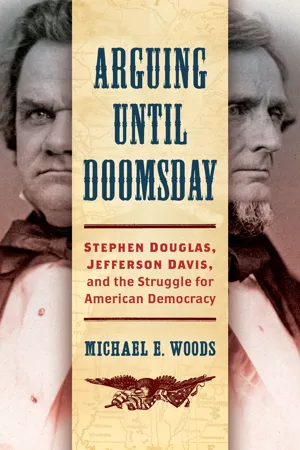
Arguing until Doomsday
Stephen Douglas, Jefferson Davis, and the Struggle for American Democracy
- 352 pages
- English
- ePUB (mobile friendly)
- Available on iOS & Android
eBook - ePub
Arguing until Doomsday
Stephen Douglas, Jefferson Davis, and the Struggle for American Democracy
About this book
Information
1
Western Men
“There is a power in this nation greater than either the North or the South,” proclaimed Senator Stephen Douglas, “a growing, increasing, swelling power, that will be able to speak the law to this nation, and to execute the law as spoken. That power is the country known as the great West—the Valley of the Mississippi.” Sprawling from the Great Lakes to the Gulf of Mexico and from the Appalachians to the Rockies, this heartland empire would save the Union from suicidal sectionalism.1 Delivered in March 1850, Douglas’s prophecy was a timely one: Americans’ mental geographies were adjusting to the conquest of northern Mexico, and sectional strife was glowing white-hot. Skeptics might have warned that expansion would inflame, not dampen, sectional quarrels over slavery’s extension. Perhaps the West was the problem, not the solution. But Douglas had long since made western development the central theme of his career, and his “swelling power” speech transmuted his fondest desires into surefire guarantees.
Senator Jefferson Davis was a westerner, too. His Mississippi plantation was over a hundred miles west of Douglas’s Chicago home, and as a young army officer, Davis had forayed onto the Great Plains, farther west than Douglas ever traveled; more recently, his Mexican War service had burnished his credentials as an agent of Manifest Destiny. A year after Douglas’s speech, Davis self-identified as “an inhabitant of the valley of the Mississippi” and “a western man.”2 But his regional affiliation was complicated. Davis’s admiration for John C. Calhoun, his calls for southern solidarity, and his vision of slavery’s unbridled expansion all suggested that the South came first. He dreamed of the West as a powerful appendage to his native region, not as an antidote to sectional strife. Yet hindsight should not obscure Davis’s western ties or elide his vision of a slaveholding sunbelt that stretched to the Pacific. Like his Illinois rival, Davis gazed westward with ambition, confidence, and passion born of personal experience and political aspiration. Both men enjoyed the upward mobility that white Americans associated with westward migration and saw the Mississippi Valley as the key to continental hegemony. As Democrats, Davis’s and Douglas’s western dreams drew them together and tore them apart. To understand their rivalry, we must situate both men in the dynamic river valley that they envisioned as the nucleus of a growing empire with enticingly imprecise borders.
This burgeoning domain was also riven by sectionalism. The monolithic “West” that Douglas imagined as the Union’s mainstay was, even in his youth, splintering into northwestern and southwestern sections. True, Illinois and Mississippi had much in common. Hugging the eastern bank of the grandest western river, they shared a colonial past (which included exploitation of slave labor), a rugged self-image, and economic dependence on the global trading hub of New Orleans. Their citizens’ commitment to commercial agriculture bred a voracious appetite for land, zeal for Indian removal, and esteem for Andrew Jackson. But Illinois and Mississippi began drifting apart even before they gained statehood in the nationalist afterglow of the War of 1812. Mississippi was maturing into the Cotton Kingdom’s richest province, while slavery died fitfully in Illinois amid an influx of free migrants from the Northeast and abroad. By the 1830s, the two states were linked by the valley of the Mississippi and the party of Jackson, but demographic, economic, and political changes were dividing them. These divergent societies bred two titans who never agreed on what it meant to be a westerner, a Democrat, or an American.

The Civil War cemented Davis’s image as a southerner, but Douglas’s association with the West is unshakable. Renowned by contemporaries as “The Giant of the West,” “The Giant Intellect of the West,” and “the foremost of Western Democrats,” Douglas’s western persona endured long after his death.3 But what did contemporaries mean by “the West”? Regional definitions are inherently unstable, but mid-nineteenth-century Anglo-American conceptions of the West centered on the Mississippi River. Even after U.S. sovereignty reached the Pacific, easterners imagined the West in terms of hydrological networks, with the Mississippi and its mighty tributaries veining one cohesive region. In 1860, Mississippi historian J. F. H. Claiborne eulogized the “vast empire of the West, stretching along the Ohio, the Missouri, and the Mississippi,” as “the backbone of our Union” and the “citadel of our national strength.”4 He imagined the West as both a geopolitical center and a region thankfully peripheral to North-South conflict. Connection with the Mississippi River was therefore a source of pride. Davis heartily identified with those who “live on that great highway of the West—the Mississippi river,” while Douglas boasted that “we” of the “great Mississippi Valley” constituted “the heart and soul of the Nation and the continent.”5
Contemporaries associated the West with material bounty as well as with national strength. The Mississippi River cut a deep channel into eastern imaginations during the “flush times” of the 1830s, when the valley’s booming economy attracted migrants and admirers. Many easterners encountered the region through the writings of publicists like Robert Baird. A Pennsylvanian who graduated from Princeton Seminary, Baird was an unlikely western promoter, but in 1832 he published a western guidebook whose title, View of the Valley of the Mississippi, or the Emigrant’s and Traveller’s Guide to the West, reinforced the identification of the river with the region. Writing roughly a year before Douglas reached Illinois and three years before Davis settled on his Mississippi plantation, Baird explained how to thrive on the frontier. Meticulous research into everything from transportation timetables to start-up costs informed his advice on where to go, how to travel, and what to plant. The Princetonian also dabbled in boosterism. Defining his subject as everything between the Alleghenies and the Rockies (which he called the “Oregon” mountains), Baird exulted that the “Valley of the Mississippi” encompassed 1.3 million square miles of incomparably bountiful real estate. The valley “surpasses all others in the richness and variety of its soil. … In beauty and fertility it is the most perfect garden of nature; and by means of its thousand streams, wonderful facilities are extended to every part of it for commercial intercourse.” Like many contemporaries, Baird thought in terms of transport, agriculture, and geopolitical power. Blessed on all three accounts, the Mississippi Valley would soon control “the destiny of this nation,” making “the West an object of the deepest interest to every American patriot.”6
Surveying the Mississippi from its headwaters to the Gulf, Baird appraised each adjacent state and territory from the perspective of a potential migrant, revealing that the valley was not a single economic or geographic unit. Take his implicit comparison between Illinois and Mississippi. After enumerating the Prairie State’s “exceedingly productive” (if stubbornly compact) soil, navigable rivers, and budding commercial capital of Chicago, Baird proclaimed that Illinois had “the finest situation of all the western states.” For those who could afford $1,080 in start-up costs, Illinois was ideal.7 Baird also attended to Mississippi but offered little specific advice. Instead, he warned of the sickly summer months and noted that cotton “absorbs almost the whole attention” of the locals, although they could raise corn, wheat, and cattle as well. Growing cotton, Baird conceded, “is by no means a difficult operation,” at least not for his presumably free readers, because the “tedious” harvest work was done “by slaves, who go along with a basket, and gather all that they can pick out.” Just a few enslaved laborers could run a paying plantation.8 The lessons were clear: Illinois was a healthy place, in every sense, for smallholders; Mississippi was a riskier proposition, but the owner of human chattels could prosper. Emigrants who shared Baird’s worldview would likely head northward. Baird tipped his hand when he calculated that the West contained enough land for four million farms of 160 acres each. A generation later, that magic number would taunt migrants whose dreams withered on arid western quarter-sections, but in 1832, it betrayed Baird’s affinity for northern family farming over southern plantation agriculture.9
Yet Baird recognized that not all migrants shared his perspective, and his analysis of migration patterns indicated that the West would succumb to sectionalism. Addressing easterners trying to imagine life in the Mississippi Valley, Baird noted that migrants tended to move directly from east to west: New Englanders to the Great Lakes, Virginians to Kentucky, and South Carolinians to Mississippi. Thus, western communities were arranged in a pattern familiar to denizens of the Atlantic Coast. “If one knows what are the peculiarities of the several states east of the Allegheny Mountains,” Baird explained, “he may expect to find them … in the corresponding parallels in the West.” This included the most peculiar peculiarity of all: “Slavery keeps nearly within the same parallels.”10 Years before Davis and Douglas established western homes, sectionalism was already perceptible in the West. Easterners might imagine the Mississippi Valley as a homogeneous frontier where pioneers subdued a wilderness with rifle and ax, but as the West developed into a hothouse of commercial agriculture, sectional divisions reappeared. Davis and Douglas inhabited very different Wests.
For all intents and purposes, Jefferson Davis was a Mississippian. His Kentucky birth, not far from Abraham Lincoln’s, makes for a satisfying coincidence, but it meant little to Davis’s life. Even his birth year is clouded by doubt; many scholars accept 1808, as recounted in an autobiographical sketch, but others favor 1807.11 Either way, Kentucky made little impression on the infant. In 1810, his father, Samuel, relocated the family, first to Louisiana and then to Woodville, Wilkinson County, in Mississippi’s southwestern corner. There, Davis recalled a lifetime later, “my memories begin.”12 His neighbors’ memories often began there, too. In 1859, a Vicksburg friend exulted over the political renown won by Davis, “a native Mississippian.”13 Davis noticed that “the old people about Woodville very frequently have spoken of me as a native of that neighborhood.”14 He relished this because he was a Mississippian by upbringing and by choice. After years away for school and military service, Davis elected to return to Mississippi to raise a family and pursue a political career. For a well-connected white male, it was a smart move. Contrary to the image of the Old South as a world frozen in amber, Davis’s Mississippi was a dynamic place. Not long before his birth, it was an isolated backwater, but a combination of gumption and avarice, cunning and brutality, and private enterprise and government coercion transformed it into one of the world’s richest cotton-growing regions.15 Davis rose with Mississippi to the pinnacle of power.
The Davises arrived just as Mississippi was poised for an economic boom. A generation earlier, while Georgia-born Samuel fought in the Revolutionary War, Anglo-American migrants trickled into the area, usually avoiding the Choctaw and Chickasaw communities to the north and gravitating toward Natchez, a Mississippi River town some forty miles north of Woodville. Established in 1716, Natchez passed between French, British, and Spanish overlords until Spain relinquished it to the United States in 1798. Colonial-era planters had exploited slave labor to grow tobacco and cotton in the Natchez District, but in the late eighteenth century, plantation agriculture was confined to a small area. Many early American arrivals lived very much like their counterparts in frontier Illinois, including the hardy souls who settled upriver in Warren County, Davis’s future home. Few owned slaves or large estates, and most lived rough, simple lives as subsistence farmers, raising hogs, planting gardens, cutting wood, hunting game, and trading locally. They toiled to get by, not to get ahead. By the turn of the nineteenth century, however, some had started exporting cattle through New Orleans, a foreign (Spanish and briefly French) city until 1803, and purchasing slaves as a source of extra household labor. Many locals persisted as subsistence farmers, but a growing number had accumulated capital, acquired enslaved workers, and ventured into plantation agriculture. By the time Samuel and his toddler son reached Mississippi, it was primed for an economic revolution.16

Map of Louisiana and Mississippi, from [Baird], View of the Valley of the Mississippi, 247. (Courtesy of Rare Book Collection, Louis Round Wilson Special Collections Library, University of North Carolina at Chapel Hill)
When the takeoff arrived, it swept through Mississippi with the intensity of a gold rush. By the mid-1830s, Mississippi had become “the Mecca of American fortune hunters” whose dreams of quick riches anticipated California forty-niners or Texas oilmen.17 Migration swelled the population by 175 percent between 1830 and 1840, when the total reached 375,000.18 From every corner of the Union came young upstarts chasing material gain and professional advancement. When John A. Quitman, a wide-eyed New Yorker who later became Davis’s neighbor, arrived in 1822, he kicked himself for having dawdled in Ohio before pushing on to Natchez. “No part of the United States holds out better prospects for a young lawyer” than Mississippi, he reported. Money was plentiful and attracted “the floating population of the whole West,” bringing a mixture of sleaze and gentility, with “blackguardism and depravity” jostling alongside an elegant aristocracy. It meant brisk business for a hustling lawyer. With planters raking in $50,000 per year and 120 criminal indictments crowding the docket, Quitman liked his chances.19 These, recalled another writer, were “the golden days of Mississippi.”20
The rush was fueled by cotton. Ravenous British demand, coupled with Mississippi’s long, hot growing season, created a bull market. In 1808, Natchez District planters exported around 5,000 bales of cotton, but output soared as cultivation spread across the state.21 By 1830, Mississippi yielded around 100,000 bales, and the “flush times” were just beginning. When Mississippi passed Georgia to become the South’s leading cotton producer in 1840, production exceeded 386,000 bales and reached 1.2 million twenty years later.22 The western river counties, including Warren County, led the way. When Davis settled there in 1835, Warren County’s soil was yielding some 30,000 bales per year, with its 32,000 bales in 1840 ranking second in Mississippi.23 Notably, much of the state was beginning to resemble the older plantation zone of the southwest, as zealous planters acquired fresh land in the northern and eastern counties.24 On the eve of the Civil War, small farmers predominated in the northeastern hills and southern piney woods, but much of Mississippi was cotton country. No longer confined to the Natchez District, King Cot...
Table of contents
- Cover Page
- Title Page
- Copyright Page
- Dedication
- Contents
- Figures
- Introduction
- 1. Western Men
- 2. Jackson Men
- 3. Manifest Destinies
- 4. Down to the Crossroads
- 5. Wages of Whiteness
- 6. Rule or Ruin
- Epilogue. Countries over Party
- Acknowledgments
- Notes
- Bibliography
- Index
Trusted by 375,005 students
Access to over 1.5 million titles for a fair monthly price.
Study more efficiently using our study tools.
Frequently asked questions
Yes, you can cancel anytime from the Subscription tab in your account settings on the Perlego website. Your subscription will stay active until the end of your current billing period. Learn how to cancel your subscription
No, books cannot be downloaded as external files, such as PDFs, for use outside of Perlego. However, you can download books within the Perlego app for offline reading on mobile or tablet. Learn how to download books offline
Perlego offers two plans: Essential and Complete
- Essential is ideal for learners and professionals who enjoy exploring a wide range of subjects. Access the Essential Library with 800,000+ trusted titles and best-sellers across business, personal growth, and the humanities. Includes unlimited reading time and Standard Read Aloud voice.
- Complete: Perfect for advanced learners and researchers needing full, unrestricted access. Unlock 1.5M+ books across hundreds of subjects, including academic and specialized titles. The Complete Plan also includes advanced features like Premium Read Aloud and Research Assistant.
We are an online textbook subscription service, where you can get access to an entire online library for less than the price of a single book per month. With over 1.5 million books across 990+ topics, we’ve got you covered! Learn about our mission
Look out for the read-aloud symbol on your next book to see if you can listen to it. The read-aloud tool reads text aloud for you, highlighting the text as it is being read. You can pause it, speed it up and slow it down. Learn more about Read Aloud
Yes! You can use the Perlego app on both iOS and Android devices to read anytime, anywhere — even offline. Perfect for commutes or when you’re on the go.
Please note we cannot support devices running on iOS 13 and Android 7 or earlier. Learn more about using the app
Please note we cannot support devices running on iOS 13 and Android 7 or earlier. Learn more about using the app
Yes, you can access Arguing until Doomsday by Michael E. Woods in PDF and/or ePUB format, as well as other popular books in History & American Civil War History. We have over 1.5 million books available in our catalogue for you to explore.