- 264 pages
- English
- ePUB (mobile friendly)
- Available on iOS & Android
eBook - ePub
About this book
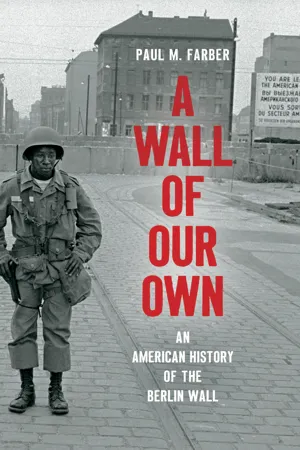
The Berlin Wall is arguably the most prominent symbol of the Cold War era. Its construction in 1961 and its dismantling in 1989 are broadly understood as pivotal moments in the history of the last century. In A Wall of Our Own, Paul M. Farber traces the Berlin Wall as a site of pilgrimage for American artists, writers, and activists. During the Cold War and in the shadow of the Wall, figures such as Leonard Freed, Angela Davis, Shinkichi Tajiri, and Audre Lorde weighed the possibilities and limits of American democracy. All were sparked by their first encounters with the Wall, incorporated their reflections in books and artworks directed toward the geopolitics of division in the United States, and considered divided Germany as a site of intersection between art and activism over the respective courses of their careers. Departing from the well-known stories of Americans seeking post–World War II Paris for their own self-imposed exile or traveling the open road of the domestic interstate highway system, Farber reveals the divided city of Berlin as another destination for Americans seeking a critical distance. By analyzing the experiences and cultural creations of “American Berliner” artists and activists, Farber offers a new way to view not only the Wall itself but also how the Cold War still structures our thinking about freedom, repression, and artistic resistance on a global scale.
Information
CHAPTER 1 | SEGREGATED SECTORS
Leonard Freed, the Berlin Crisis, and the Color Line
If the American found in Europe only confusion, it would obviously be infinitely wiser for him to remain at home. Hidden, however, in the heart of confusion he encounters here is that which he came so blindly seeking: the terms on which he is related to his country, and to the world.
—JAMES BALDWIN
On August 13, 1961, East German forces closed the borders of East Berlin and, in turn, encircled the allied sectors of the city’s western half. Two weeks later, American photographer Leonard Freed wandered along the internal edges of the divided city. In those uncertain days of the Berlin Crisis, each side was on high alert, as the potential for conflict in Berlin between the superpowers seemed imminent, leading to a standoff and the eventual sealing of the city’s western sectors. It would take the East German Democratic Republic months to fully enclose West Berlin, but within a matter of hours and days, the newly fortified boundary was beginning to take shape: barbed wire, wooden barricades, torn-up pavement, bricks, and the rudimentary beginnings of a concrete wall. In the weeks that followed, soldiers from each side drew near to protect and inspect the implementation of the closed border.1
Freed was fascinated by the implications of this Cold War front line. Berlin was again the epicenter of global conflict, in what he conceived as “a war of nerves” between the Soviet-led East and American-allied West.2 By August 1961 Freed had been living outside America for more than five years. During his August travels, he spent his time close to the center of the partitioned city. With the world on the brink of war, he pointed his camera toward one of the West’s last lines of defense: American GIs in the American sector of West Berlin. These new images summoned an impulse to seek out American subjects, a focus that had been only latent in his European work up to this point.
From his earliest travels to Germany in the early 1950s, Freed pondered the ways in which history and memory influenced the nation’s postwar condition and, in turn, his own relationship to its people and landscapes. He wrestled with his Jewish identity in Germany and throughout Europe. Freed was born in 1929 and grew up Brooklyn, New York. His parents, Sam and Rose, were both born to Jewish families in Minsk, Russia, but met and married after they emigrated to the United States, escaping a wave of pogroms in their native land around World War I. His older brother, Milton, served as a pilot in the U.S. Air Force, flying missions over the Pacific theater in World War II. Leonard, too young to be drafted during that war, instead was compelled to leave the United States in the years afterward to encounter the legacies of global conflict. Starting in 1952, in his early twenties, Freed traveled through Europe and North Africa for two years. After going home briefly to the United States, he returned to Europe in 1956. He honed his craft as a documentary photographer and supported himself by selling photographs to local magazines and newspapers. Freed sought to further understand his Jewish heritage in the context of post–World War II Europe.
Freed had begun photographing in Germany on his first trip to Europe, focused especially on its landscapes of memory and reconstruction. On his second trip, in 1956, he met a German woman, Brigitte Klück, and his work was first published by Klück’s hometown newspaper in Dortmund under the headline “Eine Amerikaner sieht unsere Stadt” (An American sees our city). In 1957 Leonard and Brigitte married in Amsterdam. He thought of the idea for his first book, Joden van Amsterdam (Jews of Amsterdam) (1958), after visiting the Anne Frank House. Early in 1961 Freed started photographing in neighboring Cold War Germany for a project that would later cohere into his second book, Deutsche Juden heute (German Jews Today) (1965). Both publications were released in Europe, accompanied by texts in their respective national tongues. Postwar Europe was a puzzle for Freed: a land of great artistic civilization, familial aura, Jewish trauma and estrangement, postwar destruction, and potential redemption. In his mind Germany was the central and most jagged piece of the whole.3
The legacy of conflict in Germany weighed on Freed in August 1961, when he took a train from Amsterdam to West Berlin. Freed arrived with his close friend Dutch journalist Willem Oltmans on or around August 25. Neither man had an assignment or a particular itinerary. As many around the world waited on edge for the breakout of World War III, Freed and Oltmans stepped close to the border. Freed’s photographs and recollections from that trip found in Oltmans’s private journals attest to their movements near Zimmerstrasse as they stalked the Wall’s emergent path. Freed meandered through parked army tanks and jeeps, GIs squatting with trays of fast food, and pedestrians passing through a then-makeshift but heavily guarded Checkpoint Charlie on Friedrichstrasse. On August 27 he and Oltmans crossed the city’s internal border to East Berlin, traveling down the monumental boulevard of Stalin Allee and into the Oberschöneweide neighborhood, where they sat with workers on a terrace and visited a bookstore. Later that day, back in West Berlin, Freed and Oltmans witnessed a frenzied evening scene on Moritzplatz in which U.S. military tanks with searchlights, joined by jeeps equipped with speakers, blasted Elvis Presley music near the border wall to galvanize throngs of West Berliners who had gathered to protest the still-fresh physical division of the city.4
Freed confronted his visions of a war-prone Germany in the American sector of a newly walled Berlin, and through his own directed movement, he pursued his own circuit of alternative cultural diplomacy. In doing so, he examined American power along the border and reflected on his own expatriate status. He traveled to divided Berlin to comprehend the ways Jewish history was present within a city experiencing a new wave of division. But in the majority of his images from this trip, the new wall is barely visible. Instead American GIs stationed by the border receive his most consistent and direct focus. Many of the soldiers barely acknowledge Freed’s presence, while others cast sidelong glances at him and his camera.
There is one exception to this indirect viewpoint, when Freed faced head-on both the Berlin Wall and a fellow American in the same frame. The resulting image would haunt Freed, beckon his return from exile, remind the expatriate of his American whiteness, and transform his practice as a photographer. Here, at the nascent wall, Freed snapped a photograph of an unnamed black soldier standing at the edge of the American sector (fig. 1.1).5 After lifting his finger from the shutter release, he left the scene without taking any more photographs. Freed’s contact sheets from this trip confirm that, unlike his other GI images at the Wall in which he sometimes captured the same serviceman from several angles, this soldier image was a single shot.6
Taken at middle distance in black and white, the frontal portrait features the uniformed soldier in the foreground, his eyes cast downward and to the side. Freed stands near the intersection of Zimmerstrasse and Charlottenstrasse streets, between trolley tracks that dead-end in the imposing boundary of the Wall, seen in the background. The soldier is outfitted in full combat gear, and a helmet weighs heavily on his head, suggested by a slight forward tilt. One of his fellow GIs can be seen in an army jeep behind him, traveling with another photographer, yet their attention is elsewhere, outside the frame. At the image’s highest magnification, the soldier’s nametag remains out of focus, but his uniform identifies him as likely in the 2nd Battle Group, 6th Infantry in West Germany. The soldier’s arms jut out to his sides, and his hands rest below at his hips. This image, as an exceptional single shot, demonstrates two central and productive challenges for Freed in this period: how to identify with his subjects, and how to consider the new Berlin Wall as subject matter within a post-Holocaust European landscape.

FIGURE 1.1 Leonard Freed, Berlin, 1961. (Estate of Leonard Freed/Magnum Photos)
When Freed’s single shot of the soldier was later included as the opening image to his book Black in White America (1967/68) (fig. 1.2), Freed identified the location as “Berlin, Germany,” citing the city as a whole, without distinguishing between East and West. His caption further calls attention to the soldier’s affiliation and stance: “In defense of Western Civilization, an American soldier’s hand rests on his gun.”7 Freed narrates the photographic moment in personal terms: “We, he and I, two Americans. We meet silently and part silently. Between us, impregnable and as deadly as the wall behind him, is another wall. It is there on the trolley tracks, it crawls along the cobble stones, across the frontiers and oceans, reaching back home, back into our lives and deep into our hearts: dividing us, wherever we meet. I am White and he is Black.”8 Freed’s annotation affirms the profound duality of this visual encounter: citizens of the same country stand mere feet away from each other as countrymen in an American-occupied zone in West Berlin, and yet the experience of racial division is laid bare. In fact, this image stylistically departs from his other American GI images at the Wall, as it is also the only image in Black in White America that presents racial division as static and impervious to interaction. Throughout the book, Freed locates fields of vision in order to wrestle with racial formation and his own whiteness. Freed acknowledges his role as a white photographer in America’s racially divided society by encroaching on scenarios like this, to scrutinize his encounters with black subjects. Throughout the published book, he does so by balancing distance while moving closer to his subjects, registering their gazes in numerous directions, and marking mutual recognition without erasing social lines of division implicit or evident in his photographic encounters.

FIGURE 1.2 Cover, Leonard Freed, Black in White America, 1967/68. (Grossman/Estate of Leonard Freed)
Freed’s Berlin Wall images and the trajectories that spring forth from them present photography as a tool to study relationships informed by race and the legacies of repression inscribed into Cold War and civil rights–era public spaces. His tactics of perspective at the Berlin Wall are informed by technical approaches and philosophical imperatives. In a technical photographic sense, perception marks the distance between photographer and subject, determined by the angle, framing, and relative distance between the camera and the focal point of the scene. As a concept, the word “perspective” also connotes a personal viewpoint informed by history, experience, and interaction. Curator William Ewing, in Freed’s retrospective Worldview, explains the one-word title by means of its German cognate, Weltanschauung, and the parallel between Freed’s practice as a photographer and his philosophical outlook: “Leonard Freed saw, interpreted and transmitted in a particular way. He had a Weltanschauung. This term and its less-than-perfect translation, worldview, wraps beautifully around both Freed the man and Freed the photographer. … He used photography as a tool to better understand the world, first to himself (to discover who he was), and then for us (to help discover who we are).”9 Freed’s perspective as it pertains to the Berlin Wall epitomizes the way his approach to photography was influenced by his ideas of how people relate to one another and the cultural landscapes that surround them, both formalistically and historically. In Germany, he considers its status as a “nation” as a way to ruminate on the connections between its divided people, places, and epochs. In the geopolitical spaces of divided Berlin, Freed attended to a range of reflections and relationships, determined by his own photographic frame or footsteps toward encounter. Freed pursued the meaning-making of a photographic image, both at the point of capture and later in editorial selection, where he could spatially and conceptually convey questions regarding identity and mutuality. By alternately turning toward the Berlin Wall and away from its tense border zones, he intended to mark historical dividing lines while seeking recognition across them. Freed treats the Wall and other sites and structures of division as symbols of geopolitical standoff and venues for critical engagement and studied connection between otherwise divided peoples.
Most of Freed’s photographs from the period of 1961–65 can be categorized by their inclusion in either his German or American portfolios; they were included in two books, Black in White America and Made in Germany (1970). Because of Berlin’s geopolitical situation, limiting Freed’s photographs at the Wall to only two national contexts becomes difficult. Yet by thinking through the overlapping national contexts in which Freed’s black soldier image may reasonably “belong,” we can trace his methodology of engaging historical dividing lines and the people who populate them. Freed maps his Berlin-based images in photobooks in order to mark and contest the Wall’s simplest narratives. Freed carefully calibrated a relative proximity with his subjects, at once moving closer to identify with them and allowing for a space of estrangement to capture the multiple historical and social buffers that he attempted to comprehend or overcome by the Wall.
This chapter explores Freed’s movements in and out of Berlin during the early years of the Berlin Wall, with an eye toward locating the single-shot image of a black GI within the broader currents of cultural history. While producing his respective studies of U.S. and German division, Freed would travel back and forth between the “old” and “new” Jewish worlds of Europe and America. In doing so, he produced book projects and challenged the underlying dichotomies of home and away, past and present, countryman and stranger. First, this chapter explores the larger context of the Berlin Crisis and the walling of Berlin by means of cultural productions, texts, and voices that sought to connect the German wall with the lines and legacies of American segregation. Second, it looks to Freed’s development as a photographer, especially how the city of Berlin, the country of Germany, and his breaks from exile in America informed an understanding of geopolitical division and identification in the context of transnational geopolitics and cultural memory. Third, the chapter closes with a consideration of Freed’s Black in White America and Made in Germany, alongside the moments he visited and viewed the Wall in subsequent trips to Germany as it further took shape in the city. Despite the separate emphases of each project, the fact that Freed took photographs across roughly the same period in overlapping territories affirms the shared productive contexts and tensions of these works. More specifically, Freed’s depiction of the Berlin Wall alongside other historical boundaries—especially those along the color line in America—as well as long-term processes of reconciliation in Germany, marks these projects as products of the same emergent practice of roving perspective and identification. Understanding where Freed locates the Berlin Wall, other historical structures or figures, and himself in each of these images allows us to measure his transformation as a photographer and his evolving view of the Wall and its connotations. Freed depicted the Wall’s surrounding urban and cultural landscapes, as he identified with and distanced himself from his subjects during these transatlantic travels. Freed’s images suggest he viewed the American post–World War II democratic project as a fragile co...
Table of contents
- Cover Page
- Title Page
- Copyright Page
- Dedication
- Contents
- Acknowledgments
- Introduction | Roadmap: American Berliners
- Chapter 1 | Segregated Sectors: Leonard Freed, the Berlin Crisis, and the Color Line
- Chapter 2 | Walls Turned Sideways are Bridges: Angela Davis, Cold War Berliners, and Imprisoned Freedom Struggles
- Chapter 3 | Scaling the Wall: Shinkichi Tajiri, Exiled Sculpture, and the Reconstruction of the Berlin Wall
- Chapter 4 | Midnight Crossings: Audre Lorde, Intersectional Poetics, and the Politics of Historical Memory
- Conclusion | Returns: 1989 and Beyond
- Notes
- Bibliography
- Index
Trusted by 375,005 students
Access to over 1.5 million titles for a fair monthly price.
Study more efficiently using our study tools.
Frequently asked questions
Yes, you can cancel anytime from the Subscription tab in your account settings on the Perlego website. Your subscription will stay active until the end of your current billing period. Learn how to cancel your subscription
No, books cannot be downloaded as external files, such as PDFs, for use outside of Perlego. However, you can download books within the Perlego app for offline reading on mobile or tablet. Learn how to download books offline
We are an online textbook subscription service, where you can get access to an entire online library for less than the price of a single book per month. With over 1.5 million books across 990+ topics, we’ve got you covered! Learn about our mission
Look out for the read-aloud symbol on your next book to see if you can listen to it. The read-aloud tool reads text aloud for you, highlighting the text as it is being read. You can pause it, speed it up and slow it down. Learn more about Read Aloud
Yes! You can use the Perlego app on both iOS and Android devices to read anytime, anywhere — even offline. Perfect for commutes or when you’re on the go.
Please note we cannot support devices running on iOS 13 and Android 7 or earlier. Learn more about using the app
Please note we cannot support devices running on iOS 13 and Android 7 or earlier. Learn more about using the app
Yes, you can access A Wall of Our Own by Paul M. Farber in PDF and/or ePUB format, as well as other popular books in History & German History. We have over 1.5 million books available in our catalogue for you to explore.