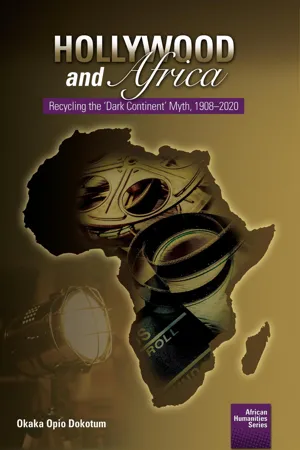
eBook - ePub
Dokotum: Hollywood and Africa
Recycling the 'Dark Continent' Myth from 1908-2020
- 334 pages
- English
- ePUB (mobile friendly)
- Available on iOS & Android
eBook - ePub
About this book
Hollywood and Africa - recycling the ëDark Continentí myth from 1908ñ2020 is a study of over a century of stereotypical Hollywood film productions about Africa. It argues that the myth of the Dark Continent continues to influence Western cultural productions about Africa as a cognitive-based system of knowledge, especially in history, literature and film. Hollywood and Africa identifies the ëcolonial mastertextí of the Dark Continent mythos by providing a historiographic genealogy and context for the termís development and consolidation. An array of literary and paraliterary film adaptation theories are employed to analyse the deep genetic strands of HollywoodñAfrica film adaptations. The mutations of the Dark Continent mythos across time and space are then tracked through the classical, neoclassical and new wave HollywoodñAfrica phases in order to illustrate how Hollywood productions about Africa recycle, revise, reframe, reinforce, transpose, interrogate ó and even critique ó these tropes of Darkest Africa while sustaining the colonial mastertext and rising cyberactivism against Hollywoodís whitewashing of African history.
Information
11
Afrofuturism
So let’s just bury that notion that movies about black characters don’t sell.
– Clarence Page
The Tate Museum defines Afrofuturism as ‘a cultural aesthetic that combines science-fiction, history and fantasy to explore the African American experience and aims to connect those from the black diaspora with their forgotten African ancestry’ (“Afrofuturism…”). According to Kodwo Eshun, Afrofuturism ‘studies the appeals that black artists, musicians, critics and writers have made to the future, in moments where any future was made difficult to imagine’ (2003, 294). Ryan Coogler’s 2018 film Black Panther dramatically illustrates these social phenomena and for many, defines the term. The film draws upon a forgotten African history and the perception of that history as defined by all the central tropes discussed in this book. Science fiction speculates about the future from a perspective of the present, and the present in the representation of Africa remains replete with the legacy of colonialism and its fantasies about the Dark Continent. Part of that speculation envisions a future triumph over this past through the comic book imaginary of the super-heroic victory of good over evil. Black Panther charts an epic journey, from a mystical past rooted in the power of nature through an enslaved and violent diaspora, through a rich diversity of social cultures, through an imagined amalgam of nature resources and native ingenuity to a final victory for the human race, courtesy of African wealth, innovation, compassion and benevolence. This book would therefore be incomplete without discussing Black Panther, Disney’s most talked-about Afrofuturist cinematic block buster of 2018, a screen adaptation of several superhero books by Marvel Comics. Black Panther received a bumper harvest of nominations and awards including seven Oscar nominations and three wins — for music, costume design and production design.
The Black Panther character created by Stan Lee and Jack Kirby in 1966 was incarnated onto the screen by African American director, Ryan Coogler. Almost the entire cast was black and it featured an African soundtrack. As an Afrofuturist film, Black Panther is part of the battle of black countermemory waged through science fiction, which Eshun calls an example of ‘cybernetic futurism…that talks to things that haven’t happened yet…oscillating between anticipation and determinism’ (2003, 291). The film creates counterfutures of Africa devoid of the classical evocations of the Dark Continent template of ignorance, poverty, war, diseases, cannibalism, and so on, which are those products of the colonial imaginary reinforced by the brutality of transatlantic slavery, colonial alienation, dislocation and loss. In the film, Wakanda is an African country that is uncolonised and self-determined, with a unique pristine culture, massive wealth and ultimate superpower technological advancement mediated by African epistemology. The country pursues an economic policy of isolationism and shuns globalisation to protect itself from corruption and exploitation. As science fiction, Black Panther constitutes a forum for evaluating Africa’s present and calling for reparations for the stolen past in order to produce a desired future.
Synopsis
After the assassination of his father, King T’Çhaka, his first-born son and heir, T’Challa, returns home to lead Wakanda, the secluded and technologically advanced East African nation made rich by vibranium, a rare and powerful metal that came from the heavens in the form of a meteor. His authority is soon challenged in ritual combat, first by M’Baku of the Jabari Tribe and then by his hardened American cousin brother, Erik Stephen (N’Jadaka) whose nickname ‘Killmonger’ comes from the atrocities he committed while in a US black-ops unit. Killmonger defeats and seemingly kills T’Çhalla and assumes the throne and Wakanda’s military might and wealth to use in his planned liberation of black people worldwide. Just as he is launching an aerial attack on the enemies of black people around the world, T’Çhalla returns, teams up with M’Baku, CIA agent, Everett K. Ross and members of the Dora Milaje, the all-women Wakandan commando unit, to prevent Wakanda from being dragged into a global war. T’Çhalla kills his cousin in the final battle but learns a lesson from Killmonger’s black-liberation philosophy and vows to avenge his father’s betrayal by offering Wakanda’s wealth and technology to benefit the entire world.
Black Panther portrays Wakanda as the most civilised, affluent, and technologically advanced nation on earth, an African country never colonised and shielded from the world of colonial extraction and globalisation through a holographic camouflage. Powered by vibranium, Wakanda has magnetic levitation trains and teleoperated self-driving cars; the king flies the Royal Talon Airship, the Dora Milaje carry sonic spears powerful enough to stop a tank; in fact, General Okoye considers guns very primitive. King T’Çhalla wears a nanotechnology suit with vibranium-powered ‘kimono’ wrist blasters and sound absorbent boots and carries electromagnetic pulse discs that can stop enemy convoys; the army has armoured rhinos. The Afrofuturism of this film establishes these phenomena as part of its theoretical premise that ‘challenges traditional representations of the future world, setting it in conjunction with African and black culture’ (Murray 2018).
African setting
The trope of Africa as a monolithic space of primitive people and exotic animals in colonial representations is replaced by a geologically specific Wakanda. In different Marvel Comics it is situated on the map of Africa as a fictitious landlocked c...
Table of contents
- 0-2
- 3
- 4
- 5-7
- 8
- 9-10
- 11-end
Trusted by 375,005 students
Access to over 1.5 million titles for a fair monthly price.
Study more efficiently using our study tools.
Frequently asked questions
Yes, you can cancel anytime from the Subscription tab in your account settings on the Perlego website. Your subscription will stay active until the end of your current billing period. Learn how to cancel your subscription
No, books cannot be downloaded as external files, such as PDFs, for use outside of Perlego. However, you can download books within the Perlego app for offline reading on mobile or tablet. Learn how to download books offline
Perlego offers two plans: Essential and Complete
- Essential is ideal for learners and professionals who enjoy exploring a wide range of subjects. Access the Essential Library with 800,000+ trusted titles and best-sellers across business, personal growth, and the humanities. Includes unlimited reading time and Standard Read Aloud voice.
- Complete: Perfect for advanced learners and researchers needing full, unrestricted access. Unlock 1.5M+ books across hundreds of subjects, including academic and specialized titles. The Complete Plan also includes advanced features like Premium Read Aloud and Research Assistant.
We are an online textbook subscription service, where you can get access to an entire online library for less than the price of a single book per month. With over 1.5 million books across 990+ topics, we’ve got you covered! Learn about our mission
Look out for the read-aloud symbol on your next book to see if you can listen to it. The read-aloud tool reads text aloud for you, highlighting the text as it is being read. You can pause it, speed it up and slow it down. Learn more about Read Aloud
Yes! You can use the Perlego app on both iOS and Android devices to read anytime, anywhere — even offline. Perfect for commutes or when you’re on the go.
Please note we cannot support devices running on iOS 13 and Android 7 or earlier. Learn more about using the app
Please note we cannot support devices running on iOS 13 and Android 7 or earlier. Learn more about using the app
Yes, you can access Dokotum: Hollywood and Africa by Opio Dokotum in PDF and/or ePUB format, as well as other popular books in Media & Performing Arts & African Literary Criticism. We have over 1.5 million books available in our catalogue for you to explore.