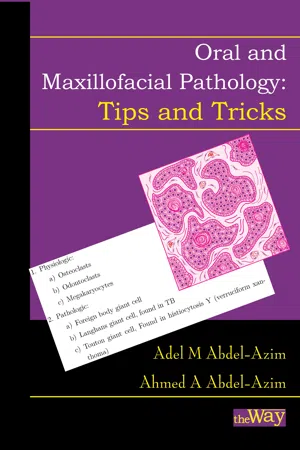
A unique book that collects similar disease manifestations, related histopathological features, similar confusable cell names, phenomena, radiographic pictures, and important syndromes. The book is indispensable for the last-minute review of the pathology before you are subjected to written, oral, practical, chair-side exams or board certification.
eBook - ePub
Oral and Maxillofacial Pathology - Tips and Tricks
Your Guide to Success
- English
- ePUB (mobile friendly)
- Available on iOS & Android
eBook - ePub
Oral and Maxillofacial Pathology - Tips and Tricks
Your Guide to Success
About this book
Information


1 How to Use this Book

This book is by no way an alternative to the standard pathology textbooks. After finish studying a standard textbook, proceed in and return to this book to comprehend and assemble your knowledge. You can use the companion book “Oral and Maxillofacial Pathology: A Study Guide” by the same authors as a start point.
This book is designed to help the students and clinicians memorize diseases by organizing and categorizing disease entities according to their most important or identifiable pathological, radiographic, and clinical features. For example, disorders with similar or notable histological features are grouped together. Also, the most prominent and famous phenomena are mentioned collectively.
The most critical syndromes are mentioned in alphabetical order with a synopsis of their most characteristic features. Besides, you will find a chapter on normal variants that could be mistaken for diseases, lesions of infants and newly born, essential tests and histological stains used in the differential diagnosis are put together with samples of written and chair-side exams. Finley, you will find a chapter for the bad, obsolete, or problematic terms used in pathology with a valuable glossary and definitions.
2 Normal Variants That Could be Mistaken as Disease
Some normal variants of the oral mucosa or teeth might be mistaken as diseases. The general practitioner should be aware of them.
2.1 Cusp of Carabelli
- Is an extra cusp or tubercle or groove found on the palatal surface of the upper first molar and to a lesser extent in the upper second molar.
- This cusp may be entirely absent in some individuals and present in others but in a variety of sizes, sometimes very prominent, and in other instances, be very small and unrecognizable.
- Most common among Europeans (75–85% of individuals).
- It was found that more than half of the Saudi population have a degree of expression of the Carabelli cusp and the Carabelli trait is associated with increased caries incidence [5].
- It appears to be genetically determined.
2.2 Peg-shaped Lateral Incisor
- A peg-shaped lateral is a small, tapered, maxillary lateral incisor.
- The tooth is conical in shape and tapers incisally to a blunt point.
- Peg shaped teeth develop from a single lobe instead of four.
- The condition appears to have a genetic basis.
- The condition is considered as a type of microdontia.
- Prevalence of unilateral and bilateral lateral incisors is the same, however, the left side was twice as common as the right side.
- Individuals with unilateral peg-shaped maxillary lateral incisors might have a 55% chance of having lateral incisor anodontia on the contralateral side [27].
Table of contents
- Preface
- Dedication
- 1 How to Use this Book
- 2 Normal Variants That Could be Mistaken as Disease
- 2.1 Cusp of Carabelli
- 2.2 Peg-shaped Lateral Incisor
- 2.3 Retrocuspid papillae
- 2.4 Tissue Tag
- 2.5 Torus Palatinus
- 2.6 Torus Mandibularis
- 2.7 Leukodema
- 2.8 Racial or Ethnic Pigmentation
- 3 Tumors and Tumor-like Lesions of childhood
- 3.1 Cysts
- 3.1.1 Eruption Cyst or Eruption Hematoma
- 3.1.2 Gingival Cyst of Newborn (Bohn’s Nodule)
- 3.1.3 Epstein’s Pearls
- 3.2 Tumor-Like Conditions (Hamartomas)
- 3.2.1 Hemangioma
- 3.2.2 Lymphangioma
- 3.2.3 Intrabony vascular malformations
- 3.2.4 Pigmented cellular nevi
- 3.3 Tumors
- 3.3.1 Congenital Epulis of Newborn
- 3.3.2 Melanotic Neuroectodermal Tumor of Infancy
- 3.3.3 Juvenile Nasopharyngeal Angiofibroma
- 3.3.4 Infantile Hemangioendothelioma of the Parotid
- 4 Grouped Lesions
- 4.1 Giant Cell Lesions
- 4.1.1 List of giant cell lesions
- 4.1.2 Other lesions which may contain giant cells
- 4.1.3 Types of Giant Cells
- 4.2 Granulomas of the Oral Cavity
- 4.3 Granular Cell Lesions
- 4.4 Fibro-osseous Lesions
- 4.5 Clear Cell Tumors
- 4.6 Lymphoepithelial Lesions
- 4.7 Epulis and Epulides
- 4.7.1 Congenital epulis of new born
- 4.7.2 Epulis fissuratum
- 4.7.3 Pyogenic granuloma
- 4.7.4 Epulis granulomatosa
- 4.7.5 Pregnancy epulis
- 4.7.6 Fibrous epulis
- 4.7.7 Ossifying fibrous epulis
- 4.7.8 Giant cell epulis
- 4.8 Dysplasia and Dysplasias
- 4.8.1 Epithelial Dysplasia
- 4.8.2 Fibrous Dysplasia
- 4.8.3 Familial Fibrous Dysplasia
- 4.8.4 Cemento-Osseous Dysplasia
- 4.8.5 Dentin Dysplasia (Dentinal Dysplasia)
- 4.8.6 Cleidocranial Dysplasia
- 4.8.7 Hereditary Ectodermal Dysplasia
- 4.8.8 Chondroectodermal Dysplasia
- 4.8.9 Regional Odontodysplasia
- 4.8.10 Streeter’s Dysplasia
- 4.8.11 Periapical Cemental Dysplasia
- 4.8.12 Focal Cemento-Osseous Dysplasia
- 4.8.13 Florid Cemento-Osseous Dysplasia
- 4.9 Dyskeratosis
- 4.9.1 Benign dyskeratosis
- 4.9.2 Malignant dyskeratosis
- 4.9.3 Hereditary Benign Intraepithelial Dyskeratosis
- 4.9.4 Dyskeratosis Congenita
- 4.10 Hamartoma
- 4.11 Pseudoepitheliomatous Hyperplasia
- 4.12 Recurrent Ulcers
- 4.13 Bilateral Parotid Swelling
- 4.14 Common features of Odontogenic Tumors
- 4.15 Common features of Salivary Gland Tumors
- 4.15.1 Benign Salivary Gland Tumors
- 4.15.2 Malignant Salivary Gland Tumors
- 4.16 Common Features of Cysts
- 4.16.1 Intra-bony cysts:
- 4.16.2 Soft tissue cysts:
- 4.17 Some Specific Features of Cysts
- 4.18 Common Features of Benign Tumors
- 4.19 Common Features of Malignant Tumors
- 4.20 Mutated Genes Associated with Tumors
- 4.21 Hereditary Diseases Associated with Tumors
- 4.21.1 Fanconi anemia
- 4.21.2 Hereditary breast-ovarian cancer syndrome (HBOC)
- 4.21.3 Polyposis coli (Gardener syndrome)
- 4.21.4 Hereditary non-polyposis colon cancer (Lynch syndrome)
- 4.21.5 Li-Fraumeni syndrome
- 4.21.6 Nevoid basal cell carcinoma syndrome
- 4.21.7 Xeroderma pigmentosum
- 4.21.8 Bloom syndrome
- 4.21.9 Von Hippel–Lindau disease
- 4.21.10 Ataxia telangiectasia
- 4.21.11 Neurofibromatosis 1 and 2
- 4.21.12 Multiple endocrine neoplasia 1 and 2
- 4.22 Keratin
- 4.23 Collagen
- 4.24 Vesiculobullous lesions
- 4.25 Verrucous-Papillary Lesions
- 4.26 Lymphadenopathy
- 4.26.1 Important Causes of Localized Cervical Lymphadenopathy
- 4.26.2 Generalized Lymphadenopathy
- 4.27 Tumor-like lesions (appear clinically as swellings)
- 4.28 Hereditary diseases characterized by melanin pigmentation
- 4.29 Hereditary syndromes associated with early loss of teeth
- 4.30 Root Resorption
- 4.31 Generalized Loss of Lamina Dura
- 4.32 Widening of Periodontal Ligament Space
- 4.33 Pulp Stones
- 4.34 Reduced Pulp Space
- 4.35 Enlarged Pulp Space
- 4.36 Juxta-Epithelial Hyalinization
- 4.37 Cotton Wool Appearance
- 4.38 Sun Ray Appearance
- 4.39 Psammoma-Like Bodies
- 4.40 Delayed Formation of Sequestrum
- 4.41 Yellow lesions
- 4.42 Multiple tumors
- 4.43 Generalized Gingival Enlargement
- 4.44 IgG4-Related Diseases
- 4.45 Radiolucent and Radiopaque Lesions
- 4.45.1 Well-defined monolocular radiolucency
- 4.45.2 Ill-defined monolocular radiolucency (poorly defined)
- 4.45.3 Multilocular radiolucency at the body of the mandible
- 4.45.4 Mixed radiopacity and radiolucency with sharply defined borders
- 4.45.5 Mixed radiopacity and radiolucency with ill-defined borders
- 4.45.6 Well defined mostly radiopaque lesion
- 4.45.7 Diffuse radiolucency of even density with ill-defined borders
- 4.45.8 Diffuse or focal radiopacities of even density with ill-defined borders
- 4.45.9 Radiopaque or radiolucent with abnormal trabecular pattern
- 5 Important Syndromes
- 5.1 Apert syndrome
- 5.2 Ascher syndrome
- 5.3 Auriculotemporal syndrome
- 5.4 Behcet’s syndrome
- 5.5 Bloch-Sulzberger syndrome (Incontinentia pigmenti)
- 5.6 Candidosis endocrinopathy syndrome
- 5.7 Carpenter syndrome
- 5.8 Christ-Siemens-Touraine syndrome
- 5.9 Chronic mucocutaneous candidosis syndrome
- 5.10 Coffin-Siris syndrome
- 5.11 Cracked tooth syndrome
- 5.12 Crouzon syndrome
- 5.13 Down’s syndrome
- 5.14 Dysplastic nevus syndrome
- 5.15 Ehlers-Danlos syndrome
- 5.16 Endocrine candidosis syndrome
- 5.17 Familial chronic mucocutaneous syndrome
- 5.18 Fanconi’s syndrome
- 5.19 Focal dermal hypoplasia syndrome
- 5.20 Franceschetti’s syndrome
- 5.21 Frey’s syndrome
- 5.22 Gardener syndrome
- 5.23 Goltz syndrome
- 5.24 Gorlin-Chaudhry-Moss syndrome
- 5.25 Gorlin-Goltz syndrome
- 5.26 Heerfordt’s syndrome
- 5.27 Hyperparathyroidism-jaw tumor syndrome (HPT-JT)
- 5.28 Hypertrichosis syndrome
- 5.29 Jaffe-Lichtenstein syndrome
- 5.30 Laugier-Hunziker syndrome
- 5.31 Lethal midline granuloma syndrome
- 5.32 Li-Fraumeni syndrome (LFS)
- 5.33 Maccune-Albright syndrome
- 5.34 Marshall syndrome
- 5.35 Mazabraud syndrome
- 5.36 Melkersson - Rosenthal Syndrome
- 5.37 Mikulicz syndrome
- 5.38 Mucocutaneous-ocular syndrome
- 5.39 Multiple endocrine neoplasia (MEN) syndrome
- 5.39.1 Multiple endocrine neoplasia syndrome type 1 (MEN-1)
- 5.39.2 Multiple endocrine neoplasia syndrome type 2 (MEN-2)
- 5.40 Nevoid basal cell carcinoma syndrome
- 5.41 Oral facial digital syndrome
- 5.42 Otodental syndrome
- 5.43 Paterson-Kelly syndrome
- 5.44 Peutz-Jeghers syndrome
- 5.45 Pfeiffer syndrome
- 5.46 Pierre Robin Syndrome
- 5.47 Plummer-Vinson syndrome
- 5.48 Polyposis coli syndrome
- 5.49 Progeria syndrome
- 5.50 Ramsay-Hunt syndrome
- 5.51 Reiter’s syndrome
- 5.52 Rieger syndrome (Axenfeld-Rieger syndrome)
- 5.53 Rendu-Osler-Weber syndrome
- 5.54 Rothmund-Thomson syndrome
- 5.55 Salamon syndrome
- 5.56 Silver-Russell syndrome
- 5.57 Sjogren’s syndrome
- 5.58 Steven-Johnson syndrome
- 5.59 Streeter’s syndrome
- 5.60 Sturge-Weber syndrome
- 5.61 Treacher Collins syndrome
- 5.62 Van der Woude syndrome
- 5.63 Williams syndrome
- 6 Important Descriptions
- 6.1 Mosaic Appearance
- 6.2 Onion Skin Appearance
- 6.3 Corps Ronds and Grains
- 6.4 Captain’s wheel or Pilot wheel
- 6.5 Spider-like telangiectases
- 6.6 Cell within cell dyskeratosis
- 6.7 Cobblestone appearance
- 6.8 Punched out appearance
- 6.9 Hair-on-end appearance
- 7 Important Cells
- 7.1 Langhans vs Langerhans cells
- 7.2 Foam Cells
- 7.3 Goblet Cells
- 7.4 Acantholytic cells
- 7.5 Tzanck Cells
- 7.6 Ghost Cells
- 8 Important Phenomena
- 8.1 Anachoresis
- 8.2 Monoclonality vs Polyclonality
- 8.3 Pathergy reaction
- 8.4 Codominance
- 8.5 Penetrance
- 9 Important Tests
- 9.1 Laboratory Tests
- 9.1.1 Lactobacillus count test
- 9.1.2 Antibiotic sensitivity test
- 9.1.3 Immunoelectrophoresis test
- 9.1.4 Tzanck test
- 9.1.5 Coccidioidin test
- 9.1.6 ELISA – Enzyme Linked Immunosorbent Assay
- 9.1.7 Western blot test
- 9.1.8 PCR (Polymerase chain reaction)
- 9.1.9 Kveim Test
- 9.1.10 Skin Prick Test
- 9.2 Clinical Tests
- 9.2.1 Percussion test
- 9.2.2 Aspiration test
- 9.2.3 Vitality test
- 9.2.4 Diascopy Test
- 10 Normal Values
- 10.1 Blood and Serum
- 10.1.1 ESR
- 10.1.2 Red blood cells
- 10.1.3 Hematocrit value
- 10.1.4 White blood cell count
- 10.1.5 Differential White blood cell count
- 10.1.6 Platelet count
- 10.1.7 Hemoglobin
- 10.1.8 Calcium level
- 10.1.9 Phosphorus level
- 10.1.10 Alkaline phosphatase
- 10.1.11 Acid phosphatase
- 10.2 Urine
- 10.2.1 Vanillylmandelic acid (VMA)
- 10.2.2 Bence Jones proteins
- 10.2.3 Proteinuria
- 10.3 Saliva
- 11 Tropical Diseases of the Oral Cavity
- 11.1 Fungal Infection
- 11.1.1 Oral Candidosis (Moniliasis)
- 11.1.2 Histoplasmosis Capsulatum
- 11.1.3 Blastomycosis
- 11.1.4 Coccidioidomycosis
- 11.1.5 Paracoccidioidomycosis
- 11.1.6 Cryptococcosis
- 11.1.7 Mucormycosis (Zygomycosis, Phycomycosis)
- 11.1.8 Aspergillosis
- 11.2 Bacterial Infections
- 11.2.1 Maxillofacial Gangrene (Noma, Cancrum Oris)
- 11.2.2 Syphilis
- 11.2.3 Leprosy (Hansen’s disease)
- 11.2.4 Actinomycosis
- 11.2.5 Cutaneous Tuberculosis (Lupus vulgaris)
- 11.2.6 Donovanosis (Granuloma Venereum, Granuloma Inguinale)
- 11.3 Parasitic Infections
- 11.3.1 Mucocutaneous Leishmaniasis (Espundia)
- 11.3.2 Myiasis
- 11.3.3 Larva Migrans (Creeping Eruption)
- 12 Special Stains in Oral Lesions
- 12.1 Workup Summary for Special Stains
- 13 Important Microorganisms
- 13.1 Metazoa
- 13.2 Protozoa
- 13.3 Fungi
- 13.4 Bacteria
- 13.5 Viruses
- 13.5.1 DNA viruses
- 13.5.2 RNA viruses
- 13.6 Prions
- 14 Always Remember
- 15 Samples of Oral and Chair-Side Exams
- 16 Samples of Written Exams
- 17 Bad, Obsolete, Problematic Terms
- 17.1 Fibroosteoma
- 17.2 Pulp Polyp
- 17.3 Streeter’s Syndrome
- 17.4 Pyogenic Granuloma
- 17.5 Enameloma
- 17.6 Dentinoma
- 17.7 Histiocytosis Y
- 17.8 Histiocytosis X
- 17.9 Eosinophilic Granuloma
- 17.10 Osteitis Fibrosa Cystica
- 17.11 Brown Nodes of Hyperparathyroidism
- 17.12 Adeno-Ameloblastoma
- 17.13 Mixed tumor of the Parotid
- 17.14 Latent Bone Cyst
- 17.15 Fissural Cysts
- 17.16 Granular Cell Myoblastoma
- 17.17 Inflammatory Pseudotumor
- 17.18 Inflammatory Myofibroblastic Tumor
- 17.19 Familial Fibrous Dysplasia
- 17.20 Morsicatio Mucosae Oris
- 17.21 Melanoameloblastoma
- 17.22 Traumatic Bone Cyst
- 17.23 Juvenile Melanoma
- 17.24 Central Giant Cell Reparative Granuloma
- 17.25 Central Giant Cell Granuloma vs Giant Cell Tumor of Bone
- 17.26 Osteoclastoma
- 17.27 Mikulicz Disease Vs Mikulicz Syndrome
- 18 Important Glossary and Definitions
- Bibliography
- Index
- About the Author
Trusted by 375,005 students
Access to over 1.5 million titles for a fair monthly price.
Study more efficiently using our study tools.
Frequently asked questions
Yes, you can cancel anytime from the Subscription tab in your account settings on the Perlego website. Your subscription will stay active until the end of your current billing period. Learn how to cancel your subscription
No, books cannot be downloaded as external files, such as PDFs, for use outside of Perlego. However, you can download books within the Perlego app for offline reading on mobile or tablet. Learn how to download books offline
Perlego offers two plans: Essential and Complete
- Essential is ideal for learners and professionals who enjoy exploring a wide range of subjects. Access the Essential Library with 800,000+ trusted titles and best-sellers across business, personal growth, and the humanities. Includes unlimited reading time and Standard Read Aloud voice.
- Complete: Perfect for advanced learners and researchers needing full, unrestricted access. Unlock 1.5M+ books across hundreds of subjects, including academic and specialized titles. The Complete Plan also includes advanced features like Premium Read Aloud and Research Assistant.
We are an online textbook subscription service, where you can get access to an entire online library for less than the price of a single book per month. With over 1.5 million books across 990+ topics, we’ve got you covered! Learn about our mission
Look out for the read-aloud symbol on your next book to see if you can listen to it. The read-aloud tool reads text aloud for you, highlighting the text as it is being read. You can pause it, speed it up and slow it down. Learn more about Read Aloud
Yes! You can use the Perlego app on both iOS and Android devices to read anytime, anywhere — even offline. Perfect for commutes or when you’re on the go.
Please note we cannot support devices running on iOS 13 and Android 7 or earlier. Learn more about using the app
Please note we cannot support devices running on iOS 13 and Android 7 or earlier. Learn more about using the app
Yes, you can access Oral and Maxillofacial Pathology - Tips and Tricks by Adel M Abdel-Azim,Ahmed A Abdel-Azim in PDF and/or ePUB format, as well as other popular books in Medicine & Dentistry. We have over 1.5 million books available in our catalogue for you to explore.