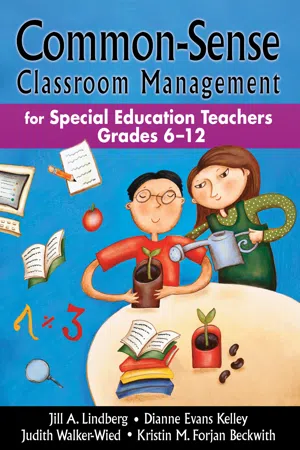
Common-Sense Classroom Management for Special Education Teachers, Grades 6-12
eBook - ePub

Common-Sense Classroom Management for Special Education Teachers, Grades 6-12

  1. 160 pages
  2. English
  3. ePUB (mobile friendly)
  4. Available on iOS & Android
eBook - ePub

Common-Sense Classroom Management for Special Education Teachers, Grades 6-12

About this book

"Teachers will love the straightforward, practical information. The topics and strategies are excellent."
—Debi Gartland, Professor of Special Education, Towson University

"Impressive. Pinpoints current classroom issues and offers direct problem-solving approaches. This easy-to-implement resource, with its organized chapter outlines and well-crafted format, is flexible and adaptable to any grade, subject, or ability level."
—Erin Ann Witty, Special Education Teacher, Milwaukee Public Schools, WI

"Provides great insight for developing and organizing your overall daily routine, planning, and teaching."
—Mariann C. Carter, Exceptional Needs Specialist, South Carolina Department of Education

"A valuable reference for any special education teacher. With a focus on classroom management, the guide covers all aspects of teaching, from paperwork to professional relationships. New and veteran teachers will find indispensable resources to improve their practice and enrich their learning."
—Peggy Holtman, Special Education Supervisor, Milwaukee Public Schools, WI

Special education teaching strategies in a no-nonsense format!

If you?re a teacher new to special education, this book is for you! This newest Common-Sense Classroom Management guide addresses the most critical challenges that arise when teaching adolescent learners with special needs.

In this flexible and easy-to-implement resource, educators will find 80 concise and teacher-tested strategies. Each strategy works in five steps or fewer, helping special educators feel competent and confident about working with coteachers, teacher aides, support staff, administrators, and families. The authors, all special education experts, provide practical assistance with:

  • Specially designed instruction and student organization to make teaching more effective
  • Legal responsibilities aligned with IDEIA and NCLB requirements
  • Positive behavioral supports, including incentive programs and meaningful consequences

Ideal for teachers new to special education, teacher trainers, and teacher mentors, this resource provides a clear-sighted focus to help you shape the structure of each teaching day and ensure success for all your learners with special needs!

Frequently asked questions

Yes, you can cancel anytime from the Subscription tab in your account settings on the Perlego website. Your subscription will stay active until the end of your current billing period. Learn how to cancel your subscription.
No, books cannot be downloaded as external files, such as PDFs, for use outside of Perlego. However, you can download books within the Perlego app for offline reading on mobile or tablet. Learn more here.
Perlego offers two plans: Essential and Complete
  • Essential is ideal for learners and professionals who enjoy exploring a wide range of subjects. Access the Essential Library with 800,000+ trusted titles and best-sellers across business, personal growth, and the humanities. Includes unlimited reading time and Standard Read Aloud voice.
  • Complete: Perfect for advanced learners and researchers needing full, unrestricted access. Unlock 1.4M+ books across hundreds of subjects, including academic and specialized titles. The Complete Plan also includes advanced features like Premium Read Aloud and Research Assistant.
Both plans are available with monthly, semester, or annual billing cycles.
We are an online textbook subscription service, where you can get access to an entire online library for less than the price of a single book per month. With over 1 million books across 1000+ topics, we’ve got you covered! Learn more here.
Look out for the read-aloud symbol on your next book to see if you can listen to it. The read-aloud tool reads text aloud for you, highlighting the text as it is being read. You can pause it, speed it up and slow it down. Learn more here.
Yes! You can use the Perlego app on both iOS or Android devices to read anytime, anywhere — even offline. Perfect for commutes or when you’re on the go.
Please note we cannot support devices running on iOS 13 and Android 7 or earlier. Learn more about using the app.
Yes, you can access Common-Sense Classroom Management for Special Education Teachers, Grades 6-12 by Jill A. Lindberg,Dianne Evans Kelley,Judith Walker-Wied,Kristin M. Forjan Beckwith in PDF and/or ePUB format, as well as other popular books in Education & Inclusive Education. We have over one million books available in our catalogue for you to explore.

Information

1

Getting Organized

Special education teachers may have a classroom of their own, share space with other special educators, or have a corner in a general education classroom, hallway, or other area. No matter what your situation, you need to be organized—especially if you are a traveling teacher. With the large amount of paperwork and other data for which special education teachers are responsible, having a system that makes sense and keeps important information handy is essential.

Chapter Outline

Student Information
Supplies and Materials
Your Desk and Surrounding Areas
Forms and Schedules
Room Arrangement
Wall Displays

Student Information

Do you feel as though you need a secretary to keep yourself organized? Paperwork responsibilities can be overwhelming, and for that reason you need to find a system to help you keep current with your many duties. (Please note that Individuals with Disabilities Education Improvement Act of 2004 [IDEIA] states that short-term objectives in Individualized Education Programs [IEPs] can be eliminated for all but a small group of students who take alternative assessments on the basis of alternative achievement standards. However, be sure to check with your school district to see whether it plans to implement this directive.)
1. IEPs are the most important documents you will draft and refer to throughout the year. Keep them in a safe place that is easily accessible to you. IEPs for all of your students should be in place by the first day of school. If you are missing any IEPs, inform your principal or the special education administrator in your school immediately. The IEP cover page provides a great deal of student and family data as well as the all-important IEP due dates. Make certain these dates are accurate, current, and in compliance with your district and state regulations or laws. Goals and objectives should be written based on your district standards. Double-check all IEPs for behavioral issues, transition goals, transportation, and other supplementary aids and related services that are required for the goals. If you have questions or feel you need assistance writing IEPs, ask your special education supervisor or another member of the special education administration staff in your building. IEPs are legal documents for which you are responsible. Be sure they are done correctly.
2. Having easy access to necessary student information is very important. If you are teaching students under the age of majority, be sure to have the names of family members or a guardian who has the legal right to make school and health care decisions for the student. Include current home address, home and work phone numbers, and the times when the person can be reached at these numbers. Record the name of another person who can be called in case of emergency. In addition, know the correct last names of family members, as they may not be the same as the student’s. You may also want to include the student’s birth date, ID number, or any other information that might be useful to you when having a phone conversation about the student with a support staff member or supervisor. Store this information in a secure yet easily accessible location. It’s also a good idea to lock up these confidential documents whenever you leave the classroom.
3. Behavioral information regarding your students should of course be included in the IEP. Be sure you read and understand the specifics, especially if you are responsible for implementing a formal Behavior Intervention Plan (BIP). A BIP is a individualized and detailed plan of action developed to support the student in learning more appropriate behaviors. (See Chapter 4, Positive Behavioral Supports, and Chapter 7, Legal Issues, for more information.) Behavioral information may include a detailed explanation of what the student has responded to in the past and the type of incentive program that has helped the student to be successful, as well as other positive behavioral supports. You may want to make copies of IEP behavior pages for yourself and any general education teachers or support staff involved with the student. If a formal BIP is in place, each staff member involved should have a copy or have access to it and should understand how the plan will be implemented. In addition, be sure you and any involved general education teachers and support staff are aware of serious behavior issues students might have in order to ensure the safety of other students and adults in the classroom.
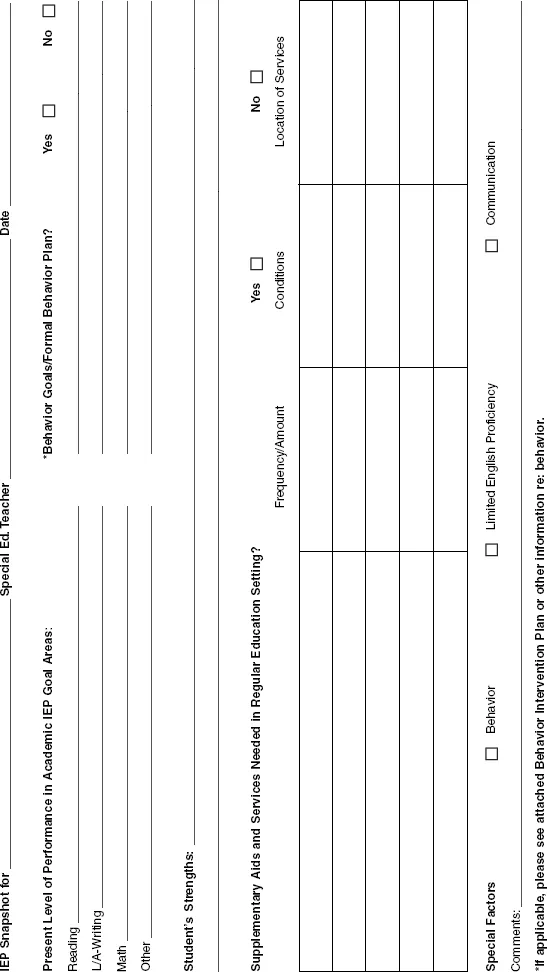
4. IEP snapshots are a great way to have necessary student information at your fingertips and to share this important data with your general education colleagues in an easy-to-read format, such as Figure 1.1. The special education administrator in your building or school district may have a form for you to use. If not, you may wish to use the one provided here or create your own.
5. Many students with disabilities have varying degrees of medical needs that teachers should be made aware of. Before you disclose confidential information, however, find out your district policy regarding the distribution of medical and health information. Your school should have on file any essential medical information such as the name of the student’s doctor and who (including parent, guardian, and school staff) has permission to administer medication or medical assistance. Some students take medication at home rather than at school, and there may be times when, for whatever reason, they do not get it. You may want to keep a record of this so you can work with the student (if appropriate), parents, or guardians to ensure the medication schedule is followed. Often, school performance is affected by medication or lack thereof. In addition, take note of any side effects that may result from the medication. You will also want to keep on hand any information regarding therapy a student may be receiving outside of school if families have shared this with you and have given you permission to speak with the therapist. You can usually obtain parental permission forms from your school psychologist, social worker, or your administrator. Also note that some students with disabilities may have special classroom needs. Be sure you are aware of these and make arrangements to accommodate them.

Supplies and Materials

Sometimes it’s a real challenge for special education teachers to obtain supplies. But part of your job is to be a strong advocate for your students’ rights to the same education using the same materials as their counterparts in the general education classroom. Keep that in mind if you feel apprehensive about asking for what you and your students need.
1. As you begin to gather supplies and materials, make sure to get copies of all the current textbooks and teachers’ manuals you will need for teaching your students. If you have students at different grade levels, then you will need materials for all the levels. Your administrator should be aware of your needs and supply you with these things. However, this might not always be the case, and you may need to borrow from your colleagues or even make copies of some of the materials. Become familiar with what will be taught from these texts in the general education classroom so that whether you teach students separately in an alternative setting or within the general education classroom, both you and your students with disabilities will always be as up to speed as possible. Be sure to check out the teachers’ manuals, as many of them offer suggestions for reteaching and modifying work for students who need extra practice. Some manuals may also include an audio tape of the text that can be used to accommodate students with reading or vision difficulties.
Figure 1.1 IEP Snapshot
SOURCE: Adapted from M. Nieves-Harris, M. S., 2004.
2. In addition, seek out any other professionals in your building who can offer assistance with curriculum and teaching strategy information. In some districts, there are content specialists who can offer techniques and strategies as well as materials you can use. This person may even be willing to demonstrate for you or even teach a lesson with you. In addition to content area specialists, most high schools have a department chair for each curricular area. This person can also be a va...

Table of contents

  1. Cover
  2. Dedication
  3. Title Page
  4. Copyright
  5. Contents
  6. Preface
  7. Acknowledgments
  8. About the Authors
  9. 1. Getting Organized
  10. 2. Organizing Students
  11. 3. Delivery of Special Education Services
  12. 4. Positive Behavioral Supports
  13. 5. General Education Instructional Planning
  14. 6. Specially Designed Instruction
  15. 7. Legal Issues
  16. 8. Working With Families
  17. 9. Working With Support Staff
  18. 10. Working With Teacher Assistants
  19. 11. Working With Administration
  20. 12. Working Within Your School Community
  21. References
  22. Suggested Readings
  23. Index