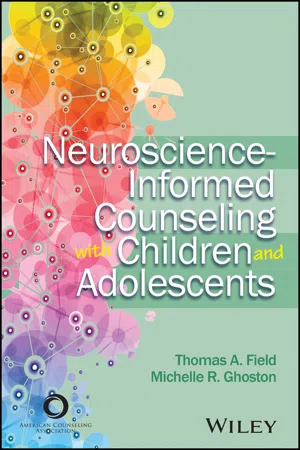
Neuroscience-Informed Counseling with Children and Adolescents
- English
- ePUB (mobile friendly)
- Available on iOS & Android
Neuroscience-Informed Counseling with Children and Adolescents
About this book
This innovative text is the first to illustrate how neuroscience concepts can be translated and applied to counseling with children and adolescents. Drs. Field and Ghoston discuss general principles for child and adolescent counseling before examining neurophysiological development from birth to age 18. They then provide in-session examples of neuroscience-informed approaches to behavior modification, play therapy, cognitive behavior therapy, biofeedback, neurofeedback, and therapeutic lifestyle change with diverse clients in a variety of settings.
Each chapter contains knowledge and skill-building material for counselors-in-training; counselor educators; and practitioners in schools, hospitals, residential facilities, and outpatient clinics. Text features include learning objectives, alignment with the CACREP Standards specific to child and adolescent counseling, explanatory diagrams, reflection questions to prompt deep processing of the material, case vignettes to demonstrate how to apply neuroscience concepts to counseling work, and quiz questions to test knowledge of key concepts. In addition, the text includes an extensive neuroscience glossary.
*Requests for digital versions from ACA can be found on www.wiley.com
*To purchase print copies, please visit the ACA https://imis.counseling.org/store/
*Reproduction requests for material from books published by ACA should be directed to [email protected]
Frequently asked questions
- Essential is ideal for learners and professionals who enjoy exploring a wide range of subjects. Access the Essential Library with 800,000+ trusted titles and best-sellers across business, personal growth, and the humanities. Includes unlimited reading time and Standard Read Aloud voice.
- Complete: Perfect for advanced learners and researchers needing full, unrestricted access. Unlock 1.4M+ books across hundreds of subjects, including academic and specialized titles. The Complete Plan also includes advanced features like Premium Read Aloud and Research Assistant.
Please note we cannot support devices running on iOS 13 and Android 7 or earlier. Learn more about using the app.
Information
Index
A
- Abuse
- drug, 147, 166, 167, 174–176
- physical, 63
- psychological, 63
- sexual, 63, 64, 154
- Academics. See School experiences
- Acetylcholine, 153, 239
- ACTH. See Adrenocorticotropic hormone
- Action potential, 28, 239
- ACT model for limit setting, 132–133
- Adaptive functioning, 94–95
- Adaptive immunity, 43
- Addiction. See Substance use and addiction
- Adenine, 53
- ADHD, 92, 99–101
- autism and, 96
- characteristics, 99
- etiology, 99–100
- impact on family functioning, 101
- interventions, 101
- neurofeedback and, 212–214
- premature birth and, 78
- school experiences and, 84
- transdiagnostic approach and, 103
- Adolescents, 145–218
- anxiety issues, 170–171
- biofeedback, 206–209
- case vignette, 177–178
- cognitive behavior therapy, 187–203. See also Cognitive behavior therapy
- counseling approaches, 187–218
- depression, 166–169
- eating disorders, 173–174
- effective working relationships with, 8–14
- identity ...
Table of contents
- Cover
- Title Page
- Copyright Page
- Dedication Page
- Table of Contents
- Preface
- About the Authors
- Acknowledgments
- Section I: Foundations
- Section II: Childhood
- Section III: Adolescence
- Section IV: Conclusion
- Neuroscience Glossary
- Answer Key to Quiz Questions
- Index
- Technical Support
- End User License Agreement