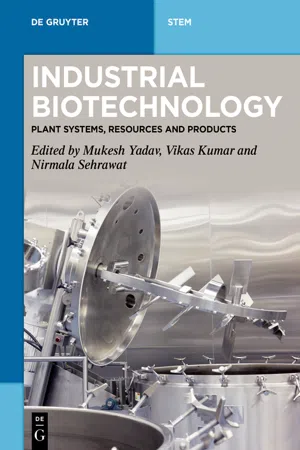
Industrial Biotechnology summarizes different aspects of plant biotechnology such as using plants as sustainable resources, phytomedical applications, phytoremedation and genetic engineering of plant systems. These topics are discussed from an academic as well industrial perspective and thus highlight recent developments but also practical aspects of modern biotechnology.
eBook - ePub
Industrial Biotechnology
Plant Systems, Resources and Products
- 234 pages
- English
- ePUB (mobile friendly)
- Available on iOS & Android
eBook - ePub
Industrial Biotechnology
Plant Systems, Resources and Products
About this book
Information
1 Inulinase and pullulanase production from agro-industrial residues
R. S. Singh
Taranjeet Singh
Abstract
Inulinases and pullulanases have attracted the global attention of researchers owing to their vast applications in food industries. Inulinases hydrolyze the glycosidic linkages of inulin to produce fructooligosaccharides and high fructose syrup, whereas pullulanases hydrolyze the α-1,4 and α-1,6 glycosidic linkages in pullulan, starch and amylopectin to yield maltotriose, resistant starch, panose, isopanose, etc. Commercially, pullulanases are used in the starch liquefication and saccharification process, which reduces the use of glucoamylases by 50% in the industrial starch conversion process. Cost of substrate is an important factor in bioprocess economics. Therefore, many low-cost fermentation processes have been developed for the production of inulinases and pullulanases using various agro-industrial wastes. This chapter focuses on the production of inulinases and pullulanases in both the solid state and submerged fermentation (SmF) using agro-industrial residues, their purification, characterization as well as their applications.
Keywords: Inulinase, pullulanases, glucoamylases, liquefication, saccharification,
1.1 Introduction
Inulinases, are an important class of industrial enzymes belonging to the glycoside hydrolase (GH) family 32, are characterized on the basis of their action pattern on inulin. Although inulinases have been reported from a variety of plants, animals and microorganisms, they are present in very minute quantities in plants and animals, thereby making microorganisms the best source of inulinases. Among the microorganisms, Aspergillus sp., Bacillus sp., Kluyveromyces sp., Penicillium sp., Pseudomonas sp. and Streptomyces sp. are quite efficient inulinase producers [1]. There are several advantages of microbial inulinases, such as they offer easy cultivation and genetic manipulation, high production yield, rapid multiplication, and considerable variability in biophysical and biochemical characteristics, and they are mostly inducible and extracellular in nature [2, 3]. Inulinases from fungal sources can be produced at lower substrate concentrations and have low pH and higher temperature stability, making them industrially more advantageous over other microbial sources. Inulinases have been produced in both solid state and submerged fermentations (SmFs) using a wide range of substrates and microorganisms [2, 3].
On the basis of their mode of action, inulinases are classified as exoinulinases (EC 3.2.1.80) and endoinulinases (3.2.1.7). Exoinulinases perform sequential degradation from the non-reducing end of the inulin, releasing fructose with a molecule of glucose, whereas endoinulinases act arbitrarily on the internal β-2,1-glycosidic linkages of inulin to produce fructooligosaccharides of varied chain lengths. The exoacting and endoacting natures of inulinases mainly depend on the source of the enzyme. Inulinases from fungal sources are generally exoacting. However, in some cases, fungal strains like Aspergillus sp., Chrysosporium pannorum and Penicillium rugulosum, and the yeast strain Cryptococcus aureus produce both exo- and endoinulinases [1, 2]. Although most of the microorganisms produce extracellular inulinases, in some strains the enzyme location is intracellular [4, 5], and yet some other microbial species produce both extra- and intracellular inulinases [6]. Inulinases are used for the production of high fructose syrup, fructooligosaccharides, bioethanol, single-cell oil, single-c...
Table of contents
- Title Page
- Copyright
- Contents
- Preface
- List of contributing authors
- Editors’ Biographies
- 1 Inulinase and pullulanase production from agro-industrial residues
- 2 Agro-industrial lignocellulosic residues for the production of industrial enzymes
- 3 Biotechnological conversion of plant biomass into value-added products
- 4 Plants and plant-derived materials used for biosensor development
- 5 Plant resources: In vitro production, challenges and prospects of secondary Metabolites from medicinal plants
- 6 Phytomedicine: History, scope and future prospects
- 7 Plant tissue culture for commercial propagation of economically important plants
- 8 Genetically modified plants: Developments and industrial aspects
- 9 Chloroplast genetic engineering: Concept and industrial applications
- 10 Plant biotechnology: Industrial prospects and scopes
- Index
Trusted by 375,005 students
Access to over 1.5 million titles for a fair monthly price.
Study more efficiently using our study tools.
Frequently asked questions
Yes, you can cancel anytime from the Subscription tab in your account settings on the Perlego website. Your subscription will stay active until the end of your current billing period. Learn how to cancel your subscription
No, books cannot be downloaded as external files, such as PDFs, for use outside of Perlego. However, you can download books within the Perlego app for offline reading on mobile or tablet. Learn how to download books offline
Perlego offers two plans: Essential and Complete
- Essential is ideal for learners and professionals who enjoy exploring a wide range of subjects. Access the Essential Library with 800,000+ trusted titles and best-sellers across business, personal growth, and the humanities. Includes unlimited reading time and Standard Read Aloud voice.
- Complete: Perfect for advanced learners and researchers needing full, unrestricted access. Unlock 1.5M+ books across hundreds of subjects, including academic and specialized titles. The Complete Plan also includes advanced features like Premium Read Aloud and Research Assistant.
We are an online textbook subscription service, where you can get access to an entire online library for less than the price of a single book per month. With over 1.5 million books across 990+ topics, we’ve got you covered! Learn about our mission
Look out for the read-aloud symbol on your next book to see if you can listen to it. The read-aloud tool reads text aloud for you, highlighting the text as it is being read. You can pause it, speed it up and slow it down. Learn more about Read Aloud
Yes! You can use the Perlego app on both iOS and Android devices to read anytime, anywhere — even offline. Perfect for commutes or when you’re on the go.
Please note we cannot support devices running on iOS 13 and Android 7 or earlier. Learn more about using the app
Please note we cannot support devices running on iOS 13 and Android 7 or earlier. Learn more about using the app
Yes, you can access Industrial Biotechnology by Mukesh Yadav, Vikas Kumar, Nirmala Sehrawat, Mukesh Yadav,Vikas Kumar,Nirmala Sehrawat in PDF and/or ePUB format, as well as other popular books in Biological Sciences & Biochemistry. We have over 1.5 million books available in our catalogue for you to explore.