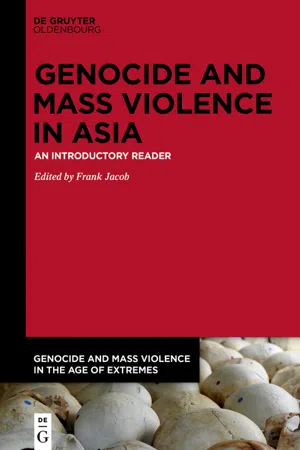
In Asia the "Age of Extremes" witnessed many forms of mass violence and genocide, related to the rise and fall of the Japanese Empire, the proxy wars of the Cold War, and the anti-colonial nation building processes that often led to new conflicts and civil wars. The present volume is considered an introductory reader that deals with different forms of mass violence and genocide in Asia, discusses the perspectives of victims and perpetrators alike.
- 226 pages
- English
- ePUB (mobile friendly)
- Available on iOS & Android
eBook - ePub
About this book
Information
Subtopic
Asian HistoryIndex
History1 Genocide and Mass Violence in Asia: An Introduction
Frank Jacob
Nord Universitet, Faculty of Social Science, Universitetsalléen 11, 8049 Bodø, Norway
“A genocide begins with the killing of one [woman or] man—
not for what [she or] he has done, but because of who [she or] he is.”1
The late Nobel Peace Prize laureate and former General Secretary of the UN Kofi Annan (1938–2018) emphasized in his Nobel Lecture in 2001 that the “crime of all crimes” often begins with a single murder. This violent act does not only physically destroy a human being, but, as French philosopher Michel Foucault (1926–1984) highlighted, power relations are established and new mechanisms of power are eventually installed or fortified within a society.2 The 20th century in particular witnessed countless attempts to restructure such power relations and, as a whole, the years between the First World War and the end of the Cold War, i.e. the period Eric Hobsbawm (1917–2012) called the “Age of Extremes,”3 were perhaps, as Kofi Annan correctly further remarked, “the deadliest in human history, devastated by innumerable conflicts, untold suffering, and unimaginable crimes.”4
The century was determined by imperial wars, two World Wars, the Cold War, and new wars at its end.5 These were often accompanied by forms of mass violence, i.e. mass killings or genocides.6 German historian Christian Gerlach consequently speaks of “extremely violent societies” that determined the course of this “Age of Extremes.” Gerlach describes these “extremely violent societies” as
formations where various population groups become victims of massive physical violence, in which, acting together with organs of the state, diverse social groups participate for a multitude of reasons. Simply put, the occurrence and the thrust of mass violence depends on broad and diverse support, but this is based on a variety of motives and interests that cause violence to spread in different directions and varying intensities and forms.7
Individuals and groups were challenged by political developments, and identity conflicts between, but often also within, societies were the consequences. In Asia, nationalism and anti-colonialism stimulated change, but also opened new conflicts, especially between those who had different concepts of identity that were based on religion, political ideas, or social classes.8 The Cold War in particular influenced genocidal acts related to the proxy wars of the superpowers in Asia, which is why Immanuel Wallerstein’s evaluation of this conflict is correct: the Cold War may have been “cold” in Europe, but in Asia, it was definitely a “hot” war, causing countless casualties and destruction.9 Regardless of the numerous attempts to contain such violent eruptions and to prevent further genocides, the last two decades of the 20th century made it obvious that the “crime of crimes” did not only determine the last century, but is still a dangerous factor and, as Italian sociologist Franco Ferrarotti emphasizes, “[i]t is significant that genocide[s] occurred after the establishment of human rights organizations [and] after the invention of modern, instantaneous communication technologies.”10 The term “Age of Genocide,”11 as used by the Canadian political scientist Peter J. Stoett for the last century, obviously stretches into the 21st century as well, especially when considering current cases, like that of the Rohingyas in Myanmar.12
Regardless of such contemporary cases of mass violence, the number of genocides since the end of the Second World War is rather low, especially in Asia. This, however, is related to problems with the definition, introduced by Polish lawyer and anti-genocide activist Raphael Lemkin (1900–1959) in the 1940s.13 When Lemkin defined genocide in 1944,14 he, of course, coined a term “born from the Holocaust,”15 which was almost naturally often read in reference to the almost total destruction of the European Jews by the Nazis.16 Due to the timely context of Lemkin’s theoretical concept, as legal scholar Tatiana E. Sainati states, “the Holocaust remains the lens through which other cases of possible genocide are interpreted, [and] which has significantly limited the number of incidents that have ultimately been labeled as genocide.”17 This limitation is, however, in the first place related to Lemkin’s original concept as such:
Genocide is the crime of destroying national, racial or religious groups. The problem now arises as to whether it is a crime of only national importance, or a crime in which international society as such should be vitally interested. Many reasons speak for the second alternative. It would be impractical to treat genocide as a national crime, since by its very nature it is committed by the state or by powerful groups which have the backing of the state. A state would never prosecute a crime instigated or backed by itself.18
Lemkin consequently argued that it was important to sign the UN Convention on the Prevention and Punishment of the Crime of Genocide of 1948 to prevent further genocides in the future.19
Nevertheless, his concept has its limitations, namely related to methods of killing20 and the reasons for it. Although Lemkin wanted to continue his research on genocide and the available project description for a planned global history of genocides21 implies that the Polish lawyer would have included non-Western and especially Asian case studies as well, it is a fact that the concept as such remained existent in its limited and very Eurocentric form. Today, two conceptions – i.e. a minimalist one, arguing for the pursuance of Lemkin’s original definition of 1944 and the UN Convention of 1948, and a maximalist one arguing for the inclusion of “death from state negligence, imperial expansion, economic exploitation, and cultural destruction”22 – are used to either limit or to broaden the number of genocides.
In particular, mass violence against a group that shares a specific political or gender identity is not covered by the UN Convention, and therefore would rather deserve to be defined as or called “politicide”23 or “gendercide.”24 Especially in the Asian context, the use of the UN Convention’s definition limits the perspective, as mass violence due to political reasons is almost totally excluded,25 and the case of Cambodia already “illustrates the critical shortfall of the Genocide Convention.”26 The limitations of the 1948 Convention must be understood as a necessity of the time, however, because, as Sainati correctly highlights, the “explicit omission of political groups from the definition of genocide that was enshrined in the 1948 Convention … exemplifies the practical compromises that were necessary to ensure widespread support in the harsh world of Cold War politics.”27 It is, however, no surprise, that this limitation has been criticized in the decades since the late 1940s, and attempts to change the terminology have been made by many lawyers, historians, and activists alike.28
While genocide scholars are very often hesitant to consider politically motivated mass violence as genocide,29 it has to be incorporated in studies of the phenomenon during the “Age of Extremes,” which is why the present volume will not only look at genocide, but also at mass violence in Asia. Since the six “officially accepted” cases of genocide in the 20th century – the Armenian genocide, the Holocaust, the Cambodian genocide by the Khmer Rouge, the killing of the Kurds in North Iraq, the killing of the Tutsi in Rwanda...
Table of contents
- Title Page
- Copyright
- Contents
- 1 Genocide and Mass Violence in Asia: An Introduction
- Section I: Forms of Mass Violence and Genocide
- 3 “Kill 3 Million and the Rest Will Eat of Our Hands”: Genocide, Rape, and the Bangladeshi War of Liberation
- Section II: Victims
- 5 From Student Activists to Muktibahini: Students, Mass Violence and the Bangladesh Liberation War
- Section III: Perpetrators
- 7 Excessive Violence in a War Without Fronts: Explaining Atrocities in South Vietnam (1965–1973)
- Section IV: Memory and Justice
- 9 Forgotten Genocide in Indonesia: Mass Violence, Resource Exploitation and Struggle for Independence in West Papua
- 10 Murder, Museums, and Memory: Cold War Public History in Jakarta, Ho Chi Minh City, and Phnom Penh
- Contributors
Trusted by 375,005 students
Access to over 1.5 million titles for a fair monthly price.
Study more efficiently using our study tools.
Frequently asked questions
Yes, you can cancel anytime from the Subscription tab in your account settings on the Perlego website. Your subscription will stay active until the end of your current billing period. Learn how to cancel your subscription
No, books cannot be downloaded as external files, such as PDFs, for use outside of Perlego. However, you can download books within the Perlego app for offline reading on mobile or tablet. Learn how to download books offline
Perlego offers two plans: Essential and Complete
- Essential is ideal for learners and professionals who enjoy exploring a wide range of subjects. Access the Essential Library with 800,000+ trusted titles and best-sellers across business, personal growth, and the humanities. Includes unlimited reading time and Standard Read Aloud voice.
- Complete: Perfect for advanced learners and researchers needing full, unrestricted access. Unlock 1.5M+ books across hundreds of subjects, including academic and specialized titles. The Complete Plan also includes advanced features like Premium Read Aloud and Research Assistant.
We are an online textbook subscription service, where you can get access to an entire online library for less than the price of a single book per month. With over 1.5 million books across 990+ topics, we’ve got you covered! Learn about our mission
Look out for the read-aloud symbol on your next book to see if you can listen to it. The read-aloud tool reads text aloud for you, highlighting the text as it is being read. You can pause it, speed it up and slow it down. Learn more about Read Aloud
Yes! You can use the Perlego app on both iOS and Android devices to read anytime, anywhere — even offline. Perfect for commutes or when you’re on the go.
Please note we cannot support devices running on iOS 13 and Android 7 or earlier. Learn more about using the app
Please note we cannot support devices running on iOS 13 and Android 7 or earlier. Learn more about using the app
Yes, you can access Genocide and Mass Violence in Asia by Frank Jacob in PDF and/or ePUB format, as well as other popular books in History & Asian History. We have over 1.5 million books available in our catalogue for you to explore.