This book counters the cultural homogenization of global policy. It examines the integrity of teacher education in particular places, serving particular communities, at particular historical moments.
In this collection, Canadian scholars articulate a response to their collective concerns about the impact of global policy on teacher education, provoking a far-reaching dialogue about teacher education in and for our times. The first two decades of the new millennium have witnessed unprecedented appraisal, analysis, and educational policy formulations related to teaching (K–12) across the Western world. In turn, teacher education has been greatly impacted, as governments around the world see the reform and management of teacher education as a key component in restructuring education toward greater economic competitiveness. The result has been an unwarranted and undesirable level of standardization.
It is vital to the future of teacher education, and concomitantly public education, that we imagine alternatives to the homogenization of the educational experience that globalizing policies install. What is needed are vocabularies that enable educators and teacher educators to discern and articulate educational purposes beyond capital and which focus on the kinds of educational experiences that can help prepare the young to lead good and worthwhile lives.
Using lessons learned from the Canadian context, the authors identify and investigate the importance of initial and continuing professional education that fosters teachers' intellectual freedom and study; advances an informed and critical appreciation of civic particularity and historical circumstance; and cultivates ethical (i.e., pedagogical) engagement with ideas and histories—teachers' own and their students—as crucial themes of teacher education globally.
Published in English.
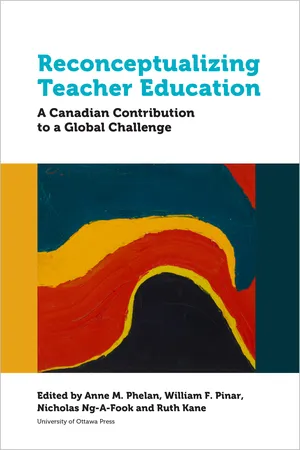
eBook - ePub
Reconceptualizing Teacher Education
A Canadian Contribution to a Global Challenge
- 284 pages
- English
- ePUB (mobile friendly)
- Available on iOS & Android
eBook - ePub
Reconceptualizing Teacher Education
A Canadian Contribution to a Global Challenge
About this book
Information
Topic
EducationSubtopic
Professional DevelopmentCHAPTER 1
Reconciliation in Teacher Education: Hope or Hype?
Jan Hare
Policy directives have motivated the changing curriculum of Canadian teacher education programs to be inclusive of Indigenous content, perspectives, and learning approaches. The Association of Canadian Deans of Education established priorities for Indigenous education as early as 2010, with goals that emphasize improving teacher candidates’ knowledge of and experiences with Indigenous knowledge systems.1 More recently, teacher regulation bodies are developing new standards for the teaching profession concerned with implications for Indigenous education. For example, starting in 2019, the province of Alberta expects the following competency in order to maintain an Alberta teaching certificate: “A teacher develops and applies foundational knowledge about First Nations, Métis, and Inuit for the benefit of all students.”2 A ninth standard concerning teachers’ requirements for the profession concerned with Aboriginal histories and worldviews has been approved by the British Columbia Teachers’ Council, which develops competencies and professional conduct for educators in the province of British Columbia.
The efforts of those seeking to revise teacher education programs to include Indigenous perspectives, histories, and pedagogies have been assisted in this large-scale reform by the work of Canada’s Truth and Reconciliation Commission (TRC). Reconciliation is fast becoming a vehicle for expression, concern, attention, and action in educational spheres. The TRC’s Calls to Action3 has inspired formalized responses at post-secondary institutions that include strategic plans, task-force recommendations, symposia, symbolic representations on campuses, Indigenous community engagement initiatives, professional learning, and required course instruction that authorizes the teaching and learning of Canada’s shared colonial history with Indigenous peoples, and more specifically the legacy and impact of residential schools.4 Specifically, the Calls to Action confer responsibilities for teacher education through actions that include “educat[ing] teachers on how to integrate Indigenous knowledge and teaching methods into classrooms” and “identify[ing] teacher training needs”5 as it pertains to building pre-service teachers’ capacity for intercultural understanding, best practices on residential school history, and implementing Kindergarten to Grade 12 curriculum and learning resources. As a result, teacher education has become a critical site for reconciliation in both policy and practice.
Across Canada, the number of teacher education programs embracing the TRC’s Calls to Action continues to grow.6 Conditions that support curriculum content aimed at enhancing the capacity of pre-service teachers to engage with the Indigenous histories, perspectives, and content occurs through specific and related approaches that include anti-racism, critical pedagogy, decolonization, and more recently, indigenization.7 In addition, there is an increasing number of teacher education programs offering a mandatory and concentrated course in Indigenous education, while other programs integrate their commitments to the Calls to Action across the teacher education curriculum.
In this chapter, I contend that preparing settler pre-service teachers for the profession through a framework of reconciliation holds promise for fundamental shifts in Indigenous-settler relations so urgently needed in Canada. Exploring the role of reconciliation in teacher education, I present three themes that bear upon curriculum and teaching. These themes consider how teacher candidates makes sense of reconciliation, the significance of residential school history as a necessary part of curriculum, and the role of teacher educators addressing Indigenous perspectives, content, and pedagogies in their work with pre-service teachers. While each theme reveals certain tensions that exist with reconciliation approaches, the conversations also raise important elements for nurturing reconciliation efforts in the curriculum and pedagogies of teacher education. Given the increasing presence of reconciliation in teacher education inspired by Calls to Action that bear directly on teacher responsibilities, we need to bring the concept of reconciliation into dialogue with the policies, practices, and programs that shape our work with educators.
Making Sense of Reconciliation amid the Conceptual Confusion
Introducing reconciliation in or through teacher education forms part of a broader political and cultural agenda aimed at transforming Indigenous-settler relations in this country, beginning with teacher educators and their students. This reconciliation agenda for teacher education assumes that, by engaging students of all backgrounds in the theory and practices of Indigenous education, they will have a greater historical awareness of Canada’s shared colonial history and engage in respectful relationship building between Indigenous and non-Indigenous peoples. In turn, these education students’ ability to embed Indigenous perspectives and content in their practice will be enhanced in ways that extend their teaching skills and sense of professionalism. Consolidation of national and provincial policy imperatives directed at reconciliation through or in teacher education places “new pressures and responsibilities on teachers to work in extremely sensitive, knowledgeable and critical ways.”8
A good part of the effectiveness of this consolidation strategy will depend on how reconciliation is understood by pre-service teachers in terms of pedagogies and practices. Scholars and educators have scrutinized the concept of reconciliation within Canada. It has been used to draw attention to the significant disparities in well-being between Indigenous and non-Indigenous peoples, and to concentrate efforts at reducing the gap and addressing long-standing inequities in the quality of life between First Nations and Canada.9 It has also been considered an influential framework for raising awareness about the on-going legacies of colonialism in settler societies. For example, Clarke, de Costa, and Maddison suggest that we have not, until recently, talked in national or mainstream discussions about shared colonial histories.10 Rather, the problems that have been identified are always located as Indigenous, limiting the exploration and responsibilities of non-Indigenous peoples’ role in reconciliation. The necessary social reconstruction involved in reconciliation begins with small acts of learning about what has happened in our past.11 Further, the ninety-four Calls to Action directed at settler Canadians serves as a rubric for social policy and roles for churches, governments, schools, and other institutions.12 Other advocates underscore the personal and collective healing so urgently needed among Indigenous families and communities, but also healing of relationships in our larger society.13 Recognition of and redress for past injustices would contribute to that restoration. Within these sentiments, settlers play an important role in reconciliation.
Others responding to the TRC have been more critical, taking issue with reconciliation’s focus on residential schools, rather than attention to the broader set of relationships that created policies and practices of assimilation.14 Still, there are those who dismiss reconciliation altogether given the disconnection from decolonization movements and Indigenous land rights.15 Kanein’kehaka scholar, Taiaiake Alfred, argues that any “notion of reconciliation that rearranges political orders, reforms legalities and promotes economics is still colonial unless it centres our relationship to the land,” otherwise, “reconciliation is recolonization.”16 Anishinaabe scholar Leanne Simpson suggests that reconciliation needs to focus on Indigenous peoples’ political resurgence and regeneration of languages, cultures, and traditions of governance.17 According to these Indigenous scholars, reconciliation, if it is to be possible at all, must account for Indigenous peoples’ priorities of land, resurgence, and sovereignty.
These varying perspectives on reconciliation reveal the opportunities and limitations that reconciliation holds for Indigenous-settler relations and underscore the complexities of the heightened social responsibilities that settlers have towards reconciliation. It is in the context of this “conceptual confusion”18 created by diverse viewpoints that teacher educators and teacher candidates are currently engaging with recommendations put forward in the Calls to Action. Even though reconciliation implicates teacher candidates in settler colonialism, its focus on changing Indigenous-settler relations through redress and accountability motivates their participation in curricular frameworks and pedagogical practices. This is because reconciliation allows many teacher candidates to continue to be invested in their own innocence. That is, these students tend to see themselves as “being good people … doing good things, in engaging with destructive histories or problematic power structures,”19 and doing so in ways that protect their privilege. Such a strategy, which Tuck and Yang refer to as “settler moves to innocence,” allows teacher candidates to be “relieved of feelings of guilt or responsibility without giving up land or power or privilege.”20
Teacher candidates engage in other “moves to innocence” shaped by conceptual understandings of reconciliation. Indigenous scholar Susan Dion describes rationalizations that educators make to absolve ...
Table of contents
- Cover
- Half Title Page
- Title Page
- Copyright Page
- Table of Contents
- Introduction
- 1. Reconciliation in Teacher Education: Hope or Hype?
- 2. Reconceptualizing Teacher Education in Ontario: Civic Particularity, Ethical Engagement, and Reconciliation
- 3. Accounting for the Self: Teacher Education in a Post–Truth and Reconciliation Context
- 4. Using Methods of Juxtaposition to Jolt Teacher Understanding: Exploring Ethical Forms of Pedagogical Practice
- 5. “Tenants of Time and Place”: Teacher Education as Translational Practice
- 6. From Africa to Teacher Education in Ontario
- 7. Unknowing the Child: Towards Ethical Relations with the Precarious Other
- 8. Teaching as a Learned Profession: The Evolution of Inquiry in a Teacher Education Program
- 9. A Renewed Understanding of Learning to Teach: Aristotle, Confucius, and My Mother’s Stories
- 10. Knowing, Thinking, Living: Teacher Education in the Most Enlightened Age
- 11. George Grant’s Critique of Education: Civic Particularity, Academic Erudition, Ethical Engagement
- Back Cover
Trusted by 375,005 students
Access to over 1.5 million titles for a fair monthly price.
Study more efficiently using our study tools.
Frequently asked questions
Yes, you can cancel anytime from the Subscription tab in your account settings on the Perlego website. Your subscription will stay active until the end of your current billing period. Learn how to cancel your subscription
No, books cannot be downloaded as external files, such as PDFs, for use outside of Perlego. However, you can download books within the Perlego app for offline reading on mobile or tablet. Learn how to download books offline
Perlego offers two plans: Essential and Complete
- Essential is ideal for learners and professionals who enjoy exploring a wide range of subjects. Access the Essential Library with 800,000+ trusted titles and best-sellers across business, personal growth, and the humanities. Includes unlimited reading time and Standard Read Aloud voice.
- Complete: Perfect for advanced learners and researchers needing full, unrestricted access. Unlock 1.5M+ books across hundreds of subjects, including academic and specialized titles. The Complete Plan also includes advanced features like Premium Read Aloud and Research Assistant.
We are an online textbook subscription service, where you can get access to an entire online library for less than the price of a single book per month. With over 1.5 million books across 990+ topics, we’ve got you covered! Learn about our mission
Look out for the read-aloud symbol on your next book to see if you can listen to it. The read-aloud tool reads text aloud for you, highlighting the text as it is being read. You can pause it, speed it up and slow it down. Learn more about Read Aloud
Yes! You can use the Perlego app on both iOS and Android devices to read anytime, anywhere — even offline. Perfect for commutes or when you’re on the go.
Please note we cannot support devices running on iOS 13 and Android 7 or earlier. Learn more about using the app
Please note we cannot support devices running on iOS 13 and Android 7 or earlier. Learn more about using the app
Yes, you can access Reconceptualizing Teacher Education by Anne M. Phelan, William F. Pinar, Nicholas Ng-A-Fook, Ruth Kane, Anne M. Phelan,William F. Pinar,Nicholas Ng-A-Fook,Ruth Kane in PDF and/or ePUB format, as well as other popular books in Education & Professional Development. We have over 1.5 million books available in our catalogue for you to explore.