- 196 pages
- English
- ePUB (mobile friendly)
- Available on iOS & Android
eBook - ePub
About this book
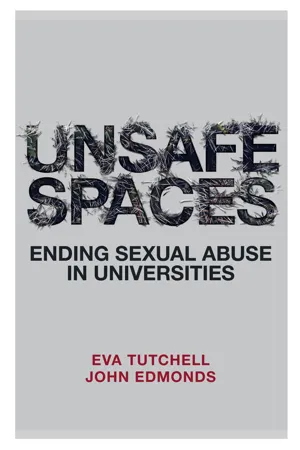
Unsafe Spaces reveals the shocking extent of sexual abuse in English and Welsh universities. Thousands of students and staff suffer sexual abuse every year and too little is being done to end what has become a public scandal. This important book is based on research, a detailed examination of current practice and on the compelling testimony of survivors, who tell of their ordeal and the miserable after-effects. Confidence is shattered and careers are damaged. Unsafe Spaces names the handful of universities who have approached this problem with sympathy and professionalism, but finds that the majority are failing their students and staff. Usually sexual abuse is given too little attention, and most universities have not even collected reliable information or recruited trained specialists. Too often, universities seek to conceal the extent of sexual misconduct instead of focusing on care and prevention. The authors advocate greater openness and a new policy agenda, making the safety and welfare of everyone on campus into a top priority for university management. Crucial reading for university leaders, staff, students, and those committed to ending sexual violence, Unsafe Spaces offers practical solutions both to the present crisis and to the culture of disrespect which blights many universities and allows sexual abuse to continue unchecked.
Information
Topic
EducationSubtopic
Education General1
A Scandal Concealed
The story of sexual abuse in universities is long and often unedifying.
Fifty years ago, many universities had their ‘Dirty Dick’ or ‘Lester the Molester’ who seemed to spend a good part of their time touching or propositioning women staff and students. Other men mostly grinned indulgently at these antics. Women who complained got little support. ‘It is just the way he is’, was the normal response, as if an inclination to prey on women is as excusable as short sight or deafness.
In Oxford University the behaviour of two predators has passed into legend. The Principal of Lady Margaret Hall is said to have stormed down to Corpus Christi College and demanded that Eduard Fraenkel, a celebrated classical scholar, be stopped from chasing after her women students.
Then there is the behaviour of the prominent historian Norman Stone. His obituary records that he did not visit Oxford often to do any teaching but
‘…on the occasions when he did appear… Stone became notorious for groping his female students …’1
Not just in Oxford, but in many universities sexual misconduct came to be regarded as so common and so amusing that it found a niche in fiction. In his introduction to a late edition of Lucky Jim, David Lodge remarks that a common theme of the so-called ‘campus novels’ was
‘…the taboo subject of sex between staff and students’.2
Whether taboo or not, readers seemed to appreciate the humour and few offered a word of censure. No wonder universities felt under no pressure to deal with the real-life miscreants in their midst.
Changes
Fortunately, in the 1970s the Women's Liberation Movement campaigned for a change in the way women were treated and Britain became rather less forgiving of sexual abuse. Universities changed too. Many more women were admitted as students, and some universities slowly began to look less like upper class boys' clubs and more like the community outside the campus.
Had this revolution been completed, perhaps universities would have developed the scholarly ethos of equality and mutual support which many hoped for. But universities have never entirely shed their gender bias. A sense of male entitlement still seems important in judgements about the value of research and in the appointment of senior academics.
If universities had changed more radically, perhaps sexual abuse would have withered away. But it never did. Instead, sexual misconduct in universities just faded from public view. It never seemed to appear on the political agenda. We asked a senior Minister who was in the Education Department during the early years of this century whether the issue of sexual abuse in universities had been brought to his attention. He told us that, as far as he could remember, it had never crossed his desk.
Even the scandals surrounding Savile, Weinstein and other notorious predators across society did not prompt much debate about what was going on in higher education. To awaken interest, the National Union of Students (NUS) conducted the first ever survey into sexual abuse in universities.
The results, published in 2010, were startling. A total 3,833 incidents were reported by 1,210 women. One in seven had suffered serious physical or sexual abuse; over two-thirds had suffered groping, flashing or unpleasant comments; a quarter had suffered unwanted sexual contact like kissing or touching; one in eight reported stalking. The NUS summed up the results by concluding
‘…higher education is not a safe place for women.’3
Surprisingly even this damning judgement did not produce much reaction in the media. Reports appeared in a few newspapers but there was little follow-up.
The change came in 2014 when The Telegraph commissioned its own survey and, in a series of powerful articles, demonstrated that sexual abuse was widespread in universities. Using the evidence from its survey, the newspaper approached Sajid Javid, then Business Secretary, and Jo Johnson, then Universities Minister, to demand that they deal with the problem. For more than six months nothing much happened, so The Telegraph threatened to run a campaign attacking the two ministers for ignoring a matter of great public importance. At that stage, Johnson wrote to Universities UK (UUK), the organisation representing universities, asking it, ‘to take action to address the issues involved.’
The Telegraph regarded Johnson's initiative as feeble. It commented:
“He's not publicly spoken about his commitment for change, and so far has achieved no concrete action.”4
Nevertheless, feeble or not, UUK was rather affronted by Johnson's approach. Although a taskforce was set up apparently in response to Johnson's letter, UUK insisted that it was already tackling sexual abuse and that the taskforce was part of its ongoing programme.
Taskforce report
In 2016, the UUK Taskforce published its report:
Changing the culture: Report of the Universities UK Taskforce examining violence against women, harassment and hate crime affecting university students.
The report concluded that the high incidence of sexual harassment and abuse in universities was ‘unacceptable’ and that universities should adopt a policy of zero tolerance. It drew attention to the ‘positive action’ which was being taken in a number of universities, but acknowledged that work to reduce sexual abuse was not ‘systematic’.
The report made a range of recommendations,
‘…including (the greater involvement of) senior leadership, adopting an institution-wide approach, encouraging positive behaviours, working with the students’ union and having effective governance, data collection and staff training.’
The Taskforce published 14 case studies and said it wanted to,
‘…facilitate the sharing of good practice across the university sector’
A Serious Problem
It was not difficult for the taskforce to reach the conclusion that universities had a serious problem and were not coping very well.
The Telegraph article which spurred the government into action had made very worrying claims. Nearly a third of female students, polled by the research organisation YouthSight, said they had been the victim of ‘inappropriate touching or groping’ and around 1 in 20 had experienced more intimate but unwelcome advances or been pressurised into sexual activity. Meanwhile one in eight male students had also been subjected to groping or unwanted advances.5
Public Health England commented on The Telegraph article by declaring that the situation was ‘unacceptable.’6
Sarah Green, director of the End Violence against Women Coalition, was even more explicit.
‘We currently have a situation where women in the workplace are accorded more protection than young women who live as well as study at university… This cannot be allowed to continue.’7
Meanwhile, a major scandal was developing in Sussex University, and it began to attract media attention at about the time the Taskforce was drafting its conclusions.
In December 2015 a senior lecturer at Sussex was charged with assault. He had beaten the postgraduate student with whom he was living and was convicted of the offence in the following June. The university did not suspend the senior lecturer until nine months after he was charged and only then after considerable criticism in the media.8 When challenged, the university said, wrongly, that there was nothing the university could do until sentencing had taken place.
Many people in Sussex university were outraged by the university's apparent lack of concern. Faced with massive internal criticism, the incoming Vice Chancellor asked Professor Nicole Westmarland of Durham University to conduct a review. Her report was damning. She exposed many examples of poor practice and said that the university had made its decisions on the basis of bad advice.
Media interest had now become intense. Newspapers were noisily researching the issue – inviting women who had been abused to contact their news desks. The Independent followed the Sussex case closely and was scathing in its criticism. The Guardian focused on the fact that the Sussex case concerned an assault by an academic on a student with whom he was sleeping. It found that abuse of this kind was common in universities. The first sentence of its article reads:
‘The scale of sexual harassment and gender violence by UK university staff has been likened to the scandals involving the Catholic church and Jimmy Savile in accounts shared by more than 100 women with the Guardian.’9
Surveys
The years since 2016 have been filled with testimony from students and staff who have suffered sexual abuse. A number of important surveys have been conducted by the NUS, the Universities and College Union (UCU), national campaign groups and activists in particular universities. They all indicate that there is a major problem. Most show that the incidence of sexual abuse is high and is not diminishing.
In February 2018, the campaign group Revolt Sexual Assault, in partnership with The Student Room conducted a survey of 4,500 students and former students from 153 different institutions. It reported an appalling situation:
‘Almost two thirds (62%) of students and graduates have experienced sexual violence at UK universities…This figure rises to 70% of female respondents, 48% of whom have experienced sexual assault, and 73% of respondents with a disability, where 54% have experienced sexual assault… A third of students (31%) felt pressured into doing something sexual.’
In 2019 the campaign group Brook commissioned an online survey conducted by Absolute Research. It was emailed out to thousands of students across the UK. A total of 5,649 replied and the results are based on their responses. The main conclusion is that
‘…more than half of UK university students across the country are being exposed to unwanted sexual behaviours such as inappropriate touching, explicit messages, cat-calling, being followed and/or being forced into sex or sexual acts.’10
The main form of abuse identified in the report is inappropriate touching. A total 49% of women said that they had suffered this abuse. The figure for men is 3%.
We also studied surveys conducted at particular universities. In one small university college over three quarters of women students replied to a Student Union questionnaire and just over half of them said they had experienced sexual assault. Another survey of a bigger cohort of students managed a response rate of close to 50%, and more than half of those replying said that they had suffered sexual harassment or assault. In 2017 The Sun newspaper carried out a survey in Durham University and, under the headline Campus Sex Shame, reported that:
‘A shocking 48 per cent of female undergrads at Durham claim to have been attacked.’11
The NUS's 2010 report12 had found that some students were being sexually abused by university staff. In 2017 the NUS conducted an online study in conjunction with the campaign group 175213 to explore this issue more fully.
A total of 1,839 current and former students took part. 4 out of 10 current students had experienced at least one instance of ‘sexualised behaviour’ from staff. Women were twice as likely as men to have suffered such sexual misconduct. Gay, queer and bisexual women were particularly likely to have been touched in a way which made them feel uncomfortable. Postgraduate students were more likely to suffer abuse than undergraduates.
Accuracy
There are differences between the results from these various surveys but they all reach the same conclusion: each survey shows that a very large number of students have suffered sexual abuse at universities. Sir Michael Barber, Chair of the Office for Students (OfS), described the survey results as, ‘disturbing’.14 This might be a careful understatement. Taken at face value, the survey results suggest that universities face a problem which is so serious that it could reasonably be described as an emergency.
The reaction of the universities to the survey results has varied significantly. Coventry University used the research carried out by the NUS15 to reinforce its call for urgent action. On the other hand, the majority of universities made no public comment on any of the surveys. A few have cast doubt on the figures. One major university questioned the validity of the polling methods used in one of the national surveys and refused to circulate the questionnaire to its students.
The important question is whether these surveys give an accurate picture of sexual abuse in universities. One obvious concern can be dismissed very quickly. Surprise has been expressed in some universities that the number of students who say that they have been abused is so much higher than the number of complaints of sexual abuse actually recorded by the universities.
In fact the gap between the survey results and the number of reported complaints is easily explained. Only a very small proportion of people who suffer sexual abuse ever report it to the authorities. We examine the reasons in the next chapter, but the evidence of under-reporting is overwhelming. Some of the surveys we have quoted asked victim/survivors whether they had reported the abuse, and the number of students who said they had is very low.
The first national survey, by the NUS in 2010, found that only one in five victims of sexual assault reported it to the university and a smaller proportion told the police.
The survey commissioned by The Telegraph in 2014 found that almost half of the women who had suffered sexual assault or abuse at university, did not report their ordeal to anyone, even to friends or family. And six in 10 male victims also said they had told no one.
The Revolt Survey in 2018 found even lower reporting figures. Only 6% of students who answered the survey said they had submitted a report to the university; 10% said they had reported it to the police.
A year later the Brook survey added further detail. Even students who were forced into having sex were unlikely to make a report: only a quarter did so. Of the women who were inappropriately touched, only 5% reported it and, of the women who were sent unwanted sexually explicit messages, only 3% reported it.
Students who were sexually abused by staff are also very relucta...
Table of contents
- Cover
- Title
- Copyright
- Contents
- Biographies of Eva Tutchell and John Edmonds
- Authors' Note
- Preface
- 1. A Scandal Concealed
- 2. Stories of Distress
- 3. Doubts and Discontent
- 4. Evidence from the Media
- 5. A Failing Process
- 6. Living with the Market
- 7. Seeking a Better Culture
- 8. Ending the Abuse
- 9. Regulation and Pressure
- 10. Starting Afresh
- Notes
- Glossary
- Index
Trusted by 375,005 students
Access to over 1.5 million titles for a fair monthly price.
Study more efficiently using our study tools.
Frequently asked questions
Yes, you can cancel anytime from the Subscription tab in your account settings on the Perlego website. Your subscription will stay active until the end of your current billing period. Learn how to cancel your subscription
No, books cannot be downloaded as external files, such as PDFs, for use outside of Perlego. However, you can download books within the Perlego app for offline reading on mobile or tablet. Learn how to download books offline
Perlego offers two plans: Essential and Complete
- Essential is ideal for learners and professionals who enjoy exploring a wide range of subjects. Access the Essential Library with 800,000+ trusted titles and best-sellers across business, personal growth, and the humanities. Includes unlimited reading time and Standard Read Aloud voice.
- Complete: Perfect for advanced learners and researchers needing full, unrestricted access. Unlock 1.5M+ books across hundreds of subjects, including academic and specialized titles. The Complete Plan also includes advanced features like Premium Read Aloud and Research Assistant.
We are an online textbook subscription service, where you can get access to an entire online library for less than the price of a single book per month. With over 1.5 million books across 990+ topics, we’ve got you covered! Learn about our mission
Look out for the read-aloud symbol on your next book to see if you can listen to it. The read-aloud tool reads text aloud for you, highlighting the text as it is being read. You can pause it, speed it up and slow it down. Learn more about Read Aloud
Yes! You can use the Perlego app on both iOS and Android devices to read anytime, anywhere — even offline. Perfect for commutes or when you’re on the go.
Please note we cannot support devices running on iOS 13 and Android 7 or earlier. Learn more about using the app
Please note we cannot support devices running on iOS 13 and Android 7 or earlier. Learn more about using the app
Yes, you can access Unsafe Spaces by Eva Tutchell,John Edmonds in PDF and/or ePUB format, as well as other popular books in Education & Education General. We have over 1.5 million books available in our catalogue for you to explore.