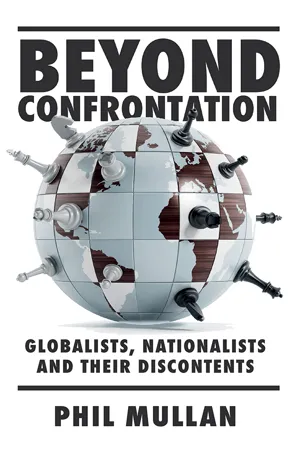
Coupling argumentative rigor with a pragmatic, plainspoken approach, Phil Mullan charts out a novel, democratic way past dangerous and self-defeating confrontations towards a future of open international collaboration based on popular participation within nation states. With its clear-eyed assessment of the opportunities and challenges of a more interconnected world - an assessment in which the economic internationalisation underpinning globalisation theories is neither romanticised nor vilified - Beyond Confrontation sets a judicious tone for the big geopolitical themes of our times.
- 276 pages
- English
- ePUB (mobile friendly)
- Available on iOS & Android
eBook - ePub
About this book
Reactions to the Coronavirus pandemic have escalated the pre-existing tensions between the US and China and among different Western nations. Confrontations between political globalists and mercantilist nationalists - between supporters of the rules-based international order and proponents of overt protectionism - are fueling ever-stronger international resentments.
Information
Part 1
A World of Rules
Chapter 1
Making the Rules-based International Order
Globalists are committed to the ascendancy of a rules-based institutional international order over the powers of individual nation states. The subordination of the nation state to a global framework was the legacy of the economic and political turmoil of the mid-twentieth century. Early theorists of globalisation attributed this disorder in large part to the turbulent impact of mass democracy.
Restricting the scope of national sovereignty reflects a fatalistic outlook towards the domination of global market forces and a lack of confidence in human agency in commanding economic factors. The elevation of the rule of law and the power of the judiciary – in both national and supranational bodies – over the authority of democratically elected national governments has become a pervasive feature of governance in the advanced industrial societies.
More than 70 years after the end of the Second World War and the subsequent codification of a new framework of global authority, the shifting balance of international economic power is a cause of growing tensions within the established order. In response to a long period of stagnation and political exhaustion, the West’s status quo powers are inclined to cling to the structures within which they flourished in the post-war decades, using the rules selectively and pragmatically to protect their enfeebled positions.
It is symptomatic, for instance, that it was the United States and the EU that brought about the collapse of the reforming Doha round of international trade talks by refusing to reduce their agricultural subsidies at the expense of developing countries (Amadeo, 2019). The old powers also frequently promote their “universal” standards that they have previously defined, which just happen to protect their national interests and hold back the rise of emerging nations (Wijen, 2015).
As a consequence, the rising powers in the rest of the world become frustrated by the restrictions imposed by the prevailing rules and the established institutions. While reluctant to challenge the existing arrangements openly, these advancing countries are starting in a piecemeal and tentative manner to develop parallel systems. This heralds the end of the old order.
In the first part of this book, we examine the emergence of the current rules-based international order, the dogma of the “rule of law”, the anti-democratic roots of neoliberalism and the growing tensions within the old framework. Later, we go on to consider the potential for the nation states of the industrialised powers – and more broadly for political activity – to play a constructive role in reducing the rivalries among these states.
Creating the Post-war Order
War creates as well as destroys. Out of the barbarism and chaos of the twentieth century’s world wars, international order was created. Now, the strains within it could precipitate the next conflict. The structures established at the end of the 1939–1945 war were seen as enablers of peace. In practice, they were also the continuation of warfare by non-violent means. The post-1945 order reflected the hierarchy consolidated during wartime. It is now outdated.
What was most distinctive about the post-war system was the way its institutions were built on rules. Its architects sought to outlaw aggression and instead promoted the judicial resolution of international disputes (Anghie, 2004, p. 124; Kennedy, 1987, pp. 282–289). This rules-based approach has permeated international relations ever since (Claude, 1984, p. 57; Williams, 1929, p. 67).
The core presumption behind elevating the role of international law was the belief that law was separate from politics. The post-war planners were attracted to international law as a procedural way to manage relations between nation states and ultimately within them. As an “independent variable”, law was not only detached from politics. The post-1945 architects hoped it could constrain the “wrong type” of politics (Trimble, 1990, p. 823).
The attraction to political leaders of an institutionalised rules-based order does not derive from breaches to the rules being easy to prosecute, or the rules’ details being simple to comprehend. Authority is derived from the very existence of a depoliticised rules-defined order detached from the uncertainties of political contestation.
Furthermore, the apparent autonomy of international law and its accompanying organisations allows them to extend their reach and authority. They feed on themselves (Camilleri & Falk, 1992). Governments are then able to exert influence by drawing upon this authority. This offers the leading countries a less costly and, they hope, non-confrontational way for exercising power, certainly compared to the direct political domination of pre-war colonialism or the mandated territories.
For example, the UN began as an alliance of the victorious nations embedded inside a notionally “universal” organisation (Mazower, 2008, p. 7). Its sympathisers today brush over that there were only 51 original members in 1945, with large parts of Africa and Asia excluded. Such revision helps the UN today to still exert great moral authority on a number of issues.
Although the UN’s own website accentuates its core universal principles of “individual liberty”, “democracy” and “the rule of law”, it is telling that none of these phrases can be found in its founding Charter. At the time it was written, it was easier for critics to expose the rhetoric about international equality as a veil that masked the consolidation of a great power directorate. It was clear then that the bigger countries controlled the UN through the Security Council, the only component with the authority to issue binding resolutions.
League of Nations as Precursor
The earlier response to the end of the “Great War” had been different. That conflict had been precipitated by the breakdown of the late nineteenth century arrangement of global power (Kagan, 2018, p. 26). By the turn of the century, the British hegemon was well in decline and being challenged both by old rivals like France and Russia and the newer industrial economies of the United States, Germany and Japan.
The First World War famously failed to resolve those global imbalances. In 1918, it was not even obvious which of the big powers would in future be adversaries and which would be allies. A month after the fighting ended, US President Woodrow Wilson was frustrated with its wartime partner Britain’s refusal to grant the United States freedom of the seas. He warned that if Britain would not come to terms, America would
build the biggest Navy in the world, matching theirs and exceeding it … and if they would not limit it, there would be another and more terrible war and England would be wiped off the face of the map. (Tooze, 2015, p. 268)
Antagonistic feelings were mutual. Two years later British Prime Minister David Lloyd George was so irritated with America’s uncooperative stance in Europe that he considered strengthening the Anglo-Japanese alliance instead. The US secretary of state had a “blue fit” in response (Tooze, 2015, p. 395). Meanwhile, London and Paris clashed over the German reparations question with France adopting a more punitive position partly because of its experiences of German, and previously Prussian, land invasions. France’s unilateral invasion of the Ruhr as its enforcement of the Versailles Treaty made United Kingdom–French relations particularly fraught. An expanded Royal Air Force was agreed by the UK parliament in 1923 with the principle mission of deterring a French attack on Britain (Howard, 1972, pp. 81–84).
Subsequently, the big three victor nations were unable to agree how to incorporate a potentially resurgent Germany, a rising industrial Japan, or a Mussolini-led Italy. For example, when in 1931, US President Herbert Hoover proposed to freeze all political debts to alleviate the pressure on a Germany in emergency economic conditions, France initially vetoed the plan. London and Washington were outraged. This was symptomatic of the abject weakness of the inter-war system (Eichengreen, 1992, p. 278). Hoover speculated that he could see the possibility of an Anglo-German alignment, possibly including the United States, against France (Tooze, 2015, p. 496).
Such national divisions were aggravated by the shell-shocked state of the leading ruling classes, especially of the major European countries. The fighting had not only physically devastated large regions of the continent but also severely weakened Europe’s claims to moral superiority (Anghie, 2004, p. 138).
Writing while the bloodshed continued, the anti-colonial writer Henry Brailsford summed up the profound impact on the political classes. The war “struck us with surprise as the thing it is, an anachronism, an absolute barbarity, a blot on civilisation” (Brailsford, 2012, pp. 1–2). The warfare itself, reinforced by the punitive “peace” imposed on the losers, tarnished trust in Enlightenment values. Millions of lives had been lost, but for what? For a “botched civilization” as Ezra Pound put it, “for an old bitch gone in the teeth” (Kagan, 2018, p. 18).
The confidence of the political elites of all combatant nations was so shaken that it destroyed belief in the normality of international peace (Kennedy, 1987, p. 901). This sense of disarray and loss of control stimulated desperate efforts to try to avoid the return of armed conflict. War was the impetus driving mankind to absolve itself by establishing superior arrangements (Mangone, 1954, p. 167). The League of Nations that ensued was the first time leading powers had proposed a permanent world organisation to address the classic dilemma of war and peace.
In contrast to what followed later in the century, this experiment in international governance was not launched as an antidote to nationalism but as its expression (Mazower, 2019). Promoted most actively by Wilson, this novel departure in international affairs garnered support not just from the leaders of Britain and France but also, as the bloodshed dragged on, from those of Germany and Austria. The objective of the League was to prevent nations fighting, while guaranteeing national territorial integrity and political independence (Mazower, 2013, pp. 116–117).
Also in contrast to the approach taken with post-Second World War international institutions, Wilson sought to keep power with the politicians, rather than give it to lawyers. Departing from the legalist tradition in America Wilson envisaged the League as a forum for quasi-parliamentary deliberations, rather than a judicial court to deliver judgements. What mattered were “values”, not legal codes. He preferred to put his trust in people and their political representatives, rather than in abstract law (Mazower, 2013, pp. 119–122).
Although in late 1919, the US Senate famously rejected American participation, the League broadly followed the Wilsonian non-legalist format (Wertheim, 2012). Lloyd George and the other British politicians who took over leadership mostly shared Wilson’s distrust of law not least because they worried international law might constrain British colonial activities (Mazower, 2013, p. 128). When an international court was eventually set up in 1922 under the League’s auspices, it was an insubstantial body with meagre enforcement mechanisms over inter-country disputes.
Lessons for the 1940s
The failure of the League’s relatively loose system to prevent conflict encouraged a different approach in the 1940s. In the aftermath of fascism, the Holocaust, urban aerial bombing and the atomic bomb, the victorious political classes’ moral purpose and authority was further eroded. Their deeper gloom was offset by a stronger determination to achieve an effective international organisation (Claude, 1984, p. 57).
Influenced by emerging globalist ideas, they favoured a strict rules-based regime further removed from the sway of national politics than the League had been. A robust international authority was proposed with the power to make and enforce rules and laws (Mazower, 2013, p. 187; Patrick, 2008).
While governing through rules has been the globalist norm since the Second World War, it had precedents. The inter-war desire by Britain, France, Germany and other developed countries to return to the pre-1914 gold standard expressed the pre-existing political affinity for rules. Despite John Maynard Keynes presciently calling it a “barbarous relic” in 1923, in the immediate post-1918 period rejoining a gold standard was a mostly uncontentious goal. By the end of 1925, 35 currencies were either officially convertible into gold or had been stable against it for at least a year (Tooze, 2015, p. 465). Return was seen as pursuing a rule that had in effect only been “suspended” because of the emergency contingent circumstances of war.
Re-adoption of the standard was thought to impose some necessary political “discipline” through binding fiscal and monetary policy actions. In this spirit, Montagu Norman as Governor of the Bank of England saw the return to gold as “knaveproof” (Crafts, 2018). A common adherence to the gold standard by developed countries created a de facto international rule.
It is pertinent for an appreciation of the deeper significance of rules today that the essence of the gold standard rule was a domestic commitment mechanism. Alignment limited discretionary state policies at home. It tied the hands of government, thereby shielding the political class from democratic pressures to abandon “hard-money” deflationary policies. In fact, the earlier breakdown of the gold standard in 1914 has been partly attributed to the rise of democracy. The newly enfranchised masses had been suffering the most from the austerity imposed to adhere to the rule (Bordo & Kydland, 1995, pp. 430, 457, 459).
The stubborn inter-war adherence to following the gold standard rules contributed to the tensions that resulted in the resumption of global conflict in 1939. Nevertheless, this lesson about the dangers of rule following was not learnt. Efforts were redoubled in the aftermath of the 1939–1945 bloodbaths to govern through a rule-organised regime.
Peace after the war became associated with neutral, non-political institutionalisation. The new architects of order thought the League’s incapacity to fetter sovereign authority had been a core deficiency. The inter-war system was perceived as having allowed too much scope for the political process at the expense of international law. The objective now was to find a legalistic organisational means of channelling the pursuit of national sovereign interests into international cooperation.
For instance, majoritarian voting was initially favoured in the UN instead of the previous practice of unanimous voting. The latter was regarded as an earlier error derived from sovereign autonomy that had stymied inter-war efforts at cooperation1 (Kennedy, 1987, pp. 862, 931–933, 964).
This depoliticised rules-based approach to international order was reinforced by the elites’ greater antipathy to politics in general. It was foreshadowed by late 1930s literature that attributed the failure of the League to its emasculation by the intrusion of ideology and power politics (Kennedy, 1987, pp. 876–877). Alongside concerns about great power manoeuvrings, the other large influence on the institution makers of the 1940s was their distrust of popular politics, which they associated with fascism and violence. They were motivated by the thought of nationalism stirring people up into frenzied fears and taking inhuman actions against others.2
Their plainspoken reaction to the horrors of combat and the Holocaust identified German nationalism as the cause. Denunciations of it morphed into an intellectual suspicion of nationalism in general and especially the nationalism driving mass movements. This represented a distinctive and thoroughly hostile approach to nationalism.
Following this particular antagonistic interpretation of nationalism, those planning the international post-war systems assumed that sensible national political elites, like themselves, could be managed through institutionalised cooperation. They sought to reverse the inter-war privileging of politics over law with the opposite: the dominance of law over politics. They turned to rely on rules-based institutions that could regulate and control relations not only directly between countries but...
Table of contents
- Cover
- Title
- Part 1. A World of Rules
- Part 2. Myths about Trade
- Part 3. Internationalism Starts at Home
- References
- Index
Trusted by 375,005 students
Access to over 1.5 million titles for a fair monthly price.
Study more efficiently using our study tools.
Frequently asked questions
Yes, you can cancel anytime from the Subscription tab in your account settings on the Perlego website. Your subscription will stay active until the end of your current billing period. Learn how to cancel your subscription
No, books cannot be downloaded as external files, such as PDFs, for use outside of Perlego. However, you can download books within the Perlego app for offline reading on mobile or tablet. Learn how to download books offline
Perlego offers two plans: Essential and Complete
- Essential is ideal for learners and professionals who enjoy exploring a wide range of subjects. Access the Essential Library with 800,000+ trusted titles and best-sellers across business, personal growth, and the humanities. Includes unlimited reading time and Standard Read Aloud voice.
- Complete: Perfect for advanced learners and researchers needing full, unrestricted access. Unlock 1.5M+ books across hundreds of subjects, including academic and specialized titles. The Complete Plan also includes advanced features like Premium Read Aloud and Research Assistant.
We are an online textbook subscription service, where you can get access to an entire online library for less than the price of a single book per month. With over 1.5 million books across 990+ topics, we’ve got you covered! Learn about our mission
Look out for the read-aloud symbol on your next book to see if you can listen to it. The read-aloud tool reads text aloud for you, highlighting the text as it is being read. You can pause it, speed it up and slow it down. Learn more about Read Aloud
Yes! You can use the Perlego app on both iOS and Android devices to read anytime, anywhere — even offline. Perfect for commutes or when you’re on the go.
Please note we cannot support devices running on iOS 13 and Android 7 or earlier. Learn more about using the app
Please note we cannot support devices running on iOS 13 and Android 7 or earlier. Learn more about using the app
Yes, you can access Beyond Confrontation by Phil Mullan in PDF and/or ePUB format, as well as other popular books in Business & Business generale. We have over 1.5 million books available in our catalogue for you to explore.