eBook - ePub
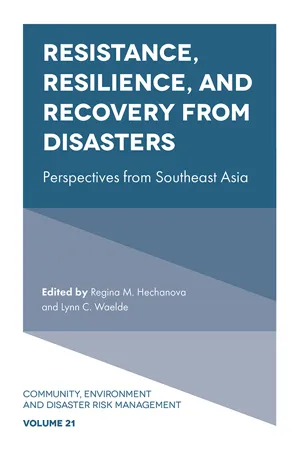
Resistance, Resilience, and Recovery from Disasters
Perspectives from Southeast Asia
- 224 pages
- English
- ePUB (mobile friendly)
- Available on iOS & Android
eBook - ePub
Resistance, Resilience, and Recovery from Disasters
Perspectives from Southeast Asia
About this book
The book fills a void by bringing together literature in an under-represented but disaster-prone region – Southeast Asia. It discusses the cultural considerations of those providing mental health and psychosocial support in the region. It highlights the role of education in reducing disaster vulnerability. It presents ways in which workplace organization have sought to enhance employee and organizational resilience in the face of disasters. It discusses how the disaster planning process, including prevention, mitigation, and preparedness efforts, can be integrated with mental health efforts. It features how mental health interventions including psychological first aid, resilience interventions, mindfulness, and art therapy have been carried out. It also discusses the issues of those caring for survivors and describes MHPSS interventions for disaster responders themselves. The book also addresses post-traumatic growth as an outcomes of disaster exposure, concluding by summarizing the challenges and prospects for promoting resistance, resilience, and recovery in SEA.
Information
Topic
Sciences socialesSubtopic
Études du développement mondialPART I
INTRODUCTION
CHAPTER 1
CULTURAL IMPLICATIONS FOR THE PROVISION OF DISASTER MENTAL HEALTH AND PSYCHOSOCIAL SUPPORT IN SOUTHEAST ASIA
ABSTRACT
Southeast Asia (SEA) is a region highly susceptible to earthquakes, volcanic eruptions, and tsunamis, though the region has been underrepresented in disaster mental health research. This chapter addresses risk factors for SEA, including its disaster-prone location, the psychological toll of frequent disasters, and stigma and shame and lack of psychoeducation about psychological help-seeking. Collectivism, strong family ties, and religious faith are among SEA’s resilience factors. Culture should be heavily accounted for in mental health and psychosocial support (MHPSS), considering the wide array of cultural differences in spirituality, affect and expression, power distance, and gender and masculinity in SEA. Because culture affects treatment satisfaction, treatment engagement, and treatment outcomes, future research should explore how aspects of SEA culture impact accessibility and engagement in MHPSS.
Keywords: Mental health and psychosocial support; Southeast Asia; culturally adapted interventions; trauma; disaster mental health; culture
The Southeast Asia (SEA) region consists of two geographic regions. Mainland SEA consists of Myanmar, Thailand, Malaysia, Laos, Cambodia, and Viet Nam. Maritime SEA consists of Indonesia, Brunei, Singapore, East Timor, Christmas Island and Cocos Island. It is considered as one of the most disaster-prone regions in the world (United Nations International Strategy for Disaster Reduction (UNISDR), 2010) because it lies along the Pacific Ring of Fire.
Despite its vulnerability, the region is underrepresented in terms of disaster mental health research. In this chapter, we summarize the literature about the impact of disasters, risk factors, and vulnerabilities in SEA. We also describe various aspects of SEA culture that may shape the provision of mental health and psychosocial support (MHPSS) in the region. Culture is a set of behavioral norms and cognitions representative of people from a definable population that are different from members of other populations (Lehman, Chiu, & Schaller, 2004). There is a growing need for cultural adaptations of MHPSS interventions, because most approaches were developed in Western, individualistic cultures with uncertain application in SEA. Culture can impact treatment satisfaction, engagement in treatment, and treatment outcomes (Constantine, 2002), making cultural considerations for MHPSS a vital concern.
The SEA region is located between two great oceans – the Pacific Ocean and the Indian Ocean and in the intersection of geologic plate creating earthquakes, volcanic eruptions, and tsunamis. Not surprisingly, countries in SEA have a history of disasters including typhoons, floods, tsunamis, volcanic eruptions, earthquakes, landslides, epidemics, and droughts (UNISDR, 2010). Between 1981 and 2010, the region experienced as many 912 disasters such as floods (47%) and tropical cyclones (38%) (Hechanova & Waelde, 2017). During this period, disasters have killed 199,075 and affected 310,443,666 survivors in the region (Samphantharak, 2014).
PSYCHOLOGICAL IMPACT OF DISASTERS IN SEA
There is an extensive literature demonstrating that disasters’ survivors experience depressive symptoms and related symptoms of mood disorders including fatigue, loss, helplessness, withdrawal, and enduring grief reactions. In addition, the experience of trauma exacerbates previous disorders such as substance use disorders and depression (Bonanno, Brewin, Kaniasty, & La Greca, 2010). Studies in SEA have reported similar symptoms among disaster survivors. For example, a post-Typhoon Haiyan study in the Philippines described somatic, emotional, cognitive, and behavioral symptoms similar to that reported by disaster survivors in other parts of the world (Hechanova, Ramos, & Waelde, 2015). Beyond these deleterious outcomes, survivors of the Mount Merapi volcanic eruption in Indonesia (Warsini, Buettner, Mills, West, & Usher, 2014) and the survivors of the 2004 tsunami in Thailand (Rigg, Grundy-Warr, Law, & Tan-Mullins, 2008) described a sense of solastalgia or the loss of a feeling of safety and comfort because of the devastation of their environment.
Around the world, studies suggest that about 30% of disaster survivors experience transient PTSD symptoms but only about 5%–10% of survivors develop full-blown PTSD (Bonanno et al., 2010). Although there is a lack of epidemiological studies in SEA from which to draw conclusions, initial reports from Asia report a higher proportion (8.6%–57.3%) of survivors with PTSD symptoms immediately after a disaster. However, in the medium term, by nine months to a year after the disaster, this proportion decreases to 2.3%–32%, and two years after the disaster, it deceases to 1.2%–7.6% (Udomratn, 2008). Although the relatively higher prevalence may be because of small and biased samples (Bonanno et al., 2010), the percentage of those who are at risk for PTSD may also be due to the lack of mental health resources, poor disaster preparedness, social and educational disruption, and enduring poverty (Dawson et al., 2014). For example, a study in the Philippines after Typhoon Haiyan reported that millions of survivors were displaced and did not have adequate shelter for months (Hechanova, Ramos, et al., 2015). A study in Thailand showed that among displaced survivors of the 2004 tsunami, 12% had PTSD symptoms as compared to 7% of non-displaced survivors (van Griensven et al., 2006).
In addition to the classical symptoms of trauma, there appear to be some cultural nuances of trauma in SEA. Tuliao’s (2014) review of the Philippine literature concluded that Filipinos do not differentiate between physical and mental disorders. He cited a study by Shakman (1969) that described how survivors seek out indigenous and folk healers because of disturbed behavior and somatic complaints that appear to have no medical causes. The somatization of illness may not be unique to the Philippines, however, because different cultural groups somaticize psychological symptoms (Chhim, 2013). There is also evidence of some trauma-related symptoms that appear to be culturally specific. In Cambodia, the term baksbat (broken courage) is used to describe posttrauma symptoms including feeling fearful, mute and deaf, and lacking trust in others (Chhim, 2013).
MENTAL HEALTH PROFESSIONALS
Fortunately, countries in SEA have increasingly instituted disaster risk reduction and management (DRRM) and mental health policies and programs. Indonesia, Myanmar, and Thailand included MHPSS in their disaster preparedness programs (Ito, Setoya, & Suzuki, 2012). A barrier to the delivery of MHPSS is the lack of mental health resources to provide the needed services. Countries in SEA (Lao, Cambodia, Myanmar, Indonesia, Viet Nam, and the Philippines) have the lowest number of psychiatrists in Asia (Ito et al., 2012). Fortunately, a protective factor is the active role of non-governmental organizations (NGOs) and universities in providing psychosocial rehabilitation services in the community. Some countries such as Indonesia have begun to embed community mental health in their nursing training programs (Ito et al., 2012).
In addition, although there may be dearth of formal mental health care providers, a protective factor in the region is the existence of traditional healers. Many Cambodians seek help from herbalists (Kru Khmer). In Indonesia, up to 80% of people consult traditional healers before they consult a medical professional. Traditional healers are also popular in East Timor and Viet Nam. Many Filipino, especially in rural areas, consult arbolarios (herbal doctors) who use prayers, herbs, and medicinal plants to heal afflictions (Araneta, 1993). Some also seek help from manghihilots who provide magnetic healing using prayers and massages similar to acupressure or reflexology (Araneta, 1993; Tan, 2008). Thus, it is important to disaster responders to work with and build capability of local healers (Ito et al., 2012).
STIGMA AND SHAME
Even where mental health programs exist, an important risk factor is whether survivors will actually avail of them. Two important cultural barriers to the provision of postdisaster support is the presence of stigma attached to persons with mental illness and the cultural value of shame. There is much evidence that Asians, in general, are reluctant to seek help from mental health professionals (Hechanova & Waelde, 2017; Matsuoka, Breaux, & Ryujin, 1997; Tuliao, 2014). The reasons are varied. Some are reluctant to open up to people they do not know (Hechanova, Tuliao, Teh, Alianan, & Acosta, 2013). There are also those who simply do not want to burden others (Hechanova & Waelde, 2017). Others are ashamed because seeing mental health professional may mean they are crazy and they do not want to tarnish their dignity or damage their family’s reputation (Hechanova & Waelde, 2017). The desire not to lose face is evident in findings that internalized stigma is negatively correlated to the intent to seek professional help (Tuliao, 2014).
THE ROLE OF FAMILY
Given the presence of stigma and shame, survivors in SEA generally prefer seeking help from family and friends (Hechanova et al., 2013) or local healers (Haque, 2010). Fortunately, family relationships are usually protective factors in SEA because families play an essential role in the patients’ mental health treatment (Ito et al., 2012).
However, a risk factor is that the lack of knowledge and negative attitudes toward mental illness may prevent people from seeking care (Ito et al., 2012). Thus, it is important for disaster responders to work with survivors’ natural counselors – families, community health workers, leaders, religious workers, and healers (Ito et al., 2012; Seekins, 2009; Udomratn, 2008).
COLLECTIVISM
Countries in SEA are described as collectivist and in such cultures, people’s identities are interdependent and tied to that of their families, community, and society (Hofstede, 2003). However, collectivism may be a risk factor because even t...
Table of contents
- Cover
- Copyright
- Part I. Introduction
- Part II. Leadership and Organization for Mental Health and Psychosocial Support
- Part III. Mental Health and Psychosocial Support Interventions
- Part IV. Conclusion
- Index
Trusted by 375,005 students
Access to over 1.5 million titles for a fair monthly price.
Study more efficiently using our study tools.
Frequently asked questions
Yes, you can cancel anytime from the Subscription tab in your account settings on the Perlego website. Your subscription will stay active until the end of your current billing period. Learn how to cancel your subscription
No, books cannot be downloaded as external files, such as PDFs, for use outside of Perlego. However, you can download books within the Perlego app for offline reading on mobile or tablet. Learn how to download books offline
Perlego offers two plans: Essential and Complete
- Essential is ideal for learners and professionals who enjoy exploring a wide range of subjects. Access the Essential Library with 800,000+ trusted titles and best-sellers across business, personal growth, and the humanities. Includes unlimited reading time and Standard Read Aloud voice.
- Complete: Perfect for advanced learners and researchers needing full, unrestricted access. Unlock 1.5M+ books across hundreds of subjects, including academic and specialized titles. The Complete Plan also includes advanced features like Premium Read Aloud and Research Assistant.
We are an online textbook subscription service, where you can get access to an entire online library for less than the price of a single book per month. With over 1.5 million books across 990+ topics, we’ve got you covered! Learn about our mission
Look out for the read-aloud symbol on your next book to see if you can listen to it. The read-aloud tool reads text aloud for you, highlighting the text as it is being read. You can pause it, speed it up and slow it down. Learn more about Read Aloud
Yes! You can use the Perlego app on both iOS and Android devices to read anytime, anywhere — even offline. Perfect for commutes or when you’re on the go.
Please note we cannot support devices running on iOS 13 and Android 7 or earlier. Learn more about using the app
Please note we cannot support devices running on iOS 13 and Android 7 or earlier. Learn more about using the app
Yes, you can access Resistance, Resilience, and Recovery from Disasters by Ma. Regina M. Hechanova, Lynn C. Waelde, Ma. Regina M. Hechanova,Lynn C. Waelde in PDF and/or ePUB format, as well as other popular books in Sciences sociales & Études du développement mondial. We have over 1.5 million books available in our catalogue for you to explore.