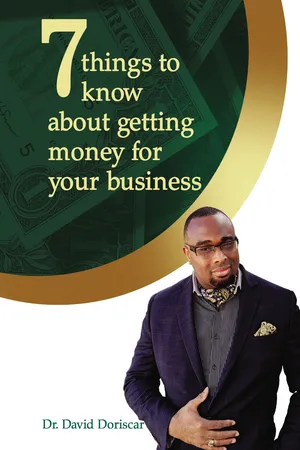
This book will share some insights for both people who are currently in need of getting money for their business as well as people that are in a situation where they currently do not feel like they need any money but would like to be armed with the knowledge that may be useful if they ever did need to consider financing. This book will arm the reader (Business owner, or aspiring Business owner) with the perspective that most funders have, which will allow the Business principal to better anticipate and position themselves in a way that can increase their chances for receiving funding. The book was written after witnessing the different perspectives that business owners and funders have, its aim is to bridge that gap so that there can be greater understanding between those aspiring to receive funds and those giving it. The book is mainly focus on speaking to those aspiring to receive funds, to help them be more successful by learning these 7 things they should know as a foundational piece to their funding endeavors.
- 68 pages
- English
- ePUB (mobile friendly)
- Available on iOS & Android
eBook - ePub
7 Things to Know About Getting Money for Your Business
About this book
Information
CHAPTER 1 Why You Should Get It When You Don’t Need It
It is better to look for business funding when you don’t need the funding, versus when you are in need of funding. This sounds very counterintuitive because if you have a business and things are going great, you do not think there is a need for funding and some people might even feel that this advice is too dependent on a debt-centric philosophy. However, this advice is based upon two very important points.
Number one, you have the greatest leverage to shop for the best rates when you are not in dire need. Banks, funders, or investors are very nervous about lending money to people who need it. As weird as that sounds the concern is the poor choices that put you in a situation where you have a dire need may still be the very same reason why you may default on the loan that they give you, which creates the first dilemma in this book. Many people who feel that they are in a good financial situation will have to go against the instincts to remain in the comfort zone of no action and arm themselves with the needed knowledge that may allow them to enjoy the greatest benefit from being in their good to great situation.
The second benefit in shopping for funding when you don’t need it is that you are less likely to use it irresponsibly if you are funded. This is a principle that also applies to personal finances. For example, if you get a credit card with a $10,000 limit. What most people don’t understand is that you can use up to 30 percent of that maximum limit before it begins to impact your credit negatively, which means that the $10,000 limit is really a $3,000 limit if you do not want to see any slippage in your credit.
Before one signs up for a line of credit or a bank loan or add to an existing loan, it is understandable to contemplate about whether the business really needs to borrow the money. In such perilous economic times, with rising bills and economic uncertainty, there are many people who choose to stay clear of borrowing money when they believe they have the cash to pay the bills they currently have. It is something that will require someone to understand that situations can change that may also change their calculus. Deciding whether one should be borrowing money is a big decision. There are some critical questions that one should answer before one borrows money, and they include where the money will be spent, whether the business can seek other ways of financing the activities, and if the business can afford to pay back the money that it plans to borrow.
Borrow When Owner Least Expects the Business to Require It
Kassar (2014) advised his readers to only think about borrowing a loan when they least expect the business to need it. While working for a loan brokerage firm, Kassar (2014) had observed many small business owners who on a daily basis are in dire need for business credit, to save their businesses and for their own survival. Kassar (2014) believed that had they called on him much earlier, when at a point when their financial needs were just creeping, applying and securing a loan or a line of credit could have been easy. It is rational, however, that numerous small businesses disregard and overlook the fact that it is even easier to secure a loan or a line of credit when they do not need one, compared to when they are in a dire situation.
Consider an example where at the height of summer and one’s own air conditioner gets destroyed. It is going to cost $30,000 to get another, and since it is a hot period it should be procured quickly. This is a moment in time when no thinking is needed or the business will be at risk. When the business has an existing line of credit for such types of emergencies, the business owner can simply write a check and pay at very low interest rates until the individual figures out the long-term plan (Johnson, 2019). If one fails to make that contingency plan, and then one does not have cash on hand, one can be forced to get a really expensive loan where a high interest can be charged for the convenience of getting the funding that quickly. This is what businesses should avoid.
Business owners tend to have short-term memories. When things are moving smoothly, one probably thinks that it will continue on the same path. However, if one were to learn from the events of the last global financial crunch and the subsequent recession, then it is apparent that things can change rapidly and unpredictably. Nothing is immune from shocks. Compare it to a case where a person takes out a life insurance scheme to help them handle things out of unforeseeable situations, and hence business owners should have lifelines for their entities. The most successful business owners expect the possible problems down the road and make plans accordingly before they hit the business (Debt, 2019).
At this juncture, the entrepreneurs know that they are in a good position to borrow when things are quiet. When the business is moving in the right direction, it is time to examine the contingency plan options. When the cash flow is sound and it is increasing, lenders will be more inclined to give the business funds and even at the best interest rate. Overdrafts might be lifesaver in case of unforeseeable emergencies or during the troughs. Even though there might be some small expenses to obtain a line of credit, when it is procured, one can only pay it if it is used.
For a business with accounts receivable and the industry is indicating growth, and the business has a good credit, then the business is in a great position to obtain credit or even a high line of credit at a great rate (rate that favors the borrower, not the creditor). With a firm that is generating positive income, the owner can be confident that it will also be able to repay the loan, which is something that aids firms and business owners to feel at ease.
There can be cases and situations when the business owners know that they are at a bad position to borrow. On the flip side of the coin, when one waits until they are not able to make their payroll or are not able to pay for the lease, it will be much more problematic to obtain any sort of loan because lenders and even shylocks can be hesitant to advance a loan to a firm that is at the risk of not becoming a going concern anymore, or even being declared bankrupt. When the business owner is desperate, his options decrease and one can be stuck with a high interest credit and short amount of time to repay it, and this leave the business back where it began just some few months ago. It occurs when firms can get drawn into the traps of short-term loans renewals that they have problems moving out of it and at the rates that they struggle to repay. For most business owners, this lifesaver loan can be avoided if the loan is taken when the business is not in dire need of it, and it can repay the loan back with much ease.
The bottom line on borrowing has little to do with one’s relationship with a bank or other factors. When a lender assesses a credit application or some line of credit request, the only issue they are drawn to is whether the business can repay the loan and make payments within the agreed timeline. This doesn’t mean that a relationship can’t help if the fundamentals of the application are strong (revenue and credit demonstrate the loan could be repaid) and the business is the type of business the bank likes to fund. For example, at Doriscar Capital Group I remember sending a client’s file to one of my funders and was able to get the client a letter of intent within three days. What made this remarkable is that the client went to over fifteen banks and had their credit pulled over fifteen times prior to my involvement. A great part of that was because the fundamentals of the application was strong, but more importantly my relationship with the banker gives them confidence that when they get a file from me it usually is in the area that they have an interest in. When a business is already having some turbulent times when trying to make an application for a loan, th...
Table of contents
- Cover
- Half-title page
- Title page
- Copyright page
- Contents
- About the Author
- Acknowledgements
- Introduction
- Chapter 1: Why You Should Get It When You Don’t Need It
- Chapter 2: Why You Should Get the Maximum Possible
- Chapter 3: The Denial of the Qualified
- Chapter 4: How Knowing Why You Need It May Help You Get It
- Chapter 5: Why So Little or So Much Interest?
- Chapter 6: The Three C’s of Funding
- Chapter 7: Documentation and Its Connection to the Interest Charged
- Back cover
Trusted by 375,005 students
Access to over 1.5 million titles for a fair monthly price.
Study more efficiently using our study tools.
Frequently asked questions
Yes, you can cancel anytime from the Subscription tab in your account settings on the Perlego website. Your subscription will stay active until the end of your current billing period. Learn how to cancel your subscription
No, books cannot be downloaded as external files, such as PDFs, for use outside of Perlego. However, you can download books within the Perlego app for offline reading on mobile or tablet. Learn how to download books offline
Perlego offers two plans: Essential and Complete
- Essential is ideal for learners and professionals who enjoy exploring a wide range of subjects. Access the Essential Library with 800,000+ trusted titles and best-sellers across business, personal growth, and the humanities. Includes unlimited reading time and Standard Read Aloud voice.
- Complete: Perfect for advanced learners and researchers needing full, unrestricted access. Unlock 1.5M+ books across hundreds of subjects, including academic and specialized titles. The Complete Plan also includes advanced features like Premium Read Aloud and Research Assistant.
We are an online textbook subscription service, where you can get access to an entire online library for less than the price of a single book per month. With over 1.5 million books across 990+ topics, we’ve got you covered! Learn about our mission
Look out for the read-aloud symbol on your next book to see if you can listen to it. The read-aloud tool reads text aloud for you, highlighting the text as it is being read. You can pause it, speed it up and slow it down. Learn more about Read Aloud
Yes! You can use the Perlego app on both iOS and Android devices to read anytime, anywhere — even offline. Perfect for commutes or when you’re on the go.
Please note we cannot support devices running on iOS 13 and Android 7 or earlier. Learn more about using the app
Please note we cannot support devices running on iOS 13 and Android 7 or earlier. Learn more about using the app
Yes, you can access 7 Things to Know About Getting Money for Your Business by Dr. David Doriscar in PDF and/or ePUB format, as well as other popular books in Business & Management. We have over 1.5 million books available in our catalogue for you to explore.