Overview
This chapter introduces you to supervised learning, using Anaconda to manage coding environments, and using Jupyter notebooks to create, manage, and run code. It also covers some of the most common Python packages used in supervised learning: pandas, NumPy, Matplotlib, and seaborn. By the end of this chapter, you will be able to install and load Python libraries into your development environment for use in analysis and machine learning problems. You will also be able to load an external data source using pandas, and use a variety of methods to search, filter, and compute descriptive statistics of the data. This chapter will enable you to gauge the potential impact of various issues such as missing data, class imbalance, and low sample size within the data source.
Introduction
The study and application of machine learning and artificial intelligence has recently been the source of much interest and research in the technology and business communities. Advanced data analytics and machine learning techniques have shown great promise in advancing many sectors, such as personalized healthcare and self-driving cars, as well as in solving some of the world's greatest challenges, such as combating climate change (see Tackling Climate Change with Machine Learning: https://arxiv.org/pdf/1906.05433.pdf).
This book has been designed to help you to take advantage of the unique confluence of events in the field of data science and machine learning today. Across the globe, private enterprises and governments are realizing the value and efficiency of data-driven products and services. At the same time, reduced hardware costs and open source software solutions are significantly reducing the barriers to entry of learning and applying machine learning techniques.
Here, we will focus on supervised machine learning (or, supervised learning for short). We'll explain the different types of machine learning shortly, but let's begin with some quick information. The now-classic example of supervised learning is developing an algorithm to distinguish between pictures of cats and dogs. The supervised part arises from two aspects; first, we have a set of pictures where we know the correct answers. We call such data labeled data. Second, we carry out a process where we iteratively test our algorithm's ability to predict "cat" or "dog" given pictures, and we make corrections to the algorithm when the predictions are incorrect. This process, at a high level, is similar to teaching children. However, it generally takes a lot more data to train an algorithm than to teach a child to recognize cats and dogs! Fortunately, there are rapidly growing sources of data at our disposal. Note the use of the words learning and train in the context of developing our algorithm. These might seem to be giving human qualities to our machines and computer programs, but they are already deeply ingrained in the machine learning (and artificial intelligence) literature, so let's use them and understand them. Training in our context here always refers to the process of providing labeled data to an algorithm and making adjustments to the algorithm to best predict the labels given the data. Supervised means that the labels for the data are provided within the training, allowing the model to learn from these labels.
Let's now understand the distinction between supervised learning and other forms of machine learning.
When to Use Supervised Learning
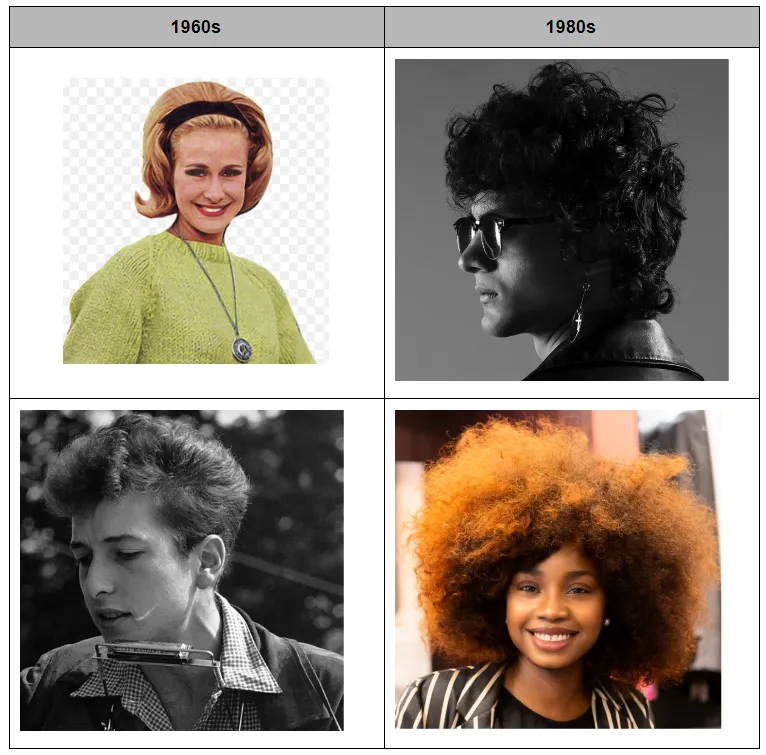
Generally, if you are trying to automate or replicate an existing process, the problem is a supervised learning problem. As an example, let's say you are the publisher of a magazine that reviews and ranks hairstyles from various time periods. Your readers frequently send you far more images of their favorite hairstyles for review than you can manually process. To save some time, you would like to automate the sorting of the hairstyle images you receive based on time periods, starting with hairstyles from the 1960s and 1980s, as you can see in the following figure:
Figure 1.1: Images of hairstyles from different time periods
To create your hairstyles-sorting algorithm, you start by collecting a large sample of hairstyle images and manually labeling each one with its corresponding time period. Such a dataset (known as a labeled dataset) is the input data (hairstyle images) for which the desired output information (time period) is known and recorded. This type of problem is a classic supervised learning problem; we are trying to develop an algorithm that takes a set of inputs and learns to return the answers that we have told it are correct.
Python Packages and Modules
Python is one of the most popular programming languages used for machine learning, and is the language used here.
While the standard features that are included in Python are certainly feature-rich, the true power of Python lies in the additional libraries (also known as packages), which, thanks to open source licensing, can be easily downloaded and installed through a few simple commands. In this book, we generally assume your system has been configured using Anaconda, which is an open source environment manager for Python. Depending on your system, you can configure multiple virtual environments using Anaconda, each one configured with specific packages and even different versions of Python. Using Anaconda takes care of many of the requirements to get ready to perform machine learning, as many of the most common packages come pre-built within Anaconda. Refer to the preface for Anaconda installation instructions.
In this book, we will be using the following additional Python packages:
- NumPy (pronounced Num Pie and available at https://www.numpy.org/): NumPy (short for numerical Python) is one of the core components of scientific computing in Python. NumPy provides the foundational data types from which a number of other data structures derive, including linear algebra, vectors and matrices, and key random number functionality.
- SciPy (pronounced Sigh Pie and available at https://www.scipy.org): SciPy, along with NumPy, is a core scientific computing package. SciPy provides a number of statistical tools, signal processing tools, and other functionality, such as Fourier transforms.
- pandas (available at https://pandas.pydata.org/): pandas is a high-performance library for loading, cleaning, analyzing, and manipulating data structures.
- Matplotlib (available at https://matplotlib.org/): Matplotlib is the foundational Python library for creating graphs and plots of datasets and is also the base package from which other Python plotting libraries derive. The Matplotlib API has been designed in alignment with the Matlab plotting library to facilitate an easy transition to Python.
- Seaborn (available at https://seaborn.pydata.org/): Seaborn is a plotting library built on top of Matplotlib, providing attractive color and line styles as well as a number of common plotting templates.
- Scikit-learn (available at https://scikit-learn.org/stable/)...