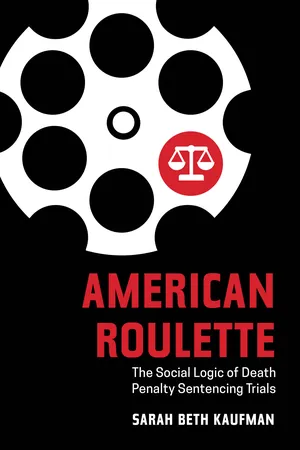
As the death penalty clings to life in many states and dies off in others, this first-of-its-kind ethnography takes readers inside capital trials across the United States. Sarah Beth Kaufman draws on years of ethnographic and documentary research, including hundreds of hours of courtroom observation in seven states, interviews with participants, and analyses of newspaper coverage to reveal how the American justice system decides who deserves the most extreme punishment. The “super due process” accorded capital sentencing by the United States Supreme Court is the system’s best attempt at individuated sentencing. Resources not seen in most other parts of the criminal justice system, such as jurors and psychological experts, are required in capital trials, yet even these cannot create the conditions of morality or justice. Kaufman demonstrates that capital trials ultimately depend on performance and politics, resulting in the enactment of deep biases and utter capriciousness. American Roulette contends that the liberal, democratic ideals of criminal punishment cannot be enacted in the current criminal justice system, even under the most controlled circumstances.
- 260 pages
- English
- ePUB (mobile friendly)
- Available on iOS & Android
eBook - ePub
About this book
Information
Publisher
University of California PressYear
2020Print ISBN
9780520344396
Edition
1eBook ISBN
9780520975507
PART I
The Social Logic of Death Penalty Cases
• • • • •
Summer 2008. I’m driving through the swampy heat of a large southern city to attend the first day of a murder trial. The new state’s attorney general is being interviewed on the radio and is bragging about putting a serial killer on death row. I make my way downtown, looking for the county courthouse. There are few people on the street but many cars, so different from the West Village neighborhood in New York where I attend graduate school. The building I am looking for turns out to be a shade of lighter tan among many shades of tan, a nondescript modern monolith, a ten-story rectangular building with standard rectangular windows inside standard rectangular sides. I pull up just outside the back entrance where a parking garage connects to the courthouse, and see groups of two and three people standing around, smoking leisurely. I imagine they are clerical staff, gossiping about their coworkers and delaying the start of the day inside. I park with the dozens of other people coming to work for the day and make my way toward the main entrance.
There are no metal detectors as I come into the building, which surprises me. In other courthouses I’ve found security heightened to the point of ridiculousness. In the post–9/11 era, federal and state buildings have closed parking garages, erected concrete barriers, and have forbidden visitors from bringing in electronics. At one federal courthouse I was told that I could not bring my laptop inside. When I said I had taken public transportation and had no place to put it, the sheriff’s deputy told me to go across the street to a convenience store where the owners had started a small side-business, charging courthouse visitors five dollars to store their banned cellphones and laptops for the day.
At this courthouse, however, people are walking into the large black marble foyer from a few different entrances with nobody checking them at all. Several dozen people hang around in the big open space, seemingly waiting for the day’s events to begin. In one corner of the lobby a group of about twenty professionally dressed people cluster around a man at a podium. Each is holding an identical large, legal-sized document, flipping through its pages. I ask someone what it is, and she says, “Sheriff’s auction.” I step closer as houses and cars that have been repossessed by the county are sold to the highest bidder, without mention of the people who have lost them. The quickness of these transactions disturbs me. Hundreds of thousands of dollars are traded in just seconds, documents passed from what looks like one white male hand to another. This is what sociologists call capitalism’s “disinvestment” in the urban poor, I think. Turning my attention elsewhere, I identify a courthouse deputy by his dingy brown sheriff’s uniform and ask him if he knows which floor is having the big murder trial. He looks blasé and says, “Sixth.”
I take an elevator up to the sixth floor, and there I find the security I was surprised didn’t exist downstairs. Four elevators open onto a big hall with two metal detectors through which sheriff’s deputies are checking bags and sending people on into what look to be several courtrooms. The uniformed checkers are all African American, many being women and many overweight, a decidedly different crowd from that at the auction in the lobby. Up here the deputies variously joke and look surly, and they are all moving frustratingly slowly. This is a big day—testimony is beginning for a local murder case, and I feel a slightly edgy sense of anticipation. Having been through these trials before, I know I will be questioned as the outsider I am, a young Yankee. Noticeable in the public space of the courtroom, my appearance does not fit with the professional crowd, and very few people who aren’t actively involved ever watch these things.
When it is my turn at the security check, the deputy stops and says she loves my bag. I say thanks and tell her that I bought it for myself for my thirtieth birthday. We talk about handbags for a minute and I realize I am bullshitting her because I think it will get me privileges. I don’t care that I’m holding up the line because maybe this conversation will get me easier access in the weeks to come when I have to cross between the courtroom and the central hall that holds the bathroom and lounge. I’ve noticed that the professionals who seem to know what they are doing go around the gate without having to be scanned, and I want this too: I want to join the ranks of those who belong instead of those who are considered part of the lowly “public.” The trial is going to be a long one, I think. Thinking about what in my suitcase might outfit me for these privileges, I am about to ask the checker her name when she stops me with her arm coming down across my chest like a gate. “Step back for a moment,” she says abruptly. Everyone in the hall freezes as if playing a children’s game. Led by a sheriff, five men emerge from a doorway I hadn’t noticed, chained together at wrists and ankles and wearing identical orange jumpsuits. One looks like an archetypal crazy old white man, unshaven, slovenly, and muttering to himself. The other four are young and African American. As they shuffle past, a silence hangs momentarily over the procession. The shackled men pass slowly through one of the courtroom doors and the activity and the noise resume. I decide to skip the name exchange and find the courtroom with the trial I’ve come to watch. The bag I was so proud of a minute ago feels like a heavy, bourgeois symbol on my shoulder.
The courtroom I am looking for is easy to identify. It hasn’t been unlocked for the day yet, and lots of people are congregating nearby. This might be different from the other trials I’ve watched, I realize. There are so many people! Trying to figure out what to do with myself, I spot a man about my age who looks like a reporter. He’s wearing wire-rimmed glasses and carrying a steno pad, trying to get people to talk to him. I sidle up to him, watch until he pauses to look at his notes, and I say, “Excuse me, can I ask you what’s going on?” I tell him I’m writing my dissertation about murder trials and give him my best smile. In an accent that is not local, he tells me about the progress of the pretrial motions. He’s African American and he tells me he moved here for a reporting job from the Midwest only six months ago. He is still pretty surprised by the goings on in the courthouse. In thirty seconds of looking over each other’s clothing (solid earth tones rather than pastels; no cowboy boots, flowers, or bows) and hearing our shared accent and a few code words, we establish that we share a mutual appreciation for the injustices usually done to the accused, and we back into a corner of the room so we can talk in our foreign liberal language without being overheard. He tells me hurriedly that the prosecutor on this case has a reputation for being cruel and that the judge is known for letting the prosecutor run the courtroom. He says this case is especially fucked up because it shouldn’t even be a death penalty case. The defendant isn’t the shooter, and they are just using the death penalty to scare him into testifying against his codefendant. Everybody’s waiting to see if the defense lawyers are going to be able to stop the proceedings and secure a deal for a term of years. Last week, he tells me, he was reporting on a homicide that was not tried as a death penalty case. It was across the hall in a different courtroom, with a different judge and prosecutor. In that case the defendants picked up two kids, ages fifteen and seventeen, duct-taped their ankles and hands and mouths, and put them in the trunk of their car. They drove into the woods and shot one in the head and the other something like seventeen times—but the prosecutors didn’t seek death for them. He paused meaningfully and I said, “Because the victims are African American, right?” He said yes, and we both shake our heads. The victim in the case we’re about to watch is white.
He continues to explain to me the workings of this particular county’s criminal court system. Every one I’ve visited has its own quirks and patterns. He says that this system has a docket that works by weeks. Depending on the date when a crime is committed, it gets assigned to one of the six courtrooms that comes with its own judges and prosecutors. “If you get a bad prosecutor or judge like the case we’re about to see . . . ” As he’s telling me this, a man who looks like he is wearing face makeup and has his eyebrows plucked walks up to us, holding a microphone with a TV station logo on it. My new friend goes into work mode, tensing up. I turn to the crowd waiting for the doors to be unlocked and wonder who else I should talk to. Nobody seems to notice me because so many people are swarming close to the door. I think I’ll blend in with the reporter crowd, adopting their efficient mannerisms and clutching my notebook in front of me conspicuously.
• • • • •
Despite the fact that the defendant in the above case was not the shooter, he was tried and sentenced to death in less than forty-eight hours, the shortest trial I observed. My field notes position these decisions in the social world, a world of bodies and clothing, skin tones, voice modulations, and changes of gaze. None of these make it into a legal record.
Most people assume that some sort of majestic force is behind American death sentences and that each decision to sentence a person to death is accomplished with a dignity equal to that of the (idealized) law, or of death itself. In reality the death penalty is an object that gets produced and contested in venues scattered across time and place, with some sensible and other nonsensical elements. The reporters, judges, prosecutors, and court clerks who work in capital sentencing might be able to evaluate one aspect or another of this multifaceted process. But few discern the systematic logic of selecting who faces capital sentencing each year.
Sociologists regularly problematize taken-for-granted “truths” of a given society. No less than art, beauty, and science have suffered such treatment in recent years. The chapters in part I bring capital sentencing into this company, bringing to the fore the full array of institutions and actors that influence who is sentenced to death. I begin with the broadest factors.
1
Constructing Capital Homicide

Criminal courthouse USA, no. 1.
In capital trials, jurors are given a host of reasons to punish defendants. For one, if jurors have reached the sentencing stage, they have confirmed as a group that the defendant has murdered at least one person, the details of which jurors suffer in minute detail. To their mind, the defendant’s guilt is no longer in question. The central conflict is whether they should recommend a sentence of lifetime imprisonment or execution. To decide between these two punishments, juries are given a variety of considerations. At the beginning of the sentencing procedure at one trial I observed, a prosecutor told jurors:
My daddy would always say there’s a road that you are gonna travel, Son, in life. . . . As you travel through life you can go wrong or you can go right. And when you travel down the road of wrongfulness, you don’t blame society for what happens to you. You have to be accountable for your actions in this country. Our legislature and our courts have given us a small window in which we can ask for the death penalty. And our law has reserved the right for us to put someone to death when their conduct deviates from the standard of which you and I and the rest of us must live by. I submit to you that as a man, with a family and a wife at home, that if someone were to break into your house and humiliate your wife and wreaked utter horror upon you and your family—that’s what we are dealing with over there [pointing to defendant]. That’s the part of society we’re dealing with. His conduct has fallen so far below that he has to be stopped. You can send that message to him. You can send a message to him that if first degree murder were a tailored suit, it would be custom-made to fit him. And that’s why he should be put to death.
His statement contained a variety of reasons jurors should decide on execution, which was not at all unusual in my observation of lawyers’ opening statements. The prosecutor suggests that the defendant should be punished because of an act tha...
Table of contents
- Title
- Copyright
- Contents
- Acknowledgments
- Introduction
- Part I. The Social Logic of Death Penalty Cases
- Part II. The Social Logic of Death Penalty Trials
- Appendix A. Methodology
- Appendix B. Court Cases Cited
- Notes
- Bibliography
- Index
Trusted by 375,005 students
Access to over 1.5 million titles for a fair monthly price.
Study more efficiently using our study tools.
Frequently asked questions
Yes, you can cancel anytime from the Subscription tab in your account settings on the Perlego website. Your subscription will stay active until the end of your current billing period. Learn how to cancel your subscription
No, books cannot be downloaded as external files, such as PDFs, for use outside of Perlego. However, you can download books within the Perlego app for offline reading on mobile or tablet. Learn how to download books offline
Perlego offers two plans: Essential and Complete
- Essential is ideal for learners and professionals who enjoy exploring a wide range of subjects. Access the Essential Library with 800,000+ trusted titles and best-sellers across business, personal growth, and the humanities. Includes unlimited reading time and Standard Read Aloud voice.
- Complete: Perfect for advanced learners and researchers needing full, unrestricted access. Unlock 1.5M+ books across hundreds of subjects, including academic and specialized titles. The Complete Plan also includes advanced features like Premium Read Aloud and Research Assistant.
We are an online textbook subscription service, where you can get access to an entire online library for less than the price of a single book per month. With over 1.5 million books across 990+ topics, we’ve got you covered! Learn about our mission
Look out for the read-aloud symbol on your next book to see if you can listen to it. The read-aloud tool reads text aloud for you, highlighting the text as it is being read. You can pause it, speed it up and slow it down. Learn more about Read Aloud
Yes! You can use the Perlego app on both iOS and Android devices to read anytime, anywhere — even offline. Perfect for commutes or when you’re on the go.
Please note we cannot support devices running on iOS 13 and Android 7 or earlier. Learn more about using the app
Please note we cannot support devices running on iOS 13 and Android 7 or earlier. Learn more about using the app
Yes, you can access American Roulette by Sarah Beth Kaufman in PDF and/or ePUB format, as well as other popular books in Social Sciences & Criminology. We have over 1.5 million books available in our catalogue for you to explore.