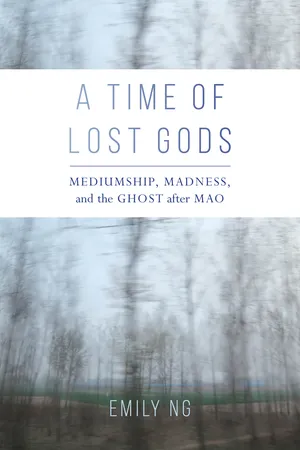
Traversing visible and invisible realms, A Time of Lost Gods attends to profound rereadings of politics, religion, and madness in the cosmic accounts of spirit mediumship. Drawing on research across a temple, a psychiatric unit, and the home altars of spirit mediums in a rural county of China’s Central Plain, it asks: What ghostly forms emerge after the death of Mao and the so-called end of history?
The story of religion in China since the market reforms of the late 1970s is often told through its destruction under Mao and relative flourishing thereafter. Here, those who engage in mediumship offer a different history of the present. They approach Mao’s reign not simply as an earthly secular rule, but an exceptional interval of divine sovereignty, after which the cosmos collapsed into chaos. Caught between a fading era and an ever-receding horizon, those “left behind” by labor outmigration refigure the evacuated hometown as an ethical-spiritual center to come, amidst a proliferation of madness-inducing spirits. Following pronouncements of China’s rise, and in the wake of what Chinese intellectuals termed semicolonialism, the stories here tell of spirit mediums, patients, and psychiatrists caught in a shared dilemma, in a time when gods have lost their way.
- 224 pages
- English
- ePUB (mobile friendly)
- Available on iOS & Android
eBook - ePub
About this book
Information
Publisher
University of California PressYear
2020Print ISBN
9780520303034
Edition
1eBook ISBN
9780520972636
1
After the Storm
“Would you like to know how a person of my era feels when riding on this train?” Yang Shaoliu’s eyes spark with no uncertain mischief. His wife, Fan Jie, gazes past us, out the window. We are hours in on a day-long train ride, northward from the coast, away from the sprawl of factory dorms, through deep-green fields of rice paddies and banana trees, past hillsides peppered with homes and tombs. Traversing the thousand miles between the rolling landscape of South China and the vast expanses of the Central Plain, the K1040 links my departure point in Shenzhen, the booming “factory of the world” in Guangdong Province, to one among the more emblematic sources of its floating population (piaoliu renkou) of migrant laborers, Henan Province. A native of Henan who has resided in Shenzhen for several decades, Yang Shaoliu is heading to his hometown for a visit and agreed to introduce me to the province.
Aboard the train carts, migrant workers and families return to the old home (laojia) from the South. Young mothers bring grandchildren to their grandparents “left behind” in the hometown, and grandparents bring grandchildren to their parents “floating” in the city. Entrepreneurs navigate potential markets in so-called second- and third-tier cities across central China, although those who have the means often prefer the plane or bullet train. Older passengers chat in local dialects, and younger riders swap stories and advice, often in standard Mandarin—the language of the nation, the language of cities and strangers. Children run up and down the aisle, finding new playmates. There is the rolling sound of the train, the murmur of voices, and the crackle of sunflower seeds. There are no empty seats or bunks.
“Let me tell you how a person of my era, a person of the sixties and seventies, feels when riding on this train,” Yang Shaoliu repeats emphatically, after I answered his initial question with a smirk. Yang Shaoliu was born in the 1950s, so the 1960s and 1970s mark the time of his youth across the Maoist era, which he spent in his hometown, when not traveling with the People’s Liberation Army. He begins slowly, with a theatrical grandiosity:
Aboard the train of soaring speed | Zuozai feikuai de lieche shang |
Through the brilliant windows of the cart | Touguo mingliang de chechuang |
“Is this a poem?” I interrupt.
He laughs and turns to his wife. “She thinks I’m reciting a poem!”
Fan Jie gives a slight nod but continues busying herself cracking sunflower seeds, showing little interest in endorsing his antics. A loyal and jaded public administrator, Yang Shaoliu rarely misses an opportunity for lessons in jest. Mouthing his words with sardonic deliberateness, he retorts, “No, it’s not a poem. I’m just telling you my feelings about riding this train. Did you get those two lines down?”
“Memorize it or document it?”
“Either.” He starts over.
Aboard the train of soaring speed | Zuozai feikuai de lieche shang |
Through the brilliant windows of the cart | Touguo mingliang de chechuang |
See the great, grand rivers and mountains of the homeland | Kankan zuguo de dahao heshan |
All around are scenes filled with flourishing vitality | Daochu chongman le shengqibobo de yingxiang |
He bursts into laughter. “That’s what a person of my generation feels riding on a train.” He glances over at Fan Jie, who is now listening. He continues, “In fact, trains of that era weren’t fast at all, to say nothing of ‘soaring’ speed. The windows weren’t clear either—there was a metal frame barring the view. Since there was no heat or air-conditioning like there is now, the windows had to be opened, so the view was never ‘clear,’ always disrupted by a window frame. Perhaps the rivers and mountains were truly more decent though.”
“There was no pollution or environmental destruction back then!” A neighboring passenger pitches in, a young migrant worker who shifted his attention from his cell phone to join our conversation for a moment. Yang Shaoliu ignores him. It is a stage, not a forum.
I raise an eyebrow. “Those verses—that’s how people in fact felt about the train back then?”
“People of that era didn’t really feel much at all. They weren’t very internal; everything was external. But they did say this a lot. Everyone said this. If you were going to say anything at all while sitting on the train, it’d better be this. If you wanted to say something else—for instance, that the train was not soaringly speedy—then you’re better off keeping your mouth shut. In that era people were very good at speaking. They spoke very precisely, very carefully. Because if you didn’t speak carefully, you’d never get to your stop on the train, understand?”
Fan Jie pitches in, in disagreement. “The verses simply express how joyous we are while riding the train, looking at the pretty scenery.” She breaks into a wide smile, tilting her head side to side, a gesture associated with the singing of children’s songs. Yang Shaoliu and I sneak each other a sidelong glance.
Thinking back, I realize that our moment of jest and collusion against Fan Jie’s more seemingly straightforward reading of Maoist-era language and affect missed something she was reminding us of—that unlike retroactive caricatures from within China and abroad, the powerful vocabularies and grammars of the Maoist era were polysemic and carried multiple simultaneous potentials for engagement and detachment, feeling and nonfeeling. In this chapter I first reflect on accounts of language, trauma, and history in China. Then, following the ethnographic sensibility I would later come to in the months after this train ride, I reconsider the affective power infused in language and speech before, during, and after Maoism, with relation to the figure of the rural and the peasantry, to register the historical forces infusing cosmological accounts in Hexian.
MAKING HISTORY SPEAK
In Illuminations from the Past (2004), Ban Wang writes that the trauma encountered by China, first manifest through the 1919 May Fourth Movement—a modern political and intellectual movement after the collapse of the dynastic system—as response to imperial and colonial threats following the Opium Wars, then in escalations of the Maoist era culminating in the Cultural Revolution, instituted a shift from history to memory. History, for Wang in this sense, refers to the possibility of generating meaningful narrative linkage between past and present—a present capable of making sense of the past through available symbolic resources.1 While modern historiography came to the fore as a challenge and an aim during the May Fourth era, what finally rendered the coherence of historical narrative an impossibility (albeit an impossibility that in turn occasioned a proliferation of new genres—what he terms memory), for Wang, were the decades of Maoist revolutionary campaigns.
The campaigns’ traumatic disruption of historical narrativity stemmed from their infliction of world-shattering experiences on the one hand, from public humiliation to corporeal violence, and the political aesthetics of Maoist newspeak on the other hand, which pushed language to its limits—to a codedness so heightened that language could no longer operate as a means of expression. In Yang Shaoliu’s words, if you were going to say anything at all while sitting on the train, it’d better be this. One had best remain within the authorized genre of coded speech, in a regime of language reinforced by the threat of violence that rendered its usage precise—an external precision marking the split between feeling and saying, a precision that required the delinking of speech from interiority.
If the violence encountered across the May Fourth and Maoist eras inflicted a rupture of narrative coherence for Ban Wang, Ann Anagnost provides another reading of these two moments: narrativity—realist narrativity, specifically—itself constituted a genre imported during May Fourth, one that provided the very conditions for the later manifestation of corporeal violence in the Maoist era. Drawing on Marston Anderson’s (1990) work on Chinese literary realism of the 1920s and 1930s, Anagnost writes that the figure of the subaltern shifted in this period from a passive object of pity (tongqing) to a subject of speech.2 This “ ‘coming into voice’ of the subaltern subject” in literature, for Anagnost, was then “eerily doubled” in later Maoist campaigns—realism moved from the text of intellectuals to the body of the peasant, as villagers were made to speak the truth of history through the public practice of “speaking bitterness,” or suku (1997, 19).
Moreover, the corporeal emphasis of this realist “myth of presence,” Anagnost suggests, eventually led to the physical violence of the Cultural Revolution and still echoes in post-Mao narrative practices (1997, 17). Through an enacted “localization of the sign,” abstract notions of world historical forces—imperialism and capitalism—were transposed onto a “highly embodied form identifiable within a local cast of characters,” resulting in bursts of mass violence (35).3 In short, literary realism provided the discursive precondition for the corporeal literalization of a politics of representation. Narrativity acquired a style that claimed direct access to the real, and hence a particular political valence could subsequently be assigned to spoken narration, predicated on the realist claim.
Across Wang and Anagnost are two approaches to narrativity and the Maoist era. In Wang, narrativity constitutes the precondition for what he calls history, grounded in the coherent temporalization of experience (linking the past and present meaningfully) and interrupted by the traumatic rupture of corporeal violence and the rigidification of language: an official newspeak.4 In Anagnost, narrativity constitutes a party-state apparatus that offered the basis for both subjectivation and the apparent (but in fact discursively consistent) excess of corporeal violence. The formation of the national subject was thus continuous with the formation of violence; both were premised on a realist conception of language. Drawing on trauma studies, particular the work of Cathy Caruth (1996), Wang’s concern pivots around the state-impinged threat to the possibility of a narrative-based subjectivity, in which the state is to some extent distinct from and external to the subject.5 Taking up Michel Foucault’s (1995) notion of the semiotechnique as distinguished from disciplinary power, Anagnost tasks the Chinese state with the former’s play of signs “on the surface of subjects, reordering their outward practice rather than their inner psyches,” addressing subject-making operations at the site of the social body rather than subjective interiority (1997, 116).
To these two accounts, let us add a third: Arthur Kleinman’s work on depression and neurasthenia. Addressing the Cultural Revolution through the accounts and symptoms of psychiatric patients he encountered in the clinic, Kleinman suggests that the risk of complaints about depression and mental illness would have been dangerous in China in the 1960s and 1970s, taken as a sign of skewed political thinking. In contrast, neurasthenia (shenjing shuairuo) was exempt from such politically fraught associations at the time and thus provided a bodily, medically legitimized, and politically tolerable idiom through which to articulate otherwise punishable laments.6 In light of the discussion here, Kleinman’s account thus adds another dimension: during the Cultural Revolution, in the case of some patients diagnosed with neurasthenia, the body became a shelter for speech and a sheltered object of speech, in a time when certain narrativizations of suffering might have been subject to persecution. Neurasthenia offered a “hard exoskeleton congealing key meanings,” an indirect reference to potential disaffection and dissent, with historical antecedents in the deployment of chronic illness by Confucian literati as a mode of withdrawal from dangerous political circumstances (1986, 159–60).
Across Wang’s, Anagnost’s, and Kleinman’s writings and Yang Shaoliu’s staging on the train arise variations on a theme: something happened to narrativity during the Maoist era and during the Cultural Revolution in particular. Between May Fourth and Maoism, the function of language and the possible sites of enunciation were interrupted or altered. While such alterations may inflict aphasia at one site, it could also produce—in simultaneity or in deferral—other forms of ciphered, shattered, or proliferating signification: the codification of speech and delinking of interiority in Yang Shaoliu, the literalization of historical truth through bodily violence in Anagnost, the somatization of lament in Kleinman, and the fragmentation of historical coherence and proliferation of new genres in Wang.
In these post-Mao reflections, various disfigurations of language are ascribed to Maoism as distilled and encapsulated in the language-shattering violence of the Cultural Revolution. Yet what of a scene in which Maoism and the Cultural ...
Table of contents
- Imprint
- Subvention
- Title
- Copyright
- Dedication
- Contents
- Prologue: We Never Should Have Met
- Introduction: The China of China
- 1. After the Storm
- 2. Ten Thousand Years
- 3. Spectral Collision
- 4. A Soul Adrift
- 5. Vertiginous Abbreviation
- Coda: Those Who Remain
- Acknowledgments
- Notes
- References
- Index
Trusted by 375,005 students
Access to over 1.5 million titles for a fair monthly price.
Study more efficiently using our study tools.
Frequently asked questions
Yes, you can cancel anytime from the Subscription tab in your account settings on the Perlego website. Your subscription will stay active until the end of your current billing period. Learn how to cancel your subscription
No, books cannot be downloaded as external files, such as PDFs, for use outside of Perlego. However, you can download books within the Perlego app for offline reading on mobile or tablet. Learn how to download books offline
Perlego offers two plans: Essential and Complete
- Essential is ideal for learners and professionals who enjoy exploring a wide range of subjects. Access the Essential Library with 800,000+ trusted titles and best-sellers across business, personal growth, and the humanities. Includes unlimited reading time and Standard Read Aloud voice.
- Complete: Perfect for advanced learners and researchers needing full, unrestricted access. Unlock 1.5M+ books across hundreds of subjects, including academic and specialized titles. The Complete Plan also includes advanced features like Premium Read Aloud and Research Assistant.
We are an online textbook subscription service, where you can get access to an entire online library for less than the price of a single book per month. With over 1.5 million books across 990+ topics, we’ve got you covered! Learn about our mission
Look out for the read-aloud symbol on your next book to see if you can listen to it. The read-aloud tool reads text aloud for you, highlighting the text as it is being read. You can pause it, speed it up and slow it down. Learn more about Read Aloud
Yes! You can use the Perlego app on both iOS and Android devices to read anytime, anywhere — even offline. Perfect for commutes or when you’re on the go.
Please note we cannot support devices running on iOS 13 and Android 7 or earlier. Learn more about using the app
Please note we cannot support devices running on iOS 13 and Android 7 or earlier. Learn more about using the app
Yes, you can access A Time of Lost Gods by Emily Ng in PDF and/or ePUB format, as well as other popular books in Social Sciences & Anthropology. We have over 1.5 million books available in our catalogue for you to explore.