Environmental remediation technologies to control or prevent pollution from hazardous waste material is a growing research area in academia and industry, and is a matter of utmost concern to public health, to improve ecology and to facilitate the redevelopment of a contaminated site. Recently, in situ and ex situ remediation technologies have been developed to rectify the contaminated sites, utilizing various tools and devices through physical, chemical, biological, electrical, and thermal processes to restrain, remove, extract, and immobilize mechanisms to minimize the contamination effects. This handbook brings altogether classical and emerging techniques for hazardous wastes, municipal solid wastes and contaminated water sites, combining chemical, biological and engineering control methods to provide a one-stop reference.
This handbook presents a comprehensive and thorough description of several remediation techniques for contaminated sites resulting from both natural processes and anthropogenic activities. Providing critical insights into a range of treatments from chemical oxidation, thermal treatment, air sparging, electrokinetic remediation, stabilization/solidification, permeable reactive barriers, thermal desorption and incineration, phytoremediation, biostimulation and bioaugmentation, bioventing and biosparging through ultrasound-assisted remediation methods, electrochemical remediation methods, and nanoremediation, this handbook provides the reader an inclusive and detailed overview and then discusses future research directions. Closing chapters on green sustainable remediation, economics, health and safety issues, and environmental regulations around site remediation will make this a must-have handbook for those working in the field.
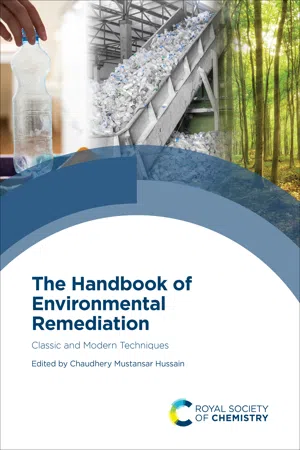
eBook - ePub
The Handbook of Environmental Remediation
Classic and Modern Techniques
- 506 pages
- English
- ePUB (mobile friendly)
- Available on iOS & Android
eBook - ePub
About this book
Trusted by 375,005 students
Access to over 1.5 million titles for a fair monthly price.
Study more efficiently using our study tools.
Information
CHAPTER 1
Innovation in Environmental Remediation Methods
a Department of Chemical Engineering, University of Petroleum and Energy StudiesEnergy Acres, Post Office Bidholi, Via Prem Nagar, Dehradun, Uttarakhand 248007, India
b Department of Chemistry and Environmental Sciences, New Jersey Institute of Technology, University Heights, Newark, NJ 07102, USA
*Email: [email protected]
1.1 Introduction
Environmental engineering science and chemical process engineering are today witnessing immense scientific challenges and extensive scientific intricacies. Technological vision, great scientific motivation and the futuristic vision of environmental engineering science are the forerunners towards a new visionary scientific order in the field of science and engineering. Global water shortages and climate change during this century are devastating the global scientific landscape. In this chapter, the authors consider in depth the immediate necessities of human civilization such as energy and environmental sustainability. Water, energy, food, shelter and education today stand as major pivots in the success of global human scientific endeavor. The world of environmental engineering, drinking water treatment and industrial wastewater treatment is in the process of new scientific rejuvenation. Futuristic vision and future research trends should be targeted towards greater scientific emancipation in the fields of nanotechnology, nanomaterials and engineered nanomaterials. The targets of human civilization and human scientific research pursuits should be towards the application of nanomaterials in diverse areas of science and engineering. Technology and engineering science currently have few answers to the arsenic and heavy metal contamination in drinking water prevalent in many developing and developed countries around the world.
This chapter considers in depth the scientific needs, the scientific vision and the deep scientific insight in membrane science applications in environmental protection. The authors expound the importance of advanced oxidation processes as a strong non-conventional environmental engineering tool. The current need is mitigation of global water shortages and global climate change. Hence human civilization needs to be reorganized and restructured as regards environmental protection and the manifold needs of environmental remediation. Technological and scientific validation are also equal necessities of the scientific realization of environmental engineering. The authors’ deep insight is brought to bear on the imminent needs of chemical process engineering and also novel separation processes. Membrane science needs to be restructured and reorganized based on the passage of scientific history and the future visionary time frame. This chapter should be an eye-opener towards the scientific intricacies of innovations in environmental engineering techniques.
1.2 The Vision of This Chapter
Human civilization and human scientific research pursuits are today at the center of deep scientific vision and engineering introspection. Today, environmental engineering science is an engineering success. In a similar vein, chemical process engineering, material science, nanotechnology and petroleum engineering are currently at the forefront of human scientific endeavor. The vision of this chapter is to open new doors of scientific innovation in the field of conventional and non-conventional environmental engineering tools. The success and the validation of the science of environmental remediation are multifarious and versatile. This chapter targets the widely observed necessities of the technology, engineering and science of environmental remediation. Human scientific endeavor will then usher in a new era in the field of energy and environmental sustainability. Sustainable development is the one of the greatest needs of human civilization today. The areas of energy and environmental sustainability are of immense concern in modern-day human civilization. This chapter reiterates the great scientific needs of sustainability applications in human society.
1.3 The Needs and the Rationale of This Chapter
The status of the environment today is extremely dismal. The needs and the rationale of this chapter go beyond deep scientific imagination. Environmental remediation is the greatest current need. The authors emphasize particularly environmental sustainability and conventional and non-conventional environmental engineering techniques. The world of science today stands transfixed with the ever-growing concerns regarding environmental disasters, loss of ecological biodiversity and global climate change. In such a situation, this chapter is intended to reveal the scientific intricacies and scientific insight in the field of environmental engineering science. The great scientific determination and perseverance of humans, mankind's scientific stature and the futuristic vision of environmental engineering will all lead a visionary approach in the true realization of both energy and environmental sustainability. Humankind is currently faced with an immense scientific conundrum. The world today stands mesmerized with the growing concerns of global climate change, a total lack of clean drinking water in some parts of the world and the challenges of sustainable development. Environmental sustainability is therefore the greatest need at present. The definition of “sustainability” by Dr Gro Harlem Brundtland will be re-envisioned and restructured in the present context of environmental engineering and environmental protection. Science, technology and engineering therefore all need to be revamped and reorganized with the passage of scientific history and time. In this chapter, the authors re-emphasize the need for environmental sustainability in human scientific progress. Millions of people around the world are without pure drinking water and with improper sanitation. This is the need and the rationale of this study. Mankind's extensive scientific profundity, the futuristic endeavors of science and the needs of sustainability science will all be torchbearers towards a new visionary era in environmental remediation.
1.4 Environmental Sustainability and the Vision for the Future
Environmental sustainability, water purification and integrated water resource management are today linked with each other as a result of extensive scientific vision and scientific perseverance. The vision of environmental engineering techniques is manifold and versatile. Scientific truth, deep scientific perseverance and scientific candor are hallmarks towards a new visionary era in the field of environmental remediation. Today, the crisis of global warming and frequent environmental disasters are stimulants to future research and development directions. Arsenic and heavy metal groundwater pollution is today devastating the fabric of many developing and developed nations around the world. The world of environmental engineering and chemical process engineering is truly struggling with this ever-growing and intricate issue, hence the vital need for global environmental remediation and environmental sustainability. Many countries around the globe do not have proper drinking water provision and lack proper sanitation. The authors stress these vital issues and open up a new world order in environmental engineering and environmental sustainability.
Barrow1 discussed in detail environmental management and development. Environmental management and sustainable development are two opposite sides of the visionary coin today. The author discussed in great detail the theory of and approaches to environmental management in developing countries, resource management issues by sector, water, coastal and island resources, agriculture, land degradation, food security, biodiversity resources, atmospheric issues and environmental tools and policies. Environmental management and development are both difficult domains to define.1 The former can be a goal or vision, an approach to steer a process, the application of a set of tools and a more philosophical exercise. Development can be a goal or vision, also the application of some visionary tools and an attempt to steer a process. The science of environmental protection in a similar vein is in the process of new scientific rejuvenation.1 Providing a universally accepted definition of sustainable development is absolutely impossible. It is a veritable process of change that can enhance, accelerate, slow, stagnate or push backwards. Development can be increasingly seen as a social transformation through the use of capital, technology and knowledge.1 Clearly, it is immensely difficult to separate the concepts of development from cultural, ethical and religious outlooks. Sustainable development is a major need of human scientific progress today.1 Development management has evolved independently of the vast domain of environmental management but the concepts often overlap. Barrow's book opened up new scientific thoughts and new scientific innovations in the field of environmental sustainability for decades to come.1
Barrow2 subsequently discussed environmental management for sustainable development, considering the theory, principles and concepts of environmental management, environmental management approaches, standards, monitoring, modeling, auditing and coordination. His book provided a deep insight into pollution and waste management. As already stated, today environmental management and sustainability are two opposite sides of the visionary coin.2 Sustainability is an important need for present-day human civilization. The author discussed the goal of sustainable development, multidisciplinary and interdisciplinary approaches, concerns for limits, hazards and potential, short-term planning, translation from theory to practice and the awareness of the need to change the ethics of people, businesses and governments.2 He redefined the concept of environmental management fundamentals and its goals. He also specifically focused on environmental management and science, biodiversity, biosphere cyclic processes and the great environmental crisis that the world is facing.2
LeBlanc3 presented a detailed review that depicted in depth the implications for industry and the infrastructure involved in demystifying the risk of climate change. The premise of the book was that long before the Paris Agreement, scientists, engineers, businessmen and -women, public officials, academics and non-governmental organizations throughout the USA and the world were at the threshold of the issue of solving the myriad problems associated with anthropogenic climate change and global warming,3 hence it is time to share research ideas amongst diverse people in diverse areas of scientific endeavor. This volume covers implications for industry and infrastructure in (1) a stand-alone chapter on the Montreal Protocol, (2) a chapter on industry and infrastructure concerns, (3) a section devoted to sustainability and strategic planning and (4) a chapter on climate science and business risks.3 The scientific challenges in mitigating global climate change are deliberated and discussed in detail.
Katman4 discussed and deliberated on global climate change, the environment and energy in great detail. Climate change represents a fundamental challenge for global environmental and energy sustainability. Global warming and climate change are both environmental and sustainable development issues.4 His book aimed to cover both sides of the coin in providing comprehensive information concerning climate change, environment and energy domains. The chapters in this book represent multidisciplinary perspectives with considerable elaboration on their interdependence. Global climate change is related to an increase in the temperature of the atmosphere and the oceans.4 Some gases, such as carbon dioxide, methane, nitrous oxide and hydrofluorocarbons, increase the temperature of the atmosphere. The immense skill and depth of human scientific endeavors and the great scientific success of environmental engineering innovations are minutely deliberated in this book.4
The pursuit of human scientific research and technological and engineering innovations are at the crossroads of vision and deep profundity. Throughout this chapter, the author rehearses the scientific needs of environmental and energy sustainability in the furtherance of science and engineering.
1.5 The Present State of the Environment and the Success of Scientific Endeavor
The present state of the human environment is very dismal and thought provoking. The provision of basic human needs such as energy and water is a scientific imperative of modern science today. In a similar vision, global warming and the depletion of fossil fuel resources are current concerns of human civilization. Scientific research pursuits and the participation of civil society are major cornerstones of human progress. Global warming and global climate change, frequent environmental disasters, depletion of fossil fuel resources and loss of ecological biodiversity are major scientific problems for human civilization. At such a crucial juncture of scientific history and time, important needs are scientific innovation and greater scientific emancipation in research and development initiatives. In this chapter, the author reiterates the success of science and engineering, the intricacies and struggles of technology and engineering science and the futuristic vision of water science and technology. The main need is environmental sustainability. This chapter goes beyond...
Table of contents
- Cover
- Title
- Copyright
- Preface
- Contents
- Chapter 1 Innovation in Environmental Remediation Methods
- Chapter 2 Hazardous Wastes – Types and Sources
- Chapter 3 Thermal Treatment
- Chapter 4 Soil Vapor Extraction: Fundamentals, Theory (Permeability and Gas–Non-aqueous Phase Liquid Mass Transfer Coefficient) and Applications
- Chapter 5 Electrokinetic Remediation
- Chapter 6 Stabilization/Solidification
- Chapter 7 Permeable Reactive Barriers (PRBs) for Environmental Site Remediation
- Chapter 8 Thermal Desorption and Incineration
- Chapter 9 Green Technique for the Remediation of Soil Using Composting
- Chapter 10 Phytoremediation
- Chapter 11 Biostimulation and Bioaugmentation: Modern Strategies for the Successful Bioremediation of Contaminated Environments
- Chapter 12 Strategies for Enhancing Soil Phytoremediation and Biomass Valorization
- Chapter 13 Landfarming: A Green Remediation Technique
- Chapter 14 Ultrasound-assisted Remediation Methods
- Chapter 15 Electrochemical Methods for Environmental Remediation
- Chapter 16 Nanoremediation
- Chapter 17 Economic, Legal and Safety Issues of Environmental Site Remediation
- Chapter 18 Future of Environmental Remediation Methods
- Subject Index
Frequently asked questions
Yes, you can cancel anytime from the Subscription tab in your account settings on the Perlego website. Your subscription will stay active until the end of your current billing period. Learn how to cancel your subscription
No, books cannot be downloaded as external files, such as PDFs, for use outside of Perlego. However, you can download books within the Perlego app for offline reading on mobile or tablet. Learn how to download books offline
Perlego offers two plans: Essential and Complete
- Essential is ideal for learners and professionals who enjoy exploring a wide range of subjects. Access the Essential Library with 800,000+ trusted titles and best-sellers across business, personal growth, and the humanities. Includes unlimited reading time and Standard Read Aloud voice.
- Complete: Perfect for advanced learners and researchers needing full, unrestricted access. Unlock 1.5M+ books across hundreds of subjects, including academic and specialized titles. The Complete Plan also includes advanced features like Premium Read Aloud and Research Assistant.
We are an online textbook subscription service, where you can get access to an entire online library for less than the price of a single book per month. With over 1.5 million books across 990+ topics, we’ve got you covered! Learn about our mission
Look out for the read-aloud symbol on your next book to see if you can listen to it. The read-aloud tool reads text aloud for you, highlighting the text as it is being read. You can pause it, speed it up and slow it down. Learn more about Read Aloud
Yes! You can use the Perlego app on both iOS and Android devices to read anytime, anywhere — even offline. Perfect for commutes or when you’re on the go.
Please note we cannot support devices running on iOS 13 and Android 7 or earlier. Learn more about using the app
Please note we cannot support devices running on iOS 13 and Android 7 or earlier. Learn more about using the app
Yes, you can access The Handbook of Environmental Remediation by Chaudhery Mustansar Hussain in PDF and/or ePUB format, as well as other popular books in Technology & Engineering & Chemical & Biochemical Engineering. We have over 1.5 million books available in our catalogue for you to explore.