Over the last two decades, the study of discourse in film and television has become one of the most promising research avenues in stylistics and pragmatics due to the dazzling variety of source material and the huge pragmatic range within it. Meanwhile, with the advent of streaming and the box set, film and television themselves are becoming separated by an increasingly blurred line.
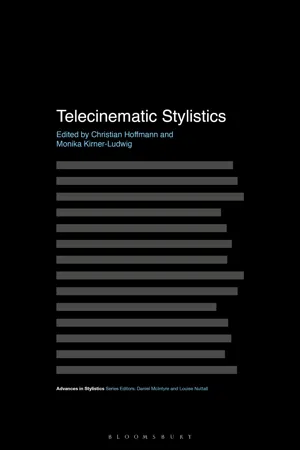
This volume closes a long-standing gap in stylistics research, bringing together a book-level pragmastylistic showcase. It presents current developments from the field from two complementary perspectives, looking stylistically at the discourse in film and the discourse of and around film. This latter phrase comes to mean the approaches which try to account for the pragmatic effects induced by cinematography. This might be the camera work or the lighting, or the mise en scène or montage. The volume takes a multimodal approach, looking at word, movement and gesture, in keeping with modern stylistics.
The volume shows how pragmatic themes and methods are adapted and applied to films, including speech acts, (im)politeness, implicature and context. In this way, it provides systematic insights into how meanings are displayed, enhanced, suppressed and negotiated in both film and televisual arts.
- 352 pages
- English
- ePUB (mobile friendly)
- Available on iOS & Android
eBook - ePub
Telecinematic Stylistics
About this book
Information
1
‘I shouldn’t have let this happen’
Demonstratives in film dialogue and film representation
Maria Pavesi
1 Introduction
Film, compared to other forms of representation and narration, shows more than it tells. Verbal language, however, is there, performing several functions among which relating what we hear with what we see. As in real life, deictic features in film evoke the space where interaction occurs together with the entities that populate it. They identify the objects and people involved in the interactional exchange, set the time of the event and refer to discourse itself. Yet, unlike real life, deixis in film works along two distinct dimensions: at the diegetic level, it appeals to the characters and tightens up their turns in the fictional world’s spoken interactions; at the extra-diegetic level, it guides viewers to the scene and the represented events by linking what they hear in the dialogue with what they watch on-screen. Among the various deictic devices, demonstratives deserve special attention in fictional dialogue as they point to some segments of the extralinguistic reality or current discourse and, prototypically, to the physical and visual context surrounding participants. Here, verbal language refers ostensibly to entities perceivable in the scene but can also symbolically evoke wider situations belonging to the narrative.
Two major referential uses of demonstratives are recognized in general language: exophoric and endophoric (Halliday and Hasan 1976; Diessel 1999). Exophoric demontratives are prototypical deictics directing the interlocutors’ attention onto items in the non-verbal context. The entities referred to by the demonstrative can only be understood by drawing on the awareness and knowledge of the context of situation, that is, the set of extralinguistic circumstances of use that affect the linguistic form of an utterance, including physical and social setting, social relationships, the task at hand, the medium and the topic of discourse (cf. Halliday and Hasan 1985). Hence demonstrative pronouns can refer to physical objects, as well as – by extension – to more abstract situations, conditions and states of mind populating the environment in which the utterance is placed. By contrast, endophoric demonstratives point to elements, whole segments and propositions within the verbal text. Overall ‘demonstrative pronouns […] may have referents of all ontological types: first-order (individuals, physical objects), second-order (situations), third-order (concepts and prepositions) and […] fourth-order entities (illocutionary forces)’ (Cornish 2007: 150). The different types of reference are significant in films because, on the one hand, demonstratives have a cohesive role that serves an interactional function by linking up audiovisual dialogue turns together. Exophoric demonstratives, on the other hand, take viewers away from the verbal exchange and bring them to the local or global situation by shifting interlocutors’ and viewers’ attention onto the sensorial input and the fictional events unravelling on-screen.
Corpora studies show that demonstratives are more frequent in speech than in writing, both as pronouns and determiners and as all reference types (Biber et al. 1999; Botley and McEnery 2001; also Diessel 2014). This means that locutors in speech use more demonstratives than in writing to pick up portions of text as well as concrete and abstract entities in the context of situation. The frequent use of these deictic features in speech is due to a variety of factors, starting with the immediacy of the relationship between situation and discourse in face-to-face interaction, where speakers are usually involved in joint activities and experience the extralinguistic reality together and at the same time (Botley and McEnery 2001; Carter and McCarthy 2006: 178). In addition, demonstratives require less processing to pick up entities than more elaborated noun phrases and are thus more amenable to the communicative constraints of online verbal planning. Moreover, these devices do not impose a definite interpretation of referents, but rather contribute to the casualness of talk and promote face-to-face politeness, especially in face-threatening acts (e.g. Margutti, Traverso and Pugliese 2016). The emotional and interactional involvement frequently associated with demonstratives likewise increases their frequency in spoken discourse, a privileged locus for its expression (see Quaglio and Biber 2006). Demomstratives’ attributes of immediacity, compactness, casualness and interactivity are highly relevant for telecinematic discourse, where spokenness is represented and the mechanisms underlying spontaneous conversation can be exploited for the specific goals of film.
The centrality of demonstratives in the staging of fictional worlds calls for an in-depth exploration of their frequency, uses and functions with reference to spontaneous conversation, the multimodal context of film representation and the double-layeredness of audiovisual communication. The present study hence aims to investigate the roles of demonstratives in audiovisual orality. It focuses on how they highlight the iconicity of film texts and offer a given perspective on narration. As a background to the ensuing corpus-based investigation, the next section provides a brief description and conceptual definitions of demonstratives in English.
2 A look at demonstrative deixis in English
In English demonstratives are traditionally distinguished into proximal and distal ones, depending on the relative proximity (this/these) or distance (that/those) of...
Table of contents
- Cover
- Half-Title
- Series
- Title
- Contents
- List of illustrations
- Notes on contributors
- Acknowledgements
- Introduction
- 1 ‘I shouldn’t have let this happen’: Demonstratives in film dialogue and film representation
- 2 On the usefulness of the Sydney Corpus of Television Dialogue as a reference point for corpus stylistic analyses of TV series
- 3 ‘Drucilla, we need to talk’: The formulaic nature of problem-oriented talk in soap operas
- 4 Repetition in sitcom humour
- 5 Ideology in the multimodal discourse of television documentaries on Irish travellers’ and gypsies’ communities in the UK
- 6 Voice-over and presenter narration in TV documentaries
- 7 A mixed-method analysis of autism spectrum disorder representation in fictional television
- 8 The visual discourse of shots and cuts: Applying the cooperative principle to horror film cinematography
- 9 Effectful advertising? Film trailers and their relevance for prospective audiences
- 10 Adapting scripture to (trans)script: A cognitive-pragmatic approach to cinematic strategies of evoking pseudo-medieval frames
- 11 How comics communicate on the screen: Telecinematic discourse in comic-to-film adaptations
- 12 ‘Subtitles have to become my ears not my eyes’: Pragmatic-stylistic choices behind Closed Captions for the deaf and hard of hearing: the example of Breaking Bad
- 13 Metapragmatic awareness in cinematic discourse: Cohesive devices in Notorious (Hitchcock, 1946)
- Index
- Copyright
Trusted by 375,005 students
Access to over 1.5 million titles for a fair monthly price.
Study more efficiently using our study tools.
Frequently asked questions
Yes, you can cancel anytime from the Subscription tab in your account settings on the Perlego website. Your subscription will stay active until the end of your current billing period. Learn how to cancel your subscription
No, books cannot be downloaded as external files, such as PDFs, for use outside of Perlego. However, you can download books within the Perlego app for offline reading on mobile or tablet. Learn how to download books offline
Perlego offers two plans: Essential and Complete
- Essential is ideal for learners and professionals who enjoy exploring a wide range of subjects. Access the Essential Library with 800,000+ trusted titles and best-sellers across business, personal growth, and the humanities. Includes unlimited reading time and Standard Read Aloud voice.
- Complete: Perfect for advanced learners and researchers needing full, unrestricted access. Unlock 1.5M+ books across hundreds of subjects, including academic and specialized titles. The Complete Plan also includes advanced features like Premium Read Aloud and Research Assistant.
We are an online textbook subscription service, where you can get access to an entire online library for less than the price of a single book per month. With over 1.5 million books across 990+ topics, we’ve got you covered! Learn about our mission
Look out for the read-aloud symbol on your next book to see if you can listen to it. The read-aloud tool reads text aloud for you, highlighting the text as it is being read. You can pause it, speed it up and slow it down. Learn more about Read Aloud
Yes! You can use the Perlego app on both iOS and Android devices to read anytime, anywhere — even offline. Perfect for commutes or when you’re on the go.
Please note we cannot support devices running on iOS 13 and Android 7 or earlier. Learn more about using the app
Please note we cannot support devices running on iOS 13 and Android 7 or earlier. Learn more about using the app
Yes, you can access Telecinematic Stylistics by Christian Hoffmann,Monika Kirner-Ludwig in PDF and/or ePUB format, as well as other popular books in Lingue e linguistica & Linguistica. We have over 1.5 million books available in our catalogue for you to explore.