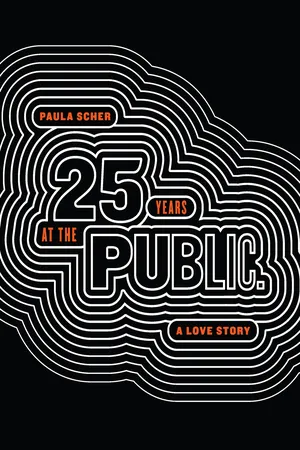
A larger-than-life figure in the design community with a client list to match, Paula Scher turned her first major project as a partner at Pentagram into a formative twenty-five-year relationship with the Public Theater in New York. This behind-the-scenes account of the relationship between Scher and "the Public," as it's affectionately known, chronicles over two decades of brand and identity development and an evolving creative process in a unique "autobiography of graphic design."
I first saw A Chorus Line on the steps of the Public Theater in 1975 when I was in my twenties and working as an art director at CBS Records. My husband, Seymour Chwast, took me to see it. It was a very New York thing to do. At that time, Seymour was in partnership with Milton Glaser at a design studio called Push Pin. They worked out of a building they owned on East Thirty-Second Street. New York magazine (which was founded by Clay Felker and launched with Milton as design director) rented office space on the third floor of the Push Pin building. Seymour heard what was going on around town directly from the writers at the magazine, and seeing A Chorus Line at the Public was the thing to do. Everyone at New York magazine knew it was going to be a smash hit and go on to Broadway. Of course it did, for decades. It was, and is, riveting and true. It was a breakthrough musical. The experience of seeing it was magical.
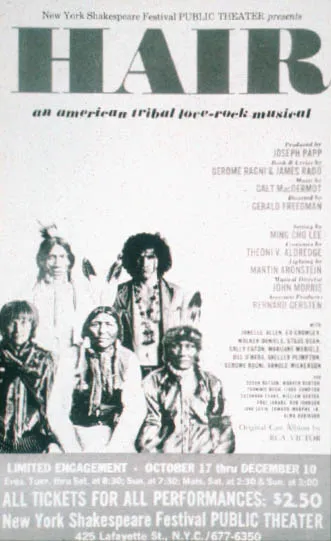
The physical experience of being at the Public Theater was what New Yorkers at the time would call “downtown.” You went if you were in the know, a risk taker, ahead of the crowd. The theater was founded by Joe Papp, who also produced the free summertime New York Shakespeare Festival (now called Shakespeare in the Park) in Central Park. Papp had also produced the rock musical Hair in the late ’60s. In fact, Hair was the first production staged at the Public Theater. Joe Papp had saved the old Astor Library on Lafayette Street from destruction and turned it into a theater. The library, founded by John Jacob Astor in 1854, was a free public library that for a time was part of the New York Public Library system. In 1911, the building was vacated and the books were moved to the large public library in Bryant Park. In 1920, the Hebrew Immigrant Aid Society purchased the Astor Library. By the 1960s it was abandoned and faced demolition. Joe Papp and the New York Shakespeare Festival persuaded New York City to purchase the building as a theater for the benefit of the public, enabling them to expand their offerings beyond the festival.
I’m glad I didn’t see Hair at the Public Theater when it first opened in 1967. I never liked the musical and especially hated the movie, because I went to college in the late ’60s and the musical was essentially about my peer group. We all hated that kind of Broadway-style musical and felt that calling it a “rock musical” was an insult to real rock and roll. “Aquarius / Let the Sunshine In” was a top forties hit, but at that time no one I knew respected it. My view of Hair and its competitor Godspell was that they were for dorky straight people who liked Broadway musicals about contemporary subject matter.
In 2008, after I had been designing for the Public for fourteen years, I went to the opening night of the Public’s production of Hair in Central Park at the Delacorte Theater. It was a cloudy, humid night and everyone hoped the weather would hold out. The park was the perfect venue for the musical—after all, the story takes place in a park. The songs and music seemed so much better than I had remembered; many had survived their time and become classics. At the very end of the performance, the clouds that had been generously holding back the rain throughout the production finally broke, just as the cast began joyously singing “Let the Sunshine In.” The audience was swept up in the moment, singing, clapping, and dancing in the rain. It was a night to remember in New York City.
PAUL DAVIS
In 1955, graphic artist Paul Davis moved to New York from Oklahoma and became an illustrator at Push Pin Studios. His work was uniquely American, marrying a folk-painting style with surrealism. He soon became a popular illustrator and left Push Pin to work on his own. I knew him through Seymour and admired his work. (I hired him to paint a record cover in the ’70s at CBS Records.)
In 1975 he made a dark painting of the actor Raul Julia wearing a bowler hat that became an iconic image for Joe Papp’s production of Bertolt Brecht and Kurt Weill’s The Threepenny Opera, which later opened on Broadway. Raul Julia played Mack the Knife, and his performance and that painting were forever entwined. The poster became a New York City icon.
Paul Davis would go on to make posters for Joe Papp for the next eighteen years. The posters were for the Shakespeare in the Park productions at the Delacorte Theater and for productions at the Public Theater, which was called “the Joseph Papp Public Theater” or “the Papp” at the time. Many of Paul’s posters for the Papp were among the best theater posters ever designed and were icons for both the international design community and New York’s theater community.
At one point in the mid ’80s, after I had left CBS Records, Paul called me up at my new design company, Koppel & Scher, and asked me where I found inspiration for my recent typographic work. I told him that I was influenced by Constructivism and encouraged him to look up the work of El Lissitzky and Alexander Rodchenko. Apparently he did, because several months later I saw a large bus shelter poster for a Masterpiece Theatre production of Sherlock Holmes that was painted by Paul—it was not dissimilar to his Papp production paintings, but the typography was more prominent and definitely constructivist.
Masterpiece Theatre was a Public Broadcasting Service (PBS) series. I remember several PBS posters by Paul, but by t...
Table of contents
Cover
Title
Dedication
Contents
George C. Wolfe
Oskar Eustis
Steven Heller
Ellen Lupton
Paula Scher: 25 Years at the Public
Acknowledgments
Contributor Bios
Trusted by 375,005 students
Access to over 1.5 million titles for a fair monthly price.
Study more efficiently using our study tools.
Frequently asked questions
Yes, you can cancel anytime from the Subscription tab in your account settings on the Perlego website. Your subscription will stay active until the end of your current billing period. Learn how to cancel your subscription
No, books cannot be downloaded as external files, such as PDFs, for use outside of Perlego. However, you can download books within the Perlego app for offline reading on mobile or tablet. Learn how to download books offline
We are an online textbook subscription service, where you can get access to an entire online library for less than the price of a single book per month. With over 1.5 million books across 990+ topics, we’ve got you covered! Learn about our mission
Look out for the read-aloud symbol on your next book to see if you can listen to it. The read-aloud tool reads text aloud for you, highlighting the text as it is being read. You can pause it, speed it up and slow it down. Learn more about Read Aloud
Yes! You can use the Perlego app on both iOS and Android devices to read anytime, anywhere — even offline. Perfect for commutes or when you’re on the go. Please note we cannot support devices running on iOS 13 and Android 7 or earlier. Learn more about using the app
Yes, you can access Paula Scher by Paula Scher in PDF and/or ePUB format, as well as other popular books in Design & Design History & Criticism. We have over 1.5 million books available in our catalogue for you to explore.