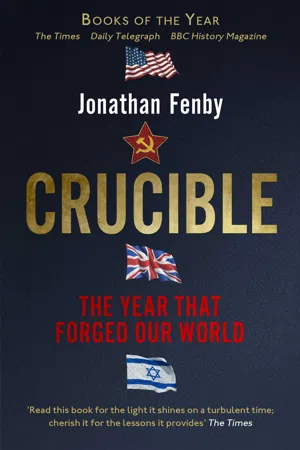
Crucible
eBook - ePub

Crucible

Thirteen Months that Forged Our World

  1. 544 pages
  2. English
  3. ePUB (mobile friendly)
  4. Available on iOS & Android
eBook - ePub

Crucible

Thirteen Months that Forged Our World

About this book

The Times Book of the Year
BBC History Magazine Book of the Year
Daily Telegraph Book of the Year
BOOK OF THE WEEK - The Times


‘The strength of this book lies in the cold realities it delivers. “The thirteen months of 1947-48,” writes Fenby, “provide trenchant examples of how realpolitik can serve a wider purpose if those in power know how to use it.” Crucible captures perfectly the urgency of the time…Read this book for the light it shines on a turbulent time; cherish it for the lessons it provides’ - Gerard DeGroot

'Looking back 70 years Jonathan Fenby argues convincingly that the period from 1947 to 1948 “really did change the world”.  His book is an assured gallop across the terrain of contemporary history in this fateful year. The global devastation of the second world war had smashed longstanding institutions and bankrupted empires, leaving behind the kind of power vacuums that were major openings for change and chaos.  Crucible swings from one region to the next in a fast-moving account of how local actors filled those vacuums, often with violence.’
Mary Sarote, Financial Times

One year shaped the world we know today. This is the page-turning story of the pivotal changes which were forged in the space of thirteen months of 1947-48 

Two years after the end of the second conflict to engulf the world in twenty years, and the defeat of the Axis forces of Germany, Italy and Japan, this momentous time saw the unrolling of the Cold War between Joseph Stalin's Soviet Russia and the Western powers under the untried leadership of Harry Truman as America came to play a global role for the first time.

The British Empire began its demise with the birth of the Indian and Pakistan republics with the flight of millions and wholesale slaughter as Vietnam, Indonesia and other colonies around the globe vied for freedom. 1948 also marked the creation of the state of Israel, the refugee flight of Palestinians and the first Arab-Israeli war as well as the victories of Communist armies that led to their final triumph in China, the coming of apartheid to South Africa, the division of Korea, major technological change and the rolling out of the welfare state against a backdrop of events that ensured the global order would never be the same again.
 

This dynamic narrative spans the planet with overlapping epic episodes featuring such historic figures as Truman and Marshall, Stalin and Molotov, Attlee and Bevin, De Gaulle and Adenauer, Mao Zedong and Chiang Kai-shek, Nehru and Jinnah, Ben Gurion and the Arab leaders. Between them, they forged the path to our modern world.
Frequently asked questions

Yes, you can cancel anytime from the Subscription tab in your account settings on the Perlego website. Your subscription will stay active until the end of your current billing period. Learn how to cancel your subscription.
No, books cannot be downloaded as external files, such as PDFs, for use outside of Perlego. However, you can download books within the Perlego app for offline reading on mobile or tablet. Learn more here.
Perlego offers two plans: Essential and Complete
  • Essential is ideal for learners and professionals who enjoy exploring a wide range of subjects. Access the Essential Library with 800,000+ trusted titles and best-sellers across business, personal growth, and the humanities. Includes unlimited reading time and Standard Read Aloud voice.
  • Complete: Perfect for advanced learners and researchers needing full, unrestricted access. Unlock 1.4M+ books across hundreds of subjects, including academic and specialized titles. The Complete Plan also includes advanced features like Premium Read Aloud and Research Assistant.
Both plans are available with monthly, semester, or annual billing cycles.
We are an online textbook subscription service, where you can get access to an entire online library for less than the price of a single book per month. With over 1 million books across 1000+ topics, we’ve got you covered! Learn more here.
Look out for the read-aloud symbol on your next book to see if you can listen to it. The read-aloud tool reads text aloud for you, highlighting the text as it is being read. You can pause it, speed it up and slow it down. Learn more here.
Yes! You can use the Perlego app on both iOS or Android devices to read anytime, anywhere — even offline. Perfect for commutes or when you’re on the go.
Please note we cannot support devices running on iOS 13 and Android 7 or earlier. Learn more about using the app.
Yes, you can access Crucible by Jonathan Fenby in PDF and/or ePUB format, as well as other popular books in History & Modern British History. We have over one million books available in our catalogue for you to explore.

Information

PART ONE

A NEW WORLD ORDER

CHAPTER ONE

LEGACY OF WAR

I: THE COST OF VICTORY
WAR IN EUROPE OVER. There is absolutely no reason to get up in the mornings any more,’ wrote the photographer Robert Capa in his diary when the news of Germany’s capitulation was announced. Few other people could take such an insouciant attitude as the cataclysm, which had killed an estimated 15 million military personnel and 40 million civilians, gave way to continuing high anxieties and turbulence that escalated beyond any expectations, gathering pace between the summers of 1947 and 1948.1
The conflict had seen a high build-up in industrial output to fuel the war machine on all sides, but, across much of the globe, recovery from the devastation it caused was slow; in some places things actually got worse. In 1947, the United Nations concluded that the previous two years had been ‘characterized by retardation of economic progress’. While the US grew greatly, the potential of many other important countries diminished even more. Inflationary pressures increased. The dollar, the main vehicle for international exchanges, was in critically short supply. ‘The far-reaching post-war dislocations of international trade have remained acute,’ the UN noted in its global report for 1948. ‘Productive facilities were still not generally significantly larger than before the war while progress in agricultural output still lagged seriously in many areas.’2
Wartime destruction stretched from Western Europe to China, where, after occupying Manchuria for six years, Japan launched a full-scale invasion in 1937. Killing and devastation had been indiscriminate. Civilians died in much greater numbers than fighting troops, including 6 million Jews slain in the Holocaust, Slavs and other groups targeted by the Nazis and Asian civilians massacred by the Japanese. The number of Soviet dead has been put officially at 26.6 million though another estimate raised this to 40 million. Anywhere from 15 to 22 million Chinese perished. Ten per cent of the population of Yugoslavia was killed. Of the two defeated Axis powers, Japan lost 2.6–3 million troops and civilians while German deaths amounted to between 5 and 8 million, with several million held as prisoners of war. (In contrast, the US death toll ran to 419,000, and that of the UK and its dominions and colonies to 450,000.)
In some Russian villages, a hundred or more men went off to fight and only five returned. Belarus lost up to 30 per cent of its population. The new weapons of strategic bombing and fire raids on cities took more than 1.5 million lives, followed by the atomic explosions at Hiroshima and Nagasaki, which killed up to 250,000. In Germany, which suffered 600,000 civilians killed by bombing, there were 1.6 million disabled veterans and 1.2 million war widows. In Manila, hundreds of thousands of civilians died in the fiercest urban fighting of the Pacific War as Japanese troops killed and raped indiscriminately – a doctor recalled being among only fifty survivors from a group of more than 3,000 men herded together to be killed. A quarter of the inhabitants of Okinawa perished in fighting there after US troops landed in 1945.3
One-third of the wealth of the USSR was destroyed. The damage to the Netherlands was put at one-third of pre-war gross domestic product. In European Russia, the Ukraine and Belarus, which were occupied by the Germans and then pummelled by the Soviet westward offensive, 5 million homes were destroyed, leaving 25 million people without shelter, some living in holes in the ground. Eighty per cent of Warsaw was blown away. ‘Here is a burial ground. Here is death,’ a Polish writer lamented on return to the city. Ten million Germans and 9 million Japanese were homeless. A German Communist arriving in Berlin after the defeat of the Reich described the city as ‘a picture of hell. Fires and ruins, aimless people dressed in rags.’ In France, a million houses were laid waste from the air, most after D-Day; in the Norman town of Saint-Lô, only two hundred of the 2,600 buildings escaped, while 100,000 mines were buried or floated off the beaches of the fashionable resort of Le Touquet. In Finland, the Germans laid waste 35,000 square miles of territory as they retreated, sending 170,000 people fleeing from their homes.4
In France and Italy, the economy ran at 40 per cent of the 1938–9 level. Though Britain had emerged among the victors, the war had cost a quarter of its wealth and put it deeply in debt; exports in 1945 were down by a third and almost half its old markets had been lost, mainly to the US. Coal and steel production in Germany was less than 50 per cent the pre-war level. Half of Hungary’s industrial capacity was devastated in fighting in 1945. In the Philippines, towns, farms and factories had been razed, 80 per cent of schools were in ruins and the sugar industry was devastated. Japan lost a quarter of its national wealth in its quest for regional supremacy. The industrial belt between Tokyo and Yokohama was a mass of rubble.
Famines had killed millions in the later stages of the war in Bengal, China and Vietnam. In Manchuria, 400,000 people were short of food and sometimes starving. In Budapest, 30,000 inhabitants died of hunger at the end of the conflict; ‘the bodies choked the gutters,’ the mayor remembered. In the USSR, an estimated 2 million citizens starved to death during the two years after the end of the war. People ‘survived on grass’ and there were cases of mothers eating their babies in the Ukraine, which had already been the target of the Holodomor famine engineered by Moscow in the 1930s that took some 4 million lives.5
More than half the locomotives and rolling stock were out of service in major European nations; bridge and viaducts were down; canals were blocked; of the big ports, only Bordeaux and Antwerp were still functioning. Ninety per cent of lorries in France were out of service. Fuel was scarce and coal supplies ran short. Becoming prime minister at the Liberation in 1944, Charles de Gaulle described his country as ‘ruined, decimated, torn apart’. In China, only 10 per cent of the rail network was operational, rivers were mined and most shipping had been destroyed.6
The plight of European countries was aggravated by their trade deficits with the US, which meant they had to export everything they could to earn dollars to buy vital imports, reducing the availability of consumer goods and increasing pressure on supplies. Annual price rises hit 60 per cent in France and inflation rose so fast in Hungary that the government stopped collecting taxes because the money in which it was paid was useless by the time it was banked by the treasury; bank notes issued in 1946 had twenty zeros. Queues, hoarding, barter and black markets were the order of the day. Harry Lime, the Third Man black marketer of Vienna, became emblematic of the times, as did the British spiv with his striped drape jacket, garish tie, rakish trilby hat and pencil moustache offering goods that had fallen of the back of a lorry, epitomised by the popular comedian Sid Field’s character of Slasher Green, the cockney wide boy. Spanish landowners circumvented controls to sell grain in a parallel system. Japan had 17,000 ‘blue sky markets’ dealing in black market goods.7
Health care was lacking in many nations. A fifth of the inhabitants of Warsaw were reported to be suffering from tuberculosis. Infant mortality in Vienna was nearly four times the rate in 1938. In Czechoslovakia, premature civilian mortality rose by 100,000 a year, the birth rate declined and there was a high level of disease among babies.8
The UN calculated that average per capita consumption across the globe in 1945–6 was 10 per cent below the pre-war level overall. Harvests were poor; Soviet grain output in 1946 was less than half that of 1940. Arable land had been depleted by fighting. Large numbers of farm animals had been killed – in Western Russia and adjoining territories, 20 million pigs and 11 million horses had died. In Western Europe, more than 100 million people lived on one-third of the average calorie consumption of the United States. In China, a United Nations mission reported that 40 million people were at or barely above starvation level. Japanese plundering and then the collapse of supply chains with its defeat added to the destruction caused by war and the removal of equipment, reducing much of East Asia to, at best, mere self-sufficiency and what one historian described as ‘dilipadation and decrepitude as was not seen in Western Europe’.9
A severe winter in Europe in 1946–7 followed by heavy rains in the west and drought in the east made things even more dire. As Britain suffered the worst blizzards for seventy years, electricity supply was cut to a few hours a day, factories closed and unemployment rose. There was concern about whether the railways could keep operating and the BBC suspended its fledgling television service for a month to save energy. Orme Sargent, the permanent under secretary at the Foreign Office, told a colleague that he expected ‘a very severe slump indeed’.10
The wheat crop in Belgium dropped by 70 per cent. Spanish government policy was summed up as being ‘to avoid starvation’. In Germany, Italy, Greece, Poland, Hungary and Yugoslavia, the level of calories per day was below the ‘temporary maintenance’ level, the UN reported. Similar shortages hit Brazil, Colombia, Chile, Mexico and Peru. Fishery production fell sharply in Asia because of war damage to boats and the sea. Rice, the staple food for almost half the world’s population, was ‘in critically short supply’ according to the international body.11
Truman made the world food crisis the subject of the first televised presidential address from the White House;12 he cancelled state banquets and urged Americans not to eat meat on Tuesdays or poultry or eggs on Thursdays as part of a ‘Save Food for Europe’ campaign. US distilleries were shut down for sixty days to conserve grain to be sent across the Atlantic. Louis Meyer, head of the MGM film studio, decreed that Tuesday would be a meatless day at the commissary when its big star, the collie Lassie, was served a diet of apple pancakes. The Heinz company distributed posters to be put up in shops reading ‘500,000,000 People Are Hungry. DONT WASTE FOOD.’13
The former American president, Herbert Hoover, whom the president sent to study the food situation in Europe, warned that starvation would open the gates to Communism. After a trip across the ocean in early 1947, Will Clayton, the US Under Secretary of State, reported that ‘Europe is steadily deteriorating . . . One political crisis after another merely denotes the existence of grave economic distress.’ Depending on loans from the United States to keep going, Britain and France would run out of foreign exchange reserves by the end of the year, he warned; Italy even sooner.14
II: BRUTAL NEW WORLD
Whatever the high ideals of the newly created United Nations and declarations of ‘Never Again’, the world conflict left deeply dehumanising effects. Though proclaimed as ‘the good war’, it had seen the shelving of the mutually accepted rules of engagement generally respected in 1914–18. The killing of civilians laid a legacy that infected the psyches of many parts of the world for years after the fighting ended. Morality was often inverted in an age which lived in the shadow of the Holocaust, mass killing of civilians as well as troops and Japan’s brutal attempt to dominate Asia. Inhabitants of countries occupied by the Nazis or the Japanese had come to believe that ‘their patriotic duty was to cheat, to lie, to run a black market, to discredit and to defraud; these habits became ingrained after five years,’ as Belgian Foreign Minister Paul-Henri Spaak put it.15
Once-dominant elites had lost their pre-eminence and the ability to control societies. In Central and Eastern Europe, institutions already sapped by pre-war authoritarian rulers were further weakened. The rights of citizens, the protection of property and the sanctity of life itself had been shown to be fragile. Millions of German and Japanese were held as prisoners of war. Families were split by the fighting, deportation and displacement. Children separated from their parents or living in camps became feral survivors; there were estimated to be 280,000 orphans as a result of the fighting in Yugoslavia alone while, in Germany, 1.5 million children were without parents.16
In the Philippines, criminal gangs armed with wartime weapons robbed banks and staged kidnapping in big cities while guerrillas turned to banditry. In Japan, crime and use of alcohol and drugs increased in what was called the ‘kyodatsu condition’, or ‘state of lethargy’. China’s society was hollowed out; summing up a trip to regions of China held by the Nationalists, the American diplomat, John Melby, wrote of the prevailing ‘despair and decadence and corruption’. The Communist siege of the city of Changchun in Manchuria resulted in more than 100,000 civilian deaths from starvation. A similar death toll was reported at the time as the French put down a rising in Madagascar, while fighting on the Korean island of Jeju involved mass killings.17
Independence for India and Pakistan was accompanied by spreading communal violence on a huge scale between Hindus, Muslims and Sikhs. The Viet Minh, the Indonesian Republicans and Nationalists in Madagascar battled colonial authorities, which hit back with counter-attacks. In Palestine, the Zionist army launched a campaign of violence while extremist groups staged terrorist attacks against the Mandate authorities, the Arabs vowed to drive ‘the British to the sea and the Jews to the grave’ and police and troops resorted to increasingly heavy-handed methods.
The Chinese Communists and the Nationalist government both repressed any form of opposition. A generally sympathetic American journalist who visited areas in the north occupied by the People’s Liberation Army described the ‘extermination of large sections of the population’. A Norwegian missionary told of landlords being hung up by their toes or thumbs, whipped with thorns, their arms and legs broken, starved to death or sent out as beggars with the death sentence for anybody found giving them alms.18
In parts of Eastern and Northern Europe, where the Nazis had found willing local collaborators, partisans fought bitter wars against the Soviets; 70,000 Red Army soldiers, militias and death squads were needed to suppress the ‘Forest Brothers’ of the Baltic states. The Greek government clamped down ruthlessly on Communists, whose army raided villages, press-ganged peasants into service and sent children to be brought up in Communist neighbouring states. French resistance fighters set up summary tribunals to execute collaborators and women accused of having slept with Germans had their heads shaved before being paraded through the streets.
Tito made the royalist Chetnik resistance army his first target once the Germans were gone as well as wreaking revenge on Croatian fascists who had slaughtered Serbs in death camps. In neighbouring Albania, Enver Hoxha liquidated non-Communist partisans in a settling of scores that would lead to the killing and imprisonment of hundreds of thousands of people.
Women were often particular targets. The convulsions at the end of the Raj were accompanied by mass rapes and abductions of victims to be sold to brothels or to private clients; those who escaped were often rejected by their families as shameful. Soviet troops raped an estimated 1.4 million women in East Prussia, Pomerania and Silesia; a woman in a camp in East Prussia said she had suffered 128 times. The historian Antony Beevor put the number of rapes by the Red Army in Germ...

Table of contents

  1. Cover
  2. Dedication
  3. Preface
  4. Maps
  5. Part One: A New World Order
  6. Part Two: June 1947
  7. Part Three: July 1947
  8. Part Four: August 1947
  9. Part Five: September 1947
  10. Part Six: October 1947
  11. Part Seven: November 1947
  12. Part Eight: December 1947
  13. Part Nine: January 1948
  14. Part Ten: February 1948
  15. Part Eleven: March 1948
  16. Part Twelve: April 1948
  17. Part Thirteen: May 1948
  18. Part Fourteen: June 1948
  19. Part Fifteen
  20. Photographs
  21. List of Illustrations
  22. Cast List
  23. Acknowledgements
  24. Notes
  25. Bibliography
  26. Index
  27. Copyright