Shell
eBook - ePub

Shell

A Novel

  1. 272 pages
  2. English
  3. ePUB (mobile friendly)
  4. Available on iOS & Android
eBook - ePub

Shell

A Novel

About this book

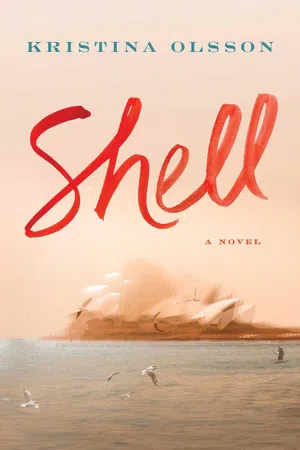
In this "luminous" ( The New York Times ) historical novel—perfect for fans of All the Light We Cannot See and The Flamethrowers —a Swedish glassmaker and a fiercely independent Australian journalist are thrown together amidst the turmoil of the 1960s and the dawning of a new modern era. 1965: As the United States becomes further embroiled in the Vietnam War, the ripple effects are far-reaching—even to the other side of the world. In Australia, a national military draft has been announced and Pearl Keogh, an ambitious newspaper reporter, has put her job in jeopardy to become involved in the anti-war movement. Desperate to locate her two runaway brothers before they're called to serve, Pearl is also hiding a secret shame—the guilt she feels for not doing more for her younger siblings after their mother's untimely death.Newly arrived from Sweden, Axel Lindquist is set to work as a sculptor on the besieged Sydney Opera House. After a childhood in Europe, where the shadow of WWII loomed large, he seeks to reinvent himself in this foreign landscape, and finds artistic inspiration—and salvation—in the monument to modernity that is being constructed on Sydney's Harbor. But as the nation hurtles towards yet another war, Jørn Utzon, the Opera House's controversial architect, is nowhere to be found—and Axel fears that the past he has tried to outrun may be catching up with him.As the seas of change swirl around them, Pearl and Axel's lives orbit each other and collide in this sweeping novel "that brings the cultural upheaval of 1960s Australia vividly to life, and readers who appreciate leisurely paced, thoughtful literary fiction will savor each word of this emotional story of two people—and a country—reckoning with their past and future" ( Booklist ).
Tools to learn more effectively

Saving Books

Saving Books

Keyword Search

Keyword Search

Annotating Text

Annotating Text

Listen to it instead

Listen to it instead

Information

Sydney, November 1960

The day the great man sang, heat blazed in haloes over Bennelong Point. This is what Pearl will remember, later, this is what she will say: that his voice turned the air holy. Men, sweat-slicked, stood with bowed heads or hung off scaffolds, swatting at flies and tears. Few looked at the singer; they needed all their senses to hear. Needed their whole bodies, skin and eyes and hearts, to absorb what they couldn’t say: that sacredness had returned to this place. It flowed through them on a single human voice, through their bodies and the building that was rising beneath their hands.
Pearl stood with the other journalists, and watched the men grow luminous. Wept as she understood: that it wasn’t just the building or the place Robeson had sanctified, but the labor. The valor of it. The modest hearts of workers. In his songs, in the faces of the men, was every story she had ever tried to write. This one too. She closed her eyes as the voice trailed away. Words formed and crumbled in her head, insubstantial. She gripped her notebook and forgot to write them down.

March 1965

She walked towards the quay in opalescent light. The city closed down, prosaic, the horizon grubby with clouds and promising nothing. It was like this sometimes: as if Sydney was within her, an idea she carried around, vaporous, unexamined. Until, on evenings like this, it revealed her to herself. She was hollowed out, impervious. As torpid as the streets.
Usually, the city was enough: a scoop of bridge as she rounded a corner, the harbor shattered by sunset. Her friends in the back bar of Lorenzo’s talking of protest, of marches, the poetics of action. She loved these nights, the conversation and argument, the taste of insurrection. They made her brave. From the Telegraph building to Hunter Street she would be optimistic, glad. The fight rising in her at the door of the bar, the defiance she was born to.
But tonight the air was precarious. All sandstone shadow, smudgy. She thought that time was like this too, a spongy edge, imprecise, as close and as far as memory. As her dead mother’s face. The world had turned her a year older in summer. In four years, she might die. Her mother had died at thirty-six; the calendar led Pearl towards it like a dirge badly played, like this vagrant shadow she moved through, that moved through her. As if she was porous, as if there was no substance to her at all.
She recognized it now. Fear, familiar as a friend, precise as a knife. Not of death, though for years it was what she expected: to suffer as her mother had. This might be worse, this prospect of slightness, of falling short. She’d felt its weight since she was fourteen—there would be two lives to live, the one she was given and the one her mother lost. As if loss could be recouped somehow, her family restored. As if she could save them.
Image
Her day had begun as they always did: with the smell of newsprint and the faces of boys. There, among bold headings and columns of type, they waited: serious, smiling, patient. She ignored them at first, skimming headlines and leads. Turned pages on the potential in their eyes. But each day one, at least, forced her hand. A frantic calculation: how old, what suburb? An ache in her, whatever the answer; her brothers were there, in every young man who passed in the street, stepped off the ferry, gazed out from a page of the Telegraph.
Today it was footballers. Preseason training, so they still looked coltish and soft, a bunch of local lads mucking around in the park. One reached for a pass with a thief’s intent; she’d leaned in until the photograph blurred, until the face was no longer Jamie’s as he swiped the milk money, or Will’s as he eyed the twins’ toast.
Six years. With each one, her fear grew: they wouldn’t know her. She wouldn’t know them. Boys changed, grew jawbones and beards. Their eyes: had they sharpened with their faces and their sorrows? Had the small soft bodies she’d helped feed and wash grown hard against the memory of her? Or would they still hold her shape in new muscles in their arms and their legs, in the hands they’d once placed against her cheek at bedtime: Sing to us, Pearlie? They’d been two and three when their mother died, adolescents when she’d seen them last. Now they were men. Or nearly. Who may not want to see her at all.
She stepped up her pace towards the harbor. That morning, as she closed the sports pages, her contact had called. The phone shrilling in the early quiet of the newsroom. Her heart flapped in her chest; it could only be one person, though he usually called at midday, when the newsroom rang with noise and adrenaline. But when she lifted the phone his voice was no different: soft, subterranean, as if it flowed over pebbles. There’s a bus at six thirty. One sentence, the call over before it began. She held the receiver hard against her ear. Sometimes he paused before he rang off, and in that gap she could see him, hunched at his desk, lips parted over what was unspoken. His pale bureaucrat’s face flushed with the euphoria of risk.
A current of anticipation bolted through her, but she lowered the receiver slowly. As if his breath was contained there, all he had to tell. What have you got? she wanted to say. Is it the date, the time? But back in its cradle the receiver was mute, the Bakelite dull and indifferent. So was the fashion feature unfinished in her typewriter. She glanced at its plain sentences, its tedious tone. Lifted her fingers to the keys. A cigarette burned down beside her.
Now she crossed Pitt Street in a pulse of office workers, the last of the light in her eyes. Turned up the hill to Macquarie Street for the pleasure of old buildings, the Mint, Sydney Hospital, Parliament. Then the library. Below her the new ribs of the opera house reached up, bleached bones against the paling sky. The building failed to lift her tonight; it looked like something broken, too difficult to fix. Perhaps, as some said, it would never be finished. Her father might be pleased; a monument to politicians, he’d said, peering at the sketches in the Herald years before. But Pearl had looked at the artists’ impressions and even then felt her heart shift. Look carefully, Da, she’d said quietly. Maybe it’s a monument to us. But like some in the newsroom—mating turtles, they laughed, a collapsed circus tent—he wouldn’t be swayed.
At the top of Bent Street she looked left and right. Sat at the bus stop until her man appeared, tie loosed, hands in pockets as arranged. A middle-aged public servant, his countenance dulled by routine. Expressionless. She stood then, and as he came up beside her she tilted her face to the sky. Even so she knew his lips barely moved as he spoke, pressing lightly over brief syllables. Melbourne, he said. Next Wednesday. Tenth of March.
He took out a handkerchief, wiped his face as if to clear some residue, a letter or noun that might betray him. Glanced at his wristwatch, then turned and walked away. Pearl watched him go. His suit ancient and loose, the pants shiny with wear. Chifley wore his suits until they were threadbare, her father once told her. People loved him for it, the old prime minister: his humility, his insistence on staying with them. Unlike the new one. In this way Patrick Keogh expressed his hatred for Menzies without having to say his name. It was like a code of honor, an act of resistance, this un-naming. So Pearl had learned her politics by inversion, always the positive rather than the negative, the heroic rather than the bastard. It gave her an optimism that couldn’t survive her childhood. In that moment at the bus stop, she hated Menzies more viciously than her father had.
A bus appeared on the other side of the road. It snorted and swallowed him, the man in Chifley’s suit. Pearl stood in the vacuum and watched the bus disappear. The date ticked dangerously in her head. Tenth of March. Just over a week. In eight days the first marbles would roll, the first ballot for conscripts for Vietnam. Menzies claimed otherwise, but they all knew: it was a lottery, a deadly one, and if you were twenty and had the right birthday, the right number on a marble, you’d win a free ride to the war.
Jamie was twenty. And might have the right birthday. And next year, so might Will.
Image
The harbor was a spill of darkening water. She sat on the grass at the end of the quay and watched the sky absorb its own color. Tried to catch the precise moment when daylight switched off. An old challenge, and she never won; tonight she turned her gaze from a lumbering ferry to find the city already faded, shrinking into shadow. When she thought of her brothers this was just as she saw them, their shapes retreating, faded to gray. Their faces refusing to be fixed.
At seven she pushed herself up and walked to a phone box on George Street. Dialed a number inked onto her hand. Ray. Her closest ally in the group. An hour later, in the dim light of the back bar, she listened to him announce the ballot date as if the leak was his own, as if he’d conjured it, as if he’d worked the contact himself. A seam of quiet triumph in his speech. It had to be like this, she knew, to protect her and the contact, but she hated Ray for whole minutes, for the fidelity of his voice, the conviction in his eyes, how plausible he was. She looked to the ceiling, sickly yellow with smoke, and then to the floor. Closed her eyes against what would follow: the murmurs and barks of outrage, the calls for placards and protests. It felt suddenly predictable. Empty.
Voices rose and fell. Disembodied, they took on a menacing quality, as if they’d emerged from the rough darkness she’d walked through, the grubby streets. A dog’s warning growl, a tubercular cough. Then Brian’s unmistakable snarl: For fuck’s sake, what did you all think? That they’d cancel because we didn’t like it? She opened her eyes, turned to look in his direction, watched him lunge at a beer jug and refill his glass. We all knew it was coming, he said, accusing the room. Now it has.
The air fell momentarily still. Then, as if at some signal, it became fraught, the voices charged with adrenaline. Usually, Pearl’s voice would be with them; instead she glanced to the door, longing to leave. She could not feel what they felt: the charge of energy beneath the anger, the excitement. It was paradoxical and familiar—they would all say the draft was criminal, a bastard act, but in truth the news enlivened them, validated them. She’d felt something similar in the newsroom when reports of a disaster broke. A crackling intensity, almost erotic in its heat and rush. And a collective sense of purpose, of responsibility: to translate a world confirmed again as incoherent, random, impersonal.
She inched sideways, dipping her head, making herself small. Tonight nothing felt impersonal or random. For Pearl, the news had assumed human faces: Jamie’s, Will’s. Standing there, she’d realized. That’s what they wanted, everyone here: the human faces of conscription. If her comrades learned about her brothers, knew their names, they’d fall upon them as surely as a journalist would. The movement needed emblems. Examples. Real men, not numbers; flesh and blood.
But they didn’t know about them. And wouldn’t. The decision hardened in her: Jamie and Will would not be used. She was surprised by the strength of her own conviction. No one would know, not here, not at work. She had a sudden image of Henry at the news desk. Sleeves pushed up, eyes narrowed to a looming deadline. She would not tell him about the boys, and she would not give him the leaked ballot date. The decision sat heavy in her stomach, but there were old scores to settle. She looked away to the back wall now, as if her thoughts were traitorous and might be visible, might be read.
The temperature in the room had turned feverish. Plans were made, tasks allocated. She had to leave before her face or her silence betrayed her. She skirted the discussions and made for the door. As she reached the back hallway a voice followed her, male, drunk: Another leak, Lois Lane. A cough or a laugh, she wasn’t sure. Baby, you keep screwing Superman.
She was almost ready for him. Without turning she said calmly: Keep screwing yourself. But the coward was gone.
Image
She stood at the rail of the ferry, pulled her hair into a band against the wind. Gulls shrieked in their wake: too late, too late. To one side of her a young man pressed a transistor to his ear and a woman slipped a foot from her shoe. Brian’s words rang in her head: What did you all think? That they’d cancel because we didn’t like it? Yes, she’d wanted to say. Yes. A part of me thought it couldn’t happen. But the gulls kept crying the truth: she’d known for months that it would, they’d all known. In the years since her mother’s death she’d found a mechanism for forgetting, a lever that turned her blood cool. She felt it in her body: it switched one Pearl off and another on, a girl without history or conscience. A girl unencumbered, trying life on for size. But in three words, tenth of March, her history had spoken back.
Darkness thickened as they passed Bennelong Point. In starlight the new structure was a strange oceanic creature mantling the land. Each head turned to it, a gravitational pull. God help us, said the man next to her. But now Pearl could see how its new curves pulled at the water. She’d heard the first thing Utzon had done, before he thought about design, before he began to d...

Table of contents

  1. Cover
  2. Dedication
  3. Epigraph
  4. Chapter 1: Sydney, November 1960
  5. Chapter 2: March 1965
  6. Chapter 3: May 1965
  7. Chapter 4: Winter 1965
  8. Chapter 5: July 1965
  9. Chapter 6: August 1965
  10. Chapter 7: Spring 1965
  11. Chapter 8: Summer, January 1966
  12. Chapter 9: February 1966
  13. Author’s Note
  14. Acknowledgments
  15. Reading Group Guide
  16. About the Author
  17. Copyright

Frequently asked questions

Yes, you can cancel anytime from the Subscription tab in your account settings on the Perlego website. Your subscription will stay active until the end of your current billing period. Learn how to cancel your subscription
No, books cannot be downloaded as external files, such as PDFs, for use outside of Perlego. However, you can download books within the Perlego app for offline reading on mobile or tablet. Learn how to download books offline
Perlego offers two plans: Essential and Complete
  • Essential is ideal for learners and professionals who enjoy exploring a wide range of subjects. Access the Essential Library with 800,000+ trusted titles and best-sellers across business, personal growth, and the humanities. Includes unlimited reading time and Standard Read Aloud voice.
  • Complete: Perfect for advanced learners and researchers needing full, unrestricted access. Unlock 1.4M+ books across hundreds of subjects, including academic and specialized titles. The Complete Plan also includes advanced features like Premium Read Aloud and Research Assistant.
Both plans are available with monthly, semester, or annual billing cycles.
We are an online textbook subscription service, where you can get access to an entire online library for less than the price of a single book per month. With over 1 million books across 990+ topics, we’ve got you covered! Learn about our mission
Look out for the read-aloud symbol on your next book to see if you can listen to it. The read-aloud tool reads text aloud for you, highlighting the text as it is being read. You can pause it, speed it up and slow it down. Learn more about Read Aloud
Yes! You can use the Perlego app on both iOS and Android devices to read anytime, anywhere — even offline. Perfect for commutes or when you’re on the go.
Please note we cannot support devices running on iOS 13 and Android 7 or earlier. Learn more about using the app
Yes, you can access Shell by Kristina Olsson in PDF and/or ePUB format, as well as other popular books in Literature & Literature General. We have over one million books available in our catalogue for you to explore.