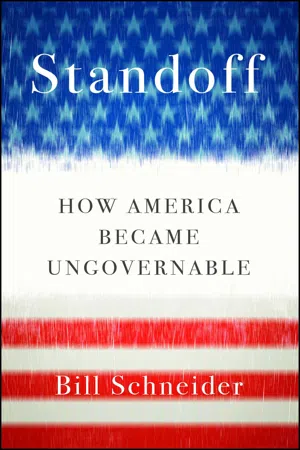
Standoff
eBook - ePub

Standoff

How America Became Ungovernable

  1. 336 pages
  2. English
  3. ePUB (mobile friendly)
  4. Available on iOS & Android
eBook - ePub

Standoff

How America Became Ungovernable

About this book

Bill Schneider, former CNN senior political analyst, takes us inside the voting booth in “a detailed examination of recent presidential elections studded with sharp observations…A good choice for political junkies” (Kirkus Reviews).

In the 1960s, a rift developed between the Old America and the New America that resulted in a populist backlash that ultimately elected Donald Trump in 2016. Bill Schneider describes today’s American populism in Standoff as one that is economically progressive and culturally conservative. Liberals are attacked as cultural elitists (“limousine liberals”), and conservatives as economic elitists (“country club conservatives”). Trump, says Schneider, is the complete populist package. He embraces social populism (anti-immigrant), economic populism (anti-free trade), and isolationism (“America First”).

Standoff examines a number of hard-fought elections to show us how we got to Trump. He asserts the power of public opinion. He points to the public that draws the line on abortion and affirmative action. He shows why an intense minority cancels a majority on gun control, immigration, small government, and international interests. Standoff tells us why fifty years of presidential contests have often been confounding. It takes us inside to watch how and why Americans pull the lever, how they choose their issues, and select their leaders. It is usually values that trump economics.

Required reading for an understanding of the 2016 election and the political future, Schneider’s “fast-paced” (Publishers Weekly) Standoff shows how Americans vote and why their votes sometimes seem to make no practical sense.
Frequently asked questions

Yes, you can cancel anytime from the Subscription tab in your account settings on the Perlego website. Your subscription will stay active until the end of your current billing period. Learn how to cancel your subscription.
No, books cannot be downloaded as external files, such as PDFs, for use outside of Perlego. However, you can download books within the Perlego app for offline reading on mobile or tablet. Learn more here.
Perlego offers two plans: Essential and Complete
  • Essential is ideal for learners and professionals who enjoy exploring a wide range of subjects. Access the Essential Library with 800,000+ trusted titles and best-sellers across business, personal growth, and the humanities. Includes unlimited reading time and Standard Read Aloud voice.
  • Complete: Perfect for advanced learners and researchers needing full, unrestricted access. Unlock 1.4M+ books across hundreds of subjects, including academic and specialized titles. The Complete Plan also includes advanced features like Premium Read Aloud and Research Assistant.
Both plans are available with monthly, semester, or annual billing cycles.
We are an online textbook subscription service, where you can get access to an entire online library for less than the price of a single book per month. With over 1 million books across 1000+ topics, we’ve got you covered! Learn more here.
Look out for the read-aloud symbol on your next book to see if you can listen to it. The read-aloud tool reads text aloud for you, highlighting the text as it is being read. You can pause it, speed it up and slow it down. Learn more here.
Yes! You can use the Perlego app on both iOS or Android devices to read anytime, anywhere — even offline. Perfect for commutes or when you’re on the go.
Please note we cannot support devices running on iOS 13 and Android 7 or earlier. Learn more about using the app.
Yes, you can access Standoff by Bill Schneider in PDF and/or ePUB format, as well as other popular books in Politics & International Relations & North American History. We have over one million books available in our catalogue for you to explore.

ONE

Old America Versus New America

On November 8, 2016, American voters did an astonishing thing. They elected a president of the United States who most voters—61 percent!—did not think was qualified to serve as president. How did that happen? How did we get from John F. Kennedy to Donald J. Trump?
A little more than fifty years ago, the United States started on a great political journey—in two opposite directions, part of the country to the right and part to the left. This is the story of where we are now and how we got here. It’s the story of the country’s journey and my own personal journey as I covered it.
It’s the story of two political movements that first emerged in the 1960s. The New America is the progressive coalition of groups whose political consciousness was stirred in that decade: African Americans, young people, working women, gays, immigrants, educated professionals, and the nonreligious. What holds the coalition together is a commitment to diversity and inclusion. That commitment provoked a fierce backlash in 2016.
In fact, a conservative backlash has defied the New America for more than fifty years. The backlash came from the Old America—mostly white, mostly male, mostly older, mostly conservative, mostly religious, and mostly nonurban. In 2016 the Old America rallied to the theme “Make America Great Again.” It was a call to restore the America they feared was being swept away by a tide of political correctness.
The two movements collided under President Barack Obama. Within weeks of Obama’s inauguration on January 20, 2009, a right-wing opposition movement broke out in the form of the Tea Party. Republicans rode that anger to power in Congress, gaining control of the House of Representatives in 2010 and the Senate in 2014. Within one day of Trump’s inauguration, a backlash broke out on the left with a massive spontaneous Women’s March on Washington that drew throngs of supporters in cities across the United States. Using the Tea Party as a model, Democrats hope to ride anger on the left to power.
The right and the left started their journeys at the same place: 38 percent. That’s the vote that Barry Goldwater got in 1964 and George McGovern got in 1972. The Republican presidential vote peaked with Richard Nixon in 1972 (61 percent) and Ronald Reagan in 1984 (59 percent). The Democratic presidential vote rose to a bare majority with Jimmy Carter in 1976 (50.1 percent) and then took thirty-two years to reach a majority again. Whereupon a new backlash quickly set in on the right. As of 2017, the Democratic Party had less clout in national and state governments than at any time since 1928.
Things started out pretty bad for Democrats. In 1972 a Democratic operative recounted the story of how George McGovern’s campaign manager had called a Democratic congressional candidate in Ohio.
“I have wonderful news for you,” the campaign manager said. “Senator McGovern is coming to campaign in your district.”
“That is good news,” the local candidate responded. “But I’m afraid I’m going to be in Florida, visiting my mother.”
“Wait a minute,” McGovern’s campaign manager said. “I haven’t told you when he’s coming.”
“It doesn’t matter,” the Democratic candidate replied. “Whenever he shows up, I’ll be in Florida visiting my mother.”
Democrats were forced to accommodate to the conservative ascendancy. Bill Clinton, who fashioned himself a “New Democrat” and a proponent of “the third way,” got elected in 1992 with 43 percent of the vote. The presidential vote was split three ways that year, with Independent Ross Perot getting 19 percent. Clinton’s coattails were unimpressive. Democrats lost seats in the House of Representatives in 1992. It was the first election following a census and redistricting. Redistricting always puts incumbents—mostly Democrats in 1992—at a disadvantage because they are forced to compete in an unfamiliar electorate.
The contours of Clinton’s 1992 victory were different from anything Democrats had won with before. Democrats may have nominated two southern white Baptists for president and vice president in 1992, but the Clinton–Al Gore ticket fared worst in the South. It was the only region of the country where George H. W. Bush led Clinton (by 2 points). Among whites born in the South—the base of the pre-1960s Democratic coalition—Bush ran 19 points ahead of Clinton.
Clinton’s vote—weakest in the South, strongest on the East and West Coasts—did not look like the Democratic votes that had elected Franklin Roosevelt and John Kennedy and Jimmy Carter. It resembled the votes the Democrats got when they nominated liberals such as George McGovern in 1972 and Michael Dukakis in 1988. That’s why 1992 was a breakthrough for Democrats: it was the first time they won with a vote that looked like the New America. But it was still not a majority.
Clinton narrowly missed a majority when he was reelected in 1996 with 49 percent. (Perot was on the ballot again.) Al Gore carried the popular vote in 2000, but it was not quite a majority (48 percent). John Kerry in 2004? Same thing: 48 percent and no victory. The breakthrough finally came in 2008 when Barack Obama won with a solid majority (53 percent), the highest percentage for a Democratic presidential candidate since Lyndon Johnson.
Even so, you could argue that the 2008 Democratic vote was inflated by the worst financial crisis since the Great Depression. What if there were no crisis? That’s why Obama’s reelection in 2012 came as such a shock. Obama was reelected with a majority (51 percent) despite a sluggish economic recovery. The New America came out to protect its president. And to prove that its coming to power was not a fluke.
However, 2016 was an even bigger shock because Trump’s primary and general election victories were unexpected. First, he staged a hostile takeover of the Republican Party. The 2016 Republican primaries were expected to be a showdown between the party establishment (former Florida governor Jeb Bush) and Tea Party conservatives (Texas senator Ted Cruz). Trump beat them both. He did it by activating a populist following of working-class white voters who had been trending Republican since Richard Nixon but had never won control of the party.
Trump rallied his supporters with crude populism: anger at the political establishment and opposition to the global elite. The Trump movement and the conservative movement formed an alliance. Trump used conservatives to legitimize his rise to power. Conservatives wanted Trump in the White House to sign whatever legislation the Republican Congress passed (and keep his mouth shut, which he refused to do).
The Trump movement is the latest manifestation of resistance by the Old America. The gradual and halting rise of the New America faced resistance every step of the way. Two years after Bill Clinton was elected in 1992, Democrats lost their majority in the House of Representatives for the first time in forty years. Resistance sprang up in the 1995 government shutdown. A violent antigovernment backlash materialized in resistance to a search and arrest warrant by a religious sect in Waco, Texas, in 1993 and in the bombing of a federal building in Oklahoma City in 1995. The Clinton impeachment was an attempt to delegitimize the first president who embraced the liberal values of the 1960s.
The recount of Florida’s votes in the 2000 presidential election between Governor George W. Bush and Vice President Al Gore is still seen by many Americans as a plot to steal the election by reversing the will of the voters. In 2009 President Obama faced a Tea Party rebellion within weeks of taking office. Obama also had to contend with a concerted effort to delegitimize him by challenging his birth, his religion, and his Americanism. The resistance showed no signs of slowing down after Obama was reelected. The most direct challenge to the New America came in 2016. Donald Trump’s resistance movement spurned diversity and inclusion as “political correctness.”
The conservative movement remains dug in largely as a result of de facto political segregation. In many red states and districts, Democrats are noncompetitive, and Trump supporters are a significant force in Republican primaries.
It’s a standoff. Democrats try to reassure themselves that demographic trends are in their favor. The percentage of working-class whites is declining, while the country is seeing growing numbers of minorities, young people, working women, highly educated Americans, and people without a religious affiliation.
But there’s a downside for Democrats. Demographics is long, politics is short. In 2016 politics clearly favored Republicans. So what happened? A Democratic resistance movement sprang up for the purpose of doing to President Trump the same thing the Tea Party did to President Obama: oppose everything the president tried to do. The result has become the new normal in the United States: gridlock and dysfunctional government.

Gridlock and Public Opinion

The potential for gridlock is built into the US constitution. The Founders set up a complex and ungainly system with two houses of Congress, three branches of government, and competing centers of power in the federal government and the states. The idea was to limit power. The result is a constitutional system that works exactly as intended. Which is to say, it doesn’t work very well at all. As president after president has discovered, there are many ways opponents can stop measures from getting passed, even if the president’s party holds a majority in Congress.
Today the New America has an advantage, though not a “lock,” in presidential elections. Democrats carried the popular vote in six out of the last seven presidential elections (1992 to 2016, except for 2004). In two of those elections, 2000 and 2016, Republicans won the electoral vote because the Democratic vote was heavily concentrated in a few large states (California, New York, Illinois).
The Old America has the advantage in congressional elections. In the House of Representatives, Democrats have been the victims of gerrymandering—the drawing of district boundaries to benefit the Republican Party—as well as a “density” problem: too many Democratic votes concentrated in Democratic congressional districts. The Constitution guarantees two senators from every state, and there are a lot of small Republican states such as Idaho and Wyoming. California, with two Democratic senators, has sixty-seven times as many people as Wyoming, which has two Republican senators.
The Old America also has the advantage in elections for state governments. After the 2016 election, Republicans had total control of twenty-five state governments and Democrats only six. The Republican heartland is now the South and the interior West. Democrats dominate the Northeast and the West Coast.
So here we are: two political parties, entrenched in different institutions, at different levels of government, and in different places. The separation of powers has given rise to fortified bunkers. And gridlock.
In the British parliamentary system, gridlock is unconstitutional. A core principle of the British constitution is “Her majesty’s government must be carried on.” If the government is gridlocked and cannot act, the government falls, and new elections are held until the people elect a government that can govern decisively.
The United States has no queen. There is no constitutional necessity for the government to act decisively. Framers of the US Constitution had just waged a revolution against a king. To them, strong government meant despotism.
American government is set up to fail. The wonder is that it actually does work. It works when there is a crisis—when an overwhelming sense of urgency breaks through blockages and lubricates the system. Under the right conditions, barriers fall away, and things get done, sometimes with amazing speed and efficiency. That’s where public opinion comes in.
The framers of the Constitution did everything they could to insulate government from public opinion with devices such as the electoral college, lifetime tenure for federal judges, and, until 1913, indirect election of senators. But public opinion has come to play a crucial role never envisioned by the Constitution. It can break gridlock and make government work. What’s required is that overwhelming sense of urgency—the public’s demand that the government do something, anything, to solve a pressing problem.
Politicians are always hyping issues to try to turn them into crises: an environmental crisis, an energy crisis, an education crisis, a moral crisis. Or they declare “wars” on things: a war on poverty, a war on crime, a war on inflation, a war on drugs, a war on terror. (Senator Daniel Patrick Moynihan of New York once said sardonically, “We declared war on poverty, and poverty won.”) Without a crisis or war to rally public opinion, the system doesn’t work at all. It was not designed to.
When Barack Obama took office in the midst of a financial disaster, his chief of staff, Rahm Emanuel, remarked, “You never want a serious crisis to go to waste. And what I mean by that is an opportunity to do things you think you could not do before.”1 Emanuel got a lot of criticism for saying that. It sounded as if he were trying to exploit the nation’s troubles. But he was right.
What distinguishes a real crisis from a phony crisis? Public urgency. If the public urgency is not real, opponents won’t have much trouble blocking government action—as they did repeatedly on measures to combat climate change, a long-term threat but not an immediate crisis for most Americans.
We’ve had plenty of real crises: the launching of Sputnik by the Soviet Union in 1957; civil rights in the 1960s; ten years of war in Vietnam, the Watergate scandal, a tax revolt, inflation, and energy shortages in the 1970s; a wave of violent crime in the 1980s; recession in the early 1990s; 9/11 in 2001, the war in Iraq, the 2008 financial crisis. They all resulted in decisive breakthroughs in public policy: the National Defense Education Act in 1958, the Civil Rights Act, campaign finance reform, the War Powers Act, tax reform, energy efficiency standards, the Patriot Act, a ban on torture by the US military, the economic stimulus plan. What happens if the sense of urgency isn’t real? Then the system of limited government locks into place. Nothing much gets done. We get gridlock. It’s in the Constitution.
The default setting in the United States is limited government.2 Almost every state has some sort of balanced-budget requirement. Franklin Roosevelt and Barack Obama, each of whom presided over huge expansions of federal spending, both proclaimed their commitment to deficit reduction.
So why do we have such high levels of government spending? Because Americans are pragmatists. Pragmatists believe that whatever works is right. Ideologues believe that if something is wrong, it can’t possibly work—even if it does work. That’s how Republicans always felt about the Affordable Care Act: it could never work because it was wrong, even if there was evidence that it was working (by shrinking the number of uninsured Americans by 20 million).
President Trump represents an extreme version of pragmatism. Conservatives have long distrusted him because he has never shown much interest in ideology. With Trump, it’s not about right and wrong, it’s about winning and losing. If you are a winner, then everything you say must be right.
Americans may not believe in big government, but they are willing to support government spending if it solves a problem. Progressives have to rely on pragmatism, not ideology, to make the case for their agenda. President Obama’s economic program got into trouble in 2010 because the recovery was weak and fitful. People did not believe stimulus spending was working, so it was difficult to make the case for more spending. The public fell back to its default position: limited government.

Showdowns

The 2012 and 2016 campaigns were showdowns between the Old America and the New America. The Old America’s rallying cry at the 2012 Republican National Convention in Tampa was “Restore Our Future.” Take us back to the days when America was rich, great, and powerful—the undisputed leader of the world. Mitt Romney declared, “You might have asked yourself if these last years are really the America we want; the America won for us by the Greatest Generation.” That same sentiment was appropriated by Trump in 2016: “Make America Great Again!” The Hollywood celebrity who spoke at the 2012 Republican convention was Clint Eastwood, age eighty-two.
The New America’s rallying cry at the 2012 Democratic Convention in Charlotte, North Carolina, was “Forward, Not Back.” President Obama declared, “When Governor Romney finally had a chance to reveal the secret sauce, he did not offer a single new idea. It was just retreads of the same old policies we’ve been hearing for decades.”
The New America celebrates diversity in age, race, sexual orientation, and lifestyles. (The Old America doesn’t have lifestyles; they have lives.) The Hollywood celebrity who spoke at the 2012 Democratic Convention was twenty-seven-year-old Scarlett Johansson.
After nearly fifty years, the two Americas have fought each other to a standoff. A college student of mine once asked me, “Is this the most divided we have ever been as a country?” I reminded him, “We did, once, have a Civil War. Three-quarters of a million Americans died in that war.” But I acknowledged that this was probably the most divided the country had been since that terrible time. We will see evidence for that argument in chapter 3.

Knowing the Times

You can’t talk about public opinion for long without using the wor...

Table of contents

  1. Cover
  2. Dedication
  3. 1. Old America Versus New America
  4. 2. Populism
  5. 3. Polarization
  6. 4. Political Separation
  7. 5. The Great Reversal
  8. 6. The Intensity Factor
  9. 7. The Power of Definition
  10. 8. The Burden of Indispensability
  11. 9. Successful Challenges
  12. 10. Failed Challenges
  13. 11. 2016: Populist Backlash
  14. Acknowledgments
  15. About the Author
  16. Notes
  17. Index
  18. Copyright