eBook - ePub
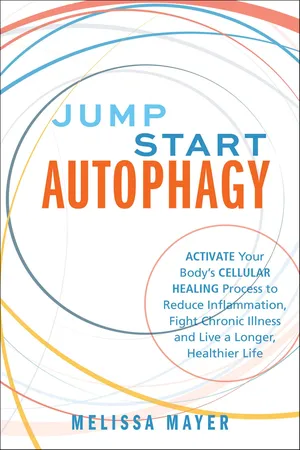
Jump Start Autophagy
Activate Your Body's Cellular Healing Process to Reduce Inflammation, Fight Chronic Illness and Live a Longer, Healthier Life
- 224 pages
- English
- ePUB (mobile friendly)
- Available on iOS & Android
eBook - ePub
Jump Start Autophagy
Activate Your Body's Cellular Healing Process to Reduce Inflammation, Fight Chronic Illness and Live a Longer, Healthier Life
About this book
Harness your body's natural cell-rejuvenating process for amazing health benefitsTo maintain good health, it is vital that your body's natural detoxing process of cleaning out damaged cells and regenerating new ones, known as autophagy, is working well. Dysfunctional cellular processes can cause all kinds of serious issues, from premature aging to cancer. On the other hand, a healthy autophagy process can reduce inflammation, prevent skin issues, boost metabolism, and even heal autoimmune issues.Jump Start Autophagy will give you all the tools you need to hack your cells for a longer, healthier life. The book will walk you through the science of autophagy, how it works, and why our bodies need it. It will break down the different ways our bodies are signaled to kick start autophagy; and, best of all, show you concrete examples, activities, and methods to push your own body into autophagy to achieve healthier skin, boost your metabolism, heal inflammation, and so much more.
Trusted by 375,005 students
Access to over 1.5 million titles for a fair monthly price.
Study more efficiently using our study tools.
Information
Topic
MedicineSubtopic
Nutrition, Dietics & BariatricsPART I
WHAT IS AUTOPHAGY?
CHAPTER 1
HOW AUTOPHAGY WORKS
Time Machine to Elementary Biology
You probably remember the fallout even decades later. You knew your science fair project was coming up but just couldn’t deal, so you ignored it until an adult in charge, horrified by your life choices, discovered the assignment scrap in the bottom of your backpack…the day before it was due. The stress level surged, and your reasonable options were few, thanks to the now-impossible deadline. The only viable choice was the old standby: a cell model.
Maybe you sat up all night forming organelles out of clay and pressing them into a cytoplasm shell, topped off with handmade labels on toothpicks (bam, done). Perhaps you were more daring (or had a more creative parent) and suspended fruits or candies in gelatin for a science-meets-snack project. (Side note: Please, for the love of all that is holy, don’t send one of these to school for your own kids. It attracts ants. And somebody is going to stick their finger in it, setting off a drama spiral that makes everybody late for recess. Signed, a former science teacher.)
Regardless of your medium, you probably still remember the big, important organelles (looking at you, nucleus, over there hogging all the cell biology glory). But you might not remember much about the rather boring-appearing, roundish blob you stuck near the cell membrane: the lysosome. Yet this relatively neglected organelle plays a powerful role in one of your body’s most important processes: autophagy.
What Even Is a Lysosome?
Lysosomes are round organelles enclosed by membranes. This membrane is an important barrier between the lysosome and the cytoplasm (the thick solution that fills each cell), since the interior of the lysosome is super acidic, which is a handy way to be if your job is taking things apart. These are your body’s recycling centers, and they are chock-full of hydrolytic enzymes, which use water to break things down.
All the stuff your cells don’t want hanging around—misfolded or malfunctioning proteins, old organelles or biomolecules, even bits of viruses or bacteria that might make you sick—get a direct ticket to the lysosome. Literally. Running through the cell’s cytoplasm, a matrix of protein fibers called the cytoskeleton gives the cell its shape and organization. Some fibers act as tethers, anchoring organelles in place. Other fibers, called microtubules, form tracks around the cell. Cell transporters use these tracks to carry rejected cargo from other parts of the cell right to the lysosome’s door.
Once there, the lysosome’s enzymes break down the unwanted cell components. Some parts are reused to build new cell components, which conserves the cell’s energy since spare parts are free. Some cargo is broken down even further and burned for energy. And some cargo is just tossed in the trash pile and destroyed, or taken to the cell membrane and pushed out of the cell.
Enter Autophagy
Of course, all that unwanted stuff doesn’t just hop on the train and head to the lysosome on its own. A tightly regulated (and pretty universal among organisms—thanks, evolution!) cell process called the autophagy lysosomal pathway handles that. This is a stress response, so while baseline-level autophagy happens all the time in your cells, stress caused by dwindling nutrients or oxygen sends out signals (code red! starving!) that kick it into high gear.
The cell responds to the stress signal by building a double-membrane bubble—called a vesicle or autophagosome, if you’re fancy—ready to load up and transport unwanted cargo. The vesicle transporter engulfs that cargo—either unselectively because it just happens to be in the neighborhood or selectively seeking it out by mechanisms still under review—like a hungry blob and moves it into the cytoplasm using those microtubule tracks. Eventually, the vesicle fuses with the lysosome, where the cargo is unloaded, stripped for parts, and degraded.
Autophagy (as in the ancient Greek terms auto + phagy) literally means “self-devouring” because, when viewed through a microscope, it appears that the vesicle transporter swallows the unwanted cell contents.
Why Autophagy Matters
As you age, unwanted material—especially those misfolded or otherwise malfunctioning proteins—accumulates in your cells and eventually causes disease. This is because the precise way a protein folds into a three-dimensional shape—its conformation—enables that protein to do its specific job. This is especially true for enzymes, a class of proteins that make the chemical reactions that keep you alive (like metabolism) work. These proteins connect with their target molecules like a lock fitting with a key. Misfolded proteins are terrible locks; the keys just won’t fit.
The way a protein folds is determined much earlier in the process. To build a protein, the cell receives instructions from the nucleus so it can “translate” a string of base pairs copied from the DNA into a chain of amino acids, which will eventually fold into a functional protein. A change to even one amino acid—say, leaving one out or substituting it for another—can wreck a protein, rendering it nonfunctional and even directly causing diseases like cystic fibrosis or sickle cell anemia.
Those misfolded proteins cause problems over time, too. They can build up in your cells, forming the tangles or toxic clumps seen in neurodegenerative conditions, such as Alzheimer’s disease, Creutzfeldt-Jakob disease, Parkinson’s disease, and type 2 diabetes.
To understand the sort of function autophagy performs, consider the current theory on Alzheimer’s disease. One of the primary features of the devastating neurodegenerative illness is neurofibrillary tangles of tau proteins in the brain cells. These proteins normally act like support beams for the nerve cells, giving them structure and helping them perform their jobs. However, abnormal or damaged tau proteins can’t function properly and instead collapse into tangles. The precise mechanisms behind these tangles is still unclear; in fact, scientists very recently proposed a new mathematical model for how these clumps form and even spread among brain cells.3
Your cells don’t just sit back and allow misfolded (or otherwise problematic) proteins to stack up. Most of these proteins, as well as other unwanted cellular matter, are tagged for destruction and routed through the cell’s recycling machinery. This is autophagy, crucial for prolonging your health span and enabling you to age successfully.
Genes, Genes, Genes
The human genome contains somewhere between 20,000 and 25,000 genes, which are the basic unit of heredity.4 Those genes are segments of paired nitrogen base molecules (plus a sugar and a phosphate) whose sequence codes for specific proteins, like a DNA recipe. Some genes are small, consisting of a couple hundred DNA bases, and some are ginormous at over 2 million bases. Each nucleus-containing cell in your body holds a full copy of your genome (which varies from the genomes of other humans by less than 1 percent!). If you were to place all that DNA end to end and stretch it out, it would cover the diameter of the sun…twice. Yet it fits inside your body, inside the nucleus of your cells, thanks to its super-twisted helical structure and the fact that it condenses into chromosomes.
Many of your genes serve as blueprints that tell your body how to build specific proteins. Other than water, proteins are the most abundant thing in your body, and they play a wide range of roles to keep you alive and functioning. Researchers have uncovered approximately a gazillion genes and proteins (okay, not really, but a whole freaking lot) involved in autophagy across all research species. When it comes to humans, the HUGO Gene Nomenclature Committee currently lists 33 autophagy-related genes (ATGs).5 The Human Autophagy Database (HADb), which is a public cache trying to keep up with the burgeoning literature, lists 232 genes that play direct or indirect roles in the autophagy lysosomal pathway.6
Keeping It All in Balance
One of the central themes in cell biology is that organisms need to maintain homeostasis; that is, a stable, life-sustaining internal landscape built by constant tweaks and adjustments to keep it just right for survival. In a word, balance.
A straightforward example of homeostasis is your comfy normal body temperature of 98.2°F. This average temp isn’t really real; it varies based on lots of factors, including your age, the flux of your hormones, the time of day—and even things like your sex assignment and race. In fact, your actual “normal” temperature is more like a fingerprint, which means your threshold for fever is not the same as your partner’s or best friend’s.
Still, whatever your normal is, your body works hard to stay there. Sensors that make up your central nervous system continuously gather temperature data and send it to your hypothalamus, a pebble-sized area near the base of your brain. The hypothalamus uses that data to regulate your body temperature by kicking up sweat production and widening your blood vessels if you are too warm, causing you to shiver and altering your metabolism, and constricting those blood vessels when you get too cold. The whole shebang is meant to keep you at just the right temperature, no matter what goes on around you (or inside you).
The opposite of homeostasis is dysregulation, or being out of balance. When your body temperature becomes dysregulated, it can rise high enough to cause brain damage or kill you, or drop so low you develop hypothermia or can’t fight off fungal infections (that last bit is the reason mammals edged out other vertebrates after the dinosaurs were wiped out—the warm-blooded body temperature system was one advantage against fungal infection in an environment marked by a changing climate and fungus blooms).
When it comes to your autophagy lysosomal pathway, the recurring motif is also balance. Your genes and signaling pathways (especially those called PKA, AMPK, and mTOR) work together to regulate autophagy such that it turns on precisely when it should. What’s more, the whole point of autophagy is to maintain cellular homeostasis, or a steady state in your cells. When this falls apart, the resulting imbalance can lead to things like cancer and neurodegeneration. Dysregulated autophagy leads to disease, plain and (not so) simple.
3 Carol J. Huseby et al. “The Role of Annealing and Fragmentation in Human Tau Aggregation Dynamics,” Journal of Biological Chemistry 294, no. 13 (2019): 4728–37. https://doi.org/10.1074/jbc.RA118.006943.
4 National Institutes of Health, Genetics Home Reference. “What Is a Gene?” US Department of Health and Human Services, May 14, 2019. https://ghr.nlm.nih.gov/primer/basics/gene.
5 HUGO Gene Nomenclature Committee. “Autophagy-Related Gene Group.” https://www.genenames.org/data/genegroup/#!/group/1022.
6 Guy Berchem and the Laboratory of Experimental Cancer Research. Human Autophagy Database. Luxembourg Institute of Health. http://www.autophagy.lu/index.html.
CHAPTER 2
A QUICK AND DIRTY HISTORY
Once Upon a Time in Japan
When Yoshinori Ohsumi recounted his childhood for his Nobel Prize biographical sketch, he described endless days tramping through hills and paddies, combing streams and the sea for insects and plants to add to his collections, and poring over science books carefully curated by his elder brother, who was away at college. The image he painted feels idyllic—almost mystical—to a reader scrolling through the story of a bucolic boyhood against the backlit glow of an iPhone. The note of curiosity and exploration he describes of his early days would follow Ohsumi throughout his schooling and career, guiding his choices and leading his discoveries.
So, too, would the harsher specters of his youth. Ohsumi was born in Japan at the tail end of World War II, a time when the entire country was gripped by poverty and food scarcity. The son of an academic, Ohsumi recalls himself as a weak child, sickly with malnourishment. And he wasn’t the only sick person in his family. His mother, Shina, contracted tuberculosis after his birth and spent nearly a decade bed- and pain-ridden.
And this image—of a naturally curious young boy watching his mother suffer in a plaster cast, the bones of her spine disintegrating from spinal caries—grabs the spotlight in the researcher’s biographical statement. Fortunately for the Ohsumi family, a care package from scientist friends in Hawaii changed the trajectory of Shina’s life—and her son’s. Inside that package lay a cutting-edge treatment, a cure for the disease that had robbed Ohsumi’s mother of her health and a young boy of his mother. That cure? Antibiotics.
A Curious Discovery
The curiosity that marked Ohsumi’s childhood pulled him toward the emerging scientific fields of cell biology and molecular biology, and guided his choices as a young researcher. During his postgraduate studies, Ohsumi noticed a peculiar layer of white matter in the centrifuge tubes he was processing. Intrigued by what this could be and otherwise unimpressed with the results of the actual research he was performing, Ohsumi glanced at the white stuff under the microscope and saw highly purified vacuoles.
These organelles were considered nothing more than trash compartments and were uninteresting to other researchers at the time, but the sight stuck with Ohsumi. He began a pet project exploring the vacuole membrane, which he says his colleagues pro...
Table of contents
- Cover
- Title Page
- Copyright
- Dedication
- Contents
- Introduction
- Part I: What Is Autophagy?
- Part II: Why Autophagy Matters
- Part III: Jump Start
- References
- Conversions
- Acknowledgments
- About the Author
Frequently asked questions
Yes, you can cancel anytime from the Subscription tab in your account settings on the Perlego website. Your subscription will stay active until the end of your current billing period. Learn how to cancel your subscription
No, books cannot be downloaded as external files, such as PDFs, for use outside of Perlego. However, you can download books within the Perlego app for offline reading on mobile or tablet. Learn how to download books offline
Perlego offers two plans: Essential and Complete
- Essential is ideal for learners and professionals who enjoy exploring a wide range of subjects. Access the Essential Library with 800,000+ trusted titles and best-sellers across business, personal growth, and the humanities. Includes unlimited reading time and Standard Read Aloud voice.
- Complete: Perfect for advanced learners and researchers needing full, unrestricted access. Unlock 1.5M+ books across hundreds of subjects, including academic and specialized titles. The Complete Plan also includes advanced features like Premium Read Aloud and Research Assistant.
We are an online textbook subscription service, where you can get access to an entire online library for less than the price of a single book per month. With over 1.5 million books across 990+ topics, we’ve got you covered! Learn about our mission
Look out for the read-aloud symbol on your next book to see if you can listen to it. The read-aloud tool reads text aloud for you, highlighting the text as it is being read. You can pause it, speed it up and slow it down. Learn more about Read Aloud
Yes! You can use the Perlego app on both iOS and Android devices to read anytime, anywhere — even offline. Perfect for commutes or when you’re on the go.
Please note we cannot support devices running on iOS 13 and Android 7 or earlier. Learn more about using the app
Please note we cannot support devices running on iOS 13 and Android 7 or earlier. Learn more about using the app
Yes, you can access Jump Start Autophagy by Melissa Mayer in PDF and/or ePUB format, as well as other popular books in Medicine & Nutrition, Dietics & Bariatrics. We have over 1.5 million books available in our catalogue for you to explore.