The Impeachment Report
eBook - ePub

The Impeachment Report

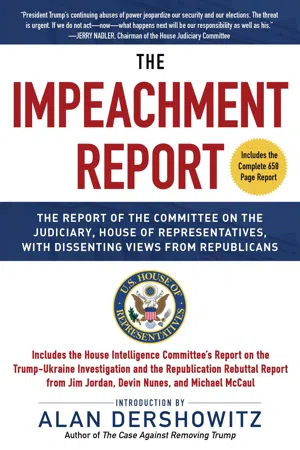
The Report of the Committee on the Judiciary, House of Representatives, with Dissenting Views from Republicans

  1. 670 pages
  2. English
  3. ePUB (mobile friendly)
  4. Available on iOS & Android
eBook - ePub

The Impeachment Report

The Report of the Committee on the Judiciary, House of Representatives, with Dissenting Views from Republicans

About this book

The Official Report of the House Judiciary Committee on the Impeachment—Plus the Dissenting Views from Republicans, the full Impeachment Inquiry Report on The Results of The Trump-Ukraine Investigation, the Articles of Impeachment and the Republican Report Disputing the Results of the Democratic Investigation, as well as an Introduction by Acclaimed Legal Scholar Alan Dershowitz This groundbreaking report—released by the US House Committeeon theJudiciary, chaired by Jerry Nadler—contains the results of the impeachment inquiry into President Donald Trump's actions as he sought for Ukraine to announce investigations into Hunter Biden, as well asan explanation of the committee's process and its justification for recommending two articles of impeachment against Trump, abuse of power and obstruction of Congress. This new report, separated into four parts, details the process by which the House Intelligence Committee investigated the case against Trump. Part Two is dedicated to examining the standards of impeachment laid out in the Constitution. Part Three delves into the proof and details of the Democrats' case that Trump abused the power of his office to pressure the Ukrainian government to investigate his political rival and interfere in the 2020 presidential election. Finally, Part Four makes the case that President Trump obstructed Congress's ability to hold the executive branch accountable by defying House investigators' requests for documents and testimony. Besides including the House Judiciary Committee's full report, The Impeachment Report also presents the Dissenting Views from Republicans, the findings of the Intelligence Committee's investigation in the full original impeachment report, the articles of impeachment themselves, a rebuttal report from Republican representatives that disputes the process and results of the Democratic investigation, and an introduction by esteemed attorney Alan Dershowitz. It is the ultimate resource for anyone who wants to know whether impeachment is warranted, and is a critical text in the ongoing back-and-forth battle to protect American democracy.
Frequently asked questions

Yes, you can cancel anytime from the Subscription tab in your account settings on the Perlego website. Your subscription will stay active until the end of your current billing period. Learn how to cancel your subscription.
No, books cannot be downloaded as external files, such as PDFs, for use outside of Perlego. However, you can download books within the Perlego app for offline reading on mobile or tablet. Learn more here.
Perlego offers two plans: Essential and Complete
  • Essential is ideal for learners and professionals who enjoy exploring a wide range of subjects. Access the Essential Library with 800,000+ trusted titles and best-sellers across business, personal growth, and the humanities. Includes unlimited reading time and Standard Read Aloud voice.
  • Complete: Perfect for advanced learners and researchers needing full, unrestricted access. Unlock 1.4M+ books across hundreds of subjects, including academic and specialized titles. The Complete Plan also includes advanced features like Premium Read Aloud and Research Assistant.
Both plans are available with monthly, semester, or annual billing cycles.
We are an online textbook subscription service, where you can get access to an entire online library for less than the price of a single book per month. With over 1 million books across 1000+ topics, we’ve got you covered! Learn more here.
Look out for the read-aloud symbol on your next book to see if you can listen to it. The read-aloud tool reads text aloud for you, highlighting the text as it is being read. You can pause it, speed it up and slow it down. Learn more here.
Yes! You can use the Perlego app on both iOS or Android devices to read anytime, anywhere — even offline. Perfect for commutes or when you’re on the go.
Please note we cannot support devices running on iOS 13 and Android 7 or earlier. Learn more about using the app.
Yes, you can access The Impeachment Report by U.S. House Committee on the Judiciary in PDF and/or ePUB format, as well as other popular books in Politics & International Relations & American Government. We have over one million books available in our catalogue for you to explore.
image
THE TRUMP-UKRAINE
IMPEACHMENT INQUIRY REPORT
Report of the House Permanent Select Committee on Intelligence, Pursuant to H. Res. 660 in Consultation with the House Committee on Oversight and Reform and the House Committee on Foreign Affairs
December 2019
TABLE OF CONTENTS
PREFACE
EXECUTIVE SUMMARY
KEY FINDINGS OF FACT
SECTION I. THE PRESIDENT’S MISCONDUCT
1. The President Forced Out the U.S. Ambassador to Ukraine
2. The President Put Giuliani and the Three Amigos in Charge of Ukraine Issues
3. The President Froze Military Assistance to Ukraine
4. The President’s Meeting with the Ukrainian President Was Conditioned on An Announcement of Investigations
5. The President Asked the Ukrainian President to Interfere in the 2020 U.S. Election by Investigating the Bidens and 2016 Election Interference
6. The President Wanted Ukraine to Announce the Investigations Publicly
7. The President’s Conditioning of Military Assistance and a White House Meeting on Announcement of Investigations Raised Alarm
8. The President’s Scheme Was Exposed
SECTION II. THE PRESIDENT’S OBSTRUCTION OF THE HOUSE OF REPRESENTATIVES’ IMPEACHMENT INQUIRY
1. Constitutional Authority for Congressional Oversight and Impeachment
2. The President’s Categorical Refusal to Comply
3. The President’s Refusal to Produce Any and All Subpoenaed Documents
4. The President’s Refusal to Allow Top Aides to Testify
5. The President’s Unsuccessful Attempts to Block Key Witnesses
6. The President’s Intimidation of Witnesses
APPENDIX A: KEY PEOPLE AND ENTITIES
APPENDIX B: ABBREVIATIONS AND COMMON TERMS
PREFACE
This report reflects the evidence gathered thus far by the House Permanent Select Committee on Intelligence, in coordination with the Committee on Oversight and Reform and the Committee on Foreign Affairs, as part of the House of Representatives’ impeachment inquiry into Donald J. Trump, the 45th President of the United States.
The report is the culmination of an investigation that began in September 2019 and intensified over the past three months as new revelations and evidence of the President’s misconduct towards Ukraine emerged. The Committees pursued the truth vigorously, but fairly, ensuring the full participation of both parties throughout the probe.
Sustained by the tireless work of more than three dozen dedicated staff across the three Committees, we issued dozens of subpoenas for documents and testimony and took more than 100 hours of deposition testimony from 17 witnesses. To provide the American people the opportunity to learn and evaluate the facts themselves, the Intelligence Committee held seven public hearings with 12 witnesses—including three requested by the Republican Minority—that totaled more than 30 hours.
At the outset, I want to recognize my late friend and colleague Elijah E. Cummings, whose grace and commitment to justice served as our North Star throughout this investigation. I would also like to thank my colleagues Eliot L. Engel and Carolyn B. Maloney, chairs respectively of the Foreign Affairs and Oversight and Reform Committees, as well as the Members of those Committees, many of whom provided invaluable contributions. Members of the Intelligence Committee, as well, worked selflessly and collaboratively throughout this investigation. Finally, I am grateful to Speaker Nancy Pelosi for the trust she placed in our Committees to conduct this work and for her wise counsel throughout.
I also want to thank the dedicated professional staff of the Intelligence Committee, who worked ceaselessly and with remarkable poise and ability. My deepest gratitude goes to Daniel Goldman, Rheanne Wirkkala, Maher Bitar, Timothy Bergreen, Patrick Boland, Daniel Noble, Nicolas Mitchell, Sean Misko, Patrick Fallon, Diana Pilipenko, William Evans, Ariana Rowberry, Wells Bennett, and William Wu. Additional Intelligence Committee staff members also assured that the important oversight work of the Committee continued, even as we were required to take on the additional responsibility of conducting a key part of the House impeachment inquiry. Finally, I would like to thank the devoted and outstanding staff of the Committee on Oversight and Reform, including but not limited to Dave Rapallo, Susanne Sachsman Grooms, Peter Kenny, Krista Boyd, and Janet Kim, as well as Laura Carey from the Committee on Foreign Affairs.
* * *
In his farewell address, President George Washington warned of a moment when “cunning, ambitious, and unprincipled men will be enabled to subvert the power of the people and to usurp for themselves the reins of government, destroying afterwards the very engines which have lifted them to unjust dominion.”
The Framers of the Constitution well understood that an individual could one day occupy the Office of the President who would place his personal or political interests above those of the nation. Having just won hard-fought independence from a King with unbridled authority, they were attuned to the dangers of an executive who lacked fealty to the law and the Constitution.
In response, the Framers adopted a tool used by the British Parliament for several hundred years to constrain the Crown—the power of impeachment. Unlike in Britain, where impeachment was typically reserved for inferior officers but not the King himself, impeachment in our untested democracy was specifically intended to serve as the ultimate form of accountability for a duly-elected President. Rather than a mechanism to overturn an election, impeachment was explicitly contemplated as a remedy of last resort for a president who fails to faithfully execute his oath of office “to preserve, protect and defend the Constitution of the United States.”
Accordingly, the Constitution confers the power to impeach the president on Congress, stating that the president shall be removed from office upon conviction for “Treason, Bribery, or other high Crimes and Misdemeanors.” While the Constitutional standard for removal from office is justly a high one, it is nonetheless an essential check and balance on the authority of the occupant of the Office of the President, particularly when that occupant represents a continuing threat to our fundamental democratic norms, values, and laws.
Alexander Hamilton explained that impeachment was not designed to cover only criminal violations, but also crimes against the American people. “The subjects of its jurisdiction,” Hamilton wrote, “are those offenses which proceed from the misconduct of public men, or, in other words, from the abuse or violation of some public trust. They are of a nature which may with peculiar propriety be denominated political, as they relate chiefly to injuries done immediately to the society itself.”
Similarly, future Associate Justice of the United States Supreme Court James Wilson, a delegate from Pennsylvania at the Constitutional Convention, distinguished impeachable offenses from those that reside “within the sphere of ordinary jurisprudence.” As he noted, “impeachments are confined to political characters, to political crimes and misdemeanors, and to political punishments.”
* * *
As this report details, the impeachment inquiry has found that President Trump, personally and acting through agents within and outside of the U.S. government, solicited the interference of a foreign government, Ukraine,...

Table of contents

  1. Front Cover
  2. Half-Title Page
  3. Title Page
  4. Copyright Page
  5. Introduction
  6. Contents
  7. Introduction
  8. The Impeachment Inquiry
  9. Constitutional Grounds for Presidential Impeachment
  10. Article I: Abuse of Power
  11. Article II: Obstruction of Congress
  12. Hearings
  13. Dissenting Views
  14. Report of Evidence in The Democrats’ Impeachment Inquiry in The House of Representatives
  15. The Trump-Ukraine Impeachment Inquiry Report